Magic Monday – Bookworm book

Philliden’s Walking Knowledge

This is a heavy book of uncountable vellum pages in a sturdy leather cover. Each page contains a wall of text and illustrations that crowd into the margins, detailing accumulated knowledge in a given field. The Walking Knowledge is also capable of sprouting a swarm of thin, metallic tendrils that it uses to walk, climb, and even protect itself.

The book seems to have a personality much like a friendly dog: it will approach people, even strangers, and respond to their treatment of it. People who give it treats are especially welcome to browse through its pages, where chances are very good indeed that they will find some relevant information no matter what topic they are searching for. There are only two drawbacks to the friendship of the Walking Knowledge.

First, the “treats” it enjoys comprise other written information, especially books. Pamphlets, leaflets, scrolls, tomes; fiction, essays, poetry, tax records, even sheet music – all attract the Walking Knowledge. It bounds up to them and touches them with a feeler or two, gently at first, and then the treat is drawn into the book’s grinding, many-toothed mouth and what follows is generally neither describable nor pretty.

And second, the information that appears in the Walking Knowledge’s pages after such an event is in digest form (appropriately enough). Thorough treatments are reduced to highlights; exceptions and special cases become footnotes or asides, or are left out altogether. Each work consumed by the Walking Knowledge, no matter how extensive, is condensed down to a capsule summary that can fit on a single page, albeit a large page with small lettering. And while this never seemed to bother Philliden much – his memory was so well-trained that mere hints from the Walking Knowledge supposedly helped him to recall the whole – his greatest creation has been banned from every major library in the land… on pain of death.

(The name for this week’s magic item comes from The Forge.)
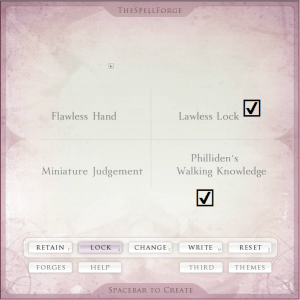
Forge Items 7-11-2016

Posted in Rules, World-Building | Tagged , , , , | 1 Comment

Like taking candy from a baby…

…by beating it in a game of chess

暖簾に腕押し
(Noren ni ude-oshi; “arm-wrestling a curtain”)

Definition:

A deed with no resistance, therefore requiring no real effort, and therefore giving no thrill or satisfaction for the accomplishment. A waste of effort. Alternately, being completely ineffective. Like arm-wrestling one of the hanging curtains that adorn many Japanese shop-fronts (especially restaurants) – they need to be pushed aside to enter, but are typically made of light cloth and lack both the power and will to respond meaningfully.

Breakdown:

This is two nouns connected by the directional particle (ni). The first noun – the one the implicit action is being directed into – is 暖簾 (noren), a traditional hanging curtain that hangs just low enough that most people can’t simply walk under it. The second noun is 腕押し (udeoshi), literally “arm-pushing.”

Notes:

In contemporary Japanese, the term udeoshi seems to refer to a shove used in sumo wrestling. My sources note that there is some debate over whether this kotowaza refers to a simple push or to arm-wrestling, but the latter interpretation seems overall to be favored even if the word udeoshi itself is more ambiguous. Apparently the arm-wrestling reading is supported by usage in texts such as the 義経記 (“The Chronicles of Yoshitsune”) and the first ever European dictionary of Japanese, the 1603 日葡辞書 (Nippo Jisho).

Example sentence:

「怒ってる二歳児を説得するのなんて、暖簾に腕押しだ。落ち着くのを待つしかないな」

(“Okotteru nisaiji wo settoku suru no nante, noren ni udeoshi da. Ochitsuku no wo matsu shika nai na.”)

[“There’s no point to trying to convince an angry two-year-old. All you can do is wait for them to calm down.”]

Posted in Japanese, Kotowaza | Tagged , , , , , , | 1 Comment

America Food for America Day!

For the Fourth of July, we didn’t do anything special. There was some sort of musical event downtown starting at dusk, capped off with fireworks at about 10pm. But the kid’s bedtime is at 8:00, so it was unclear whether he’d be able to stay up that late without getting crabby. As it turned out, he spent his naptime complaining and throwing everything out of his crib instead of sleeping, which meant that he was already getting weird from tiredness by the time we finished dinner. A trip out was definitely not in the cards for him. Which is fine; he’s only two, and there’s always next year. The wife and I went out on our apartment’s balcony and managed to see some flickering in the sky, but most of the fireworks were blocked from view by other apartment buildings and trees.

But even without music or ceremony or fireworks, we could still have a special meal!

First, I cooked up some sweet corn on the cob. This was simply a matter of boiling some water, putting the corn in, letting the water come to a boil again, and then turning off the heat. After ten to fifteen minutes I took the corn out of the water to drain, and we ate it on the cob with bread-and-butter and salt-and-pepper for flavor.

Second, coleslaw. I chopped up a head of cabbage into thin strips, tossed it with some salt, and grated a few carrots into it. This got mixed up with ground black pepper, dill weed, a splash each of rice and balsamic vinegar, and a couple big spoonfuls of mayonnaise.

The main course was hamburgers!* We had saved a couple pounds of frozen kosher beef patties. I thawed these and chopped them up before mixing the ground meat with a whole sweet onion, finely diced, about a half-cup of matzoh meal, and three eggs as a binding agent, along with a sprinkling of garlic salt. Then I made new patties and fried them in sesame oil. We ended up getting four meals’ worth of hamburgers out of it.

Of course, an all-American meal wouldn’t be complete without some overseas additions. So we accompanied the food with Jamaican ginger ale. (We gave the kid a shot glass’ worth, but he didn’t like it. Too sharp in flavor, probably.) Because we were out of both ketchup and barbecue sauce, we tried topping the burgers with yuzu (a kind of citrus) dressing. (It worked pretty well!) And dessert was matcha-flavored chocolate from a local Asian market.

The burgers and coleslaw are gone by now. The corn was enough of a hit, and cheap enough, that I’ve cooked a new batch. And our next major food project is corned beef. (I guess this is the Summer of Beef, or something?) I mixed up some broth with pickling spice and lots of kosher salt and some sugar, and even now a big chunk of brisket is soaking in our fridge. The color has changed from red to a sort of ashy brown. When the corned beef is done, I plan to cook it like my dad did, with potatoes and red cabbage and maybe some other veggies. Irish style, I guess?

In short, home cooking is great! And living in a country where many cultures mingle freely, including but not limited to food cultures, is the best part about being an American. (Don’t let any bigot-courting demagogues tell you different.)

* (Yes, the same meal contains meat and dairy – but since one isn’t cooked in the other, I consider this not to be trayf, no matter what protective fences some people may choose to build around the Law.)

Posted in Musing, Nonfiction | Tagged , , , , | Leave a comment

Still better than a frog?

喉元事案
nodo.moto.ji.an

Literally: throat – origin – think – plan

Alternately: Superficial thinking. Rash and hasty ideas.

Notes: Derived from the belief that one’s deepest thinking was done in the chest. The throat is more “shallow” than the chest, so it stands to reason that it would be the origin of more rushed and shallow ideas.

NodoMotoSuiDou

I dunno; kappa need water, so this doesn’t seem like a bad idea. Image from a Vietnamese site translating yojijukugo.

Posted in Japanese, Yojijukugo | Tagged , , , , | Leave a comment

Magic Monday – Slavery is freedom

Lawless Lock

A cylinder of rough cast iron (invulnerable to harm from the mortal plane) with an oddly-shaped keyhole on each end. It comes without any accompanying key, though: the lock is sentient and capable of speaking and understanding any language. Above all else it desires to serve the ideals of freedom; specifically the greatest freedom for the most people. Of its own accord it can merge with other objects, lock them tight, unlock, and disengage. But to do any of these, it must be convinced that doing so will serve the cause of freedom.

The Lawless Lock is not very bright. It easily loses the thread of complex philosophical or ethical arguments and responds to confusion by promptly forgetting the entire offending conversation. It tends to believe what people tell it, taking their words at face value. On the other hand, it will forever remember someone who has demonstrably lied to it, and make a point of ignoring what they have to say thereafter.

It may seem paradoxical for a lock to value freedom, but as with most sentient beings it goes out of its way to downplay contradictions between its own beliefs and actions. Tyrants have been known to imprison political foes by convincing the lock that their captives threaten the greater freedom of the populace in some way.

(The name for this week’s magic item comes from The Forge.)

Forge Items 7-3-2016

Posted in Rules, World-Building | Tagged , , , | Leave a comment

Cat, hat; in French chat, chapeau

猫を被る
(Neko wo kaburu; “To play the cat”)

Definition:

To hide one’s true (wild or willful) nature and pretend to be quiet and obedient. Alternately, to pretend not to know about a situation that one is actually involved in or aware of. Used in a negative sense to convey duplicity.

Breakdown:

This verb phrase comprises a noun – (neko), “cat,” the object-marker particle (wo), and the verb 被る (kaburu). The latter often refers to the act of wearing something on one’s head, giving this idiomatic expression a cute mental image. The verb also has a surprising range of more-or-less related meanings, among them “to be similar” or “to act like.”

Notes:

This idiom can take the form of a verb phrase, as above, but it can also appear as the noun phrase 猫被り (neko-kaburi).

Some scholars theorize that neko in this phrase is actually a corruption of 寝茣蓙 (negoza), a sleeping mat of woven rushes. In this theory, the image is not one of affecting the quiet nature of a cat, but of pulling a sleeping mat over oneself.

Example sentence:

「あいつ、いつも人を虐めてるくせに、先生が来るとすぐ猫を被るなんて、もううんざりだ!」

(“Aitsu, itsumo hito wo ijimeteru kuse ni, sensei ga kuru to sugu neko wo kaburu nante, mou unzari da!”)

[“That jerk, he’s always bullying people, but he acts all innocent as soon as the teacher comes. I’m fed up!”]

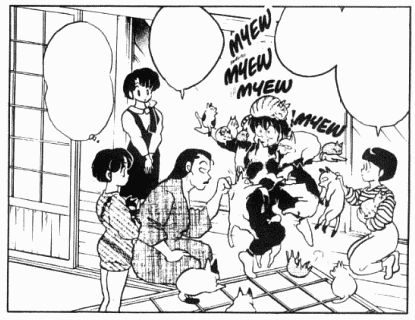
Ranma Wearing Cats

らんま 1/2

Posted in Japanese, Kotowaza | Tagged , , , , | Leave a comment

TFW you see the universe in a flower through a flower in the universe

拈華微笑
nen.ge.mi.shou

Literally: twist (with the fingers) – flower – delicate/minute – laugh/smile

Alternately: Communicating “heart to heart,” without words or writing. Subtle, unspoken communication. Plucking or toying with a flower, and a smile.

Notes: In other contexts, 微笑 can also be pronounced bishou or hohoe(mi) and changes , which can mean “laugh,” to the subtlety of a smile. In this case, though, mishou is the only correct reading.

This is another inheritance from the 五灯会元. The story is not one of stereotypical feminine communication, as I had first imagined, but rather of the Gautama Buddha picking up and holding a (white lotus) flower in front of his disciples. Most of them were nonplussed, but Mahakasyapa understood and smiled in response, proving that he was ready to be the Buddha’s successor.

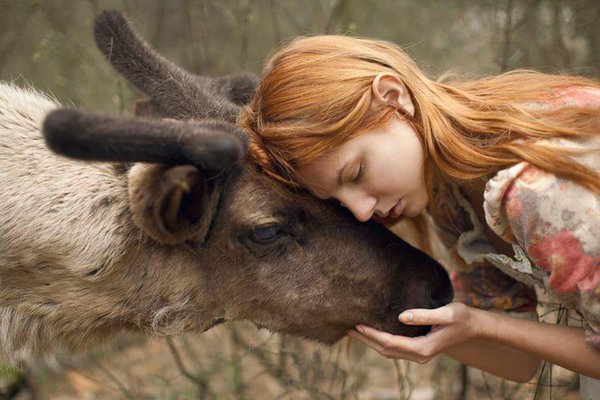
NenGeShikaOnna

Not prajna per se, but no doubt some form of understanding. From the #拈華微笑 hashtag on Twitter.

Posted in Japanese, Yojijukugo | Tagged , , , , , , , | 1 Comment

Magic Monday – Physical Magic – Goodnight, fall

Foshdani Hahd

Physical adepts of the Fells engage in long training missions out in the mountains. Snowstorms in the Fells can strike with little warning during more than half of the year. It should come as no surprise, then, that a technique was developed to induce hibernation. An adept may use their precise internal control to lower their heart rates and body temperatures and enter a deep sleep, which ends when they are disturbed by some outside stimulus such as being moved roughly or the air temperature warming significantly. The obvious benefit is that this technique allows long-term survival without food, water, warmth, or even much air. The downside is that the torpor of hibernation leaves the practitioner weak and disoriented afterwards.


This Hahd technique requires below-freezing temperatures and a period of meditation that segues into increasingly deep slumber, which can last seemingly indefinitely – all consequences of cold exposure or going without food or water are slowed by at least a factor of ten. On waking, however, the practitioner finds all of their ability scores and resilience meters effectively halved (or reduced to one if they’re woken suddenly instead of allowed to come out of hibernation over a span of several hours). With good care, food, water, and light stretches and exercise, these penalties fade at the rate of four points a day; forced activity or bad conditions can reduce the recovery rate to one point per day.

Posted in Rules, Setting | Tagged , , , | Leave a comment

Like taking cereal from a baby!

Don’t ask why the hand is wet, though.

濡れ手で粟(を掴み取る)
(Nurete de awa (wo tsukamitoru); “(grasping) millet with a wet hand”)

Definition:

Profit without hard work. Easy money. If you stick a wet hand into a container of fine grains such as millet seeds, the grains will stick to your hand without any further effort on your part; the image is of money accruing just as easily.

Breakdown:

The short form of the phrase comprises two noun, a verb, and a particle. The latter noun is (awa), common name “foxtail millet,” a cereal crop widely grown in east Asia for at least the past 2600 years. The former noun is (te), “hand.” The hand is modified by the verb 濡れる (nureru), “to get wet,” in the prenominal use of its stem form, and marked by the particle (de) as the means by which an action is carried out.

In order to discover what this action is, we have to look to the longer form of the phrase, which adds the object-marker particle (wo) and a compound verb made from 掴む (tsukamu), “to grab,” in conjunctive form plus 取る (toru), “to take,” in sentence-final form. The wo marks the millet as the noun acted on by this compound verb, which logically enough can be translated as “to grasp,” “to get.”

Notes:

Some people replace with homophone (“bubbles,” “foam”). Based on this, some assume that the small size of the awa refers to something of little value, and take this saying to mean exactly the opposite – of making little profit no matter how hard one works. Naturally, both of these are errors, as is replacing the particle de with ni – a replacement that might make sense to someone who only knows the shorter form of the saying, but which should still be avoided.

Example sentence:

毎日宝くじを買っている人は濡れ手で粟を掴み取る夢を見ているかもしれないが、結局その夢もお金も泡のように消えて行く。

(Mainichi takarakuji wo katteiru hito wa nurete de awa wo tsukamitoru yume wo miteiru kamoshirenai ga, kekkyoku sono yume mo okane mo awa no you ni kiete yuku.)

[People who play the lottery every day are likely daydreaming of easy profit, but in the end they both vanish, the dream and their money alike.]

Posted in Japanese, Kotowaza | Tagged , , , , , , | Leave a comment

Brandy Bundt, meet your match

盗人上戸
nusu.bito.jou.go

Literally: steal – person – up – door

Alternately: Someone who likes both alcohol and sweets. Alternately, someone who doesn’t show any outward signs even after consuming a large quantity of alcohol.

Notes: The first pair of characters can also be pronounced nusutto.

This one seems to come way out of left field. How does “steal person up door” point toward preferences in food and drink? It turns out that 上戸 can refer, idiomatically, to someone who doesn’t hold their liquor well (and is thus assumed to like sweets; see below for more) while 盗人 can drink and drink without seeming to be affected. A 盗人上戸 is therefore someone with aspects of both “likes to drink” and “prefers sweets.”

Japanese culture actually contains the belief that people can be divided into two types – those who like sweets, and those who like to drink. (It’s possible that there’s some sexism buried in there?) Another set of terms for these categories are, respectively, 甘党 (amatou), “sweet faction,” and 辛党 (karatou), “spicy faction.” (You know a country’s cuisine is pretty bland when alcohol is referred to as “spicy”!) For me, the interesting thing is that a related belief peeks out briefly in a Western movie called Hobson’s Choice, when an alcoholic recoils from cake because all the drinking has rendered his body incapable of enjoying sugar. Of course, this leaves open the question of how to categorize people who like sweet drinks.

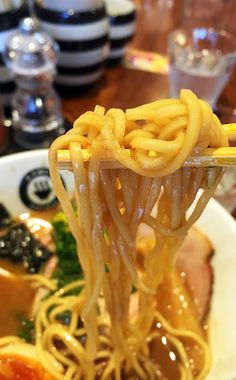
NusuBitoTabetaMen

The top results from Google image search are mostly noodles. Apparently this 四字熟語 is part of the tag-line of a food blogger.

Posted in Japanese, Yojijukugo | Tagged , , , , , , | Leave a comment