Magic Monday – God-eaters – The Progenitor

The Progenitor
(Mother; the Black Fish of the Woods with Eight Billion Young)

Description: The Progenitor is a mottled, sticky mass of dark colors shot through with streaks of red and pale yellow. It rolls through the woods at a glacial pace without any apparent aim, although it does seem to show some preference for visiting nearby lakes and streams. It consumes everything organic that it touches. At irregular intervals – perhaps when it has consumed sufficient mass – it “births” a living form – ranging from simple, natural animals to nightmarish monsters or bizarre, hostile plants. If the Progenitor is sentient, neither its mind nor its means of communication are comprehensible to humans.

Worshipers: Yes, but not many. The area of woods where Mother wanders is protected against incursion by strong taboos and only a few people know why. Some members of some communities preserve “the old ways,” knowledge of how to venture into Mother’s territory while avoiding the god itself, but religious practices end with these traditions and bans and do not extend to any direct acts of worship. Careful cartography may reveal a large, ancient engineering project: someone seems to have built a ring of berms surrounding an area of canals and artificial lakes in a successful attempt to contain the threat.

Servitors: Yes. While the Progenitor’s “young” do not serve in the normal sense – the latter keep away to avoid being consumed, while the former has no capacity to make requests or give commands – they do tend to hunt or attack intruders due to needs such as food, territorial defense, or even sport.

Confrontation: The Progenitor tends to move toward stimuli such as light, sound, and motion, and may even speed up at times, but does not seem to recognize or respond to attacks. It has no organs and is viscous enough that most piercing, cutting, or crushing attacks have no real effect. Pieces separated from the main mass will attempt to rejoin with Mother; those that cannot will either spontaneously form into “young” or simply decompose into stinking, disease-ridden slime. The Progenitor’s material is neither fireproof nor especially flammable. Touching it deals from d4 to d20 damage (depending on how much exposed flesh came into contact) and forces a Reflex save (to avoid immediately losing an entire limb or worse) and Corruption save (to avoid virulent necrosis at the point of contact) of difficulty equal to the damage die. Attempting mental contact forces a Psychic save at difficulty d30; failure deals strain equal to the amount by which the roll failed.

Aspect: Carbon, chaos, life. Those present at defeat boost each attribute and their Life meter, and immediately become ravenously hungry. Humanity must always be checked (difficulty d20) to avoid consuming as much of the Progenitor’s material as possible.

Powers – Tier 1: The character gains the skill Craft Servitor with a base value equal to their Constitution or Strength modifier, whichever is higher. Skill points may be invested in this normally. Any part of the character’s body that is separated from them – including flesh and blood, but not inert substances such as sweat, mucous, hair, or nails – forms into a living creature of equal mass and HP. These generally take the form of small copies of the character, although the character may succeed at a Craft Servitor check to shape such creatures while they are taking form. The character may heal a point of damage by consuming a day’s worth of rations.

Powers – Tier 2: The character becomes immune to poison and disease, and gains +2 to Craft Servitor.

Powers – Tier 3: The character gains the ability to reshape their servitors or even reabsorb them (healing damage in the process) with a successful Craft Servitor check, and gains +1 to any physical stat. Craft Servitor again gains +2. The character can now digest any organic material, although some materials (such as bone shards) may still be hazardous on the way down. Characters may also consume food specifically in order to create a servitor without losing HP, although the pace is sadly restricted by the limited capacity of the human digestive tract.

Powers – Other: When necessary, the character may enter a torpid, hibernation-like state in which they absorb nutrients through their skin. This requires that the character be mostly covered in natural water or loose rich soil.

Example Checks: The character has an edge of hunger, and checks Humanity to avoid attempting to consume anything that seems appealing, especially god-flesh.

Notes: The appellation “Eight Billion” from the god’s appellation is the direct translation of a term in a local tongue that could more loosely be rendered as “infinite.”

Yes, we’re getting a bit Lovecraftian here. This is one of those gods that you bring out if you want things to be a bit darker or more challenging.

Posted in Rules, World-Building | Tagged , , , , , | Leave a comment

Life finds a way

炒り豆に花が咲く
((I)rimame ni hana ga saku; “Flowers growing from roasted beans”)

Definition:

An example of something that had declined, failed, or withered flourishing again beyond all expectations. By extension, an impossible event. Something happening that’s about as likely as roasted beans nonetheless sprouting, flourishing, and even coming to flower.

Breakdown:

The primary noun here – as marked by the subject-marker particle (ga) – is (hana), “flower.” The action the flower performs is 咲く (saku), “to bloom,” in sentence-final form. To the left, meanwhile, we have a compound noun marked by the particle (ni), in this case functioning as a location marker to show us where the blooming is happening. The compound noun comprises the noun (mame), “bean,” and the verb 炒る (iru), a method of cooking where heat (traditionally an open flame) is used to remove most of the water from food. The verb appears in conjunctive form, which in modern grammar takes on a prenominal role.

Notes:

Although technically, 炒り豆 can refer to any parched or roasted beans, the most common image is that of roast soybeans, which are still a relatively common snack food and play a role in Setsubun festivities.

This is the (wi) entry in the Osaka iroha karuta set. As with several of the other phrases we’ve seen, it’s attributed to the poetic collection 毛吹草 (Kefukigusa).

It is acceptable to use the phrase without the verb, as 炒り豆に花. Related phrases invoke the image of flowers blooming from dead trees or even stones.

Example sentence:

「ああ、決戦は明日なのにカーター選手が怪我をしたらしい。優勝旗を取りたかったけど、炒り豆に花が咲く可能性がより高いみたい」

(“Aa, kessen wa ashita na no ni Kaataa senshu ga kega wo shita rashii. Yuushouki wo toritakatta kedo, irimame ni hana ga saku kanousei ga yori takai mitai.”)

[“Agh, the final match is tomorrow, but apparently Carter’s injured. I really wanted us to take home the pennant, but it looks like getting flowers from roast beans would be more likely.”]

irimame-from-cookpad

升に炒り豆 (Irimame in a masu.) Image from recipe site Cookpad.

Posted in Japanese, Kotowaza | Tagged , , , , , , , | Leave a comment

It never rains but it tiny stones

Sometimes you hit a run of bad luck. Sometimes, the bad luck is extremely specific. This is the story of such an occurrence.

I ride my bicycle a lot. It’s my preferred mode of transportation, weather permitting, and I’ve been using the kid’s bike seat to take him with me when we need to go somewhere in town. For the most part, our current town’s been decent enough to bike around in. But one day, I was on campus and went to get my bike from the rack to ride it to daycare and pick up the kid, but found that the rear tire was flat.

I didn’t have a repair kit, so all I could do was load my bike onto the bus and head for the only bike shop in town for a fix. I called my wife to see if she could pick up the kid, since I was clearly going to be later than planned. She declined on the grounds that she was too busy, so all I could do was call the daycare and tell them I’d be late by some unknown amount of time. In the worst-case scenario, I could drop off my ride at the shop and then schlep to the daycare in about a quarter of an hour.

Fortunately, they had a guy free who was able to change the tube out quickly. It had a pretty big double puncture that he said was likely the result of a “pinch” from going over a bump with insufficient pressure, although the process of going flat must have been slow given that I’d added air to my tires a couple of days previously. In any case, I was able to pick the kid up in a reasonable time frame, and given that this was my first flat in over a year in our current town, I figured that was the end of the business.

The next day, the same tire was flat again.

I took it back to the shop, hoping that it was an error on their part or a bad tube, and that I could get a repair for free. But no, this time it was a nail about a centimeter long that I’d managed to pick up somewhere in less than an hour of riding. It was clearly time to get myself a repair kit that I could attach to my bike. It would be an initial investment that was likely to pay itself off sooner or later.

A couple of days later, before I’d gotten around to buying a kit, I got another flat – this time in a front tire. So on my next trip to Target I looked for a kit (which they didn’t have in stock!) and picked up a “self-repairing” tube with some sort of slime inside that would supposedly slide around the inside of the tube, cover punctures, and dry out like a blood clot to keep the hole closed. Unfortunately the tubes at Target were all listed in inches while by bike’s measurements were in metric, so it turned out that the largest tube wasn’t big enough.

And then when I tried to deflate the tube in order to return it, some of the slime bubbled out of the valve… and performed its intended function. Right job, wrong place, and with the valve stopped up, the tube was functionally useless before it had even been used. I was able to return it later, but the moral of the story is clear: don’t spring for a self-repairing bike tube.

It would have been better to just go to the bike shop for what I needed. (The only reason I didn’t is because it was getting ridiculous at this point, with three punctures in less than a week.) But lesson learned, I ordered a kit on Amazon, then went back to the shop to get a new tube for my front tire.

I was able to put in the new tube without any trouble. And the next day, it was flat again.

Four flat tires in the space of a week. This time, when I was going over the front tire as carefully as I could, I came across a little bump that I had missed before. There was a tiny sharp pebble embedded in my front tire. It was so small, and embedded so deeply, that it wasn’t even visible unless you flexed the rubber… but it was enough to have punctured my tube twice. But then my kit came and I was able to spend ten minutes slapping a patch on the hole and save the cost of yet another new tube. And with any luck, that’ll be the end of it for a long time.

(I have a backup tube waiting, though.)

Posted in Nonfiction | Tagged , , , | Leave a comment

A rank fragrance

位階勲等
(i).kai.kun.tou

Literally: rank – stair / story – meritorious deed – quality / (first) class

Alternately: Court rank; honors; accolades. Decorations and rank awarded by the government in return for achievement or service. 位階 refers to ranks within the imperial bureaucracy under the Ritsuryou system, and 勲等 refers to ranks and titles awarded for meritorious service. The Ritsuryou system included an equivalent, known as 勲位 (kun’i), but modern 勲等 awards seem to have been introduced in 1875 and then, in 2003, all eliminated except for the Order of the Chrysanthemum, originally the highest order of twelve.

Notes: This week’s selection is a deliberately anachronistic continuation of the “alphabetical” order (actually 五十音 order) theme I’ve been following since late January. It turns out that while modern collections of yojijukugo end with , that it is possible to hunt down entries for , , and . (There is no “wu,” though.) For today’s post, I discovered that the character is in classical orthography, and after that it was simple to find a compound that begins with it.

The etymological pedigree is of sufficient antiquity to support the ゐ reading as well. 位階 were instituted in 603ce.

ikaihirohito

Remember when looking Prussian was cool? (Photo by Torikai Yukihiro, from the wikimedia commons.)

Posted in Japanese, Yojijukugo | Tagged , , , , , | Leave a comment

Magic Monday – God-eaters – Id

Id
(Old Man Fear; The Orb of Serenity, The Black Mirror)

Description: The Black Mirror is an utterly immobile sphere of a hard, translucent-black material, shot through in its depths with faint suggestions of color. It floats at about chest-height off the ground (for an adult human) on a seemingly ordinary gentle mountain slope, in the inner sanctum of the shrine its worshipers built around it. It does not seem to do anything at all or communicate in any way, except that those in its presence find their emotions magnified.

Worshipers: Yes. A cult surrounding the use of the Black Mirror developed centuries ago, and today a moderately large shrine has been built up around it, housing a staff of a couple dozen priests and capable of holding up to about the same number of pilgrims. There are layers of both physical barriers and of ritual in place to protect the unwary from the Mirror’s effects.

Servitors: No.

Confrontation: All those in the presence of the Black Mirror take a point of strain each round as it amplifies their emotions. Those who break give in to a frenzy, expressing that emotion as hard as they can for as long as they remain, and losing consciousness soon after it ends. The priests use this effect, combined with careful meditative training, to enter calm ecstatic trances which they believe allow them to experience a heightened form of reality. On rare occasions, they will use it as a final defense by entering berserk rages. The priests believe that the calm and detachment of deliberately acting out a frenzy allows one to avoid the compulsive nature of the Mirror’s effect, and they are correct – but this means passing a Concentration check at d20 difficulty in order to focus on each discrete activity to be performed, so only the most skilled among them can achieve such a state for long.

Aspect: Void, mind, spirals, astatine. Those present at defeat lose an extra point of Humanity and boost their Psychic save, Stability meter, and Concentration skill by 2 each.

Powers – Tier 1: First, those consuming any part of Id in a literal way must make Corruption and Shock saves at d20 difficulty. Failure in either results in one point of damage taken per point by which the roll(s) failed. Those who go through this and survive, or find a different way to “consume” the fallen god-thing, gain the ability to magnify the emotions of those around them. By focusing on a target and making a Concentration challenge against their Psychic save, the character can cause the target to take a point of strain each round unless acting out an exaggerated version of their current mood. If the target breaks due to the strain, they enter a frenzy as described above.

Powers – Tier 2: The character becomes more monochromatic and cold to the touch, and gains the power of immovability. Using it transforms them, essentially, into a steel-hard obsidian statue of themselves. All their senses work normally, including touch, but they cannot be moved by any force (within the context of the inertial reference frame they inhabited before invoking this power, if you’re quibbling – they don’t get left behind by the planet’s orbit around the sun!). While in this state, the character automatically passes all Shock and Corruption saves, and automatically fails all Reflex saves. They still need to eat, drink, sleep, and be in contact with clean air. They may return to their normal form at will.

Powers – Tier 3: The character’s new perspective on human emotions gives them +1 to Leadership and all social skills. Their Tier 1 power only takes one action per round instead of complete focus, the character gains a bonus to the challenge roll equal to the number of points of Humanity they have lost, and each solid or greater success allows them to influence another target simultaneously.

Powers – Other: The character can sense emotions nearby, even when the source is unseen. This gives a rough idea of the number of entities with thoughts and feelings of some kind nearby, as well as their various moods. The character becomes even more shadowy and translucent in appearance, and ceases to naturally express emotions – see below.

Example Checks: Check to express an emotion in a natural way. This must always be a conscious effort for all but the strongest emotions – and in these cases, check to avoid expressing the emotion in an extreme, possibly-destructive way.

Notes: There is some debate over whether this strange entity is even a god. It certainly doesn’t seem to be sentient or alive in any understandable way. As the above should make clear, though, it is functionally equivalent to any of the more relatable deities.

This is the first deity that presents a serious danger to the characters even after being defeated. GMs should probably warn players who try to simply choke down a mouthful of hard, glass-like shards of alien psychoactive material by noting that it has a hideous, chemical smell or flavor.

Posted in Rules, Setting, World-Building | Tagged , , , , | Leave a comment

A lost art?

和して同ぜず
(Washite douzezu; “harmonize but not agree”)

Definition:

Cooperating, but only within reason. Making a point of getting along with others – but not when doing so would be at the cost of reason, truth, one’s individuality, or other important values. Note that this saying explicitly does not include pretending to harmonize or cooperate on the surface while while secretly resisting or resenting the need to do so as an imposition.

Breakdown:

(wa) is often a noun indicating “peace” or “harmony.” Here it is a verb as 和す (wasu), “to make peace,” “to harmonize,” appearing in conjunctive form with the conjunctive form of the particle (tsu) – the precursor of the modern ~て conjunctive – attached. In contrast, cannot operate in isolation; it must be a prefix or, as in this case, the verb どうず (douzu), “to agree,” “to join.” This second verb appears in imperfective form with the negative particle (zu) in sentence-final form.

Notes:

This is derived from another passage on the Analects, in which Confucius remarks on a saying about how “The wise man harmonizes without agreeing, and the narrow-minded person agrees without harmonizing.”

It is acceptable to render the ぜず ending as the more familiar せず (sezu).

Example sentence:

個人性を大事にしているアメリカでは、和して同ぜず生活が特に送り難いかな。同ぜられない場合、和もしたくない傾向があるだろう。

(Kojinsei wo daiji ni shiteiru Amerika de wa, washite douzezu no seikatsu ga toku ni okurinikui ka na. Douzerarenai baai, wa mo shitakunai keikou ga aru darou.)

[In America, where individuality is valued, perhaps it’s especially difficult to lead a life of cooperating without necessarily agreeing. When people don’t agree, there’s a tendency to not want to cooperate either.]

Posted in Japanese, Kotowaza | Tagged , , , , , , | Leave a comment

What we could all use a little more of

和気藹藹
wa.ki.ai.ai

Literally: harmony – spirit / mood – harmonize / flourishing – harmonize / flourishing

Alternately: Full of serenity and stillness. Overflowing with tranquility. Congenial. People getting along well together.

Notes: 和気 is a feeling of harmony; 藹藹 is the state of being calm, of having a quiet mind. The latter half can be written with the doubling sign, as 藹々, or replaced with 藹然 (aizen), “hovering like mist or clouds,” “gentle,” “calm.” However, replacing it with 愛愛 is an error.

wakikaigi

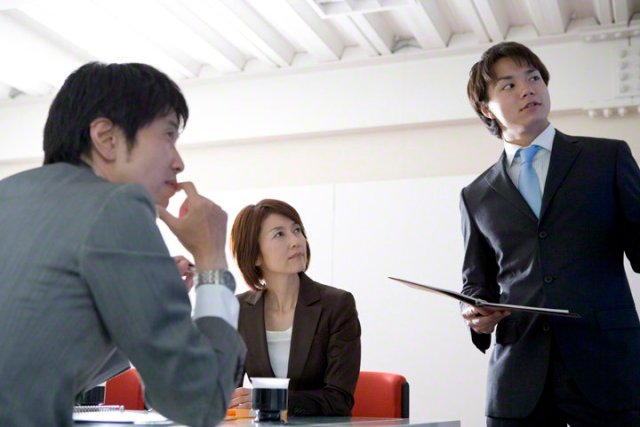
Sometimes you’re required to achieve 和気藹藹 before they let you out of the meeting? Harmonious business talks seemed to be a common theme in image search results.

Posted in Japanese, Yojijukugo | Tagged , , , , | Leave a comment

But what does it all MEAN?

論語読みの論語知らず
(Rongo yomi no rongo shirazu; “A reader of Confucius; doesn’t know Confucius”)

Definition:

Use this when someone technically knows the words of a field of knowledge but doesn’t understand the meaning of the words and is unable to act based on their surface-level textual knowledge. Being unable to translate theory into appropriate practical action.

Breakdown:

We’ll begin this one with the particle (no) in the middle. This associative particle indicates that the whole phrase is simply two nouns which are related to each other. Even though each half of the saying technically ends in a verb, the verbs are in conjunctive form (連用形), which allows them to function as nouns. Alternately, the can be read as equivalent to modern subject-marker particle (ga), in which case only the first verb is read as a noun, while the latter is read as taking sentence-final form.

In either case, both halves begin with the proper noun 論語, the title of the Analects of Confucius. In the first case, this noun is connected to the verb 読む (yomu), “to read,” in conjunctive form. In the second, it is connected to the verb 知る (shiru), “to know,” in imperfective form with the negative suffix (zu) in either conjunctive or sentence-final form.

Notes:

The 論語 is one of the “Four Books and Five Classics” forming the core of Confucian philosophy. Knowledge of these texts eventually became one of the criteria for holding governmental positions in China and then in the Japanese imperial court. Japanese aristocrats were expected to be able to read Chinese, but this saying mocks those who couldn’t engage the texts on a level deeper than oral reading.

This is the entry of the Kyoto iroha karuta set. The saying is attributed to poetic collection 毛吹草 (Kefukigusa).

An alternate, more oxymoronic version replaces 知らず with 読まず (yomazu), “doesn’t read.”

Example sentence:

「あの政治屋たちの瀬戸際政策は憲法に反する振る舞いに近い。派閥全体、論語読みの論語知らずだ」

(“Ano seijiya-tachi no setogiwa seisaku wa kenpou ni han suru furumai ni chikai. Habatsu zentai, rongo yomi no rongo shirazu da.”)

[“The brinkmanship those politicians use is all but violating the Constitution. The whole faction is all theory, no application.”]

Posted in Japanese, Kotowaza | Tagged , , , , , | Leave a comment

The natural phrasing for a cat to use

老若男女
rou.nyaku.nan.nyo

Literally: old – young – man – woman

Alternately: All people. Absolutely everybody, regardless of age or sex.

Notes: While it is not entirely wrong to read this phrase with the more standard character pronunciations rou.jaku.dan.jo, the all-Ns version above is generally considered more correct.

rounyakuclaymation

Searching for this phrase gives you SO MANY stock images of generic collections of people.

Posted in Japanese, Yojijukugo | Tagged , , , , | Leave a comment

Magic Monday – God-eaters – The Fourth King

The Fourth King
(Grandfather, Great-Grandfather, the Ancient)

Description: Many human households across the land engage in ancestor-worship. Whole communities may venerate a likeness of a particularly influential figure from their area’s history even when there is no family connection. Most such divinities do not even achieve the power or presence of common spirits, but at least one dead human has reached practical godhood. This is the so-called Fourth King, although most inhabitants have no idea what his name was or what kingdom he might have ruled, long before the archipelago was unified under the Imperial throne.

The Fourth King occasionally appears as a shadowy figure in his shrine, or riding within his (closed) palanquin during the parade at the culmination of his annual festival, and many agree that the outline shows a wise, bearded man wearing the clothing and bearing the bronze accouterments of old. He is a simple ancestor-deity, conferring mild aid on those who worship him and apparently taking no other interest in earthly affairs. He cannot communicate directly with humans, although the priests who serve at his shrine will consult him through various oracular methods.

Worshipers: Yes. The Fourth King’s worship centers in a particular village, where his festival is held and his shrine maintained, but families across the region practice his worship, and a significant number of them claim to be descended from the aristocracy of his kingdom.

Servitors: No. Some ceremonies of the Fourth King’s worship involve abstracted courtiers who no doubt have real identities as other worshiped ancestors in the region, but none are powerful enough to lend him meaningful aid or even present enough to communicate outside of rare cryptic omens.

Confrontation: The Fourth King is immaterial at the best of times and cannot be harmed directly, although those who oppose him can certainly get caught up in a protracted battle with his worshipers. Aside from human retribution against his enemies, the Fourth King has the capacity to hinder those who displease him in myriad subtle ways. This manifests mechanically as a -1 penalty to all rolls, or -2 while in his home village. These penalties double when the character is acting directly against the interests of the King, and double again if they are acting specifically in opposition to one of his followers.

The Fourth King may be attacked only through the tokens of his worship: the artifacts of his shrine and festival, and the images or statues through which people honor him across the land, especially the oldest likenesses possessed by his actual descendants. Destroying or consuming enough of these will break his power, and count as destroying or consuming the god himself.

Aspect: Family, history, kingly skills. Those present at defeat may boost their Life meter by one.

Powers – Tier 1: The character gains access to several of the Fourth King’s skills. They may add +1 to six of Concentration, Craft: Calligraphy, any local Language, any Lore, Medicine, or any Combat skill. They also add +2 to Leadership and gain the ability to comprehend the old tongue of the king’s realm.

Powers – Tier 2: The character gains access to the Ancient’s knowledge and understanding of his domain. For all rolls concerning the history, culture, or geography of the region, the character doubles their skill points and then adds four. They also gain another six skill points as above and another +2 to Leadership, and gain the ability to speak the old tongue of the King’s realm.

Powers – Tier 3: Anyone who has lost more than half of their Humanity after embracing the Ancient’s essence becomes more monochromatic and abstracted in appearance, and begins to smell faintly of funereal herbs. Any (former) follower of the Fourth King may, once in their lives, be subjected to a command, suggestion, or offer by the character. The follower will find it strangely reasonable and do their best to fulfill it (i.e. the character gains a +10 bonus to one roll made to persuade each target). The character also gains another six skill points as above, and another +1 to Leadership. Finally, they can now read the old tongue of the King’s realm.

Powers – Other: The character is always aware of the status of the Fourth King’s shrine (or to any shrine devoted to themselves, if they are being actively worshiped). This will be most useful to them if they manage to convert the shrine to their own worship, of course.

Example Checks: Anyone who has absorbed part of the Ancient’s essence must check to refuse a request made in his name. The check is more difficult if it involves ancient traditions and protecting the well-being of what were once his lands and subjects.

Notes: Again, we’re trying something a little different here. The Fourth King is literally impossible to defeat in combat and, despite existing within an animistic world, is relatively abstract. Where with other deities I’ve let it be sort of implicit that research, planning, and other forms of preparation are the best ways to defeat a god (rather than sheer combat strength), in this case it’s explicit: a party of PCs who go up against the Fourth King will need to discover his weaknesses, then systematically hunt down the tokens of his power – possibly while suffering his curse, if they’ve been unwise enough to anger him through direct confrontation in the meantime. Another intentional aspect of this hunt is that it can be spread out over a long period of time: it can be the pot on the back burner while the party focuses on other tasks. I like that defeating the Fourth King can potentially involve a whole lot of socialization and politicking as the PCs attempt to gain access to his tokens of power.

Posted in Rules, Setting, World-Building | Tagged , , , , , | Leave a comment