If I’ve told you once…

…I’ve told you so many times that life gave me lemons. In my face.

口が酸っぱくなるほど
(kuchi ga suppaku naru hodo; “until the mouth turns sour”)

Definition:

Repeating oneself over and over. Saying the same thing ad nauseum. Often used to express exasperation at having to give the same warning or advice again and again without the message ever taking root. Generally followed by a verb indicating speech.

Breakdown:

Today’s kotowaza is a dependent clause. It technically contains a complete sentence, with subject and verb, but ends with a particle, implying that it is meant to be connected to something else that follows.

We begin with the noun (kuchi), “mouth,” with the subject-marker particle (ga). Next we get the adjective 酸っぱい (suppai), “sour” or “acidic,” in an adverbial form. This connects to the verb なる (naru), “become.” And finally we get the particle ほど (hodo), which indicates an amount, limit, or degree.

Notes:

A quick Google search for this phrase turns of lots of results from Japanese people wondering why the mouth is said to become “sour,” given that they’d expect it to simply dry out. The answer seems to be that in extreme circumstances, bacteria living in the mouth might be able to overcome the ability of one’s saliva to keep itself pH-balanced, leading to an acidic taste. Interestingly, the respondent to these questions seem to generally disavow ever having had such an experience themselves. It might simply be rare, or it might be that the origin or persistence of this idiom is based less on science than on the thematic appropriateness of sourness.

Example sentence:

「フライパンを素手で掴んだの?口が酸っぱくなるほど注意したのに、まったく」

(“Furaipan wo sude de tsukanda no? Kuchi ga suppaku naru hodo chuui shita no ni, mattaku.”)

[“You grabbed the frying pan with your bare hand? Seriously; I’ve warned you about that so many times!”]
Posted in Japanese, Kotowaza | Tagged , , , , | Leave a comment

A GOP Parable: On Teaching Mercy

The LORD appeared to Avraham and to Cruz near the great trees of Mamre while they were sitting in the shade during the heat of the day. They looked up and saw three men standing nearby….

The men turned away and went toward Syria, but Avraham and Cruz remained standing before the LORD. Avraham approached and said, “Will you kill the righteous along with the wicked? What if there are fifty innocent people in the country? Will you really level it and not spare the lives of the fifty innocent people? Far be it from you to do such a thing – to kill the decent along with the wicked, harming the innocent and the guilty indiscriminately. Far be it from you! Will not the Judge of all the earth do right?”

The LORD said, If I find fifty innocent people in the country of Syria, I will not level the place, for their sake.

And Avraham spoke up again: “Now that I have been so bold as to speak to the LORD, although I am nothing but dust and ashes, what if the number of the innocent is five less than fifty? Will you destroy the whole country for lack of five innocent lives?”

If I find forty-five there, He said, I will not level it.

Once again he spoke to Him. “What if only forty innocents are found there?”

He said, For the sake of forty, I will not level it.

Then he said, “May the LORD not be angry, but let me speak a little more. What if only thirty can be found there?”

He answered, I will not do it if I find thirty there.

Avraham said, “Now that I have been so bold – what if only twenty innocents can be found there?”

He said, For the sake of twenty, I will not level it.

Then Avraham said, “May the LORD not be angry at me dragging this out, but let me speak just once more. What if only ten can be found there?”

He answered, For the sake of ten, I will not level it.

When the LORD finished speaking with Avraham, He left, and Avraham returned home.

But Cruz spat at both of them. “What a feeble foreign policy that is,” he said. “What a couple of weak-willed pansy libtards those guys are. Avraham would be a terrible leader, and so would the LORD. I say, carpet-bomb the place until we find out whether sand can glow.”

Posted in Musing, Nonfiction, Short Fiction | Tagged , , , , , | Leave a comment

The wise prince changes his panther?

君子豹変
kun.shi.hyou.hen

Literally: ruler/mister – child – leopard – change

Alternately: Originally: a wise person changes with changing circumstances; a wise person is quick to recognize their errors and change for the better. In modern usage, the phrase has taken on an ironic meaning, suggesting that someone clever would change, or has changed, their actions or professed beliefs to match whatever was convenient, profitable, or popular at the moment, without caring for loyalty, consistency, or scruples. The good meaning, then, is adaptability, while the bad meaning is flip-flopping.

君子 (kunshi) is a wise or virtuous person – possibly originally meaning a highly-ranked person, with the value judgments being attached later as the aristocracy decided that they were just the best. 豹変 (hyouhen) describes the seasonal shedding and coloration change undergone by some species of leopard – at least, the Amur Leopard, with a habitat covering the Korean peninsula and areas of Siberia and China, whose summer coat is described as being brighter and more vivid.

Notes:

This saying is thought to be derived from the I Ching, and is associated with the (animal hide / revolution) hexagram.

Some non-yojijukugo variations exist, including contraction to just the final two characters, or adding or する (su or suru, “to do”) to the end.

Note that despite a similarity in the image used, this saying stands in no relationship at all – neither synonymous nor opposed – to the English adage “A leopard can’t change its spots.”

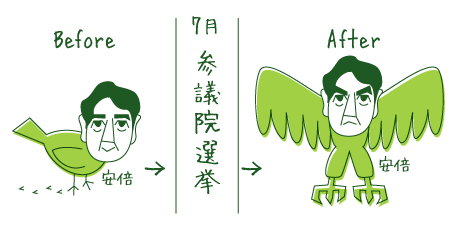
ABeHyouHen

A little bit of political commentary from here, implying that after weathering an election, prime minister Abe changed from a dovish to a hawkish stance.

Posted in Japanese, Yojijukugo | Tagged , , , , , , | 1 Comment

Fashion victim, food victim

京の着倒れ、大阪の食い倒れ
(Kyou no kidaore, Oosaka no kidaore;
“Bankrupted by clothing at the capital; bankrupted by food in Osaka”)

Definition:

In general, the people of Kyoto have a weakness for fine clothing, while the people of Osaka have a weakness for fine dining. A broad statement about the general character and priorities of the two areas. This may not seem universally applicable, but I think what sticks with people is the basic idea. We like simple categorizations, and here’s a tidy and evocative format for presenting them: people from X town are so into Y that they’re willing to let themselves be ruined financially over it. Isn’t that sweet?

Breakdown:

This one’s another repeated noun phrase. In each case you have the extinct classical verb 倒る (taoru), “fall down,” in conjunctive form, which allows it to act like a noun. (This noun, taore, can specifically take on the meaning of “bad debt,” as in “fall into debt.”) Each half precedes this noun with another verb in conjunctive form: first 着る (kiru), “to wear,” and then 食う (kuu), “to eat.” Each noun phrase is attached with the associative particle (no) to a place name (a proper noun). In the first case, (kyou), “capital” – referring to Kyoto, which is just plus (to), “city.” And in the second case, 大阪 (Oosaka), which has been standardized in English orthography as Osaka.

Notes:

There are many, many variations on this kotowaza, characterizing many different locations. (The majority seem to reference food, as it turns out.) Some come in pairs or even triplets while others stand alone. But as a rule, if you want to characterize a city or region by its tastes, go ahead and use the [place] [focus]倒れ pattern.

If you’re a beginning student of Japanese, be warned: you’ve probably been taught that “to eat” is 食べる (taberu), and 食う (kuu) may be a new and exciting alternative. While both verbs are in use, these days the latter is considered “rough” speech and generally won’t be used outside of informal, often masculine, company.

Example sentence:

「私たちの町にも、京の着倒れ大阪の食い倒れみたいな気質があるのだろう」

(“Watashi-tachi no machi ni mo, Kyou no kidaore Oosaka no kuidaore mitai na kishitsu ga aru no darou.”)

[“I wonder if our town, too, has a trait along the lines of Kyoto falling for clothing, or Osaka falling for food.”]

Posted in Japanese, Kotowaza | Tagged , , , , , | 2 Comments

A GOP Parable: The Taxman Cometh

On Taxation

When the chief priests of the Grand Old Pharisees heard Jesus’ parables, they realized that he was talking about them. And although they sought to have him arrested and silenced, they feared the crowds, who held him to be a prophet….

So they sent to him some of their politicos and some of their pundits to trap him in a gaffe. They came and said to him, “Teacher, we know that you are honest and impartial. For you are not swayed by appearances, but truly teach the way of God. Is it lawful to pay income taxes to Washington, or not? Should we pay them, or should we not?”

But, knowing their hypocrisy, he said to them, “Get out a dollar and let us look at it. Show me the currency to be used for the tax.”

They showed him a dollar. And Jesus said to them, “Whose likeness and inscription is this?”

They said “Washington’s.”

Then he said to them, “Therefore, render to Washington the things that are Washington’s, and to God the things that are God’s.”

When they heard this, they marveled at his words; they left him and went away. But they kept on exploiting tax loopholes. Because the allure of coin, and the fear of letting even a single coin escape their grasp, held more weight in their hearts than Jesus’ words.

Posted in Musing, Nonfiction, Short Fiction | Tagged , , , , , | Leave a comment

A SUPER INTERESTING YOJIJUKUGO

興味津津
kyou.mi.shin.shin

Literally: interest – flavor – harbor – harbor

Alternately: Being intensely interested in something. Overflowing with endless enthusiasm. Alternately, a descriptor of the interesting thing.

Notes: 興味, by itself, refers to curiosity about or interest in something. … is weird. It “means” something like a harbor, but has at times been used as an associative particle, as in 国津神 (kuni-tsu-kami, “gods of the land”), and in this case refers to liquid pouring or gushing out. The doubling strengthens the term, so today’s compound might be literally translated as something like “gushing with interest.”

Apparently some people replace with homophone , but this is considered incorrect. It’s okay, though, to use the doubling mark 津々 instead of writing out the same kanji twice in a row.

Super interesting… like this fishy!

Posted in Japanese, Yojijukugo | Tagged , , , , , | Leave a comment

Magic Monday – Umbrella enchanting

Bind Tool (Sorcerer’s Gambit)

Many magicians, finding themselves at the limits of their art but wishing to increase their power, may choose the risk and reward that come from placing part of their own essence into an object. The binding – that is, the permanent enchanting – of physical objects comprises an entire field of study for the magically adept, but the basics in most cases are the same.

An object of appropriate resonance must be acquired and readied. In some cases this involves the magician crafting it with their own hands; in other cases it requires them to collect components of arcane or spiritual significance, or convert a possession to which they feel a deep connection. In all cases, there is a final, grueling, ritual in which the enchanter puts part of themselves into the object to empower it and finalize the bond. The benefits are often seen to outweigh the costs, though, as the bound object becomes a potent tool for imposing the wielder’s will on the world.


The base difficulty of the enchantment ritual is d10. It takes a full day, requires the caster to sacrifice some number of attribute points, and costs the square of sum of the sacrificed attributes in both strain and fatigue. Increasing the difficulty by a step can decrease the ritual’s time requirement by a step (or vice-versa), but does not change the costs. This can be conducted as a group ritual, but only the costs in fatigue and strain may be shared.

As long as the bound item is in the binder’s possession, they operate as if they had suffered no attribute loss. When it is in hand, any attribute that was sacrificed from is increased by one. But if the item is taken and claimed by another (not simply borrowed; claimed as a possession), the attribute loss makes itself felt. If the item is destroyed, the loss becomes permanent, with an extra point taken from each relevant attribute, unless its maker unmakes it in another ritual just as difficult and draining as the first.

Enchanted items can often have other powers or special characteristics added (a good baseline is one per attribute point sacrificed), and appropriate tools (such as an enchanted mirror or flute) may make certain other spells easier to cast.

(Afterthought: this isn’t to say that this is the only way to create a magical object! There will of course be myriad variations on the theme, and a GM should feel free to change the details however they see fit. I provide this version merely as a baseline.)

Posted in Rules, World-Building | Tagged , , , , | Leave a comment

Go west, young man!

The apple is flung far from the stem?

可愛い子には旅をさせよ
(Kawaii ko ni wa tabi wo saseyo; “Send the beloved child on a journey”)

Definition:

If you love your children, your impulse may be to protect them from harm and hardship – but instead you should send them out in the world to learn from experience. Letting your children make mistakes, suffer, and fail (within reason, obviously) will help them more over the long run than ensuring their success. Don’t let worry make you keep your children locked in safe, controlled environments all the time; don’t be that one parent at the softball game.

Breakdown:

We’re going right to left again on this complete breakfast sentence. Our verb is actually さす (sasu), a causative helper verb, (i.e. translatable as “make [someone] do [something]”) in imperative form (させ; sase), with interjectory particle (yo) taking on an emphatic or assertive role. To the left of the verb we have the object-marker (wo) and the verb’s direct object, the noun (tabi), “travel (away from one’s home).”

Like many Japanese sentences, this one contains no subject – technically the subject would be the addressee. Instead, we have the directional particle (ni) and topic marker particle (wa) working together to show that the preceding element is both the indirect object of the verb, and the topic which the sentence is focusing on. That object is (ko), “child,” modified by the adjective 可愛い (kawaii). This adjective is usually translated into English as “cute,” but – as the applied kanji suggest – the base meaning is something more like “lovable” or “beloved.”

Notes:

Many of my sources suggest “spare the rod and spoil the child” as an equivalent, but I disagree. The focus in the English saying is on discipline and punishment, while the Japanese saying focuses on the importance of real-world experience and, at the harshest, simply not going out of one’s way to shield someone from the consequences of their actions.

The characters given above for kawaii are not, in some sense of the term, “proper.” Instead they are ateji, that is, characters applied to a Japanese word to make it seem more Chinese; equivalent perhaps to an English speaker inventing fake Latin roots for terms they use. Thus, while most of my sources give 可愛い instead of all-kana かわいい, the latter is perfectly acceptable.

There are several variations on this phrase; for example, kawaii may be replaced with 愛しき (itoshiki), another adjective meaning “beloved,” ending in ki due to taking an archaic prenominal form.

Example sentence:

「スミスさん、今の状況、ちょっと過保護と思わないの?可愛い子には旅をさせよって言うし、せめて近所の公園で遊ばせても大丈夫なんじゃない?別にニューヨークまで一人で行かせるわけじゃないんだから、大丈夫よ。」

(“Sumisu-san, ima no joukyou, chotto kahogo to omowanai no? Kawaii ko ni wa tabi wo saseyo tte iu shi, semete kinjo no kouen de asobasete mo daijoubu nan ja nai? Betsu ni Nyuu Yooku made hitori de ikaseru wake janain dakara, daijoubu yo.”)

[“(Mr./Mrs.) Smith, don’t you think you’re being a little overprotective right now? They say ‘send the beloved child on a journey,’ so isn’t it okay to at least let them play at the neighborhood park? It’s not like you’re sending them alone to New York; it’ll be fine!”]

Posted in Japanese, Kotowaza | Tagged , , , , | Leave a comment

It’s my way. …Did you expect an “or”?

頑固一徹
gan.ko.i-.ttetsu

Literally: firmly – harden – one – pierce

Alternately: Obstinate. Stubbornly sticking to one’s views or ideas. Pushing one’s vision through in spite of all opposition or resistance. Alternately, a person with that sort of stubbornness.

Notes: Both 頑固 and 一徹 mean “stubborn” on their own, so this is a yojijukugo that emphasizes its content through repetition.

Apparently some people accidentally replace 徹 with homophone (“removal”) in handwriting; this is an error.

Ittetsu

A guy literally named 一徹, from an old baseball manga called 巨人の星 (Star of the Giants). Apparently he’s not just stubborn but also kind of angry and violent.  8^(

Posted in Japanese, Yojijukugo | Tagged , , , , | Leave a comment

A GOP parable: The Widow’s Offering

There are politicians and pundits who profess the Christian religion, and declare that the US is a Christian nation founded on Christian principles. They claim that this means that Christian rules for living should control the law of the land instead of allowing law to remain secular. In response, many people have already pointed out that the behavior – and the rhetoric – and the goals – of the contemporary American “conservative” movement is deeply un-Christian. In the bad way.

I’m not Christian either! But then, I don’t pretend to be one. What’s more, I can read and understand a text. Again, I wouldn’t be the first to point out that many high-profile members of the current GOP have blinded and deafened themselves to Jesus’ message; that if they met him in person they would hate and fear him and try to have him punished, jailed, exiled, even executed for his actions and his words.

These powerful people are zealous about the law and about their ideological orthodoxy. Sometimes they are even sometimes knowledgeable… but they utterly reject the spirit of the law in favor of short-sighted, earthly goals. They hate and fear others who are not like themselves. They glorify wealth and violence. They seek control and domination over the laws of man for the sake of their own glory and power while mouthing empty catch-phrases about the Law of God.

In Christian terms, the GOP is the party of the Pharisees.

And in that spirit, I present the following possibly-familiar-sounding tales.


The Widow’s Offering

Jesus watched the people filing their taxes. Many rich people paid large sums. Meanwhile, a poor widow received a refund, and donated a few dollars to the local soup kitchen.

Jesus called his disciples and said to them, “Truly, this poor widow has contributed more than all those who are in much higher tax brackets. For they gave money that they could spare out of their abundance, and they have enough remaining to live comfortably for the rest of their lives. But she lives in poverty, and has given up one of her own meals to help others.”

The Grand Old Pharisees sneered at Jesus. “Socialist!,” they said. “By allowing this widow to pay a lower tax rate than we do, you only encourage a culture of dependency. If we cut off her public support, then she would surely become an entrepreneur and become rich enough to donate more.” And they flew home in their private jets, plotting strategies to reduce their tax payments.

Posted in Musing, Nonfiction, Short Fiction | Tagged , , , , , | Leave a comment