Magic Monday – Just say “no” to getting stabbed

Strong-Hand Ward

A rare and difficult, but powerful, spell that renders the magician impervious to physical attacks. The actual casting takes time and effort, and the magician must concentrate to retain its efficacy, but for as long as the spell is active, the magician may raise their hand and define a plane of force; the plane lasts for just a moment, but during that moment nothing passes through. Experienced magicians may block attacks from the mightiest warrior without moving a muscle.


The base difficulty of the Strong-Hand Ward is d12, and the base cost, six strain. Maintaining the spell’s energies costs no resources, but demands a check to maintain concentration if anything happens that might distract the caster. The need to concentrate also increases the difficulty of all other checks and challenge dice by a step. Calling upon the ward’s protection costs another point of fatigue or strain, and requires the magician to gesture with at least one hand. (It is possible to do this separately with both hands at the same time to block two attacks.) An advanced version of the spell requires no motion and is limited in range to “close” rather than “reach,” but raises the difficulty by a step and doubles all costs.

Posted in Rules | Tagged , , , | Leave a comment

I wonder what his kids thought, though.

愚公山を移す
(Gukou yama wo utsusu; “The Old Fool Moves Mountains”)

Definition:

No matter how great your troubles or difficulties, hard work and perseverance will see you through. Your goals are realized through hard work and persistence. Rome was not built in a day.

Breakdown:

In this case, 愚公 (gukou) is a proper noun. Not a name so much as a title, it effectively means “(The) Foolish Old Man.” As is often the case, modern Japanese might use a particle next, but it isn’t strictly necessary; instead we simply move on to the noun (yama), “mountain,” with the object-marker particle (wo). The mountain is taken as the object of the transitive verb 移す (utsusu), “to move (something)”; the verb is in sentence-final form, meaning that despite its brevity this kotowaza is in fact a complete sentence.

Notes:

愚公 is not an actual word in Japanese. 愚考 and 愚行 (foolish ideas and foolish actions, respectively) both are, and have the same pronunciation, but their use in this saying would be incorrect.

This comes from an ancient and famous Chinese folk tale, attested since at least the 5th Century BCE, when it was recorded in the Liezi, a Daoist text.

One day, an old man decided that he needed to remove some mountains near where he lived, because they made it difficult to transport things. He began working on removing them by hand, with pick and basket. The people made fun of him for attempting an impossible task, to which he replied that if he, and his children, and their children and further descendants all worked tirelessly, then eventually the offending mountains would be cleared away. Shangdi heard of the old man and was so impressed with his grit that he ordered the mountains moved, so that the work was finished in a single day.

Apparently Mao Zedong was very taken with this story, and popularized as a call for collective action by the Chinese people. It is not nearly so well known in Japan, given that it must compete for head-space with the synonymous 雨垂れ石を穿つ.

Example sentence:

愚公山を移すという例もあるから、私も成功するまで怯むことなく頑張るつもりです」

(Gukou yama wo utsusu to iu rei mo aru kara, watashi mo seikou suru made hirumu koto naku ganbaru tsumori da.”)

[“Following the example of the Old Fool Who Moved Mountains, I too shall work without faltering until I succeed.”]

Posted in Japanese, Kotowaza | Tagged , , , , , | 3 Comments

Vanishing Point

There was nothing but the road. It was barely visible because the only hint of light was no more than a hole in the darkness somewhere unreachable ahead. Anything else that might have been was lost in a deep and endless night that stretched from the horizon to my feet and back beyond, into a past which might have held non-dark or non-road or anything else that was not rapid silence and an endless placing of the next numb foot forward onto cold still concrete. There was nothing but the wind, somehow the same as the road, cutting so cleanly that it could not be felt except by the absence of blood.

There was nothing but the road. There was no thought, no memory, no anticipation, no hope. There was no despair either. It was not until all thought of being picked up had been cut away that I saw the car.

I saw no headlights, heard no motor. The car stopped for no thumb or sign, but simply for me. Or rather, it slowed to a crawl, because I did not stop for it.

After a while I became aware of shoelessness and blood, voices, and a faint warmth from one side, but even then my thought was not to get into the car, but simply that I was too tired to continue walking. I went where the open door led. It was so easy.

I could not feel the seat either, because it was so soft. The car too was dark, but warm, with muted green lights making a comfort of the dashboard.

My traveling companion is a cat: huge and gray and soft and warm and, when I opened my eyes and looked down, sleeping in my lap. The driver told me its name and said, I always take him with me, although some day he’ll probably go off on his own. You know how these things go. And that I did, although I’d never had a cat.

My light clothing, which did nothing to blunt the wind, is well suited to the car; but the warmth comes to me indirectly. There is only the cold leaving my body: first face and fingers and toes, then inward to the core, trickling slowly until there is nothing more than a warm blankness. I feel as if I have been draped in silk, but there are no shoes or socks and there is blood.

The driver is beautiful. Even aesthetics cannot tell why, but I would gladly stay in the car forever, or at least until we arrive where she is taking us. (I had forgotten where I was going.) She smiles at the cat, and then at me, and the smile is mostly unreadable, friendly and sad. At first I didn’t want to pick you up, she tells me. You seemed so determined to go back. But I had to make the offer.

I can’t remember where I was going, or why the road was so hard, or where my shoes went. I remember my other name, but you never forget that. I remember the cat now, too: I had seen it happily riding a kite in a picture when I was a child. I do not remember the picture, though; just the cat. I wanted a cat like that. After I leave her and the car, I will find it—perhaps this one after it leaves, as they always do eventually.

I look at her again, and she smiles back. There is no more road now, and no shoes but no blood either. There might be more later if I go back. I am lying down now and the cat sleeps on my chest and she sits across from us. I think about ghost ships for a while.

“You’re dead,” I’ll tell her.

No, she’ll say. I’m not. But everybody dies.


Yes.


For Emily Dickinson—

Posted in Poetry, Short Fiction | Tagged , , , | Leave a comment

Crossing Ts and dotting Eyes

It’s finals week! I hope everyone (for whom it’s applicable) is putting the finishing touches on their projects and ready for winter break!

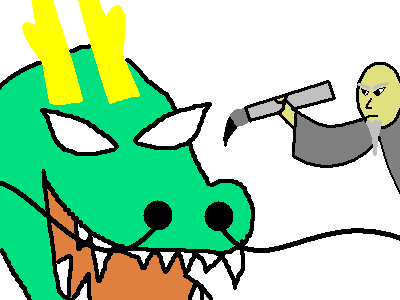
画竜点睛
ga.ryou.ten.sei

Literally: picture – dragon – point; dot – pupil (of the eye)

Alternately: Putting the finishing touches on something. Making a written or visual work of art vivid and complete with some final, vital addition. Painting in the pupil in the eye of a dragon.

Notes: Note that is pronounced ryou here rather than the more common ryuu. Be careful not to replace with the similar-looking : the former pairs the eye radical with the old-style “blue” character, while the latter pairs the sun radical with the modern version. It is acceptable, but uncommon, to replace with without any change in meaning or pronunciation.

This compound is often used when something is lacking, as 画竜点睛を欠く (~ wo kaku).

This compound comes from ancient China. There’s a story of the painter Zhang Sengyou, who was commissioned to paint some dragons on a temple wall, but left out the pupils. Here there is some variation in the story, but someone – either Zhang himself, under pressure, or a meddler – added pupils to one or two of the dragons, at which point they came to life, extricated themselves from the wall they’d been painted on, and flew off amid thunder and lightning; no doubt very very frightening.

garyoutensei

This is exactly what it looked like. Source: a blog that uses encoding my browser can’t read, but which is probably also introducing 四字熟語.

Posted in Japanese, Yojijukugo | Tagged , , , , , | 4 Comments

Magic Monday – Put yourself into your work

Enliven Blade

This is one of the few widely acknowledged rituals that can be performed unconsciously. It is known that proper care and attention from a wielder – and taking the lives of sentient beings – can leave traces on the shadow-self of a weapon (which need not be bladed, although historically most enlivened weapons have been swords). A tool or weapon being well-cared-for for a long time may leave it a little lighter in the hand, a little more durable, than its materials might suggest. A weapon taking many lives may leave it a little more quick to wound and kill than most. But the combination of these factors can result in something more. Given enough time an enlivened weapon can become magical, become sentient, even gain the power of speech. Some cultures revere these strange beings, even giving them rank in society and listening to their advice. Others fear them, and bury them deep. (Why did you think there were so many magical swords hidden away in tombs?)


As an inadvertent ritual, this “spell” requires no roll and thus has no difficulty score. Someone taking good care of a weapon or tool gains a point of fatigue in the act; someone taking a sentient life gains a point of strain in the act, and these may accumulate to the weapon. For every hundred such points accumulated, as long as at least one is from a life being taken, a weapon’s Intellect, Intuition, or Presence score may increase (choose randomly). It will gain awareness (IQ, Int) and power (Pre) in accordance with its ability scores.

Posted in Rules, Setting | Tagged , , | Leave a comment

Batman in a town without Birdman?

鳥無き里の蝙蝠
(Tori naki sato no koumori; “A bat in a village without birds”)

Definition:

When there are no exceptional people present, ordinary schmucks will talk big and throw their weight around. My sources compare it to “In the land of the blind, the one-eyed man is king,” although the feeling is probably closer to “If everybody is blind, then some random blind guy will act like he can see.”

Breakdown:

This week’s kotowaza is a noun phrase. For a change of pace (and because it’s often the logical way to approach Japanese-to-English translation), we’re going to read this one from right to left.

The noun 蝙蝠 (koumori) is bat(s), as in the animal. (Keep in mind that without additional information, almost any given noun in Japanese could be singular or plural.) Everything else in the whole saying works to modify this one noun. Working backwards, we find the associative particle (no) connecting the bat(s) with the previous noun, (sato), “village.” (The character can also refer to a unit of distance or a ten-to-fifty-home administrative division, depending on the time period, under the old ritsuryou system.) What kind of sato is it? – you ask, which is nice of you because I happen to have the answer. It is a sato where (tori), “bird(s),” are 無い (nai) – a negating adjective, here in prenominal form.

And there you have it: “The bat(s) of a birds-are-not village.”

Notes:

蝙蝠 is usually written in kana (こうもり) rather than kanji in everyday usage (not that most people use it very often), so don’t let the rare characters put you off. (Do use the kanji for writing this saying, though.) 無き can be written with or without the kanji without any particular change.

There are many versions of this saying. The closest simply changes out for (shima), “island.” Others use different animal pairs, talk about which small/prey animal is “king” when the larger or more predatory animal is absent, and so on.

Example sentence:

「三年生達が受験勉強のために練習に来なくなったや否や、鳥無き里の蝙蝠のように二年生が威張り始めた」

(“Sannensei-tachi ga juken benkyou no tame ni renshuu ni konakunatta ya ina ya, tori naki sato no koumori no you ni ninensei ga ibarihajimeta.”)

[“Almost before the seniors had stopped coming to practice so they could study for their entrance exams, the juniors started getting pushy, like bats in a town without birds.”]

Posted in Japanese, Kotowaza | Tagged , , , , | Leave a comment

At First


He lived in a large park-like place, and took care of the animals and plants there. A woman lived with him, and helped him—or maybe he helped her; they didn’t stop to consider which it might be. When he was with her, he was of the opinion that his side hurt less than usual, although most of the time he never thought that he was feeling pain. They were quite comfortable with each other: he called her “woman,” and she called him “man,” in the language they shared.

The park was a very nice place, with pleasant and varied weather and wondrous vistas and an empty place in the middle that was good for dancing in. It was a normal clearing, for the most part, but there was a wide spreading tree there with a very sweet scent and good fruit that soothed upset stomachs and other bad feelings. They thought it was the most beautiful tree they had ever seen. They both liked beautiful things, and visited it every day. They brought colored rocks to the clearing from the rivers, and made little piles. Sometimes he or she would step on a sharp bit of rock and have to stop. Then she would sit down and be melancholy, as was her way. And he would become angry with the rock and throw it as far as he could into the brush, as was his way. But they always went to one part of the park or another for more rocks, because the smooth river-stones and the rough hill-stones were beautiful.

To the west there was a broad plain, and sometimes one or both would go there and take care of the animals and plants of the plain for a while. The man would occasionally bring back some of the stones from there as well, blue like the sky or glittering like the sun, or a wounded animal he had found. They would feed it fruit from the beautiful tree, and wash it in the nearest river, and nurse it back to health.

One of his pastimes, other than finding pretty things or animals to care for, was making up names for the animals. He and she had found that other living things had personalities just like people, even though they couldn’t talk. Sometimes the two would fight over the best name for some bird or fish or insect, and he became angry and had to go to the river and throw rocks until the upset faded, because their arguments always seemed to get bigger than the issue that had started it.

One day he was resting under a tree, and caught a little mammal of some sort just as it emerged from its burrow under the tree’s roots. He called to her, and went to meet her carrying the animal, which was a soft brown and had white and black stripes down its back and tail.

She came to him, and they met in the clearing. He was just about to show her the new thing when, in its play, it scratched his hand. This hurt badly. He began bleeding, and having been careful to that point he was very startled. In surprise and anger, he threw the animal from his hand as hard as he could, and it hit the side of a tall hard tree at one end of the clearing and fell to the ground.

The woman went over to the animal and, picking it up, became very upset. She patted it and tried to give it some fruit from the beautiful tree, but of course it didn’t eat. She took it to the river; he came along behind with an unpleasant feeling building up inside. He didn’t know how to handle that any more than the animal’s scratch, but he could think of nothing to do but follow.

When they got to the river, she tried bathing blood from the creature’s fur, and making it drink, and then she stood and threw the limp dripping animal against the man’s face, crying in frustration. He flailed in disgust and shock, then stepped forward half-blindly, and shoved her as hard as he could. She went over backwards into the water with an odd sharp noise that was partially splash and partially like that of a rock falling onto other rocks.

Making great heaving inarticulate noises, he waded forward, reaching out, but she went away downstream without looking at him, swimming in an unnatural motionless way he had never seen before. He watched and called and ran along the bank for miles.

It was the breezy time of day when the Presence came to the man, who was curled up under a twisted little tree in a stony place. The man’s side was hurting him very badly now. He was full of confusion and doubt and other emotions he didn’t have the capacity to understand, and became fearful as well when he heard the sound made by the Presence approaching.

What have you done.

“I don’t know,” said the man. “I don’t know what happened.”

You do not know good and evil, so that is to be expected. What will you do now.

The man shook his head. He did not know, and he did not know how to know, and he did not know how to say this.

The man found himself deeply comforted now by the Presence, but his side was still hurting and he felt that it always would. Even if he never ate the fruit of the beautiful tree again, he could never die, and never forget, and there would always be something wrong.

Get up.

The man got up. He walked a while in the company of the Presence, and then he was not.

Then the garden wasn’t any more either, nor the plains, nor the rivers, nor any of the living things in them. The stars and moons and planets were not, leaving behind only light and darkness moving in a great open expanse, from which the lands vanished into the waters. Then the waters closed around the expanse. Then there were not even light or darkness, only something greater than either but formless. And nothing else had ever been.

The Presence was different now, without anything else there.

It was good, but not good enough. I have come to regret that image. Such a path is not worth following.

The Host seethed like an ocean, awaiting direction.

Let us make it again, directed the Presence. With a second tree, this time. Let us create something that can try to make itself whole. It is a difficult task, but I believe that that will be good.

For the most part, it was.


Posted in Short Fiction, World-Building | Tagged , , , | Leave a comment

Breathing the blues

青息吐息
ao.iki.to.iki

Literally: blue – breath – spit – breath

Alternately: Trying times. Hardship and/or great anxiety. Being in such pain (psychologically rather than physically) that you feel physically exhausted and can only sigh in response.

Notes: The “blue” refers to going pale with exhaustion rather than anything we would call “blue” in the West. So the first half of the phrase refers to being rendered “pale and sighing” through your woes, while the latter half reiterates the sigh for emphasis.

jnxhnFk

Found on imgur; original source unknown.

Posted in Japanese, Yojijukugo | Tagged , , , | Leave a comment

Magic Monday – Taiko Telecommunication

Fel Greeting (Royal Ice Drum)

The Fells are best-known, in the magical and martial communities alike, as the home of physical magic. That is not their only discovery, though. If anything, this spell was more vital in the formation of modern Phaelwelyehavne (“The Fells”) than all of the Hahdet techniques together.

This “spell” is technically an enchantment, worked on a bucket of water. The magician adds certain herbs and powders, and often a dye of some kind, for convenience’s sake. When the water is poured out on a flat, snowy surface, it spreads to form a perfect circle of non-slippery ice that reverberates when struck as if it were a drum-head. For older versions of the magic (referred to in The Fells as simply “Ice Drum”), this was all, but the version currently used has the ability to send its sound to a location envisioned by the performer, with obvious application for communication between separate valleys during the long winter months. These days, every community throughout the region has at least one drum-dancer, and even when its services are not required for official business, an Ice Drum may be used as an instrument for their own entertainment by the community. Naturally, Ice Drums of all kinds are much less useful during the summer melt.


The base difficulty is d8 (d6 for Ice Drum); attempting to craft a batch of water takes about an hour and costs two strain (one for Ice Drum). In either case, performing for about a minute costs a point of fatigue.

Posted in Rules, Setting | Tagged , , , | Leave a comment

Fortunately, this blog is a complete auteur project….

船頭多くして船山に登る
(Sendou ooku shite fune yama ni noboru;
“With many boatmen, a ship will climb a mountain”)

Definition:

Too many cooks spoil the both. With too many crew members trying to steer, a ship can become so lost that it leaves the water entirely and ends up on a mountain-top. If too many people are trying to lead or give directions, then it becomes increasingly difficult to choose and stick with a single direction or vision for whatever the team is working on, leading to poor results.

Breakdown:

This one is a functional sentence, comprising two complete verb phrases. The first begins with the noun 船頭 (sendou), literally a ferryman or boatman. As is often the case, here we might expect a particle, but it isn’t really necessary grammatically so none is forthcoming. Next we have the adjective 多い (ooi) in conjunctive form because it is modified by the following verb. The verb it is linked with is する (suru), often translated as “to do” but here more like “to make (something be a certain way).” It appears in conjunctive te-form in order to join the two halves of the saying together.

The second phrase begins with subject and object, respectively (fune), “boat/ship,” and (yama), “mountain.” The former could be marked with subject particle (ga), but again the particle is elided because grammatical function is clear from the sentences structure. The object is marked, but with the directional particle (ni) rather than the object marker (wo). Finally, we get the verb 登る (noboru), “to climb (a tree, mountain, etc.)” in sentence-final form.

Notes:

Replacing with the more specific directional particle (e) or 登る with 上る (same pronunciation) is acceptable, and does not significantly change the meaning. The verb structure of the first part may also be replaced with a simple conditional form 多ければ (ookereba).

This saying is of decent age, attested to since 1638 and included in a treatise on poetry called 毛吹草 (Kefukigusa).

Example sentence:

船頭多くして船山へ登ると言わんばかりに、蒔岡家の長女が常に家事を決定づける権限を握って誰にも委任する気配はなかった」

(Sendou ooku shite fune yama e noboru to iwan bakari ni, Makioka-ke no choujo ga tsune ni kaji wo ketteidzukeru kengen wo nigitte dare ni mo inin suru kehai wa nakatta.”)

[“As if to say that too many cooks would spoil the broth, the eldest daughter of the Morioka family always kept a firm grasp on her authority over household matters, without the slightest hint that she might delegate anything to anyone.”]

Posted in Japanese, Kotowaza | Tagged , , , , , , , | 1 Comment