The mind, a mirror; the will, like water

明鏡止水
mei.kyou.shi.sui

Literally: bright – mirror – stop – water

Alternately: Like a polished mirror. Like still water. Clear and serene. Specifically, a placid mental state that results from a mind free of ill-will or wicked thoughts. The calm of the just.

Notes: There are apparently some who write 名鏡 (“famous mirror”) instead of 明鏡 (“flawless mirror”). This is an error.

This compound apparently comes from the Zhuangzi – “one of the two foundational texts of Daoism.”

YEEEEAAAAAAHHHHRRRRRGH

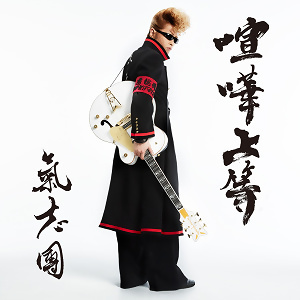
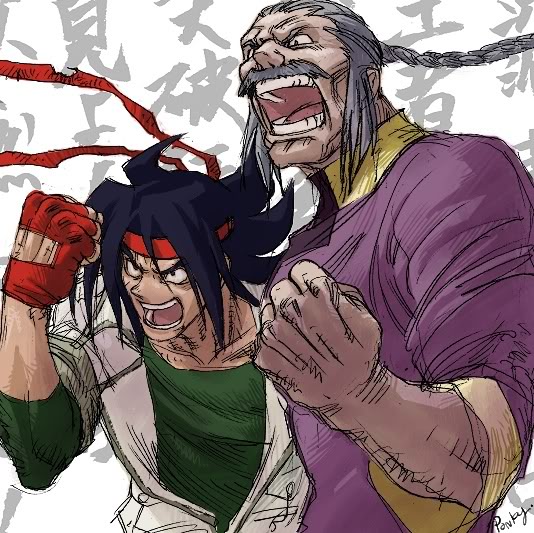
LOOK AT HOW UTTERLY PLACID WE ARE! (Source; a Chinese fan of things Japanese.)

Posted in Japanese, Yojijukugo | Tagged , , , , , , , | Leave a comment

Magic Monday – A personal radiance

Cloak of Power

The wise wizard knows that violence can cause as many problems as it solves, and reliance on it means a life of exposing oneself to potential injury and death. Yet there are also times when more subtle means of getting one’s way are unavailable due to limited information, time, patience, or other resources. Some magicians will therefore resort to this persuasive spell, in which they cause the flow of magical power through and around their person to become manifest in (usually visual) sensory display.

Visual manifestations include glowing light or darkness, sourceless dramatic wind, crackling electricity, or even a mild antigravity field that causes dirt and debris to levitate in an area around the magician. Audible manifestations include dramatic music, ringing tones at the very highest or lowest audible pitches, a sharp buzz, or the magician’s voice becoming deeper, gaining an echo, or layering over itself as a great multitude speaking in unison. Other effects are also possible, including more extreme reactions from especially susceptible individuals.

The base difficulty is d4 and the base cost, one strain. For as long as the Cloak is active, the magician gains a +1 bonus to all social rolls due to simply being so dang impressive. The effect costs one fatigue per scene (or per ten minutes), and ends when its wielder concentrates on anything more intense than walking or other simple movement, talking, automatic tasks such as eating and shoe-tying, or magic use. (While magic requires focus, the act of manipulating it feeds into the Cloak and maintains it.)

Increasing the Cloak’s bonus either doubles the fatigue, or increases the difficulty by a step, with each point added. Alternately, increasing the difficulty by a step can decrease the rate of fatigue – from “a scene” to an hour, a quarter-day, a day, a week, a month, a year. It goes without saying that some wizards wreathe themselves in magic as if it were clothing.

Posted in Rules | Tagged , , , | Leave a comment

But wouldn’t a forest be a mountain’s “cover”?

山高きが故に貴からず
(Yama takaki ga yue ni tattokarazu; “The mountain is not valued for being high.”)

Definition:

Don’t judge situations based on superficial qualities, but by their essential nature. Don’t judge a book by its cover. Don’t value a mountain just for being tall; all mountains are tall by definition, and should be valued as appropriate for their specific qualities, such as being good sources of lumber.

Breakdown:

We begin with the noun (yama), “mountain.” Here, with modern grammar, one might expect a particle of some kind, but as this is premodern Japanese there is none. Instead, we move on to the adjective 高し (takashi) in prenominal form. This connects it grammatically to the following particle, (ga), acting here in an associative function akin to modern . The associated word is (yue), “reason,” and it’s followed by the particle (ni), which in combination makes it into the conjunctive phrase yue ni, “therefore.”

Finally, we get the adjective 貴い, “valuable,” “noble,” “sacred.” In modern Japanese this can be pronounced たっとい (tattoi) or とうとい (toutoi). In older Japanese, though, the “base form” ending (insofar as there was such a thing) would be (shi) rather than (i), and on top of that the orthography would be たふとし (still pronounced toutoshi rather than “tafutoshi”!). The adjective is in imperfective form (未然形) which takes off the shi and changes it to kara, and finally we get the negative suffix (zu) in sentence-final form.

All in all, the phrase might translate literally as “Mountain high therefore valued… not!”

Notes:

The final verb may also be written 尊からず without any change in meaning or pronunciation. An alternate opening replaces 山高き with 人肥えたる, making it “A person is not valued for being fat” – reminding us of a time when girth meant prosperity, rather than poor nutrition and poor health, as it tends to mean today.

This saying comes from the 実語教 (jitsugokyou) a Heian-era pedagogical text for commoners that saw widespread use through the early Meiji era (when, presumably, it was upstaged by Western-style texts as part of a general effort to modernize Japan). In its source, it includes a second half saying 樹有るを以て貴しと為 (ki aru wo motte tattoshi to su), “value it because it has trees.” (Did you think I was just pulling that bit about lumber out of thin air?) (That said, apparently its original form wasn’t even classical Japanese; it was Chinese with notations allowing it to be read in Japanese!)

Example sentence:

「あの連中か。ちょっと...いくらアルマーニを着てても、口に出す言葉がどんなに丁寧でも、ただ人を騙し、お金を奪おうとするだけだ。やはり山高きが故に貴からず

(“Ano renchuu ka. Chotto… ikura Arumaani wo kitetemo, kuchi ni dasu kotoba ga donna ni teinei demo, tada hito wo damashi, okane wo ubaou to suru dake da. Yahari yama takaki ga yue ni tattokarazu.”)

[“Oh, those guys. Well… even if they wear Armanis, and no matter how polite they are, they’re just out to pull one over on people and take their money. You really can’t judge a book by its cover.”]

Posted in Japanese, Kotowaza | Tagged , , , , , , | Leave a comment

Another thought on toddler cognitive development

The kid has started categorizing the world and associating properties with those categories. He has also started learning the names of things. Examples:

  • He will see a dog, and say “Dah!”
  • He will hear a dog bark, and say “Dah!”
  • He will hear an airplane, and say “Buuuuuu,” and point up at the sky even if the plane isn’t in our field of sight.
  • He will spot a bus from blocks away, get very excited, and say “Buh! Buh! Buh! Buh! Buh!”
  • He will see a cat and meow at it as best he can.

But the categories are still pretty general, and the edges are blurry:

  • He will see or hear a truck and say “Buh!”
  • He will see a cat, and say “Dah!”
  • He will see a squirrel, and say “Dah!”
  • He will see or hear a dog and meow at it.
  • He will see a human child, say “Dah!,” and then meow at them.

So it seems that right now, in his mind, “Dah!” is any animal, or at least any mammal, bigger than a pigeon and smaller than an adult human, and he further believes that all non-verbal “Dah!” meow. Even more oddly, sometimes he will react verbally to no apparent stimulus – he will say “Dah!,” or “Buh!,” or start meowing, without anything around that I can detect. Sometimes he seems to be remembering previous sightings – he has definitely reacted to neighboring apartments that house cats or dogs, even if nothing is currently visible in the window – but that’s not always the answer. Is it that he heard a sound which he associates with “Dah!” or “Buh!” but which I don’t? Is he simply remembering “Dah!” or “Buh!” and talking about them? Is he trying to call one? It’s a mystery, but at least it’s one of the cuter mysteries.

Except when he looks behind me in an otherwise empty apartment and waves good-bye to nothing. That’s kind of creepy.

Catdog!

Posted in Musing, Nonfiction | Tagged , , , , , , , | Leave a comment

You have good lumber for this job!

適材適所
teki.zai.teki.sho

Literally: suitable – material – suitable – place

Alternately: “The right person in the right place.” Placing someone in a position or job that matches their character and skills. Finding the right person to do a given job.

Notes: originally means “lumber,” but by extension can mean “talent.” 人材 (jinzai) is “a capable person” or “human resources,” “personnel.”

Apparently some people write instead of , but this is an error.

Interrobang!?

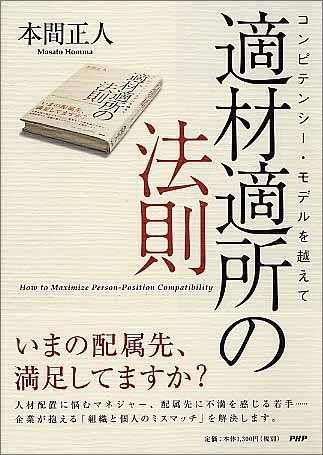
It’s a book! A book that… shows itself on its own cover!? (Without infinite recursion, sadly.)

Posted in Japanese, Yojijukugo | Tagged , , , , , , | 2 Comments

Magic Monday – Physical Magic – Iron Shirt

Tesshadzu Hahd

The cold and mountainous land known as the Fells is not the easiest place to wear, or even acquire, metal mail or other heavy armor. Hahdet practitioners have found a way around these difficulties by learning how to harden their skin until it can absorb and deflect incoming force. This is not perfect defense against harm, of course, but skilled practitioners can stride into battle more thoroughly armored than any knight. Like heavy armor, though, this technique requires preparation time: about a minute’s worth of meditation is required to prepare the mind and body.

This technique has a base difficulty of d2 and a base cost of one strain, and provides +1 to deflection defense. For each round the effect is maintained, it costs a point of fatigue. And then it gets complicated.

The deflection bonus can be increased by increasing the difficulty by one step. At deflection bonuses of +2 and above, the technique adds a point of absorption for every two points of deflection, rounded down. Alternately, the technique can be focused into a limited area – one arm, one leg, neck, head, chest, etc. – to halve the energy cost (to one point of fatigue every other round, for example) while increasing the deflection bonus in that area by +2, although this increases the difficulty by a step. The energy cost can be halved for any variant above, again at the cost of increasing the difficulty by a step per increment. And finally, the preparation time can be reduced to a single action, although this increases the difficulty by two steps.

Posted in Rules, Setting | Tagged , , , , | Leave a comment

The danger of mouth-sweat

綸言汗の如し
(Ringen ase no gotoshi; “Imperial words are like sweat.”)

Definition:

Words, like sweat, cannot be put back where they came from. Once a ruler has issued a command or decree, it cannot be changed or undone. Implicit in this saying is the warning for people in government (or in positions of influence and power in general) to watch their words and conduct; a careless word or poorly-phrased ruling or law can have wide-ranging consequences, even though we now live in an age when leaders are free to rescind, rephrase, and repent their words, and amend the laws they’ve passed.

Breakdown:

綸言 (ringen) is a noun meaning “imperial words,” specifically official orders and pronouncements. Since this is old-fashioned Japanese, this noun is not accompanied by anything special, but modern Japanese would likely add the topic marker here. Next we have another noun, (ase), “sweat.” It’s connected by the associative particle (no) to adjectivally-conjugating auxiliary verb 如し (gotoshi), “[be] like,” in sentence-final form.

Notes:

Some people may replace the first character with (also pronounced rin, but meaning “ethics” or “morality,”) but this is an error.

This is the ri entry in both the Kyoto and Osaka Iroha karuta sets. It’s based on a longer (more explicit) passage from the Book of Han.

Example sentence:
(Again borrowed from a dictionary)

日本の政治家は、綸言汗の如しという言葉を知らないのか

(“Nihon no seijika wa, ringen ase no gotoshi to iu kotoba wo shiranai no ka.”)

[“Don’t politicians in Japan know it’s said that words, like sweat, can’t be taken back?”]

Posted in Japanese, Kotowaza | Tagged , , , , , | 2 Comments

A single turn of the heart machine!

心機一転
shin.ki.i-.tten

Literally: heart – mechanism – one – turn

Alternately: A complete change (for the better) in one’s emotional state in response to something. A fresh outlook on life. Turning over a new leaf.

Notes: There are many ways to get this one wrong: for shinki, 新規, 新気, 心気, and 心器 are all possible renderings that people may try. All are incorrect. This does offer an interesting insight, though, into how people’s minds interact with kanji. It seems that the phonetic and semantic information is easier to retrieve than the associated visual symbol, leading people to use kanji with the same pronunciation that produce related, or at least plausible, meanings.

The image for... an internet-radio channel? - of songs that supposedly can help you achieve 心機一転.

The image for… an internet-radio channel? – of songs that supposedly can help you achieve 心機一転.

Posted in Japanese, Yojijukugo | Tagged , , , | Leave a comment

Magic Monday – An enchantment for Elm Street

Dream Ward

Similar to the fae affliction of iron, the progeny of Dream cannot abide the touch of salt, and will recoil from it. Although diluted salts such as what is found in sweat (for example) are no more harmful to dreams than the iron in blood is to Faerie creatures, even a handful of pure grains can be effective. By making a line of salt and chanting the proper minor wards to bind it in place, a magician may create a barrier which dream-creatures will not cross. The amount of salt required increases with the length of the line, naturally, and the line cannot have any appreciable gaps or the ward-song cannot draw on its power for the intended length.

If drawn in a circle, the barrier creates a space which dream-creatures will not enter or leave. If any sentient being that can dream crosses the barrier it will break, rendering as useless as a line of sand. Sleeping within an enclosed Dream Ward will prevent anyone inside from dreaming.

The base difficulty to create a Dream Ward is d6, and maintaining it costs its creator a point of strain each half-day (starting at the moment of creation) that cannot be recovered from until the next full sleep after the Ward is broken. Similarly, anyone sleeping inside an enclosed Ward gains a point of strain each night; these cannot be recovered until they have a full proper sleep during which they are allowed to dream. These costs are cumulative if a Ward’s creator sleeps inside it.

Posted in Rules, Setting | Tagged , , , | Leave a comment

cf. 飛龍昇天破 (Hiryuu-shouten-ha)

旭日昇天の勢い
(Kyokujitsu shouten no ikioi; “[with] the force of the rising sun”)

Definition:

Vigorous, energetic, and forceful like the sun rising in the morning sky toward its zenith.

Breakdown:

by itself can be read asahi, “morning sun.” 旭日 (kyokujitsu) is simply adding “sun,” so “morning sun” or “rising sun” is still an appropriate translation. (here read as shou) is “to ascend” and (ten) is still “the sky” or “the heavens,” so 昇天 (shouten) in this context means “rising up the sky.”

All the above acts together as a single noun phrase, and associated with it by the particle (no) is another noun, 勢い (ikioi), “force,” “energy,” “authority,” “momentum,” etc.

Notes:

Incidentally, there’s a medal that the Japanese government awards to distinguished individuals, generally for international-relations or cultural achievements called the “Order of the Rising Sun” – the 旭日賞 (kyokujitsu shou). Well, it’s hardly a coincidence that the late Meiji-era government of the “land of the rising sun” created a medal promoting an association between the rising sun and boundless, triumphant energy.

The initial four charactes can be detached from the rest of the phrase and used yojijukugo style.

Example sentence:
(This time from a dictionary; things have been rather hectic and coming up with a satisfying – and grammatically correct – example of usage on my own can be the most time-consuming part of one of these posts!)

旭日昇天の勢いで勝ち続け、決勝戦にのぞむ」

(Kyokujitsushouten no ikioi de kachitsudzuke, kesshousen ni nozomu.”)

[“After winning a string of victories with overwhelming force, they looked forward to the final match of the tournament.”]

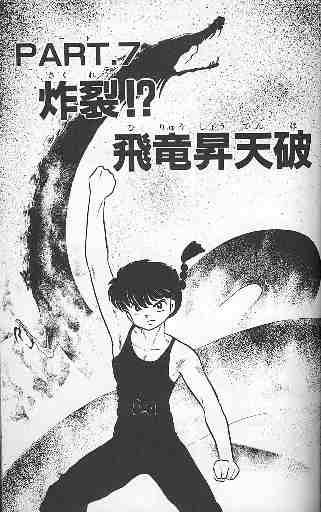
Ah, yes, the post title is the name of a high-level (non-real) martial arts move in the Ranma 1/2 manga.

Ah, yes, the post title is the name of a high-level (non-real) martial arts move in the Ranma 1/2 manga.

Posted in Japanese, Kotowaza | Tagged , , , , , | Leave a comment