Whee!

I only used to have nine pen!

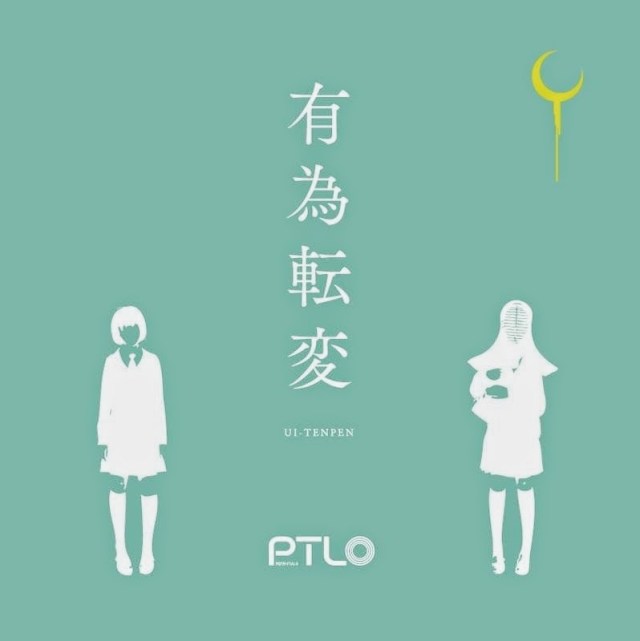
有為転変
u.i.ten.pen

Literally: exist – do / change – turn – strange

Alternately: Everything in the world is in a constant state of flux. Everything changes; nothing stays the same. A Buddhist comment on the fleeting and mutable nature of the world we live in.

Notes: U is an uncommon reading for the character 有, brought to us by the compound’s Buddhist origins. That said, the only phonetic variants of this phrase leave the initial character as it is, while the final character 変 can also be pronounced as ben or even as den.

This yojijukugo too comprises two two-character words: 転変 is “to change,” while 有為 is a more arcane expression referring to phenomena or events brought about by fate or karma. Note that this only applies to ui, though: homonym yuui means “talented.”

UITenPenCover

Also the title of a Vocaloid album. I wonder if the monks would have found it appropriate that their phrase also changed like that.

Posted in Japanese, Yojijukugo | Tagged , , , , , | Leave a comment

Out of rain, out of brain

雨晴れて笠を忘れる
(Ame harete kasa wo wasureru;
“The rain stops and you forget your umbrella (hat)”)

Definition:

As soon as a painful situation is over, the help one received is forgotten. When rain is threatening or falling people make sure to take an umbrella, but it’s all too easy for the umbrella to be forgotten and left behind as soon as the rain has stopped.

Breakdown:

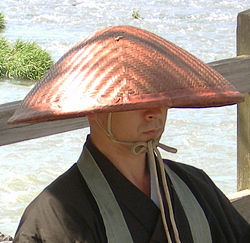
We begin with the noun 雨 (ame), “rain,” followed immediately by the verb 晴れる (hareru), “to clear up.” (One can imagine the subject-marker particle が (ga) here, but as is often the case it’s been elided.) Hareru appears in conjunctive form, leading us to the second clause of the sentence. This time the noun is 笠 (kasa)… which is a little complicated. I translate it as “umbrella” below, but the correct character for an umbrella is 傘 (also pronounced kasa). A 笠 is more properly a traditional conical or dome-shaped hat of the kind we mostly see nowadays as part of a Buddhist monk costume regardless of weather. In either case, the 笠 is marked as the object of a verb by the particle を (wo), and that verb is 忘れる (wasureru), “to forget,” in sentence-final form.

Mi Kasa

Mi kasa es mi… sombrero?

Notes:

This saying is very close in meaning to 喉元過ぎれば熱さを忘れる, although with slightly different focus and nuance.

But in contemporary America, it’s all too topical: now that the days of abusive labor practices are a distant memory we see a sustained attack on unions and worker protections; now that Lake Erie is no longer polluted enough to catch on fire we see a sustained attack on environmental protections; now that the Civil Rights era and the lessons of WWII have brought a new set of laws and a semblance of equality, the forces of bigotry are twisting languages and laws to their own ends while threatening renewed violence. And so on and so forth. Don’t rest on your laurels. Don’t assume that your rights and protections are inviolate. Keep in mind that for evil to be victorious, the only requirement is for good people to do nothing.

Example sentence:

「当然大統領は馬鹿じゃないと世界中の人々は思い込んだが、雨晴れて笠を忘れるように、色々油断して禍を招いてしまった」

(“Touzen daitouryou wa baka ja nai to sekaijuu no hitobito wa omoikonda ga, ame harete kasa wo wasureru you ni, iroiro yudan shite wazawai wo maneite shimatta.”)

[“The people of the world fell into thinking that it was natural for the president to not be an idiot. But like forgetting your umbrella once the rain has gone, we let down our guard and invited disaster.”]

Posted in Japanese, Kotowaza | Tagged , , , , | 1 Comment

Level-up Ramen

So let’s say you’ve got some packets of ramen noodles. I’m not even talking about the cups with a smattering of freeze-dried corn and peas on top; this is the ten-for-a-dollar college student staple. But let’s also say that you want to get some nutrients in your diet and are willing and able to acquire and prepare vegetables. In that case, you might want to try this recipe:

  1. Start with water in a pot or large saucepan. I use 1.5 times the recommended amount for the number of noodle packets (3 cups per packet). Add the flavor powder from the ramen, and/or some bouillon, consommé, or other flavoring of your choice. Bring the water to a gentle boil and keep it there until serving.
  2. Cut carrots into slices a couple millimeters thick (I actually just sliced a handful of bagged baby carrots lengthwise) and get them in the water to soften.
  3. Similarly slice and add some onion (I used half of a yellow onion) and mushrooms (bog-standard button mushrooms work fine, but if you can afford it I thoroughly recommend trying various Japanese mushrooms!)
  4. Cube some firm tofu or chop some meat (about one centimeter, or half an inch) and chuck it in there.
  5. In the same vein, feel free to add other ingredients in order of hardness. At this point I put in napa cabbage stems (the thick white portion), separated from the thin leafy parts and cut into strips.
  6. When the other ingredients have been cooked to about the firmness you want, add the noodles. You’re no more than five minutes from eating at this point.
  7. After the noodle blocks have started softening and coming apart, add some soft greens. I added the napa cabbage leaves and cut leek at this point.
  8. If you want some more protein and flavor, crack an egg into a bowl. When the noodles and greens are at the desired softness, pour the boiling soup over the egg.
  9. Take a couple of minutes to eat a side dish or stare at the moon or whatever, stirring the soup a bit every now and then. By the time it’s cool enough to eat, the egg should be cooked and integrated into the broth.
  10. Add any other flavorings you want and enjoy! I recommend 七味唐辛子 (a.k.a. “shichimi“), or the killer combo of fish sauce, chili sauce, and a splash of lime juice.

This takes about half an hour, and produces two to three servings per ramen packet, depending on the size of the bowls you use.


Obviously, there’s a lot of room for customization. You can turn the animal-product dial from “vegan” to “has a layer of schmaltz on top,” and the ingredients dial from “a handful of cheap veggies” to “gourmet cornucopia.” The only really important keys are to add the ingredients one or a few at a time, bringing the water back to a gentle boil each time, and to do this in the order of the amount of cooking they need.

That said, the veggies are the real heart and soul of the soup, with the noodles themselves being more of a backbone. If it were a band, the noodles would be the drums and the veggies would be almost everything else, with meat or egg taking the role of lead vocals. Um, anyway. In order to keep the soup from becoming a gray mass I do recommend throwing in some warm colors and some greens – carrots and leeks, for example. If you want to make a more classic Japanese ramen, feel free to top with slices of hardboiled egg, meat, or fish cake. If possible, eat with chopsticks and with gusto.

Posted in Musing, Nonfiction | Tagged , , , | 1 Comment

The flame and the flood

天変地異
ten.pen.chi.i

Literally: heaven – change – earth – different

Alternately: Natural disasters or bizarre natural phenomena. Bad or weird stuff that’s not man-made. You know, like eclipses, record-breaking storms, and floods.

Notes: 天変 refers to unusual celestial events like meteors, comets, and eclipses, along with bizarre or drastic weather such as tornadoes, torrential rain, and powerful storms. 地異 refers to terrestrial events such as earthquakes and tsunami, floods, and volcanic eruptions.

Apparently some people replace 天 with homophone 転, but this is considered an error. On the other hand, doubling the 変 to get 天変地変 (~chi.hen) is a valid alternate version.

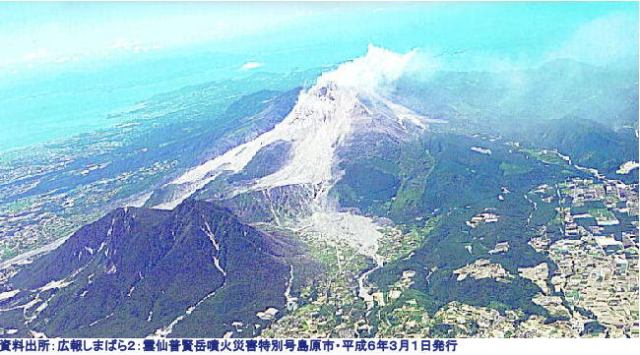
TenPenFuGen

That’s a scar from a pyroclastic flow that tore a town in half and killed dozens of people. Fifteen years later, I was living within sight of the volcano, albeit on the other side.

Posted in Japanese, Yojijukugo | Tagged , , , , , | Leave a comment

Hitting the Wong target by accident?

That title feels extra obscure even though I totally explain it below. Weird.

草を打って蛇を驚かす
(Kusa wo utte hebi wo odorokasu; “Strike the grass, surprise a snake”)

Definition:

An innocent or unthinking action that draws unintended, usually bad, consequences. Like idly swatting at the long grass by the roadside only to startled and draw out a snake that thought you were attacking it.

Alternately, to single out and punish one wrongdoer as a warning others, especially others who have some connection to the first.

Breakdown:

We begin with the noun 草 (kusa), “grass,” marked as the object of a verb by the particle を (wo). The verb being done to the grass is 打つ (utsu), in conjunctive form so that it can connect to the second half of the sentence. In turn, this begins with 蛇 (hebi), “snake.” The snake is also marked by を, and the verb being done to it is 驚く (odoroku), “to be surprised,” in causative-passive form. (I.e. the snake is being caused to become surprised.)

Notes:

This saying comes from the Chinese, and can also be found in yojijukugo form as 打草驚蛇. It’s attested in a Song-era dictionary of idioms called the 書言故事 (Shogen koji), in the story of a public official named 王魯 – I’m told it’s pronounced Wang Lu – one of whose subordinates is charged with taking bribes. 王魯 himself was guilty of the same, but takes the hint and declares himself to be like a snake taking fright even though the grass nearby, rather than the snake itself, was struck.

This implies that the second usage listed above is the original and “proper” one. It’s not clear how the “bad consequences” meaning developed, although I’d guess it’s from people seeing the phrase and guessing at its meaning without knowing its origin or common usage.

The cause and recipient of the surprise can also be reversed by replacing the latter half of the saying with 蛇に驚く (hebi ni odoroku), “be surprised by a snake.” Another similar saying replaces the grass with “underbrush,” 藪 (yabu).

Example sentence:

草を打って蛇を驚かすつもりで、あの汚職官吏の補佐官まで指摘して処罰を与えてみたが、さすがナルシストか、空気を読まずいつも通りに続けた」

(Kusa wo utte hebi wo odorokasu tsumori de, ano oshoku kanri no hosakan made shiteki shite shobatsu wo ataete mita ga, sasuga narushisuto ka, kuuki wo yomazu itsumo doori ni tsudzuketa.”)

[“As a warning shot we picked out the corrupt official’s aide for punishment, but I guess as you’d expect from a narcissist, he just carried on like always without taking the hint.”]

Posted in Japanese, Kotowaza | Tagged , , , , , , | Leave a comment

Laugh ten million laughs

And then stop?

笑止千万
shou.shi.sen.ban

Literally: smile – stop – thousand – ten thousand

Alternately: Extremely absurd, ridiculous, stupid; pitiful, unfortunate.

Notes: 笑止 refers to something funny – or stupid – or pitiable – or worrisome – or embarrassing, while 千万 is an intensifier that can be attached to a wide variety of other words (and appears in a number of yojijukugo) in order to create extreme versions.

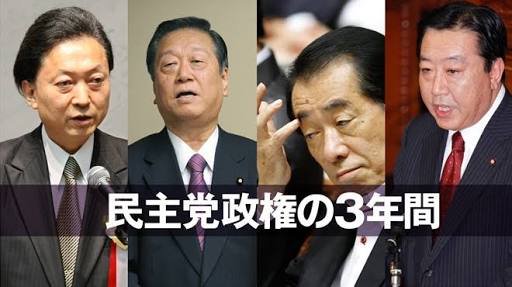
ShouShiSouRi

More political commentary, aimed at the DPJ (民主党).

Posted in Japanese, Yojijukugo | Tagged , , , , | Leave a comment

Like how Chelm was created, but almost entirely different

堪忍袋の緒が切れる
(Kanninbukuro no o ga kireru; “The string on one’s bag of patience breaks”)

Definition:

Someone reaches the end of their patience and explodes. Running out of one’s ability to hold back and put up with something, especially after suppressing anger for a long time. The image is of one’s endurance being a sack that must contain one’s anger, which spills out when the draw-string suddenly snaps.

Breakdown:

We begin with the a compound noun comprising 堪忍 (kannin), “patience,” and 袋 (fukuro), “bag.” The particle の (no), here in its role as a possessive marker, connects the bag to its 緒 (o), “cord,” which in turn is marked by the particle が (ga) as the subject of a verb. And that verb is 切れる (kireru), “to break,” “to be cut,” in sentence-final form.

Notes:

The final particle and verb may be replaced at times with を切らす (wo kirasu), “to run out of.”

Apparently this phrase comes to us from the 堀川百首題狂歌集 (Horikawa hyakushudai kyouka shuu), an Edo-era collection of satirical poetry.

Example sentence:

「ついに堪忍袋の緒が切れたのか、先生は数学のレクチャーを諦めて20分ほど学生たちを叱った」

(“Tsui ni kanninbukuro no o ga kireta no ka, sensei wa suugaku no rekuchaa wo akiramete nijuppun hodo gakusei tachi wo shikatta.”)

[“Maybe his store of patience had run out; the teacher gave up on the math lecture and spent about twenty minutes telling the students off.”]

Posted in Japanese, Kotowaza | Tagged , , , , , | Leave a comment

Fat head, skinny tail

竜頭蛇尾
ryuu.tou.da.bi

Literally: dragon – head – snake – tail

Alternately: A strong or exciting beginning and a weak or dull ending. In with a bang, out with a whimper. Anticlimax. Alternately, something that looks impressive but in reality is lacking.

Notes: The 竜 may alternately be pronounced ryou, or replaced with 虎 (here pronounced ko), “tiger.”

This compound can be traced back to The Transmission of the Lamp (景徳伝灯録), an 11th-century CE Chinese lineage of Zen Buddhists.

It can be considered something of an antonym to last weekend’s kotowaza.

RyuuTouJosukeBi

Zang, sick JoJo burn!

Posted in Japanese, Yojijukugo | Tagged , , , , , , | Leave a comment

Sham shyness, ferocious fleeing?

In like a lamb, out like a lion

始めは処女の如く後は脱兎の如し
(Hajime wa shojo no gotoku nochi wa datto no gotoshi;
“The beginning is like a virgin, after is like a running hare”)

Definition:

A battle strategy that begins with a show of caution and weakness to get the enemy off-guard, then suddenly follows with strikes of such speed and power as to seem like a completely different force or fighter. Beginning slowly and cautiously like a shy girl and ending with the speed of a fleeing rabbit. In more modern terms, pool sharking. By extension, this phrase may also be used to describe any performance that begins in a lackluster way but then suddenly shows its true strength.

Note that this phrase is not (correctly) used to describe a situation that begins amiably or quietly and later descends into hostility or violence.

Breakdown:

We begin, appropriately, with the noun 始め (hajime), “beginning,” followed by the particle は (wa). This marks it as the “topic” of the first half of the phrase while setting up a contrast with the latter half. Next comes the noun 処女 (shojo), “virgin,” linked by the associative particle の (no) to the adjective 如し (gotoshi), in conjunctive form. This points us to the second half of the sentence.

This time, in place of a beginning, we begin with 後 (nochi), “after,” again marked with は to change the topic and finish the contrasting pair. In place of the virgin we get 脱兎 (datto), “an escaping rabbit,” connected by の to 如し in sentence-final form.

Notes:

This strategy comes to us from none other than Sun Tzu’s The Art of War, (『孫子兵法』) in the chapter on “the Nine Situations” (九地).

Example sentence:

「がっかりしたな、今回の空手の組手の相手は予想以上に弱かった。ずっと始めは処女の如く後は脱兎の如し的な作戦を使ってるのかと微かに期待してたのに、結局、弱いままだった。なんか、緊張してたのが無駄になった感じだな」

(“Gakkari shita na, konkai no karate no kumite no aite wa yosou ijou ni yowakatta. Zutto hajime wa shojo no gotoku nochi wa datto no gotoshi teki na sakusen wo tsukatteru no ka to kasuka ni kitai shiteta no ni, kekkyoku, yowai mama datta. Nanka, kinchou shiteta no ga muda ni natta kanji da na.”)

[“That was disappointing; my sparring partner in karate this time was weaker than I’d expected. I spent the whole time sort of hoping they were pretending to be weak in order to set me up, but in the end they were just not that good. It’s like, it feels like I got all keyed up for nothing.”]

Posted in Japanese, Kotowaza | Tagged , , , , , | 1 Comment

But in Bizarro World, everything is great!

If you live in a democracy, be in touch with your representatives. Even if you live in a country where things are going fine, be in touch and let them know you’re paying attention. It turns out that taking the smooth and proper functioning of government for granted is a dangerous error.

悪逆無道
aku.gyaku.mu.dou

Literally: evil – reverse / wicked – no – way / teachings / morality

Alternately: Unfathomable evil. Heinous words or deeds. Violating basic human morality. Atrocity.

Notes: Apparently 悪逆 used to have a technical definition under the old Ritsuyou legal system: it was the murder of a family member, one of eight crimes for which no amnesty could be granted. 無道, logically enough, was to be lacking in human 道理 (douri), “reason” or “truth.”

This compound has a relatively large number of variants, including alternate pronunciations like ~bu.dou and ~mu.tou for 無道. The 無 may also be replaced by synonym 非 (hi).

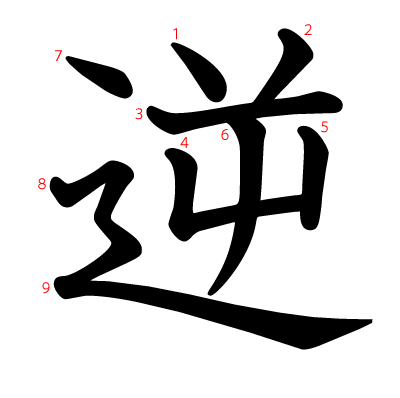
AkuGyakuGyakuGyaku

Yes, I’m thinking of Charlottesville and of a certain official response. Instead of dirtying my site, here’s a guide to writing the character 逆.

Posted in Japanese, Yojijukugo | Tagged , , , , , | 1 Comment