
Ode of the Battle Poet
Chop chop chop chop
Chop chop chop chop
Chop chop chop chop
Stab.
(Found jotted in charcoal on a piece of leather after the Skirmish of Round Rock)
Ode of the Battle Poet
Chop chop chop chop
Chop chop chop chop
Chop chop chop chop
Stab.
(Found jotted in charcoal on a piece of leather after the Skirmish of Round Rock)
一騎当千
i-.kki.tou.sen
Literally: one – equestrian – hit – thousand
Alternately: Mighty. So strong that a thousand opponents still cannot match them.
Notes: This can be expanded to the descriptive noun phrase 一騎当千の兵 (ikkitousen no tsuwamono), “a warrior who can defeat a thousand.” This is actually a pretty old one but native to Japan, first attested in the 14th-century epic Taiheiki.

Also the name of a manga and anime series! “Based on” the Romance of the Three Kingdoms! Actually about nearly-naked schoolgirls (and less-naked guys) beating each other up! You would not believe how long it took to find an image clean enough to illustrate it with! Source!
Fear-Spell
The caster must prepare an object to be the vessel of this spell at the start of the day, in the darkness just before the sun rises, by symbolically filling it with his or her own fears. To cast the spell, the caster holds it forth and invokes its power. Then, for as long as the caster concentrates, all who can see it (reasonably clearly) are filled with dread, and take a point of strain every round they do not spend reacting appropriately (by fleeing, hiding, cowering, etc.). The caster may end the spell or re-invoke it at any time until the following sunrise, or symbolically remove their fears from the object to “discharge” the spell before then.
The base difficulty is d8 for the preparation and d4 for the casting. Preparing the object costs three points of strain that cannot be recovered for as long as the object is “charged,” and invoking the magic costs two points of fatigue. A thematically appropriate vessel decreases the difficulty by one step; a thematically inappropriate one increases it by one.* Casting this spell by gnosis requires no preparation beforehand, but has a base difficulty of d10 for each casting – and because it more directly invokes the caster’s subconscious terrors, it costs four strain every time it is invoked.
* But think of how fun it would be to terrify your enemies and drive them screaming before you with a tiny plush bunny, if you could pull it off!
[What can change the nature of a kid?]
三つ子の魂百まで
(Mitsugo no tamashii hyaku made; “A child’s soul at three, until 100.”)
Definition:
Your character as a small child is set and does not change even if you live to be one hundred years old. People tend not to change in their fundamental character.
Breakdown:
三つ (often mittsu, with a double-consonant T, but here mitsu) is the number three in the old native-Japanese counting system. We find it prefixed to 子, “child” (ko, in this case pronounced go due to the compounding). While mittsu is often a cardinal (counting) number, this mitsu identifies the child’s age: three years old. Next we get the associative particle の (no), here in its possessive function, and the noun 魂 (tamashii), “soul.”
Next comes a break where, in normal rather than aphoristic prose, a particle might be found. No particle here, only the number 百 (hyaku), “(one) hundred.” To this is attached the particle まで (made, pronounced like ma-day), equivalent to English preposition “until.” Rendered literally, the whole saying might become “Until 100, child-of-three’s soul.”
Notes:
Editorial comment: Keep in mind that I don’t necessarily agree with all of the assertions these kotowaza make; I merely present them to you as little slices of Japanese language and culture.
This saying refers to inherent characteristics, not experiences or learned traits or skills. Also, while it specifies the age of three, this is not meant to be taken literally; rather, it simply refers to early youth – and is, perhaps not coincidentally, the first of the ages honored in the shichi-go-san festival [http://en.wikipedia.org/wiki/Shichi-Go-San].
There are quite a few alternate versions. Some substitute 八十, 七十, or even 六十 (hachijuu = 80, shichijuu = 70, or rokujuu = 60) for 百. Others substitute 心 (kokoro, “heart/mind”), 根性 (konjou, “nature/temper”), or 知恵 (chie, “sense/wisdom”) for 魂. A number of synonymous or near-synonymous separate sayings also exist; I’m planning on highlighting one of these next week.
Example sentence:
「太朗、赤ちゃんのころから頑固だったよな。本当に三つ子の魂百までだなあ」
(“Tarou, akachan no koro kara ganko datta yo na. Hontou ni mitsugo no tamashii hyaku made da naa.”)
[“Tarou, you’ve been stubborn ever since you were a baby. I guess people really don’t change.”]
I’m not planning on making this a regular or weekly feature – it’s just that it’s going to be Friday when this goes up, and I still like alliteration. Anyway, I’m taking a brain break from some pretty intense data-gathering by indulging in this little bit of creativity. I hope you enjoy it!

I’ve linked this before, but here’s where you can find it: I just used the basic “Forge” option.
Void Iron – A great iron maul; a holy artifact of the cult of Umu. The head of this hammer has zero mass. It imparts no momentum or impact to what it strikes. For most people, this makes it at best a great tool for pranks and tricks. In the hands of a truly faithful follower of Umu, though, it becomes a deadly weapon that creates bubbles of pure vacuum wherever it strikes. Warning: using it within an atmosphere subjects the wielder to frequent shock-wave stress from air rushing in to fill the voids, and Nature targets you with increasing abhorrence the more you use it.
Wander Tide – A fay tide. One may walk out into the ebbing surf until completely submerged within the water, then turn and walk back to land, and find oneself on a completely foreign shore. This is always a one-way trip to a random destination. Some coastal tribes have learned to recognize this rare phenomenon and send selected members of their communities through it on sacred quests.
Slow Judge – A massive, mossy sloth (or one of a tribe of them?) living on a certain small island in the Diarchal Archipelago. In case of an intractable conflict, petitioners may travel to the island and perform a ceremony involving offerings of tender shoots and leaves, with each side presenting their case. Eventually a sloth moves ponderously out of the jungle, approaches one of the supplicants at random, and reaches out with one enormous claw, leaving behind a mark that clearly indicates the Judge’s ruling. Since it can take days before a Judge appears, cases are often presented in a highly stylized, time-killing format such as dance or drama or epic poetry, and on occasion these ceremonies have resolved the issue – through compromise or violence – before a Judge can become involved.
Battle Poet – The Battle Poet is an immortal entity that travels the lands looking for military conflict. It is a humanoid figure in full, heavy armor, no features visible. It carries no weapons, apparently happy to take one from someone when it feels ready to fight, but also willing and able to use its gauntlet-clad fists. When it finds a battle, it observes for a while before choosing a side to fight for. It fights with apparent pleasure, but not in such a pivotal role that sages or scholars can say with any certainty that it actually affects the course of history. (Then again, sages and scholars are as yet unaware of many of the more subtle mechanisms by which history operates.) It is termed “poet” because it will occasionally leave behind a lyrical inscription – etched in stone, scratched into a sword blade, daubed in blood on a shield.
They played dodgeball every day, all of them, with their distinctive styles. There was Danny, who ran up to the line and heaved the ball as hard as he could; Peter, who ran around in the back and hurled the ball as hard as he could; Ben, who liked to taunt his opponents and try to catch the ball when they threw it so that they would be out. Marianne liked to deflect incoming shots with the ball in her hands, then return fire while the enemy was looking for more ammunition, while Mary-Ann would pause close to the line to draw attention, then run. TJ and Janet, who were good friends outside of the game, always managed to end up on opposite sides and would try to tag each other out as quickly as possible, ignoring all other players until this goal was accomplished. Ed took things easy, holding onto a ball in the back for minutes at a time, then lining up a shot and throwing in a precise arc. He never missed, when he got around to throwing, although he was rarely the last one left on the field. Travis would make a show of palming a ball in each hand like a basketball player and double-throwing. Rachel and Alexia, who were twins and took gymnastics lessons, had the respect of all the other players for being able to catch a ball in one hand, and were good dodgers.
That made eleven, an odd number, and they were always on the lookout for another player to round out the teams. So when Robbie joined, they were glad to have him—until the problem became plain. Robbie had been trained as a ninja, he said, since the age of five, and after half a dozen bouts in a row in which his team won quickly, handicaps were devised to preserve the game.
The first thing they did was put TJ and Janet on the team opposing Robbie, so that they had to work together against him. Then they put Rachel and Alexia on that team as well. When he still won, they started weighting the teams against him, until finally everybody was lined up on one side against Robbie on the other; a swarming multitude against one lone player. In these games, Ed became even more of a shadow, hanging in the back and barely taking part, so infrequent were his throws, and even Travis, the boldest of them all, became more cautious.
It was a wonder to see Robbie play. Fast, surefooted, unerring, he could change directions unexpectedly and hit most of his targets without even looking. He had some strange moves as well. His favorite was to drop out of the path of a throw and roll or tumble to the nearest ball, then come up out of the roll and throw. He could jump a couple feet straight up when someone targeted his shins, and he could catch anything aimed above that. During the first two games, the others found themselves too crowded, overwhelmed by their own numbers, and lost quickly. After that they began to organize and plan, and as they grew more sophisticated, Robbie had more trouble winning. Finally, he lost a game.
One of the strategies they had developed was to have the best blockers and catchers in the midfield, reducing their losses, until everybody had a ball, then to throw together in volleys. Robbie had to keep moving to avoid their throws, or crouch and block. This was when they discovered that he could catch with one hand, then pass the ball to the other hand and throw while catching again. TJ and Janet timed a pair of shots accordingly, so that TJ threw just after Robbie had caught Janet’s throw but before the transfer could be made. Robbie caught the second ball in his off-hand, and smiled.
It was a proud smile, as might be expected for such a feat, but also eerie. None of them had ever seen him smile before—his eyes were always focused in an intense, serious gaze. Then, as if to top the catch, he threw both balls at once, outing Travis and Ben. But, even as his body whipped back, recovering from the throw, Ed’s ball came down out of a high arc and bounced gently off the top of Robbie’s head.
It was such a shock that everything simply stopped for a moment. Robbie stumbled and stood, head turned away, watching the ball roll into the back of the playing field. Everybody else froze and watched him. Finally, when the ball had come to rest, he turned back with a tiny, rueful smile on his face—less unsettling than the first—shook all their hands, and left.
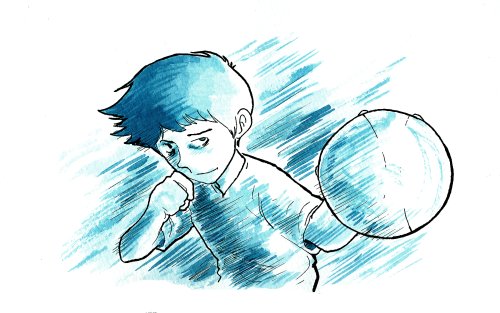
“Robbie caught the second ball in his off-hand, and smiled.” Illustration by Ryan Armand.
When they met for the next game, the mood had changed. Everybody was serious now, grim or determined according to their preferences: tense. They wanted to win again. Robbie, on the other side, was darkly inscrutable. They began playing. The blockers and catchers lined up, and Robbie began sniping at them with implacable precision, taking two out before the ammunition for the first volley was gathered.
When it did come, he was ready. At the first twitch of a thrower’s shoulder, he leapt to the side, then back again as his opponents adjusted their aim. Then, with the second volley being loosed, he jumped into a back somersault—picking up a ball with his feet and flipping it up into Danny’s chest so that he staggered back and sat down with a bump, although more out of surprise than from the force of the blow.
Then, with the first-volley throwers rearming and the third volley in the air, Robbie rebounded off of the ground, took a few quick steps, and launched himself into the air with a powerful twist like a high-jumper.
There he spun, seeming to hang horizontally while the balls thrown at him bounced and pattered below, and a ball somehow flew from his hands toward Peter, who stared at it in amazement as it ricocheted off of his belly—and then Ed’s ball moved in a straight line from his hand to Robbie’s side, and bounced off into the background.
Everybody else watched it go, wide-eyed. Robbie landed in a crouch, one hand splayed out in front of him, the other tucked behind his back. Nobody moved while he and Ed stared each other down across the playing field. Soon, though, Robbie’s eyes narrowed, and both of them turned and ran, as one, off of the playing field and vanished from sight.
–
None of the others saw Ed or Robbie again. Ed had been training as a ninja since he was three, after all, and while Marianne guessed that they were from rival clans and had run off to fight or hide, it was just a guess, and never confirmed or refuted. That was fine, though—there was an even number now, and Ed had never really played very hard anyway. The game went on.
完
意気投合
i.ki.tou.gou
Literally: mind – spirit – throw – join
Alternately: Getting along with someone really well. Hitting it off. Finding a kindred spirit. Mutual understanding. Perfect concordance.
Note: For some reason it’s easy for me to start thinking that this phrase mostly applies to when two people have just met and develop a rapport right off the bat, but that’s not the case: it can also be used for people who have developed such a rapport over time.

Please take a moment to consider these minions. They are adorable. Proof: my wife adores them.
Yambu
This spell requires a flute, pipe, or other wind instrument to cast, and the caster must play the instrument continuously for the duration of the spell. Darkness is generated in a roughly spherical space centered on the caster, and moves with them. The darkness is absolute to all but the caster, and cannot be penetrated by normal darkvision. To those using Sight from Darkness, the area affected appears misty rather than truly dark, but is still largely opaque. Outside the affected zone is a fluctuating nimbus of dimness that mildly disorients and confuses those who see or enter it, preventing the center (and the caster) from being pinpointed and targeted with ranged attacks. A variant of this spell, played in Faerie, will cast the land around it into what seems to be a starless, moonless night for as far as the song can be heard.
A Perform check for an appropriate instrument must be made in order to work this magic properly; the base difficulty is d6 for both the spell and the music. Alternately, the caster may depend entirely on the power of their music, rolling only a Perform check at a base difficulty of d12. In either case, the base cost is one strain about every minute (minimum one strain). The normal range is about four arm’s lengths (meters); this can be increased one step by either increasing the difficulty by one step or taking an extra point of strain at the time the range is increased (which doesn’t have to be at the start of casting/playing). If an enchanted flute is used, the range is doubled and the darkness lingers after the song ends, immobile, for half the time the caster spent playing.
– The inspiration for this comes from a (by now) old anime series called Vampire Princess Miyu; the protagonist regularly opens hostilities against monsters by playing her flute at them. The name “Yambu” is a very simple corruption of 闇笛 (yamibue), “flute of darkness.” This Sword & Sworcery tune is unrelated, but also very nice.
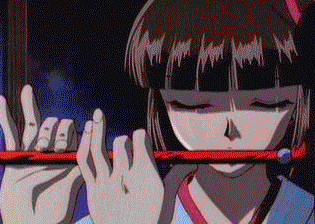
I lifted the image from here using Google image search; I don’t know where they got it.
盗人の昼寝
(Nusubito no hirune; “A thief’s midday nap”)
Definition:
Even if an activity seems purposeless, it can still have a specific reason and purpose. Someone napping in the middle of the day may seem random, but for a thief the nap is important preparation for their “work” at night. Note that due to the connotations, this phrase is only used in a negative context, so it is not equivalent to the English “there’s a method to his madness.”
Breakdown:
This is another noun phrase made of two compound nouns connected with the associative particle の (no). The first is 盗人 (nusubito), made of “steal” plus “person” and meaning “thief.” The second is 昼寝 (hirune), made of “daytime / noon” plus “sleep” and meaning “daytime nap,” “siesta.” Good times.
Notes:
盗人 can also be pronounced nusutto, but can not be replaced with near-synonym 泥棒 (dorobou), “burglar / robber.” A longer, full-sentence version of the phrase also exists: 盗人の昼寝も当てがある (nusubito no hirune mo ate ga aru), “Even a thief’s midday nap has a purpose.”
The shorter form appears in the Edo and Osaka iroha karuta sets.
Example sentence:
「盗人の昼寝も当てがあるというから、学生のテスト中の振る舞いに注目しなければならない」
(“Nusubito no hirune mo ate ga aru to iu kara, gakusei no tesutochuu no furumai ni chuumoku shinakereba naranai.”)
[“Since, as they say, for a thief even a nap has a purpose, you have to pay close attention to how the students act during the test.”]
Here’s one thematically similar to Sunday’s kotowaza:
窮鼠噛猫
kyuu.so.gou.byou
Literally: destitute / suffering / cornered – mouse / rat – bite – cat
Alternately: A cornered rat will bite at a cat. Those in desperate straits will become unexpectedly fierce. Nobody fights like someone who has nowhere else to turn.
Note: This four-character compound can also be expanded to 窮鼠猫を噛む (kyuuso neko wo kamu), which as you can see is just the same thing with some grammar thrown in.
Pyao pyao pyao!
We hope that you enjoy your stay.

 landofnudotcom