Try walking a mile in *these* shoes!

金の草鞋で探す
(Kane no waraji de sagasu; “Seek with iron sandals”)

Definition:

Searching for something tirelessly. Patiently looking everywhere. Normal straw sandals break down with use, but iron sandals will endure – as will the person whose search is described with this phrase, no matter how far they have to walk or how many hardships they have to endure. If you’re “seeking with iron sandals,” you’re not just looking for a thing: you’re thoroughly and determinedly questing.

Breakdown:

Our opening noun is (kane), meaning “gold”… or “metal” in general… or, in this case, “iron” (cf. 鬼に金棒). (no) is our associative particle, connecting kane to the following noun 草鞋 (waraji), a term for a type of traditional woven-straw sandals. Read this combined noun phrase as “sandals of iron,” and modify it with the particle (de), which indicates the means by which an action is performed. All that’s needed now is a verb, and our verb is 探す (sagasu), “to search for,” in sentence-final form.

Notes:

The verb can be replaced with 尋ねる (tazuneru). Although the latter verb is commonly translated into English as “ask” or “visit,” it can also be rendered as “to investigate” or “to search (for something known, the whereabouts of which are unknown),” and this is the meaning it takes here.

Incidentally, the difference between 草鞋 (waraji) and 草履 (zouri), another term for traditional woven-straw sandals, is apparently that the latter are more like flip-flops, with a strap that is gripped between your two largest toes, while the former include bindings that are fastened around the ankles, making them more secure (and thus more appropriate for long-distance travel). Also, if you add (mushi), a generic term for amphibians, reptiles, invertebrates, microbes, and other miscellaneous creepy-crawlies, you get the name of a living thing in each case: 草鞋虫 are apparently isopods (aka woodlice, aka pillbugs, aka roly-polies etc.) – although as you can see, the image search above returns some arresting pictures of very leggy centipedes – while 草履虫 are paramecia. (Interestingly, paramecia were called “slipper animalcules” for a long time in the West as well.)

As long as we’re making distinctions in word use, there are two ways to write sagasu in kanji: 捜す and 探す. The former refers to looking for something you’ve lost, or something that you were aware of but lost track of. The latter is seeking something that you hope to find, but which you haven’t encountered or confirmed the existence of yet.

Example sentence:

「うちの弟、先月彼女が欲しいって言ってから、金の草鞋で探している」

(“Uchi no otouto, sengetsu kanojo ga hoshii tte itte kara, kane no waraji de sagashiteiru.”)

[“Last month my younger brother said he wanted a girlfriend, and he’s been looking for one tirelessly ever since.”]

Posted in Japanese, Kotowaza | Tagged , , , , , | Leave a comment

Even uniquer! (Yes, I know that that’s not a word.)

This should look a little familiar, but there’s a twist:

空前絶後
kuu.zen.zetsu.go

Literally: empty – before – cut off – after

Alternately: Unique in all of history. Never before, and never again. Something so amazing, or so horrible, that the like of it is unheard-of in the past… and furthermore, it’s not likely to ever be repeated. If you’re talking about something in the past, then perhaps it’s something that was unprecedented at the time and hasn’t been reproduced yet.

Orange on orange!

Apparently this phrase is the title of an opening theme for the Dragonball anime. It seems fitting.

Posted in Japanese, Yojijukugo | Tagged , , , , , | 1 Comment

Magic Monday – opening thoughts

So my current “fantasy heartbreaker” is YAOSC. As a grad student with a baby, I don’t have time to do more than take it out and putter around with it a little every now and then. But recently* this post at Necropraxis got me mulling things over again. For a long time I’ve only had vague ideas about how the YAOSC magic system would work. I just felt that Vancian magic (D&D style) didn’t really put me in my happy place. Well, now’s as good a time as any to get things ironed out. I’ve gotten myself into the habit of putting up new content here, with my Japanese-study posts, and the nice thing about working out the details of a magic system is that writing up individual spells can be a non-demanding way to produce a lot of content. So we’re going to have a try at Magic Mondays, because alliteration that’s why.

A brief refresher: YAOSC (Yet Another Old School Clone) is my tongue-in-cheek working title for a fantasy tabletop role-playing adventure game. It riffs off of my experiences playing, DMing, and reading about D&D in all its incarnations, and is heavily inspired by what I read on various OSR blogs. Some notable characteristics are:

  • I want a set of rules that starts out simple, for beginners, but which can be unfolded by various player choices to include more options, i.e. more complexity. (Magic use will probably end up being one of those complexity-unfolding options. C’est la vie.)
  • Characters are structured around a class-and-level system, but the impact of class and level are de-emphasized.
  • Most of what you do will be centered around a robust skill system. This includes combat, which in standard D&D is largely divorced from whatever skill systems a given edition or version may use for non-martial activities.
  • Skill checks use different dice types. Results below a target number (your skill level) are successes. (So if you have a skill of 3, an easy check using a d4 has a 75% chance of success; a moderate check using a d8 has a 37.5% chance.) Gaining levels, and various in-game activities, grant you skill points.
  • There are three “survival meters” that reflect a character’s resilience in the face of harm, fatigue, and mental strain. These can function as a resource to be spent on activities… such as powering magic.
  • There are going to be multiple ways to access magic. The most powerful and versatile of them will generally be limited to the magic “class,” but these limitations can be built into the way spells work rather than being a matter of fiat.

That’s the spiel. Tune in next time, when I actually try to work out specific mechanics for how I’m thinking spellcasting will work.

*(When “recent” includes a post that’s a month and a half old, that gives you an idea of the pace at which I’m approaching this stuff.)

Posted in Meta, Rules | Tagged , , , , | Leave a comment

No spoonfuls of sugar for you today

忠言耳に逆らう
(Chuugen mimi ni sakarau; “Good advice hurts your ears”)

Definition:

When someone is truly trying to help you, they acknowledge your faults and failings and give you good advice based on that honest assessment. But it can be hard to listen to this sort of critical assessment.

Breakdown:

忠言 (chuugen) is advice – generally good advice; the characters literally mean “loyal word.” Note that there is no particle here to mark the noun 忠言‘s function within the sentence; in an aphorism, that level of grammatical detail simply isn’t necessary. (mimi) is ear(s), and 逆らう (sakarau) is a verb meaning “to defy,” “to go against.”

The particle here is where things are a little weird, from a native English speaker’s point of view. I would have expected the ears to rebel against the advice. But no, the particle (ni), marking direction or location, is attached to , meaning that the advice “goes against” the ears. It’s not as deeply counterintuitive as some of the gymnastics you’ll see the Japanese language perform, but it does at least stand as a warning not to make assumptions.

Notes:

Using 忠告 (chuukoku), which can also mean “advice” or “warning,” is incorrect.

This kotowaza also exists in yojijukugo form as 忠言逆耳 (chuu.gen.gyaku.ji), and as a much longer phrase that compares the good advice to bitter medicine. Its origins are supposedly in China, from the Family Sayings of Confucius – an apocryphal text that may or may not have anything to do with the philosopher or his disciples.

Example sentence:

忠言耳に逆らうかも知れないけど、今週は遊ばずに勉強に集中した方がいいんだよ」

(Chuugen mimi ni sakarau kamo shirenai kedo, konshuu wa asobazu ni benkyou ni shuuchuu shita hou ga ii nda yo.”)

[“You probably don’t want to hear this, but it would be better if you focused on your studies this week, and skipped gaming.”]

Posted in Japanese, Kotowaza | Tagged , , , , , | 2 Comments

The Melodious Rap Saga of Slimy Nim

(To be chanted with maximum energy)

The Melodious Rap Saga of Slimy Nim

My brother had a waffle!
Its name was Slimy Nim!
And every time he threw it out
it came on right back in!

He covered it with syrup!
He ate it with a fork!
But when he had a baby
Slimy Nim came with the stork!

He sent it to the FBI
and to the CIA,
but they just wouldn’t give him
the time! of! day!

They stabbed him with a laser!
They shot him with a knife!
and when they sent him home again
he had no life!

He sat and watched TV all day,
he had to sell his car.
When Slimy Nim came back for him
he couldn’t get far!

They had an epic battle!
They had a tiny war!
And when the dust had settled
they both were on the floor!

There never was a victor,
not even to this day.
And that is all I have to say
so it’s time to go away!

Posted in Poetry | Tagged , , , | Leave a comment

Epoch-marking uniqueness!

史上空前
shi.jou.kuu.zen

Literally: history – above/up – empty – before

Alternately: Unprecedented. Unheard of. History-making. The very first ever.

Notes:In cases like this, the character refers to a vague scope of the topic under discussion. It can also be read as “from the point of view of ~.”

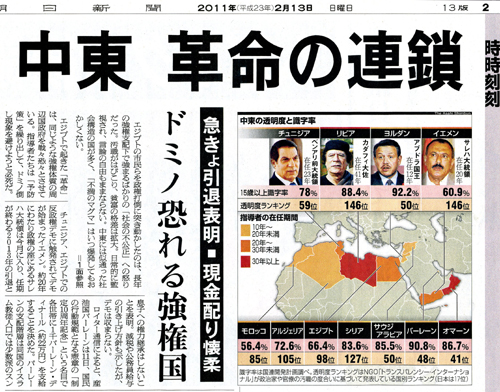
Arab Spring Map

A serious example for once – my usual image search turned up this picture of an article about the Arab Spring.

Posted in Japanese, Yojijukugo | Tagged , , , | 2 Comments

On spicing up your dungeon crawl with… sensory output!

Noisms just put up a thought-provoking post about “consequences” in the dungeon. Not the social consequences of PC actions within the fictional world, though (although that would be an excellent topic to explore in depth, if you’re up for a certain kind of group-storytelling experience). The discussion is in terms of how the dungeon detects and reacts to the party’s presence.

He mentions three categories: light, noise and “combat.” This is where things get a little murky to me. “Light” and “noise” are almost self-explanatory. Most PC parties are going to need a light source underground, and will be less than completely soundless in their actions, and so the light and noise they produce will give sensory clues about their presence and actions to whatever else is down there with them in the dark. Simple enough.

But how does “combat” parallel with these? Noisms mentions several olfactory signs of battle: blood, bile, and sweat (“fear”), which suggests a parallel with the other two categories. But if a parallel were intended, why not just say “scent”? Why limit it to the aftereffects of battle? For that matter, there’s also mention of physical detritus and blood trails, which are more visual than olfactory in nature. The non-parallel nature of the three categories bothers me, so here’s an alternative breakdown.

Parties of PCs bashing through the dungeon give away their presence and activities in two ways: through their emanations, and through their leavings. Each of these can be further specified as triggering one or more of the five major fantasy sensory facilities: visual, audio, chemical, tactile, and supernatural.

Emanations are the signs of a being’s presence that it gives off just by, well, being present, and doing things. Noism’s light and noise are both emanations. The smell of a group of unwashed people who’ve been wearing armor all day, or the smoke of their torches, are emanations. The swaying of a rope bridge as they cross it is an emanation. The heat, noise, and magical tensing and release that accompany a fireball spell being unleashed in combat are all emanations.

Leavings are anything left behind to show that someone was there. The dropped weapons, broken arrows, blood and bodies, and so on that Noisms bundles under “combat” are all leavings. But so are spent torch stubs and other trash, footprints in soft ground, lingering scents or even lingering heat, ropes and pitons that remain after the party scales a sheer wall, remains of camp-fires and crumbs from meals, even the soft tingle left behind by the passage of a wizard or magical item, or the assembly of astral spirits that clustered around a cleric praying for magical aid.

There’s no harm in keeping things simple: just pick one major sense for any given dungeon inhabitant, and keep in mind that not everything will charge in to confront the party as soon as it becomes aware of them, or even necessarily care about their presence at all. Maybe a scavenging beast will come across the remains of a battle, do its scavenging, and move on. Maybe it will follow the PCs if it encounters their trail again but try to stay out of sight, having learned that they leave lots of food in their wake. They may never know… until the day when they need to retreat from an encounter gone bad, and there’s their private clean-up crew, waiting just around the corner.

In short: if you know that something is there (and something’s always there, somewhere), think about what senses it has. If the PCs are nearby, think about what emanations those senses would pick up; if they’ve come and gone, think about what part of their leavings it might notice. Then think about what it would do with the information. Then use that to make the PCs’ day more dangerous (not necessarily by attacking; any unknown is a potential threat and should be treated with caution)… and correspondingly more interesting.

Posted in Miscellaneous, Musing | Tagged , , , , | 1 Comment

Literally half the plot of the Tale of Genji

壁に耳あり障子に目あり
(Kabe ni mimi ari shouji ni me ari;
“The walls have ears, the doors have eyes”)

Definition:

If you’re talking about something that you want to keep secret for any reason, be careful. Keep in mind how much of old Japanese estate construction was based on thin walls, screens, curtains, and partitions. It was practically a literary pastime to find ways to peek at people – for aristocratic men to try to catch glimpses of ladies they were courting, for example. So there could always be people peering through hedges, trying to get an angle to look past a carelessly-placed partition, poking holes in paper screens to peek through, or simply listening to anything they could overhear. And that’s not even counting the ubiquitous swarms of servants (themselves generally lower-ranked aristocrats receiving patronage from their richer, better-connected fellows rather than low-caste workers like you’d see in the West).

Why would Japanese culture develop a rich tradition of indirectness, of discretion and tactical silences, of talking all around a matter without ever alluding to it directly? Because someone’s always listening.

Breakdown:

Another repeated structure. Note that each half of the phrase functions as a complete sentence on its own.

(kabe) is a wall, marked with (ni), here a positional marker. (mimi) is “ear(s),” and the verb あり (ari) is the “to be” verb in its old-fashioned sentence-final form. Although in modern grammar the verb has essentially been regularized as ある (aru), in the Heian era it was essentially its own verb class, and vestiges of that heritage remain in the relatively common usage of あり, which would otherwise be an incomplete form. So you have “In the wall, there are ears.”

In the second half of the phrase, the particle and verb remain the same, and the two nouns change: the first is 障子 (shouji), a standing paper screen or sliding paper door. The second is (me, pronounced like “meh,”) “eye(s).”

Notes:

Apparently there are quite a few variations on the basic theme here. Some substitute in rocks (, ishi) or hedges (, kaki); some add a mouth (, kuchi) for what has been overheard to be passed on.

In keeping with the grammatical completeness of each half of the kotowaza, either half (especially the first half) can also be used on its own, as shown below.

Example sentence:

「あれ、持って来た?」 「後で話す。この部屋、壁に耳あり

(“Are, motte kita?” “Ato de hanasu. Kono heya, kabe ni mimi ari.”)

[“Did you bring it?” “We’ll talk later. The walls have ears in here.”]

Bonus Media!

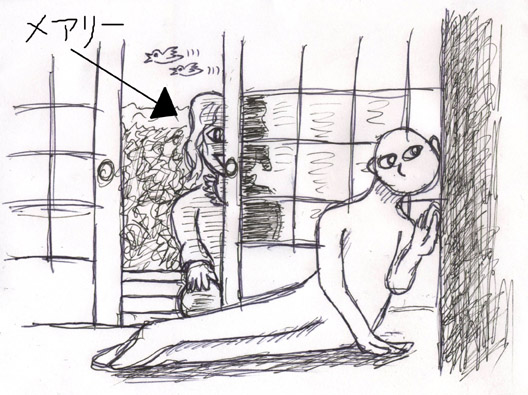
Creepy creepy girl.

Source. The joke is that the name “Mary” (メアリー) sounds like 目あり. So there’s an ear at the wall and Mary at the door. Being creepy. Again.

Posted in Japanese, Kotowaza | Tagged , , , , , , | Leave a comment

Blang blang blang

丁々発止
chou.chou.has-.shi

Literally: *chou – *chou – emit – stop

Alternately: The sound of clashing swords; an argument as fierce as if it were a life-or-death sword fight.

Notes: has a number of meanings, such as a street or a ward of a town. It’s also used as a counter-word for a number of objects and as a signifier for the fourth item in an ordered series (along with , , and ) in the same way that the letter D might be in English. The character doesn’t actually have a pronunciation of its own. It serves as a doubling mark to show that a kanji is repeated, so here 丁々 is identical to 丁丁. That said, none of that matters here: the character seems to be used purely phonetically in this phrase.

Similarly, although I give the most common meaning of the latter two characters, and 発止 seems like it might mean something that fits the content of the yojijukugo as stated… they too are purely onomatopoetic. It turns out that 発止 is a case of ateji, characters applied phonetically without regard to their meaning, and so hasshi is simply a sound that my dictionary describes as “with a loud clack.” So in the end, today’s four-character compound is probably best represented on a literal level as “clash clash clang.” Isn’t Japanese great?

Tedd's Dad is rarely-mined gold.

Yes, this is self-referential; there wasn’t anything good coming out of Google Image Search. Picture stolen from El Goonish Shive and altered slightly.

Posted in Japanese, Yojijukugo | Tagged , , , , | 1 Comment

On achieving clarity

Here’s our fortieth kotowaza:

四十にして惑わず
(Shijuu ni shite madowazu; “At forty, no doubts”)

Definition:

This extremely optimistic saying asserts that by the time you reach forty years old, your ability to reason is well-developed, your studies have given you a solid grounding in the facts of how the world works, and therefore your path through life is clear, without the need to second-guess your decisions. Because we’re all rational actors who have been given excellent educations, including good sets of mental tools for sussing out and effective pursuing our long-term best interests, right?

Breakdown:

四十 (often yonjuu, but here shijuu) is four tens, i.e. forty. (ni) is our positional or directional marker and して (shite, pronounced “shee-teh” rather than in the Olde Englishe manner!) is the verb する, “to do,” in conjunctive form. However, in combination the phrase にして can itself be a positional marker. Hence the translation as “at.” 惑わず (madowazu) is an old-fashioned negative form of the verb 惑う (madou) “to be puzzled,” “to have doubts.”

Notes:

This saying also exists as a yojijukugo, 四十不惑.

Today’s kotowaza is attributed to the Analects of Confucius for its ultimate source, which tells you something about the worldview that informs the assertion it makes. It is drawn from a much longer saying that begins at age 15 (with the desire to study) and extends to 70, when one supposedly attains the ability to not wander from the righteous path even while doing whatever the heart desires. Thirty is the year at which the basics are mastered and true study can begin; forty is the year by which confusion and lingering doubts have fallen away.

Some people apparently replace 惑う (madou) with 迷う (mayou, “to lose one’s way,” “to hesitate”), but this is an error.

Example sentence:

「パパ、頭良いね」 「歳のお陰だ。四十にして惑わずというからね、ハハハ」

(“Papa, atama ii ne.” “Toshi no okage da. Shijuu ni shite madowazu to iu kara ne, ha ha ha.”)

[“Daddy, you’re so smart!” “It’s the wisdom of years. They say at forty you’re no longer subject to doubt, ha ha ha.”]

Posted in Japanese, Kotowaza | Tagged , , , , , , | Leave a comment