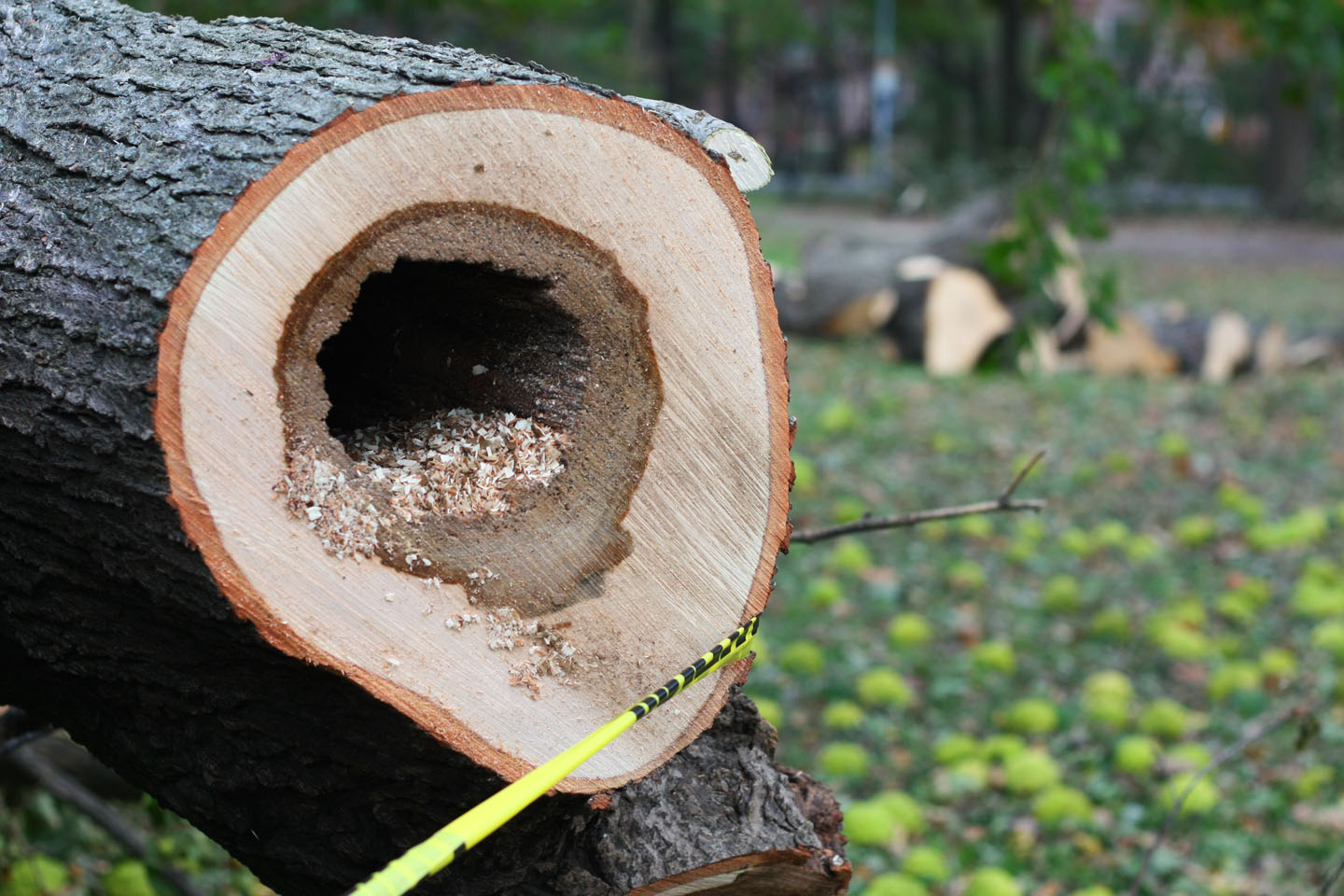
Maybe gene therapy, some day

阿呆に付ける薬はない
(Ahou ni tsukeru kusuri wa nai; “There’s no medicine for stupidity.”)

Definition:

There’s nothing that can be done to help a fool. Note that this saying isn’t about mere lack of education, or about people holding opinions or beliefs that you feel to be wrong, even stupid-wrong. It’s about how someone who doesn’t think about things much can’t be corrected because no matter what you do… they won’t think about it much. A special case of “you can lead a horse to water, but you can’t make it drink.” A wry version of “Against stupidity, the gods themselves contend in vain.”

A more positive interpretation emphasizes the fact that there is no quick fix, no simple medicine, to cure foolishness – the treatment indicated is thorough schooling, preferably chosen and pursued by the patient rather than imposed on them forcefully by others.

Breakdown:

阿呆 (originally ahou but now often aho, commonly written using hiragana or katakana, rather than phonetic kanji, in modern orthography) is both a noun and an adjective. Here it functions as a noun, with (ni), the directional particle, giving its relationship to the following verb 付ける (tsukeru) – which has many meanings such as “attach,” “fasten,” etc. but in this case refers to applying ointment. This verb in turn modifies the noun (kusuri, “medicine”). (wa), the “topic marker” particle, seems a bit odd here. I suspect that its use is contrastive, emphasizing the difference between medicine for aho versus medicines for curable conditions like rashes. At the end comes the adjective of negation, ない (nai, in kanji 無い).

Notes:

The saying can also end ~薬無し (kusuri nashi) without any significant change in meaning. Some versions substitute 馬鹿 (baka) for 阿呆.

This is the proverb given for in the Osaka/Nagoya Iroha Karuta set. (Oh, those Kansai people!) As one might guess, it’s relatively old.

Example sentence:

「あああ、またやっちまったな、あいつ!どうしようっか?」 「どうしようもない。阿呆に付ける薬はないし」

(“Aaa, mata yacchimatta na, aitsu! Dou shiyoukka?” “Dou shiyou mo nai. Ahou ni tsukeru kusuri wa nai shi.”)

[“Argh, that idiot did it again! What do we do?” ”There’s nothing we can do. I mean, there’s no cure for dumb.”]
Posted in Japanese, Kotowaza | Tagged , , , , , | 1 Comment

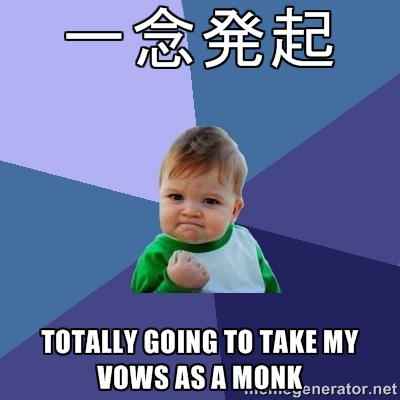
One year’s resolution?

Another phrase using 一念:

一念発起
ichi.nen.ho-.kki

Literally: one – idea – emit – wake

Alternately: Firm resolve to carry something through; a sincere and wholehearted intention. Originally used to describe the Buddhist resolve to leave “the world” (i.e. society) behind and take up religious practice, once a common step for aristocrats who had had enough of life at court, the phrase now refers to any such resolution to change one’s ways for the better or achieve a specific goal.

Notes: Make sure you don’t read 発起 as hakki; the main pronunciation of is hatsu but this compound is different.

No really, he was eating sand, supposedly

I firmly resolve never to eat sand again

Posted in Japanese, Yojijukugo | Tagged , , , | Leave a comment

One shot, one kill?

Finals are coming up!

一念岩をも通す
(Ichinen iwa wo mo toosu;
“Single-mindedness pierces even a boulder.”)

Definition:

No matter what obstacles you are faced with, sufficiently determined effort will allow you to overcome them, just as even a barrier of stone can be broken through or overcome when enough force is applied.

Breakdown:

(ichi) is “one,” and (nen) is “thought,” “feeling,” “desire,” “idea.” By their powers combined they become 一念, “a single thought” or “determination.” (iwa) is a large rock or boulder; alternately a cliff or even an anchor, although here the first meaning is at play. (wo) is our object-marker particle, while (mo), often translated as “and,” is acting as an intensifier: in this usage its meaning is something like “even” or “a whole.”

通す (toosu) is our verb; it has a long list of possible translations, but the overall gist is something like “to push something through,” “to go all the way through.” Note that the verb seems to be taking a causative (and sentence-final) form here, but that the effect is to cause the stone to be passed through, rather than causing the stone to pass through anything else. Keep in mind that passive and causative verbs can have different behavior in Japanese than they do in English.

Notes:

The origin story for this one is fascinating. Supposedly Li Guang mistook a large stone for a tiger crouching in the tall grass and fired an arrow at it. His prowess in archery was such that the arrow pierced the stone. This saying is thus based on an older version, 石に立つ矢 (ishi ni tatsu ya, “an arrow standing in a stone”). It is possible, although not certain, that the saying was altered and the Buddhist concept of 一念 added later to aid the spread of Buddhist teachings in Japan. There are a number of other sayings with related meanings, including the previously-treated 雨垂れ石をうがつ.

Although the base kanji characters involved have different meanings, in this case 通す can be replaced by 徹す without any change in meaning or pronunciation.

Example sentence:

一念岩をも通すだと思って、絶対成功してみせると断言した」

(Ichinen iwa wo mo toosu da to omotte, zettai seikou shite miseru to dangen shita.”)

[“Thinking that single-minded determination could overcome any obstacle, I declared to them that I would definitely succeed.”]

Posted in Japanese, Kotowaza | Tagged , , , , | 1 Comment

Like a plum!

An inversion of a previous yojijukugo:

外柔内剛
gai.juu.nai.gou

Literally: outside – soft/weak/gentle – inside – sturdy/strong

Alternately: Gentle but firm. An iron fist in a velvet glove. Speaking softly but carrying a big stick. Appearing soft or weak, but actually strong.

(Sorry, folks; no media this time)
Posted in Japanese, Yojijukugo | Tagged , , , , , , | Leave a comment

In which it turns out that not all round things are the same

月と鼈
(Tsuki to suppon; “The moon and a turtle shell”)

Definition:

The moon is round, and a turtle shell is also round. But they have essentially nothing else in common. This kotowaza refers to things that, while they may have some superficial similarity, are in effect so different as to make any attempt at comparison meaningless.

Breakdown:

Two nouns and a particle! (tsuki) is “moon” or “month”; (suppon) is the Chinese (or Asiatic) softshell turtle, a freshwater snapping turtle native to east Asia. The particle (to, pronounced like “toe”) here is a closed “and.” That’s all there is to it.

Notes:

Apparently a native English equivalent would be “like chalk and cheese.” Other Japanese phrases of similar meaning include 雲泥の差 (un-dei no sa), “as different as clouds and mud,” and the more closely-related 提灯に釣鐘 (chouchin ni tsurigane), “paper lanterns and hanging bells,” which also lists two things that may appear similar at first glance but are really very different.

Example sentence:

「さすが先輩、上手ですね。プロみたい!」 「いやいや、俺とプロを比べたら、月とすっぽんだよ」

(“Sasuga sempai, jouzu desu ne. Puro mitai!” “Iya iya, ore to puro wo kurabetara, tsuki no suppon da yo.”)

[“Wow, you’re really good. You’re like a pro!” “No, no, comparing me to a pro is like comparing a turtle to the moon.”]

Posted in Japanese, Kotowaza | Tagged , , , , , | Leave a comment

Our greatest foe

A more pithy relative of the most recent kotowaza:

油断大敵
yu.dan.tai.teki

Literally: oil/fat – sever/refuse/decide – big – enemy

Alternately: Your greatest enemy is your own unpreparedness. Feeling secure and letting your guard down is what makes you insecure.

Notes: This yojijukugo is brought to my mind repeatedly by incidents that occur while we’re changing our baby’s diaper. Pro tip: even if a baby just peed, there’s no rule that says they won’t pee again!

油断 (yudan) is an interesting word. Although a kanji compound, it is apparently only used in Japan. The combination of “oil” and “cut” doesn’t intuitively lead to “unpreparedness” or “inattention.” There seem to be multiple etymologies floating around online. One of the more picturesque ones is the (super apocryphal) story of a king who commanded one of his retainers to carry a bowl of oil, with the admonition that if he spilled even a single drop it would cost him his life. Another possible source is the story of a temple that was maintaining a continually-lit flame; negligence in that case would literally be allowing the oil to run out.

Samurai in a fix

From this website, apparently part of a series of posts comparing the illustrations from various yojijukugo karuta card sets.

Posted in Japanese, Yojijukugo | Tagged , , , , | 3 Comments

On properly protecting your pot

This is not a common or well-known saying by any means, but it tickles my fancy.

月夜に釜を抜かれる
(Tsukiyo ni kama wo nukareru; “having your cook-pot stolen on a moonlit night”)

Definition:

Being caught completely off-guard. Catastrophic negligence, carelessness, or inattention.

Breakdown:

月夜 (tsukiyo) is written with the characters “moon” and “night” and means, as you’d expect, “moonlit night.” The particle (ni), in this case, indicates a point in time – in English, “on.” (kama) is a traditional Japanese iron cook-pot, marked by (wo), the object-marker particle. 抜かれる (nukareru) is the passive form of the verb 抜く (nuku), which generally means “to extract,” “to pull out,” but in this case specifically refers to theft.

Notes:

In the old days, a kama was a valuable and hard-to-replace household tool, so there would naturally be the need to make sure that no area bandits or random passersby walked off with yours. The best time for theft, of course, would be in the dark of the night. You might think, therefore, that a night well-lit by the moon would be safe – but if you make that assumption, relax your guard, and allow your kama to be stolen anyway… that’s the level of carelessness referred to in this kotowaza.

The verb may be given in uninflected form as nuku, or replaced with with 取られる (torareru), from 取る (toru), “to take.” It may also be elided entirely, in the shorthand form 月夜に釜 (Tsukiyo ni kama). My sources remark that replacing the verb with 掘られる (horareru), from 掘る (horu), “to dig,” is an error. Why someone would make that particular substitution is unclear, but there you have it.

Like many others, this saying comes from the traditional Iroha karuta sets; in this case, both the Edo and Kyoto versions.

Example sentence:

「バッグをベンチに置いて、ちょっとトイレに行ってきただけなのに、戻ってきたらバッグも席も取られてたんだ。月夜に釜を抜かれちゃったぁ!」

(“Baggu wo benchi ni oite, chotto toire ni ittekita dake na no ni, modottekitara baggu mo seki mo toraretetan da. Tsukiyo ni kama wo nukarechattaa!”)

[“I put my bag on the bench and just went quickly to the restroom, but when I came back both my bag and my seat had been taken! I completely let my guard down!”]

Posted in Japanese, Kotowaza | Tagged , , , , , , | 1 Comment

Freedom

Freedom

To the bird on the horizon, a far-off shape at sea:
Could I ever soar to you? Would you ever fly to me?
What pathways would we follow then, if such a thing could be
That somewhere we could meet and fly beyond uncertain seas?

To the bird on the horizon, a far-off shape at sea:
All birds must obey the wind, but every one is free.
If you can solve the riddle of how such a thing could be
Then somehow we could meet and fly beyond uncertain seas.

We all must choose the winds we ride, although the end’s unseen
And sail into those futures, no matter what has been
And if some time we meet and fly beyond uncertain seas
Then we will have transcended this horizon and its breeze.


Once, a love poem – at a distance – knowing that the distance would probably never be closed. It wasn’t.
Posted in Poetry | Tagged , , , | Leave a comment

Crunchy on the outside, chewy on the inside?

内柔外剛
nai.juu.gai.gou

Literally: inside – soft/weak/gentle – outside – sturdy/strong

Alternately: Acting tough but actually timid. Seeming strong but actually weak. “A lion abroad and a mouse at home.”

Notes: This is a negative saying. It describes bullies, North Korea, and [insert topical political jab of your choice here].

Not pictured: cavities, bullies, the GOP political platform. Zing!

Found here – a blog post that starts out with a good point about leadership and self-examination… but by the end has devolved into an abusive screed about how you are hopeless and helpless without Jesus.

Posted in Japanese, Yojijukugo | Tagged , , , , , , | Leave a comment

In which a big head is a form of humility

実るほど頭の下がる稲穂かな
(Minoru hodo atama no sagaru inaho ka na;
“As modest as a ripened head of rice”)

Definition:

A description or proverbial example of great modesty befitting true greatness. Just as the ripened “ear” or “head” of rice on a rice plant will weigh down the stem so that it bends – reminding the Japanese of a polite bow – so will an exceptional person, a person of character, become increasingly modest even as their level of mastery or position in society rises. With great power comes great self-effacement, so to speak. There’s a passing similarity to “Still waters run deep,” although the nuance is different and the focus is on modesty.

Breakdown:

実る (minoru) is a verb, “to ripen,” “to bear fruit.” ほど (hodo) is a particle. Normally it indicates something’s extent, limits, or degree. Thus, we might expect these words to be translatable as “to the extent of fruiting/ripening.” But be careful; this kotowaza uses classical grammar. I believe that the meaning is closer to “As [A], increasingly [B].”

(atama) is a noun, “head.” (no) is a familiar particle – but here it is not the modern associative. Rather, it is a classical particle that filled the role now taken over by (ga) as a subject marker. The verb that the subject performs is 下がる (sagaru), “to hang down.” 稲穂 (inaho) is a compound noun made with the characters (“rice plant”) and (“head of rice”), and – as you’d expect – means “head of rice” (or, by analogy with corn, an “ear of rice”?).

Finally, かな is a particle combination that in modern Japanese functions as a rhetorical question, a sort of “I wonder…?” But in classical usage it has an exclamatory function, equivalent to modern Japanese だなあ (da naa). Lafcadio Hearn, upon repeatedly encountering this particle combination while translating poems about butterflies for his collection Kwaidan, simply rendered it as an exclamation point.

Putting all this together, I’d say a good rendition is “As its fruit ripens, the rice plant bows its head” – or, in a more explicit and clunkier mode, “As it ripens, and to the extent that it ripens, the rice plant bows its head ever lower.”

Notes:

This is when I learned that the “multi-branched seed head” of a rice or similar plant is called a “panicle.” The term is derived from the Latin panus, meaning “ear of millet.”

下がる can be replaced with 垂れる (shidareru or tareru), meaning “to droop,” “to hang down,” “to weep,” and perhaps familiar from a previous kotowaza. A deeper restructuring that leaves behind the classical phrasing and tweaks the image slightly is 実る稲田は頭垂る (minoru inada wa atama taru), which has an entire rice field rather than a single plant.

The soft-spoken person of great ability is an ideal in many cultures, of course, but perhaps never so eminently enforceable as it was in feudal Japan, where angering the wrong person could end up with you being put to the sword.

Finally, it is possible that the classical turn of phrase has less to do with the age of this kotowaza than with the fact that it follows the 5-7-5 syllable pattern of a haiku. Even to this day, Japanese poetry will borrow the compactness and resonance of thousand-year-old grammar and syntax.

Example sentence:

「教師が学生の謙虚な態度を褒めるために手紙に書いて送った
実るほど頭の下がる稲穂かな』」

(“Kyoushi ga gakusei no kenkyo na taido wo homeru tame ni tegami ni kaite okutta
Minoru hodo atama no sagaru inaho ka na.’”)

[“Praising the student’s modesty, the teacher sent a note in which was written,
As it ripens
the humble rice plant
bows its head!
‘”]

Posted in Japanese, Kotowaza | Tagged , , , , , | 1 Comment