Glance after equally-loving glance

No piquing, though

一視同仁
i-.sshi.dou.jin

Literally: one – look – same – benevolence

Alternately: Feeling equal affection for all, without prejudice or discrimination. Universal love, without consideration for rank, caste, or any of the other distinctions that normally divide us.

Notes: The order of the halves may be switched to give 同仁一視, or 同 may be replaced with 之 (no, equivalent to the associative particle の).

This expression comes to us from the writings of our good friend Han Yu (韓愈, Kan Yu), from an essay titled 原人 (Genjin, “Primitive Man”).

ISshiDouShiyou

So… recording artist Gackt wrote a play called Moon Saga 義経秘伝 and an accompanying two-volume soundtrack in which each track seems to have been named after a yojijukugo. “一視同仁 – Brotherhood” is the title of track 12, volume 2. This all kind of strikes me as absolutely insane.

Posted in Japanese, Yojijukugo | Tagged , , , , , , , , | 1 Comment

Potholes are another story

盲蛇に怖じず
(Mekura hebi ni ojizu; “The blind do not fear snakes”)

Definition:

The ignorant have no way to judge the true danger of a situation, and so take risks that more knowledgeable people would avoid. “Fools rush in where angels fear to tread.”

Breakdown:

We begin with the noun 盲 (mekura), “blind (person).” This is followed, with particles elided, by the noun 蛇 (hebi), “snake.” And at the end we have the verb 怖づ (odzu), “to be afraid,” in imperfective form (although note the orthographic shift from ぢ to じ in expressing the pronunciation ji), followed by negative suffix ず (zu) in sentence-final form. In between the final noun and the verb, directional particle に (ni) marks the snake as the thing not being feared.

Notes:

This saying can be referenced with just 盲蛇 (mekurahebi), but be careful – this is also the name of the Brahminy blind snake.

Example sentence:

「無理に挑戦するとひどい目に合うぞ、とどんなに警戒されても、やっぱりやってみたい。盲蛇に怖じずという状況かな」

(“Muri ni chousen suru to hidoi me ni au zo, to donna ni keikai sarete mo, yappai yatte mitai. Mekura hebi ni ojizu to iu joukyou ka na.”)

[“They all warn me that it’s too hard, and going for it will only get me in trouble. But no matter how much they say it, I still want to try. Perhaps I’m like the blind man unafraid of the serpent.”]

Posted in Japanese, Kotowaza | Tagged , , , , , | Leave a comment

Epistolary epimetheum

妄言多謝
mou.gen.ta.sha

Literally: blind/reckless – word – many – apology

Alternately: This is a utilitarian phrase used to ask forgiveness after speaking in an imprudent, careless, or prejudiced way. For example, it may be found at the end of a personal letter, especially one in which the writer openly expressed a potentially problematic emotion or opinion, instead of wrapping it in tactful niceties.

Notes: 妄 may, rarely, be pronounced bou. However, it cannot be replaced with homophone 盲, even though it can also mean “blind.”

MouGenToMa

No idea why this demon rabbit turned up in the search results, but how could I ever not use it?

(I’m really sorry if that’s a little too wacky, by the way.)
Posted in Japanese, Yojijukugo | Tagged , , , , , | Leave a comment

Make sure to rationalize your hands more often in the winter

(to prevent chapping)

理屈と膏薬はどこへでも付く
(Rikutsu to kouyaku wa doko he demo tsuku;
“Rationalizing and ointment will stick anywhere.”)

Definition:

People can come up with rationalizations for almost anything. The ideal of reason is a rigorous search for the truth no matter what conclusion one may have expected or desired at the start, but unfortunately it’s far more common to see people coming up with plausible-sounding reasons to ignore evidence, carve out special exceptions, or otherwise turn the machinery of rational thought to self-serving ends. No matter what a person has done or wants to do, reason may be turned to provide justification rather than discover the actual best path forward.

This feels pretty topical in a time where, contrary to what you might expect, political polarization seems to lead to some people rejecting reality harder, rather than accepting it more gracefully, with higher levels of education.

Breakdown:

We begin with the noun 理屈 (rikutsu), “reason(ing),” joined by the particle と (to), a comprehensive “and,” to the noun 膏薬 (kouyaku), a term for oil-based topical medicine. All of the preceding becomes a single noun phrase marked by the particle は (wa) as the topic of discussion. The comment on this topic begins with question word どこ (doko), “where.” This is followed by the direction-marker particle へ (e), and then by two more particles, で (de) and も (mo). These latter two combine to form conjunction demo, in this case “even,” rendering the comment so far as “to wherever.” And what is it that reason and liniment do to wherever? They do the verb 付く (tsuku), “to attach.” The verb appears in sentence-final form, and in fact we have a complete sentence.

Notes:

In other contexts, the compound 膏薬 can also be pronounced with its native Japanese reading as aburagusuri, but for this saying only kouyaku is correct. Some people apparently write homophone 利 (“benefit”) in place of 理 (“logic,” “truth”), but this is an error.

Example sentence:

「確かに事情もあるのだろう。だとしても、ルールに反してはいけない。理屈と膏薬はどこへでも付くからな」

(“Tashika ni jijou mo aru no darou. Da to shite mo, ruuru ni han shite wa ikenai. Rikutsu to kouyaku wa doko he demo tsuku kara na.”)

[“I’m sure there are extenuating circumstances. That said, we can’t just break the rules. People can rationalize anything, after all.”]

Posted in Japanese, Kotowaza | Tagged , , , , | Leave a comment

The problem with thigh drugs

I mean, *a problem

二股膏薬
futa.mata.kou.yaku

Literally: two – thigh / crotch – lard / ointment – medicine

Alternately: Being here and there; refusing to commit; changing one’s position or opinion based on what seems to be favorable at the moment rather than based on principle or facts. Trying to straddle both sides of a conflict, like how an ointment applied to the inner thigh will quickly be smeared all over both legs by the act of walking.

Notes: The 膏 may also be pronounced gou with no change in meaning, and my sources don’t seem to agree on which, if either, is preferred or more common. Replacing 股 with homophone 又 (“again,” “also”) is considered an error. But a variant compound uses 内 (uchi), “inside,” in place of 二.

FutaMataCGYaku

Such a useful phrase, it even got its own stock image!

Posted in Japanese, Yojijukugo | Tagged , , , , , | 1 Comment

Does it flip when you’re old?

少年老い易く学成り難し
(Shounen oiyasuku gaku narigatashi;
“For a youth to age is easy, and to become a scholar is hard”)

Definition:

People should study hard when they’re young, because time is precious and fleeting. When you’re young you feel like you have all the time in the world to get stuff done in, but then you’re old before you know it. Seen from another angle, study is hard, so it’s best to get a good head start on any skill or knowledge set that you really want to master. The original context goes on to suggest that even a little study every day adds up over time – hardly a new concept – which perhaps reduces the bleak sense of “not enough time” that the kotowaza on its own may invoke.

Breakdown:

We begin with the noun 少年 (shounen), literally “few years.” The term is most commonly used to refer to boys or young men, but here it refers to young people in a more universal sense. This is followed, with any particles elided, by the verb 老ゆ (oyu), “to age,” in conjunctive form. This allows it to act like a noun, attached to and modified by the adjective 易し (yasushi), “easy.” The adjective is also in conjunctive form, allowing the first clause to connect to the second.

The second clause begins with the noun 学 (gaku), “learning.” Again this is followed, without particles, by a verb – 成る (naru), “to be” or “to become,” again in conjunctive form and again modified by an adjective – 難し (gatashi), “difficult.” This one is in sentence-final form.

Notes:

This saying comes to us from the Ŏu chéng (偶成, in Japanese Guusei), a poem by 12th Century CE Confucian philosopher Zhu Xi (朱熹, Shu Ki).

Example sentence:

「君、宿題は罰などじゃない。少年老い易く学成り難し、毎日少しずつ勉強するのが自分の成長のためだ」 「それなら、ガクになりたくないなら休んでもいいってこと?」 「生意気!」

(“Kimi, shukudai wa batsu nado ja nai. Shounen oiyasuku gaku narigatashi, mainichi sukoshi zutsu benkyou suru no ga jibun no seichou no tame da.” “Sore nara, gaku ni naritakunai nara yasunde mo ii tte koto?” “Namaiki!”)

[“Kid, homework isn’t a punishment. Life is short and learning is hard, so studying a little every day is for your own sake!” “In that case, if I don’t want to be learned, I can take a break?” “Don’t be fresh!”]

Posted in Japanese, Kotowaza | Tagged , , , , , , , , | Leave a comment

Blurt

開口一番
kai.kou.ichi.ban

Literally: open – mouth – one – [ordinal counter]

Alternately: The first thing out of someone’s mouth. The very first thing someone says when they start talking. Alternately, to start speaking suddenly and without warning.

KaiKouEpisode

The title of the first episode (appropriately enough) of the Durarara!! anime. It looks like every episode’s Japanese title is a yojijukugo, actually.

Posted in Japanese, Yojijukugo | Tagged , , , | Leave a comment

The other big one is wearing socks on hardwood floors

生兵法は大怪我の基
(Namabyouhou wa ookega no moto; “Green soldiering leads to great harm”)

Definition:

To do things with an incomplete or half-baked set of knowledge or skills is to invite failure. “A little learning is a dangerous thing; drink deep.” Going into battle with so-so fighting skills is liable to just get you hurt, and the same principle extends to other fields of endeavor.

Breakdown:

We begin with nominal prefix 生 (nama), “raw,” or by extension “inexperienced.” This is attached to, gives an initial voicing to, and modifies 兵法 (hyouhou), literally “soldier law” but more generally referring to strategy, tactics, or other martial arts. This entire noun phrase is marked as the topic of discussion by the particle は (wa).

The comment on this topic is another noun phrase, although one can imagine an elided copula. We begin with nominal prefix 大 (oo), “large,” attached to and modifying the noun 怪我 (kega), “injury.” This is followed by the noun 基 (moto), “origin” or “source.” The latter is attached to the former by possessive particle の (no).

Notes:

Moto may also be written as 元 or 本, or phonetically as もと, or replaced with synonym 疵 (kizu), . But be careful; it’s considered an error to pronounce 兵 as hei despite that being its most common reading in other contexts.

This phrase comes to us from a 16th-century kanazoushi text called the 清水物語 (Kiyomizu monogatari, “A Tale of Kiyomizu [Temple]”).

Example sentence:

「世間を戦場だと仮定したら、生兵法は大怪我の基だから、世間に初めて出る時はある種の用心棒も必要だろう」

(“Seken wo senjou da to katei shitara, namabyouhou wa ookega no moto dakara, seken ni hajimete deru toki wa aru shu no youjinbou mo hitsuyou darou.”)

[“If you liken the public sphere to a battlefield, and given that a rookie in battle is asking to get hurt, I’d say that when you first venture into the public sphere you need some kind of social bodyguard.”]

Posted in Japanese, Kotowaza | Tagged , , , , , , , | Leave a comment

Got sunshine, in a bag

大安吉日
tai.an.kichi.jitsu

Literally: big – peace – joy – day

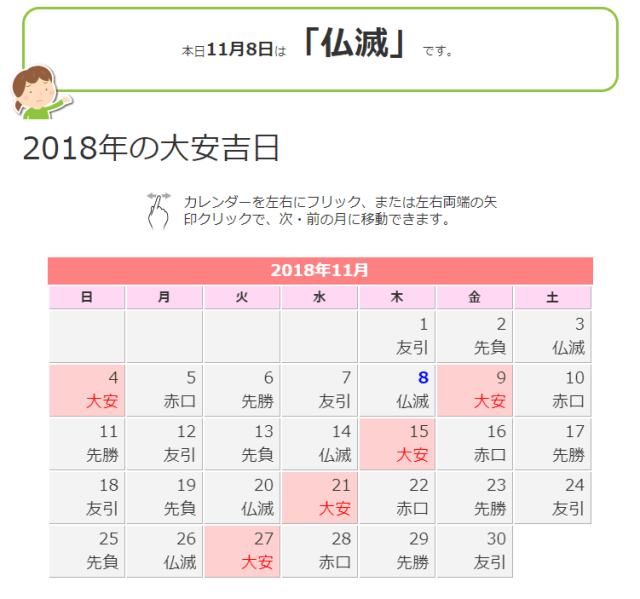
Alternately: A good day for doing things. Specifically, 大安 was a very auspicious day under the old 陰陽 (Onmyou, Japanese style yin-yang) divination system, and this compound emphasizes this positivity by adding 吉日, “a good day.”

Notes: This one has a lot of different readings. 大 may also be pronounced dai; 吉日 may also be prounounced as kitsunichi or kichinichi. (Kitsujitsu doesn’t seem to be used in this yojijukugo, though.)

If you want to get lost in interesting historical trivia for a while, you can look into the Onmyou system a little more deeply. Vaguely equivalent to the horoscopes we know in the West, it was a shifting cycle under which certain times and directions were thought to harbor good energy, making them auspicious for starting tasks, running errands, making visits. Other times were bad, meaning you should lie low, and sometimes directions became bad, meaning you should avoid them. You see this popping up in things like the Tale of Genji, where the season, day, and even time of day might determine who you visited or whether you stayed at home. But even in 2018 you can find calendars listing auspicious days, or get fortunes at shrines, that reference this system.

Keen observers will notice that Tuesday, November 6th was 先勝 (senshou, although also sometimes pronounced sakikachi or sakigachi) is “lucky in the morning, but not in the afternoon” – i.e. a mixed bag of a day.

TaiAnKonGetsu

You can find the current onmyou calendar here, among other places.

Posted in Japanese, Yojijukugo | Tagged , , , , , , , , | Leave a comment

Promise: A toboggan anapest

Promise

At the top of a very tall hill a toboggan sits,
waiting for someone to ride it on down.

And I think to myself, every time I pass by,
that as soon as it snows I will take it to town.

As it sits on its hill, does it dream of the day
it will whistle and blur on its way down the slope?

By itself it can’t move, but that just goes to show
even those who must wait still can always find hope.

Posted in Poetry | Tagged , , | Leave a comment