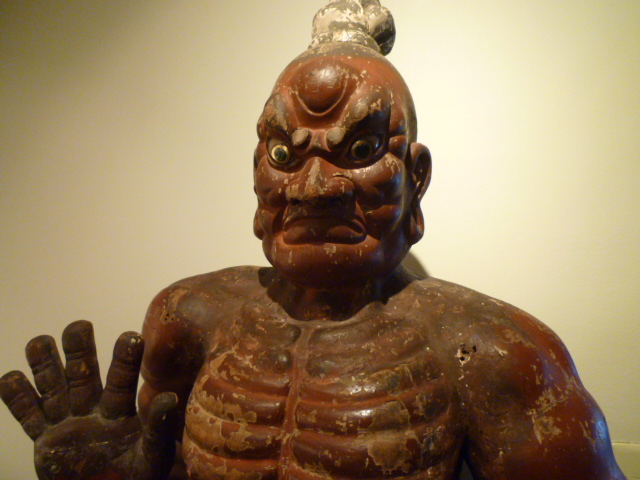
Even this old man comes rolling home

枯れ木も山の賑わい
(Kareki mo yama no nigiwai; “Even a dead tree adds life to a mountain”)

Definition:

Even something boring or drab is better than nothing at all. Even dead, withered trees give more “life” to a mountainside than if it were bare. This is most commonly used as a self-deprecating expression by someone relatively old joining a group of younger, more energetic people for some activity.

Breakdown:

We begin with the verb 枯れる (kareru), “to wither,” “to die,” in prenominal form, attached to and modifying the noun 木 (ki), “tree.” This is followed by the particle も (mo), commonly “also” but in this case “even.” Next comes the noun 山 (yama), “mountain,” and finally the verb 賑わう (nigiwau), “to be bustling,” “to flourish.” It appears in conjunctive form, which allows it to act as a noun, and the particle の (no) shows that this noun is associated with or possessed by the mountain.

Notes:

Variations on this phrase may replace “withered” with “bent” (歪み, yugami), the mountain with a forest (森, mori), or the liveliness with decoration (飾り, kazari).

Example sentence:

「あのおじいさんがうちのサークルに入った時は、彼、枯れ木も山の賑わいなんて言ってたけど、びっくりするほど上手く歌えるね」

(“Ano ojiisan ga uchi no saakuru ni haitta toki ha, kare, kareki mo yama no nigiwai nante iiteta kedo, bikkuri suru hodo umaku utaeru ne.”)

[“When that old man joined our club he was saying stuff like ‘Even an old fart like me might brighten things up a bit,’ but it turns out he can sing surprisingly well.”]

Posted in Japanese, Kotowaza | Tagged , , , , | Leave a comment

A yojijukugo for college students

Or new parents. Or night shift workers. Or…

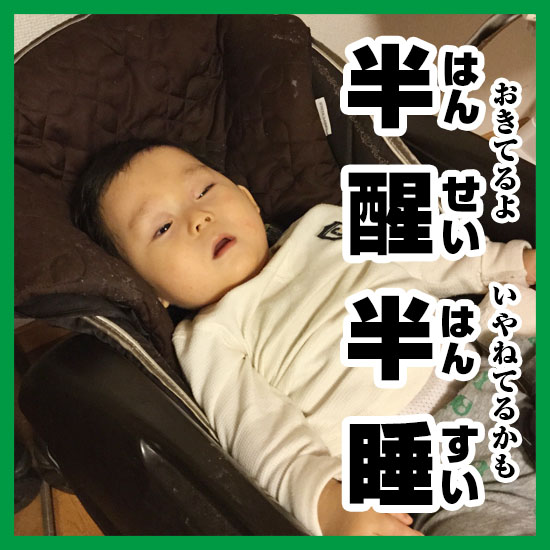
半醒半睡
han.sei.han.sui

Literally: half – wake – half – asleep

Alternately: Not fully conscious. Half awake and half asleep. Bleary.

Notes: The order of the halves may be reversed in some cases (半睡半醒), or 醒 may be replaced with the more-common 覚 (kaku), which can similarly mean “to wake up.”

HanSeiBeBe

I’m awake. No, wait, I’m asleep.

Posted in Japanese, Yojijukugo | Tagged , , , , | Leave a comment

Warm, but not a good oven

雪隠で饅頭
(Secchin de manjuu; “A bun in the outhouse”)

Definition:

Hiding away in order to enjoy something all by oneself, like squirreling oneself away in the toilet to have a snack (or go online with a smartphone, these days). Other, less common uses point to being so hungry that you don’t care where you eat, or being unable to choose where you eat (and therefore unable to enjoy the food).

Breakdown:

This is just two nouns connected by a particle. We begin with 雪隠 (secchin), an outhouse, marked as the place of action by the particle で (de). Next comes the noun 饅頭 (manjuu), a steamed yeast bun still popular as a snack or dessert in Japan. The actual verb is elided, but we can assume that the action is eating.

Notes:

Looking at the characters used to write 雪隠, one might expect it to be pronounced setsuin – and originally it was, but over time the pronunciation shifted to secchin. Further drift has also produced senchi as an accepted pronunciation. The term’s origins are unclear, other than that it comes from China, but generally involve the outhouse belonging to a Buddhist temple.

Example sentence:

弟に買ったことを知られる前に、兄は裏庭でこっそりと雪隠で饅頭を食うように漫画を読んだ。

(Otouto ni katta koto wo shirareru mae ni, ani wa uraniwa de kossori to secchin de manjuu wo kuu you ni manga wo yonda.)

[Before his younger brother realized that he had bought it, the boy stealthily read the manga in the back yard as if secretly enjoying a treat.]

Posted in Japanese, Kotowaza | Tagged , , , , , | Leave a comment

Like when you’re arguing despite agreeing

同工異曲
dou.kou.i.kyoku

Literally: same – construction – different – melody

Alternately: The technique or methodology used in making two things is the same, but the style is different. Things appearing markedly different despite being born of fundamentally the same character or craftsmanship. This phrase is especially used to describe artistic works such as poetry or music.

Notes: Some people occasionally replace 工 with homophones 巧 or 口 (perhaps mistakenly taken from compounds such as 異口同音), but this is considered an error.

This phrase originally comes from the writing of Tang-era neo-Confucian writer Han Yu.

DouKouIMug

Posted in Japanese, Yojijukugo | Tagged , , , , , , | 2 Comments

A tail full of sound, and furry

(Told by an idiot)

大山鳴動して鼠一匹
(Taizan meidou shite nezumi ippiki; “The mountain trembles; a single mouse.”)

Definition:

Terrible harbingers and portents without follow-through. Much ado, after which, nothing. Especially used in reference to empty threats. Like a large mountain rumbling and shaking as if about to erupt, only for it to turn out that all the noise was echoes raised by a lone mouse.

Breakdown:

We begin with compound noun 大山 (taizan), “large mountain.” Any particle marking this noun is elided, but it’s followed by noun 鳴動 (meidou), “rumbling,” made into a verb by the addition of する (suru), “to do.” The verb is in conjunctive form, and is followed by noun-number-counter 鼠一匹 (nezumi ippiki), “one mouse.”

Notes:

Taizan may be written with as 太山 without any change in meaning or pronunciation. It’s also sometimes mistaken for 泰山 – China’s famous Mount Tai, and this writing is actually so common and established that it’s considered acceptable. However, the point of entry into Japanese is apparently from the writings of the Roman poet Horace, as “Parturiunt montes, nascitur ridiculus mus.” (“The mountain was pregnant, and birthed a ridiculous mouse.”) And Horace himself was drawing on earlier traditions, perhaps back to Aesop’s Fables.

Example sentence:

「あの教頭先生?いつも怒鳴りつけてくるからやっぱり怖く見えるけど、怒鳴りつける以外は一切行動しないよ。大山鳴動して鼠一匹ってことさ。」

(“Ano kyoutou sensei? Itsumo donari tsukete kuru kara yappari kowaku mieru kedo, donari tsukeru igai wa issai koudou shinai yo. Taizan meidou shite nezumi ippiki tte koto sa.”)

[“The vice-principal? He always yells at people, so yeah, he looks scary, but other than yelling he does absolutely nothing. He’s all bark and no bite.”]

Posted in Japanese, Kotowaza | Tagged , , , , , | 1 Comment

Earthquake blooming

Arson benevolence?!?

改過自新
kai.ka.ji.shin

Literally: change – error – self – new

Alternately: Turning over a new leaf. Recognizing and working to correct one’s flaws and errors, and starting anew with a change of heart. New Year’s Resolution stuff.

Notes: This compound comes to us from the Records of the Grand Historian.

KaiKaYakuza

E.g. if you’re a sad yakuza, try turning into a sparkly businessman!

Posted in Japanese, Yojijukugo | Tagged , , , , , , | Leave a comment

Emerald cufflinks on a woodchuck

猿に烏帽子
(Saru ni eboshi; “A courtier’s cap on a monkey”)

Definition:

When the appearance of something is all dressed up, but doesn’t match its real content. Alternately, unfitting behavior. Like putting a fancy hat of the kind that used to be worn by aristocratic men in the imperial court… on a monkey. Like lipstick on a pig, or an expensive suit on an evil clown, but perhaps cuter.

Breakdown:

This simple phrase begins with the noun 猿 (saru), “monkey,” and ends with the noun 烏帽子 (eboshi), which is the name of a style of hat worn by Japanese court officials back in the day, based on a design imported from the mainland. They’re joined by the particle に (ni), which applies the latter noun to the former. The causative form of a verb such as 被る (kaburu), “to wear (on one’s head),” is implied but elided.

Notes:

There are several variants of this phrase, mostly replacing 烏帽子 with 冠 (kanmuri), “crown,” or the more generic 衣 (koromo), “clothing.”

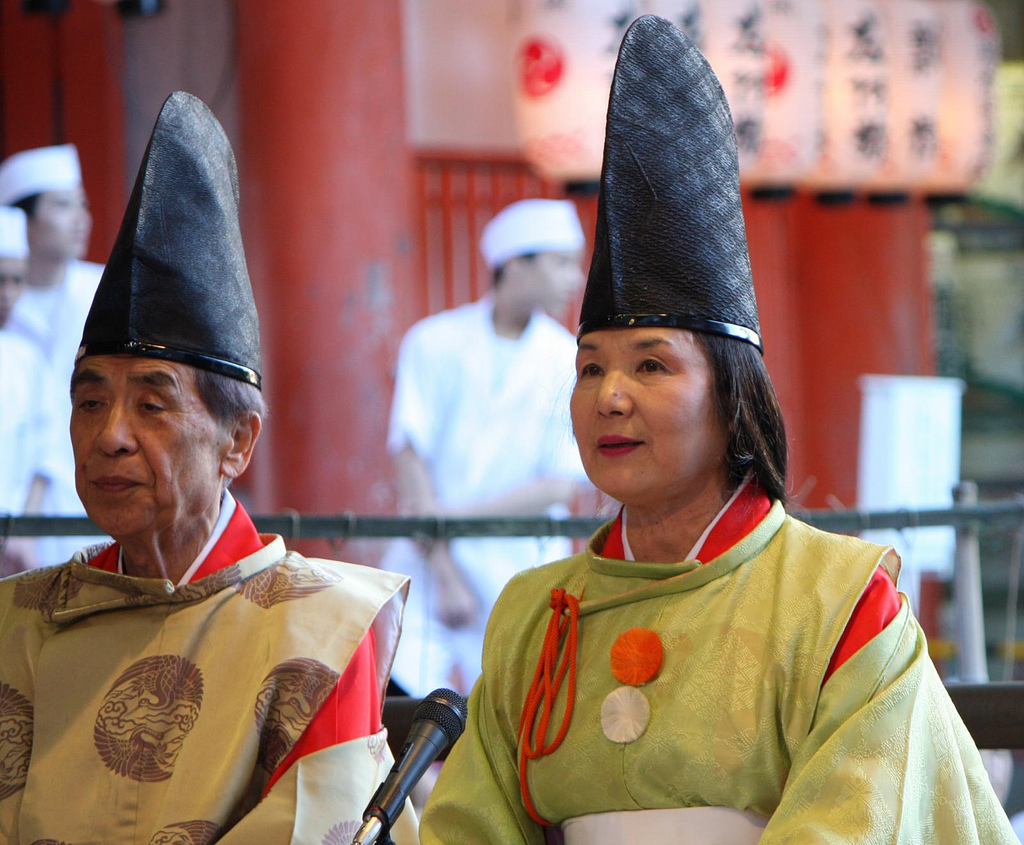
This is a common style of eboshi, by the way:

Example sentence:

「いやあ、いつも砕けた雰囲気が漂うあの人があんな固い言い方で話すなんて、まるで猿に烏帽子だ。違和感しかないね。」

(“Iyaa, itsumo kudaketa fun’iki ga tadayou ano hito ga anna katai iikata de hanasu nante, maru de saru ni eboshi da. Iwakan shika nai ne.”)

[“Naaah, they always have such a laid-back attitude that when they talk in a formal way it feels really inappropriate. It just makes me uneasy.”]

EboshiKasa

Ironically, Lady Eboshi wore a kasa-style hat.

Posted in Japanese, Kotowaza | Tagged , , , , , | 1 Comment

Snow falling on things other than cedars

雪中松柏
se-.cchuu.shou.haku

Literally: snow – middle – pine – Oriental arborvitae tree

Alternately: Not swerving from one’s intent, principles, or loyalties despite external situations. Not bending to circumstances, pressure, or fads. Most trees drop their leaves in the fall and remain bare until the weather warms in the spring. But trees such as pines or the the “Oriental arborvitae” (an evergreen native to mainland East Asia but not to Japan) don’t change in the face of changing circumstances.

Notes: This is a pretty obscure phrase – most of my usual sources don’t have it – and I haven’t found any citations for possible origins, although the combination 松柏 is attested from at least 751 CE in the 懐風藻 (Kaifuusou), a collection of Chinese-style poetry written in Japan.

SeCchuuHappou

Also the title of episode 9 of the Blue Exorcist anime.

Posted in Japanese, Yojijukugo | Tagged , , , , , , | 1 Comment

Silver tongues and golden ears

話し上手は聞き上手
(Hanashi jouzu wa kiki jouzu; “A good talker is a good listener”)

Definition:

The people who are truly skilled at speaking are those who listen well to others before saying their own piece. Good listening is an integral component of being good at conversing.

Breakdown:

We begin with the verb 話す (hanasu), “to speak,” in conjunctive form, which allows it to act as a noun – “the act of speaking.” It’s followed by adjectival noun 上手 (jouzu), “skillful.” The whole phrase is marked with the particle は (wa) as the topic being commented on, and the comment is a parallel phrase comprising the verb 聞く (kiku), “to listen,” again in conjunctive form and another 上手.

Notes:

There exists an exact opposite saying, 話し上手の聞き下手 (hanashi jouzu no kiki heta), which criticizes those who are so enamored of their own oratory that they talk and talk and talk and never listen. In contrast, today’s kotowaza stresses that skillful conversing is more than just talking.

Example sentence:

話し上手は聞き上手、とおじさんは言った。それから、「俺はさ、学生の時、先生に話し上手と言われたんだ」と続けて言っていた。「高校一年生になって、日本語だけじゃなくて英語のスプーチコンクールにも参加して……」とおじさんは口を休めることなく話した。おじさんはもしかしたら、今では話し上手じゃなくなったかもしれない。

(Hanashi jouzu wa kiki jouzu, to ojisan wa itta. Sore kara, “Ore wa sa, gakusei no toki, sensei ni hanashi jouzu to iwareta nda” to tsudzukete itteita. “Koukou ichinensei ni natte, nihongo dake ja nakute eigo no supuuchi konkuuru ni sanka shite……” to ojisan wa kuchi wo yasumeru koto naku hanashita. Ojisan wa moshikashitara, ima de wa hanashi jouzu ja naku natta kamoshirenai.)

[The guy said, “Good talkers are good listeners.” Then he went on, “And me, see, when I was a student, the teachers told me that I was good at talking.” Then, on and on without pause, “When I got into high school, I participated in speaching competitions, not only in Japanese but in English as well…”

I suspected that he was no longer a good talker.]

Posted in Japanese, Kotowaza | Tagged , , , , | Leave a comment

Ask an evil question…

悪因悪果
aku.in.a-.kka

Literally: evil – cause – evil – fruit

Alternately: Evil deeds have evil effects. From bad comes bad. Misfortune and suffering follow misdeeds.

Notes: Originally derived from Buddhist teachings (specifically the 117th verse of the Dhammapada, this compound follows in the same vein as 因果応報 or 悪因果 (akuin kuka).

AkuInEnma

How I hope the average voter feels about the current state of the US government in 2018… and 2020.

Posted in Japanese, Yojijukugo | Tagged , , , , , | Leave a comment