Ire makes me tire

What if you studied at a 短気大学?

短気は損気
(Tanki wa sonki; “A short temper leads to loss”)

Definition:

People who let their tempers get the better of them end up making errors, getting into fights, and causing trouble, and ultimately do themselves harm. Anger leads to unforced errors or unnecessary conflict and thence to failure. It’s best to be patient and reserved in one’s dealings with others.

Breakdown:

This entire phrase comprises two nouns and the particle (wa) connecting them. In this case, the particle draws a direct link between the two nouns. The first noun is 短気 (tanki), “short temper” or “impatience,” and the second is 損気 (sonki), a play on (son), “loss,” “disadvantage.”

Notes:

損気 is a word coined specifically for this saying by playing off of 短気, and is rarely found in any other context. In general, 損 can be used on its own.

Example sentence:

短気は損気、あの一貫性を知らない政治家は結局墓穴を掘った。

(Tanki wa sonki, ano ikkansei wo shiranai seijika wa kekkyoku boketsu wo hotta.”)

[“A short temper hurts you, and in the end that erratic politician dug his own grave.”]

Posted in Japanese, Kotowaza | Tagged , , , | Leave a comment

Also about good posture

“And you shall speak of them when you sit at home, and when you walk along the way, and when you lie down and when you rise up.”

行住坐臥
gyou.juu.za.ga

Literally: go / walk – reside – sit – lie down

Alternately: The four fundamental activities: moving about and staying in place, sitting and lying down (to sleep). By extension, everyday life; normal day-to-day activity. All the time, “day in, day out.”

Notes: The can also be written as , with exactly the same pronunciation and meaning.

This compound is apparently derived from a Buddhist chant known as the “Contemplation on the Mind-Ground” sutra (心地観経, shin.ji.kan.gyou). These four activities or states are also referred to as the 四威儀 or 四儀 (both pronounced shigi), the “four postures.”

gyoujuunozu

Posted in Japanese, Yojijukugo | Tagged , , , , , , , , | Leave a comment

Billennium?

起きて半畳寝て一畳
(Okite hanjou nete ichijou; “Half a tatami awake, one tatami asleep”)

Definition:

People should be satisfied when they have enough to live on, instead of hungering for unnecessary wealth and rank. There’s no point in chasing unreasonable levels of wealth. No matter how large your house is, you only use a half-mat area (about a square meter) to stand and a one-mat area (about two square meters) to lie down and sleep.

Breakdown:

Again we have a repeated pattern rather than a proper sentence, lacking even in particles. We begin with the verb 起きる (okiru), “to wake,” in conjunctive form. This is followed by the prefix (han), “half,” and the noun (jou), a tatami-style flooring element (and an area of about 1.65 square meters). The repetition gives the verb 寝る (neru), “to sleep,” “to lie down,” again in conjunctive form, and replaces with (ichi), “one.”

Notes:

The ultimate source of this saying supposedly lies in the Hanshi Waizhuan, a 2nd-century (BCE) collection of anecdotes and commentaries illustrating points made in an earlier text called the Book of Poetry or Book of Songs.

Example sentence:

「結局のところ、起きて半畳寝て一畳だと思い、ボーナスを無駄に追い掛けるのを止めて毎日六時から家の子の世話をすることにした」

(“Kekkyoku no tokoro, okite hanjou nete ichijou da to omoi, boonasu wo muda ni oikakeru no wo yamete mainichi rokuji kara uchi no ko no sewa wo suru koto ni shita.”)

[“In the end I decided that I was making enough money and didn’t need any more, and quit my pointless pursuit of the bonus in favor of taking care of the kid, starting from 6pm, each day.”]

Posted in Japanese, Kotowaza | Tagged , , , , , | Leave a comment

A wish for 2017

不偏不党
fu.hen.fu.tou

Literally: not – lean – not – faction

Alternately: Impartial. Unbiased. Neutral. Independent. Moved by facts, reason, and what is right and true rather than partisan bickering or blind loyalties.

Notes: This compound comes from a text called the Mozi (墨子) and describes one of the ideals of Mohism, a largely-lost ancient Chinese philosophical movement that (to a degree) opposed Confucian ideas in favor of self-aware reflection and impartial, universal love for humanity.

It’s also one of many yojijukugo of the pattern 不〇不●, which I find interesting for no clear reason.

fuhenjishaku

The only image-search result that really made me stop and think.

Posted in Japanese, Yojijukugo | Tagged , , , , , , | Leave a comment

Magic Monday – The Ultimate Duck Whistle

Call Beast

Some beings are so powerful that merely invoking their names is enough to draw their attention. Most of the time this attention is brief and inconsequential, but many beings can be enticed to appear physically by appropriate ceremonies or promises. While this is rarely recommended, some magicians are desperate, arrogant, or even well-prepared enough to call one. Knowing this simple spell means knowing the basic mechanics of calling a legendary beast or minor deity… the specifics of what most appeals to each and how to negotiate with them if and when they arrive are another matter entirely. Anything capable of noticing its name being used will also be well-equipped to enforce its will on the situation after it has arrived, and few such creatures or gods are automatically friendly to humanity.

Each specific being has its own Call Beast spell. The base difficulty is d8 and the base cost, a single point of strain, but these may vary depending on the specific entity being summoned. (Many Calls will also have unique requirements, such as a full moon, solstice, a particular location, gifts or sacrifices, and so on.) The caster may choose perform a harder version of the spell, because each degree of success achieved on the casting will decrease the difficulty of any checks dealing with the creature after it has arrived, such as making the proper sorts of offers in negotiation or casting other spells to contain and control it.

Posted in Rules, World-Building | Tagged , , | Leave a comment

As we journey through this world…

…Let’s wear our hearts on sleeves unfurled

(I should have written a post in advance, but yesterday was taken up largely by my sister getting married. Today’s kotowaza is in honor of that long-awaited joyous event as well as a general hope and reminder for the coming year. Meanwhile, I apologize for the delay, but please look for this week’s “Magic Monday” post to come out tomorrow.)

旅は道連れ世は情け
(Tabi wa michizure yo wa nasake;
“Fellow travelers for a journey, compassion for [our journey through] the world”)

Definition:

Just as it’s a source of comfort to have a traveling companion when you’re on a trip, it’s also important to exercise empathy and kindness while traveling through life. It’s just as important to treat your fellow humans well at any point in life as it is when you’re specifically traveling together from point to point on the earth, because in the end we all depend on each other for help, support, protection, and comfort. We all need human kindness and companionship.

Breakdown:

This saying is not a full sentence on its own; rather, it’s a repeated pattern of topic-noun pairs that draws a deliberate comparison to make, essentially, an “A is to B as C is to D” analogy. The first topic is (tabi), “journey” and the second is (yo), “[this] world.” (The term can carry Buddhist connotations of the mortal realm in contrast to other higher or lower worlds, or social connotations of “the world of aristocratic society.”)

Each topic is marked by the particle (wa), setting up the comparison. The second half of the first part is 道連れ, comprising the noun (michi), “road,” “way,” and the verb 連る (tsuru) “to go with,” in conjunctive form, which allows it to act as a noun as well. The second half of the second part is the noun 情け (nasake), “compassion,” “mercy,” “affection.” If you wanted to be cute, then, you could translate this kotowaza as [travel : fellow-travelers :: life : kindness].

Notes:

This is the entry of the Edo iroha karuta set. The saying can be used in contracted form as simply 旅は道連れ. There are several variants of the phrase, such as one that replaces 道連れ with (kokoro), “heart,” “spirit,” but none of my sources cite an origin for the saying.

Example sentence:

旅は道連れ世は情け、一緒に行きませんか」

(Tabi wa michizure yo wa nasake, issho ni ikimasen ka?”)

[“Life is a journey and we all need companions; won’t you travel along with me?”]

Posted in Japanese, Kotowaza | Tagged , , , , , | 1 Comment

Year in Review: The Kid in 2016

At the start of 2016 I was a full-time stay-at-home dad. When I had errands to run, I strapped the kid to my chest and walked or got on the bus. He was curious and observant, but couldn’t express himself very much. What little vocabulary he had was limited to nouns in rudimentary Japanese or pseudo-Japanese baby talk. He had clearly mastered some aspects of abstract thought and had an okay memory, but didn’t have many practical uses for these tools. He had a decent set of teeth, could climb up and down stairs, and could walk around and engage in some rudimentary climbing and exploration. He liked vehicles, dogs and cats, and picking holly berries off of the decorative bushes that surround our apartment complex.

It’s only to be expected for a toddler, but there have been dramatic changes in every area. On the external side of things, the two biggest were probably getting the kid into daycare and getting a bike seat for him. Where before daycare I had had at most a couple hours of uninterrupted time during his nap and again in the evening – and spent a significant portion of that time on chores – suddenly I had the whole middle of the day open. And where before I was almost his sole source of human interaction, suddenly he was spending hours each weekday in a roomful of other kids. And after we got a bike seat, we suddenly had a new activity to do together and expanded travel options. (And it was a good thing, too, because he had outgrown the carrier I’d been wearing.)

Going to daycare had a huge effect on his communication, of course. He picked up loads of English – random phrases at first, like “Oh my gosh!” Then he started assembling random words and snippets of grammar into his own private pidgin. At this point, he’s clearly got a lot of gaps, but he’s essentially speaking in sentences.

One of the most interesting “gaps” is that he doesn’t seem to have really caught on to what “me” means yet. He says it often enough in English, and he seems to have intuited that it has to do with an action being performed, but that’s all. He used to use it in an almost emphatic way, for example “[Name] fart me” to simply express that someone has farted. But now he’ll make a request like “Give me that,” followed by his own name. Since he says his name [a very common first-person usage for Japanese-speaking children], it implies that he doesn’t yet understand that “me” also refers to the self.

What with daycare, holiday visits with my parents, and other exposure, his English has been developing by leaps and bounds – this despite the fact that I’ve been using almost exclusively Japanese with him for over a year. Nobody else in my family speaks any Japanese at all, and he seems to have caught on to that – he uses English preferentially around them, even with me, unless I’m making a point of prompting him repeatedly until he speaks Japanese. (I’m not sure this is the best tactic, but I do want to make sure he understand that I expect him to speak Japanese with me when possible. Otherwise there’s just too much danger that he’ll end up half-bilingual, able to understand Japanese but hesitant when it comes to speaking.)

That’s not to say that his Japanese isn’t improving as well. He’s acquired a lot of verbs recently, and has even picked up the “te form” used in most imperative structures. (Which may say something about how often I’m telling him to do things… and/or how often I’m guiding him through full-sentence requests when he wants something from me.) He’s even picked up the emphatic sentence-final particle zo recently. This is a strongly informal, relatively masculine emphatic particle – a kind of spoken exclamation point – and hearing a two-year-old break it out (with correct usage, no less!) is cute and hilarious.

Perhaps his most significant advance in abstract thought is grasping conditionals and orders of events. He understands when I tell him that one action or event (such as watching a train video or eating a snack) must follow another (such as getting his diaper changed or drinking some water). He also has a very long memory: he’ll refer to events from many weeks previous. For example, we visited my parents over the Thanksgiving break, and for a couple weeks after we went home he would comment on how his grandpa wasn’t there with us.

He still likes vehicles, and watches train videos on a daily basis if we let him – including branching out into videos about toy train sets and Thomas the Tank Engine. And he still likes animals, although his interests have expanded to include rabbits, fish, snakes, and others. He still likes picking berries, and fortunately he’s also good enough that he listens and obeys when I tell him they’re not to be eaten by humans. But he’s also added interests. He likes the music of OK Go and the Muppets. He likes specific books, and even specific stories from certain books (like the Frog and Toad story about cookies and willpower). He likes certain shirts, and prefers to wear them when possible. He likes dried fruits and pomegranate seeds. He likes insects, especially praying mantises. He likes to run and jump. He likes to line things up:
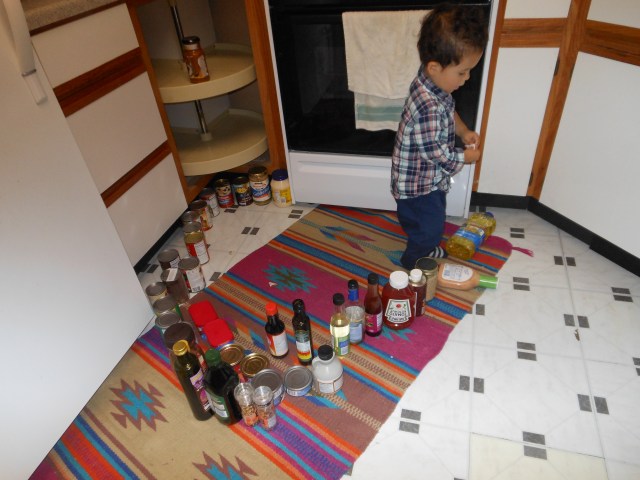
dscn2577

There; now that’s all organized.

He likes his train set, but by far his favorite thing to do with it is build bridges. Not just standard bridges, either: he builds delicate, sophisticated concatenations with long pieces held suspended in midair by nothing but tension and balance. And his preferred use for his blocks is to build “tunnels” over the railway.

It’s not all cuddles and sunshine, of course. He’ll get upset when things don’t go his way. He’ll try to hit people or things when he’s angry (a habit I can’t help suspect was picked up, or at least strengthened, at daycare). He’ll get loud and opinionated. He finds it amusing to spit. He’ll just sort of randomly bite you sometimes, even when he’s not mad at all. He’ll deliberately test boundaries. Sometimes he requires a lot of coaxing, distraction, comfort, or other tools before he’ll accept certain realities or do what we’ve asked him to do. In short, he’s two, and he’s got about the level of emotional maturity you’d expect from a two-year-old.

But overall he’s an amazing kid. 2016 was a crappy year in a lot of ways. And on top of that, the biggest things that made 2016 feel crappy were developments that made it clear worse was coming, so overall I don’t have high hopes for 2017 being enjoyable… I’ll settle for endurable. But one thing I am looking forward to is seeing how the kid develops. And I’ll try to make a point of posting about it more regularly here, especially when something seems to offer broader insight into how people work. 今年も宜しくお願いします!

Posted in Nonfiction, Uncategorized | Tagged , , , | Leave a comment

Do what I say, not what I say

朝令暮改
chou.rei.bo.kai

Literally: morning – command – evening – reform / change

Alternately: An unstable situation where it’s never clear what the rules are or what they’re going to be, because they’re being changed so frequently. Laws or decrees being issued in the morning and changed in the evening of the same day. Harmful waffling.

Notes: Some people write homophonic character , “ceremony,” “thanks,” in place of , but this is considered an error.

This compound is derived from a passage in the Book of Han; accordingly, the compound can also be read kanbun-style as 朝に令して暮れに改む (ashita ni rei shite kure ni aratamu), “command in the morning, change in the evening.”

choureimakiko

Tanaka Makiko. The red text says “Am I really that strange?” Her association with this yojijukugo seems to be due to a 2012 incident in which she refused applications for new universities, contradicting a report the previous day that she would support them. The maneuver worked: public outcry at her apparent about-face forced her to change her position to match what the report had predetermined.

Posted in Japanese, Yojijukugo | Tagged , , , , , | Leave a comment

Magic Monday – Feeling a little Ouija

Speak with Dead (Seance)

The caster summons nearby spirits of the dead for consultation. If interested, they may engage in ordinary conversation – or the caster may attempt to force them to answer questions. Specific spirits may also be called, although without the proper preparation this is difficult. While many cultures frown on any sort of necromancy as dangerous and unnatural, hedge-wizards and -witches often defend this spell as a valuable source of information only superficially related to the magics used to rouse angry ghosts or animate the bodies of the dead. They don’t often talk about the danger posed by spirits angered by an undiplomatic magician, or other malevolent forces that can be attracted by the spell.

The base difficulty is d6 and the cost, two strain plus one strain for each minute the spell is maintained. To force a spirit to answer a question truthfully (to the best of its knowledge), the caster must succeed in a Presence challenge. There are many factors that may influence the difficulty: It is increased by a step if a specific spirit is to be called, and by another if that spirit isn’t nearby. It is increased by a step if the caster wants to give the spirit an audible voice instead of forcing it to communicate through more subtle manifestations such as moving objects, causing cold winds, and so on (some ghosts are close enough to the mortal realm to speak directly on their own, but many are not). It may be increased in order to grant a +2 bonus to any Presence challenges engaged in. On the other hand, having a physical link to the deceased (such as a body part or close personal possession), knowing their true name, or being in a location where the dead are especially close to the living (such as a graveyard) will each decrease the difficulty by a step.

Posted in Rules, World-Building | Tagged , , , | Leave a comment

If you beat it, dust will come

Field of Dreams reference, right? Right!

叩けば埃が出る
(Tatakeba hokori ga deru; “If you strike it, dust will come out.”)

Definition:

No matter how much you smooth over the surface of something and make it presentable, closer inspection will reveal flaws; no matter how polished a person’s surface is, looking closer at their dealings or their past will reveal improprieties. The image is of a surface that looks clean and polished, but which yields dust when struck. By extension, the idea that every human has weaknesses and failings; we’re all only human. Note that this saying only talks about negative features; it can’t be used in reference to hidden talents or good points.

Breakdown:

We begin with the verb 叩く (tataku) in its subjunctive form, followed by a verb phrase comprising a noun – (hokori), “dust,” and a verb – 出る (deru), “to come out,” in sentence-final form. Although this noun is attached to the subject-marker particle (ga), it is only the grammatical “subject” of the verb phrase; the sentence as a whole has an indeterminate human actor as its unspoken subject. In English we express this subject as the indeterminate “you” or, if you’re feeling fancy, as “one.”

Notes:

This saying has a number of synonyms, including a version in which the final verb is replaced with 立つ (tatsu), “to rise.”

Example sentence:

「どんな政治家でも叩けば埃が出るというが、彼奴は取り繕った表面すら欠けている。ただの埃の塊が行動していると言ったら良いかな」

(“Donna seijika de mo tatakeba hokori ga deru to iu ga, aitsu wa toritsukurotta hyoumen sura kaketeiru. Tada no hokori no katamari ga koudou shiteiru to ittara ii ka na.”)

[“They say any politician will have drawbacks if you look close enough, but that guy lacks even a polished surface image – you could say he’s just a walking pile of drawbacks.”]

Posted in Japanese, Kotowaza | Tagged , , , , , | Leave a comment