Magic Monday – A trick of the light

Fool-The-Eye

This pidgin illusion is commonly used by traveling conjurers to avoid being killed by bandits, wild beasts, or other potential wayside troubles. Fool-The-Eye requires that the caster gesture continuously with one hand, presumably while dodging and weaving to evade attacks. As they do so, the caster’s form seems to blur and waver like a mirage. The caster can use his or her free hand for other tasks, such as counterattacking, but doing so risks losing the focus that maintains the spell.

For as long as the spell is maintained, the caster gains +1 to all defenses. Fool-The-Eye has a base difficulty of d6 and a base cost of one strain; for each extra point of strain taken, the bonus to Dodge increases by +1. All bonuses are doubled against ranged attacks. Taking actions with the off hand requires a Concentration check at d8 or the spell is lost. Increasing the initial spell difficulty decreases the Concentration difficulty on a one-for-one step basis.

Posted in Rules | Tagged , , , , | Leave a comment

Wiggle, roll, crawl, stand, walk, run, Olympic gymnast

I’ve been holding on to this one for a while; posting now in honor of someone’s birthday. Also, happy Father’s Day to any fathers reading this!

這えば立て立てば歩めの親心
(Haeba tate tateba ayume no oyagokoro;
“A parent’s heart that says ‘stand’ when they crawl and ‘walk’ when they stand.”)

Definition:

Parents naturally take an interest in their children’s development. If a baby learns to crawl they anticipate it being able to stand; when it can stand they anticipate it being able to walk. Despite the imperative form (see below), the image is not of parents urging their kids to develop quickly so much as looking forward to the next step, wondering if it will come soon.

Breakdown:

We begin with the verb 這う (hau, pronounced like “how” and meaning “to crawl”) in conjunctive form, with the conditional postposition (ba). This is followed by the verb 立つ (tatsu, “to stand”), in what looks like conjunctive form but is actually imperative. Together these act as a self-contained unit: “If crawl, then stand.”

The next unit follows the same structure: the verb 立つ again, this time in conjunctive form with the conditional postposition, followed by the verb 歩む (ayumu, “to walk”) in the imperative. Both of these units are then mashed together into a single quotative phrase, acted on by the associative particle (no) in order to associate it with the final noun 親心 (oya.gokoro), literally “parent heart.”

Notes:

Most learners of Japanese learn the verb “to walk” as 歩く (aruku) rather than 歩む ayumu, and my readers would be advised to depend mostly on the former. It seems that the difference between them is twofold: first, ayumu feels more formal and literary than aruku. Second, aruku can refer in general to going out and moving from place to place, without necessarily doing so by foot! Both readings can refer to one’s path through life, or the passage of time, but ayumu is more likely to be used in that sense due to its more poetic nuance.

Various contracted forms of this saying are also attested, ending at 歩め or beginning with 立てば.

Example sentence:

「盆子原さんがまだ3ヶ月の息子さんが早く喋れるようになるのを楽しみにしているという話を聞きながら、あ、これはまさに這えば立て立てば歩めの親心だなぁと思った」

(“Bonkobara san ga mada sankagetsu no musuko san ga hayaku shabereru you ni naru no wo tanoshimi ni shiteiru to iu hanashi wo kikinagara, a, kore wa masa ni haeba tate tateba ayume no oyagokoro da naa to omotta.”)

[“Listening to (Mr./Mrs.) Bonkobara talk about looking forward to their three-month-old son being able to talk ‘soon,’ I thought to myself, ‘Wow, this is exactly what they mean when they talk about parents having expectations for their kids’ development.’”]

Posted in Japanese, Kotowaza | Tagged , , , , , | 1 Comment

No title necessary; you can tell what this is already

一目瞭然
ichi.moku.ryou.zen

Literally: one – eye – clear – “in that way”

Alternately: Clear (in the sense of “easily understood” rather than literally transparent); apparent; obvious. Able to be understood after a mere glance.

Notes: It is also acceptable to write this as 一目了然. The meaning and pronunciation do not change, but a simpler character is substituted in for the relatively rare and complex .

This compound comes from the 朱子語類 (in Japanese, shushigorui; in Chinese, apparently zhu ai yu le), a Confucian text from 1270 CE, compiled into 140 volumes. Ichi.moku.ryou.zen is from the 137th.

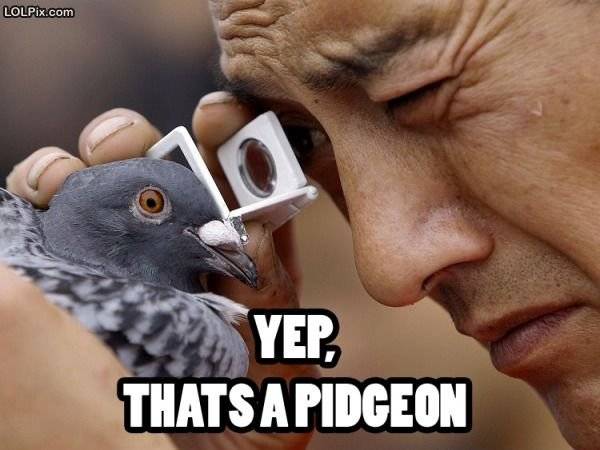
Or is it... a ROCK DOVE?!?!

It turns out that “pidgeon” used to be a correct spelling, but yes, these days it should be “pigeon.” Either way, I find this picture amusing, and it’s appropriate to the post.

Posted in Japanese, Yojijukugo | Tagged , , , , | 2 Comments

Magic Monday – And now for a multi-function air mobility spell

Today’s spell, specifically its ability to shift dramatically in functionality depending on the amount of skill and energy invested in it, was inspired by this post at The Dragon’s Flagon.

Ride the Wind

This spell depends on the caster being on good terms with at least one local wind-spirit, preferably several. When a caster enters a new geographic region they must spend some time, and probably other resources, establishing good relations. Thereafter, they may attempt to call on the spirits for a variety of favors:

  • Cloud cushion: On falling from a height, one may call for help and be wafted to the ground at safe and mostly gentle speeds on a cushion of air.
  • Levitation: One may ask to be raised or lowered (at about one arm’s length per second) to almost any height or depth. Horizontal motion can be achieved by pushing or pulling on nearby objects.
  • Sky Road: One may walk or run on the air as easily as on the ground, changing direction and ascending or descending at will. This is just as much work as normal running or walking.
  • Flight: The winds carry one effortlessly as a swallow in flight… well, a person-sized, slightly ungainly swallow that can also hover in place and ascend vertically. Overall it’s very impressive.

The base cost of any version of this spell is one point of fatigue, and the base difficulty is d3. For Levitation, increase the cost by one strain per hour and the difficulty by one step from the base; for Sky Road, one strain per ten minutes and two steps from the base; for Flight, one strain per minute and three steps. If others besides the caster are to receive the spirits’ aid, the cost is multiplied by the number of people, and the difficulty increased by a single step. If the caster has not properly established relations with the local wind-spirits, all uses of this spell have double the costs and a difficulty two steps higher.

Posted in Rules, Setting | Tagged , , , , , | Leave a comment

Not enough data to work out how or if souls scale with size, though

一寸の虫にも五分の魂
(Issun no mushi ni mo gobu no tamashii;
“Even in a one-sun bug, five parts of a soul.”)

Definition:

Even a 3cm bug has a half-share of spirit. Even a seemingly small, weak person will have a certain underlying stubbornness or strength of spirit. Don’t look down on the small or weak. “Even a worm will turn.” As with other sayings, the specified length is not to be taken literally; instead it stands as an example of something very small… despite the fact, as any entomologist can tell you, that 3cm is pretty large for many “bugs.”

Breakdown:

一寸 (issun) is one sun (pronounced somewhat close to “soon”), or about 3cm in modern terms. This is joined by the associative particle (no) to the next noun, (mushi), a broad category of animal roughly equivalent to the common American English use of “bug.” (Mushi is a category that historically includes not only insects, spiders, and other arthropods, but also other creepy-crawlies such as snakes. The modern usage is probably more tightly restricted to insects and insect-like creatures.)

The whole noun phrase is pointed to by the multi-use particle (ni), here serving a sort of attributive or possessive function, combined with (mo), “also” or “even.” And this particle cluster joins the first noun phrase with another: (bu) means a “part,” but as I’ve said before [https://landofnu.com/2014/09/24/nine-and-nine-of-ten-and-ten/], it can also refer to one tenth of a whole. 五分 (gobu) is therefore 5/10, or 1/2. And again our measure is connected by to another noun, in this case (tamashii), “soul” or “spirit.”

Notes:

The can be replaced by さえ (sae), which indicates some minimum limit and can often be translated as “even.” The whole saying can also be invoked by the truncated form 五分の魂 (gobu no tamashii).

A similar saying with the same meaning notes that 蛞蝓にも角 (namekuji ni mo tsuno); “even a slug has horns.”

Example sentence:

「相手はただの高校生だとは言え、なめるな。一寸の虫にも五分の魂があるというんだから」

(“Aite wa tada no koukousei da to wa ie, nameru na. Issun no mushi ni mo gobu no tamashii ga aru to iu nda kara.”)

[“Even if your opponent is just a high-school student, don’t underestimate them. As they say, even a bug has a half-share of spirit.”]

Posted in Japanese, Kotowaza | Tagged , , , , , , | Leave a comment

Runrise, runset, runrise, runset, swiftly fly the years

東奔西走
tou.hon.sei.sou

Literally: east – run – west – run

Alternately: Keeping busy. Being on the go. Actively involving oneself in something.

Notes: There are a number of yojijukugo along the same lines, including 東走西奔 (tou.sou.sei.hon) and 東行西走 (tou.kou.sei.sou).

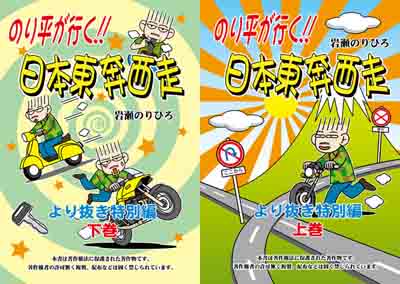
Norihiro ga yuku! Nihon Touhonseisou

It’s (part of) the title of a pair of books, too! I don’t know what they’re about. Source. Oddly, not on Amazon.

Posted in Japanese, Yojijukugo | Tagged , , , , , | 1 Comment

Magic Monday – Sign of Thanh

(As seen in this story)

Sign of Thanh

This Sign is a glowing rune, drawn on any surface or even in the air. It remains in place for as long as its caster concentrates, visible even in darkness and potent to about fifty meters [Edit: “area” range]. All within this range who look upon the Sign must pass a Psychic save or be paralyzed, unable to move voluntary muscles and barely able to breathe, until the Sign is allowed to fade. A caster who looks at his or her own Sign after its creation may also be frozen, and will maintain it involuntarily until his or her strain meter is full and he or she has to make a break roll.

The caster chooses the difficulty, and this becomes the difficulty of the save. The base cost is one strain per round. This length can be extended, increasing the difficulty by two steps for each step in time, or the difficulty can be lowered one step by doubling the cost per round. By taking on additional strain when the Sign is first drawn and each unit thereafter, the caster may add a penalty to others’ saves (on a one-for-one basis).

Posted in Rules, Setting | Tagged , , , , | 2 Comments

Your choice: on a rock, or in a brier

Suddenly I feel like this one is about grad school.

石の上にも三年
(Ishi no ue ni mo sannen; “Three years, even on top of a rock”)

Definition:

With perseverance, one can overcome hard times and achieve one’s goals. A saying about the importance of patience and endurance. Before you start getting the wrong impression, let me note that the image being referred to is not simply enduring the hardness of a rock as one’s seat. The full-length original saying refers to sitting on a cold stone, and how the cold stone will eventually warm up if one sits on it for long enough! Naturally, one should not take the number at face value: the span mentioned is simply an example of a relatively long passage of time rather than a prescription for exactly three years of stone-sitting.

Breakdown:

The noun (ishi) is a rock or stone, and the noun (ue) is equivalent to the English prepositions “above” or “up.” These are connected by our old friend the associative particle (no) to form a noun phrase. Next is the particle (ni), used as a positional and probably best rendered as “on.” The particle (mo), often translated as “also,” is taking on an emphatic function here: “even a (cold) stone.” Finally we have number and noun 三年 (san.nen), “three years.”

Notes:

The full version adds 居れば暖まる (ireba atatamaru), “if one sits, it/one will warm (up).” There are two interesting things here for the language-learner to pay attention to. First, while in modern Japanese 居る is simply the verb “to be” for animate beings, equivalent to ある for inanimate ones, classically it literally meant “to sit,” “to be seated,” thus referring specifically to sitting on a stone rather than simply being atop it.

Second, the kanji usually refers to a feeling of warmth, whereas warmth in an object or substance is represented by . This doesn’t seem to be a factor in this case, though… especially since 三年居れば温まる is a valid alternative to the saying. It’s possible that was chosen simply because can also refer to an unpleasant lukewarm quality, but this is just idle speculation on my part.

Another variant kotowaza has us persevering 茨の中にも (ibara no naka ni mo), “even in the middle of a thorn-bush.”

Example sentence:

「夏休みの間でも、石の上にも三年の気持ちで毎日三時間自習している学生たちに感動した」

(“Natsuyasumi no aida demo, ishi no ue ni mo sannen no kimochi de mainichi sanjikan jishuu shiteiru gakuseitachi ni kandou shita.”)

[“We were impressed by the students who, believing that perseverance is the key to success, studied on their own for three hours each day even during summer vacation.”]

Posted in Japanese, Kotowaza | Tagged , , , , , | 2 Comments

The mysterious ways of gods and demons

神出鬼没
shin.shutsu.ki.botsu

Literally: god – emit/come out – ghost/demon/oni – sink (downward)

Alternately: Appearing and disappearing rapidly or unexpectedly, at will. Elusive. Phantasmal. Mysterious.

Minus, in hiding

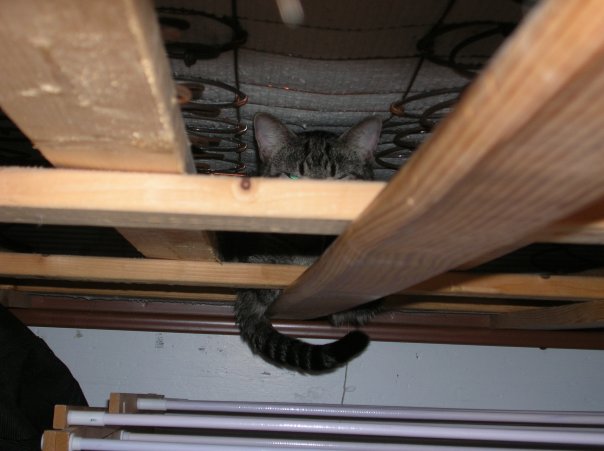
This cat is doing a pretty good job of illustrating the phrase. Picture courtesy of my sister.

Posted in Japanese, Yojijukugo | Tagged , , , , | 2 Comments

Protect your home – with spare animal bits!

Guardian Charms

The Guardian Charms are a family of rituals used during the construction of houses. The primary charm involves burying a horse’s skull beneath the door frame, which makes it difficult for certain malevolent spirits (such as vampires) to gain entry to the house unless invited in by an inhabitant. Another is placing a mummified or preserved cat within the walls, which grants a bonus to saves made by inhabitants to resist disease. A third is cutting a pattern of short lines into the beams or supports of a house, which reduces the effects of environmental damage to the building itself. All last for the house’s lifetime except the cat-charm, which must be renewed for each new inhabitant or group of inhabitants.

The base difficulty of each ritual is d6, and automatically costs a point each of strain and fatigue. Extra fatigue and/or strain can be taken by a caster familiar with the ritual (i.e. with skill points invested in it). For each doubling of the energy invested, the charms increase in power: the horse-head charm costs malevolent spirits one point each of strain, fatigue, and health if they cross the threshold uninvited. The cat charm grants an extra +1 to rolls. And the cutting charm reduces damage done by an extra +1. Energy costs can be halved by increasing the difficulty by a step, or doubled to decrease it by a step. As with many such rituals, the working of Guardian Charms often becomes a community event led by the local hedge-wizard or witch-doctor, with each member contributing a modicum of energy.

Posted in Rules, Setting | Tagged , , , | 2 Comments