Nine and nine of ten and ten

In honor of September, a yojijukugo with some nines in it!

九分九厘
ku.bu.ku.rin

Literally: nine – part – nine – smaller part [1/10 of a bu]

Alternately: 99%. Ninety-nine times out of a hundred. Almost certainly.

Notes: There is some danger here due to also meaning 1%, so that the phrase can be misread as “a 9.9% chance.” However, in this case 分 means “one part (in ten),” and from this the meaning of something almost guaranteed to happen is born.

Sorry for the tiny image size

Also apparently the name of a band!?

Posted in Japanese, Yojijukugo | Tagged , , , | 2 Comments

On how to make a mountain

A variation on a theme:

塵も積もれば山となる
(Chiri mo tsumoreba yama to naru; “Even dust, if it builds up, becomes a mountain”)

Definition:

Small things, allowed to accumulate, become large. Multiple sources reference the English saying “Many a little makes a mickle” – a phrase I’d never encountered before in my life – which goes to show something about how languages change over time.

At first glance this kotowaza seems almost identical to last week’s 雨垂れ石を穿つ, but there are a number of important differences. First, the emphasis is on small “things” (which may be metaphorical at least as commonly as they are physical) rather than small amounts of power. Second, the connotation of this saying can be negative: small amounts of work can build up into an overwhelming amount. It appears that the saying began as a Buddhist warning against neglecting small tasks. That said, modern usage allows for both positive and negative implications.

Breakdown:

We get a full sentence this time! The subject is (chiri, “dust/dirt”), modified by the particle (mo). While is often translatable as “also,” “too,” etc., in this case the nuance is closer to “even.” Next comes the verb 積もる (tsumoru, meaning “to pile up,” “to accumulate” – in the intransitive sense) – in the conditional form, which changes its final –ru to -reba. This conjoins the first clause to the second one: next we have the noun (yama, “mountain”) and the verb なる (naru, “to become”). The particle between them, (to, pronounced like “toe”) is here serving the same function as the English “to,” as in “the dough changes to bread in the oven.” The particle often serves this function in standard Japanese; is a more literary or formal alternative.

Notes:

The character can in some situations be read gomi, meaning “trash,” or “waste,” but in this case that reading would be incorrect. My sources also specifically note that taking to mean “boring things” is a misinterpretation.

This is another selection from the Edo Iroha Karuta set.

Example sentence:

塵も積もれば山となるというから、毎日百科事典の記事を一つ読むように決めた」

(Chiri mo tsumoreba yama to naru to iu kara, mainichi hyakkajitenn no kiji wo hitotsu yomu you ni kimeta.”)

[“They say that even dust can pile up and become a mountain; in that spirit, I decided to read an article out of the encyclopedia each day.”]

Posted in Japanese, Kotowaza | Tagged , , , , , , | 1 Comment

When you eat like a horse, you get thirsty

牛飲馬食
gyuu.in.ba.shoku

Literally: cow – drink – horse – eat

Alternately: To drink like a cow and eat like a horse; to eat and drink a huge amount.

Note: The first half can also be 鯨飲 (gei.in; “to drink like a whale”). The phrase can also be rendered, somewhat prosaically, as 暴飲暴食 (bou.in.bou.shoku; “violent/heavy eating and drinking”).

Random Youtube Link,
presented without comment.

Posted in Japanese, Yojijukugo | Tagged , , , | Leave a comment

Directions, part III

(Story begins here. Continued from Part II)

The next time Seth heard Thea’s voice was a week later, in the library carrel spaces. He was spending his lunch break with his CD player and a pile of books that might help him write a paper. He was walking down the row when he saw the tops of Thea’s and Isaac’s heads bent in mutual study, the latter covered by a skullcap. Seth immediately sat down in the carrel opposite theirs. He arranged his books in front of him and opened one to somewhere in the middle. Then he turned it so that the words faced him. He put his headphones on his neck, failed to turn the music on, and listened.

Her soft voice fit the library setting well. “This… ‘Tanakh’ is a long work. At this rate, we will not finish it for months.”

“Yup!”

“This is a great amount of study, Isaac. Why is it so difficult to join your tribe? To eat of my fruit is a test of faith; to read this book is a test of… ah… ‘attention span.’ Is your god not afraid that its people will fade away?”

“Um, no. Frankly, it’s difficult on purpose, to keep out the people who don’t really mean it. If you’re having doubts, this is probably a good time to rethink things. Why do you want to be Jewish anyway? Not that I mind, but….”

“Do you have a soul?”

“Yes.”

“I have no soul. I am an intelligent manifestation of an aspect of nature, given life by a knot of energy remaining from the original primal chaos.”

“Don’t start that again!” Isaac sounded upset and frustrated, as if it were a recurring issue.

“As you wish. But if I become a worshipper of another god, will I not gain a soul that lives forever? I will never be a mortal servant to any of my family, nor any of the other families like mine, even if I knew how to find them. Call it a matter of convenience.”

“We’re not a business like the goyim are. Go Episcopal if it’s convenience you want.”

Seth’s hackles went up. Thea apologized without any change in tone. “I did not mean to insult your ancestral allegiance. My meaning was that yours is one of the few beings I feel worthy of my worship left in this world. I will accept that the God described in these books is one, and mine, so that I may gain such a soul as human people have.”

“But why Judaism? This isn’t a small thing, to become Jewish, no matter how famous we are. We’re a weird little bunch, and not everybody’s going to be as friendly to you as I am.”

“I have made my choice, and will see it through. To always be making another choice would be to never see an end.”

Isaac returned to amusement. “I know of several people who converted in order to marry. I’ve heard of people who converted to reverse their parents’ or grandparents’ apostasy. Theoretically, some even convert because they learn about Judaism and think it makes sense. But I’ve never heard of somebody stepping over because they think it will get them a soul.”

“It is what I believe. Why do you argue?”

“Hey, they won’t let you join until the rabbis try to talk you out of it three times, I’m told. Consider this a warmup.”

“Isaac…?”

“Yes?”

“May I accompany you to your workplace some day? They do not allow visitors unaccompanied, but I would like to see the grounds around the Serif building.”

Seth’s eyes narrowed. “Yeah, right,” he muttered.

“No.” Isaac was adamant. “It would be better for you to stay away.”

“There is an abandoned sacred grove there. I would like to say farewell, and plant my bush there, before I leave my old ways.”

“I’m glad that you want to convert, Thea. We’ve destroyed a few pagan gods in our time, and you stepping over will mean you and I don’t have to fight. But work is still work, and the commanders don’t like civilians wandering around and getting in the way. The wooded area is where the upper levels hold their wargames.”

“I see. …Will we read this book again after learning Hebrew?”

“That would be good. Why are you taking the class, anyway?”

“I wished to learn about those who have survived and prospered. I am concurrently studying Greek, and the Arabic course was full when I attempted to sign up. Hebrew is the only other modern holy tongue available to me here.”

“Right. Well, we’ll start talking about Yaakov—Jacob—next time. He’s my son, you know.” Isaac sounded pleased with himself. The two stood; Seth watched as Isaac removed his yarmulke and the pair walked out of Seth’s field of vision.

As they went deeper into the books, the two moved their study sessions progressively into Seth and Isaac’s room. By midterms, they had entirely abandoned the library, so that at intervals Seth was treated to a seemingly endless parade of odd names and ancient laws. At first, during the transition, he would leave the room abruptly and wander the campus or play overpriced arcade games in the Campus Underground. Then he began taking pleasure in staying, reading or just staring into space with his headphones on, never allowing Isaac time alone with her. When the spice of that had worn off, he had become accustomed to their crosslegged presence in the corner. He sat on his bed and pretended to read, listening to the way her voice softened and complemented Isaac’s insistent pedantic droning, like water smoothing the edges of a canal.

He tried not to watch her. It made him nervous, as if she were always just about to pause and look up at him as she had the first time, long ago under a tree. Sometimes he was afraid that her eyes would be penetrating, knowing, that they would tell him with silent primeval laughter that she knew each time exactly when his gaze was drawn back to her, and why. Usually, though, it seemed inevitable that her face would be expressionless, unmoved. That would have been worse. And so he kept his eyes studiously on the page of his Macroeconomics text, occasionally flipping a page back or forth to make it seem realistic.

They didn’t just read the Jewish Bible, of course. At times, discussing a bit of text or some rabbinical commentary that Isaac had found and referenced, they would wander off on tangents that ate up the rest of Thea’s visit. Eventually Seth, still not looking at Thea, started making comments. He liked to point out the bloodier parts and watch Isaac dive into contextual explanations, feeling that this was a time when he could really make his roommate sweat.

One afternoon, when Isaac had excused himself to get drinks from the vending machine downstairs, Seth risked a glance at Thea. She was leaning against the wall, idly paging through some minor prophet. Then she paused, and he watched her lips moving as she read to herself. They were soft and full.

Her feet were bare on the bed and her knees drawn up, so that her ankles showed below the hem of her black slacks. She wore a pine-forest green shirt just loose enough to show the softness of her neck and just tight enough to show the firmness of her body. Her only ornament was a necklace of tiny gold links with a deep magenta stone set in it, about the size of a cherry pit. Her hair had fallen forward to nest her face in dark ringlets.

Now that he had looked, Seth found he couldn’t stop. A curious warmth and tightness were spreading out from the pit of his stomach and from his throat. Words ran circles in his head, and at first he feared, irrationally, that he would never be able to speak again.

“What’s your major, then?” he asked. “I don’t think you ever said, and all I see you studying is religion and languages.”

She looked up quizzically—which was itself a mercy. “Classical studies.”

“You mean like ancient history and mythology? Shouldn’t you know that already, if you were there to see it happen?”

“I wish to understand the contemporary human perception of my history. It is as if you were to learn American history on the other side of the world.” He grunted and nodded, pretending to consider this wisdom and assimilate it into his worldview. “What are you studying?” she asked.

“Well… I’m technically a business major right now….” He paused, wishing her eyes didn’t seem to know and wait for the rest of his thought. “…But I’m still finishing up my core. I don’t know what I want to be.”

Her mouth moved as if in a reflexive desire to respond, but she was silent. Seth found himself taken by the simple humanity of the moment.

“You know,” he said.

After some silence, she asked, “What do I know?”

“You know,” he said, “if you want, you can come here some time when Isaac isn’t around. We could talk or something.” The tightness had vanished with the words, but the warmth now took possession of every inch of his body, from forehead to fingertips, as she looked at him with those impossibly deep eyes. He felt as if a spotlight had been turned on him.

“What would we talk about?”

“Well,” he said. “Well, you said you were a fertility goddess…. I’m sure we could think of something, you know?”

Then she laughed, with real amusement and something like pity, and now she was looking at him with the knowing face from his nightmares. “After your rejection those months ago it is a compliment from you, and I thank you as such. But as for that—there is so much for you to learn, Seth,” she said. Her voice was clear and matter-of-fact. “As you are now, you wouldn’t know what to do.”

On the stairs, he met Isaac coming up. “Hey; if you wanted, I could have gotten you—” said his roommate, but then Seth was past him and on the next flight, head tucked into his shoulders, hands tucked into his pockets, shoes still untied. Isaac leaned over the railing. “Hey, are you ok?” But by then Seth was gone into the night.

Seth was writing yet another essay on some Sunday afternoon when the familiar knocking came at the door. He stood, crossed the room, and opened the door with a single swift motion. “Isaac’s not in today.”

He was closing it again when Thea said, “I know.”

“What?” The door swung back open and Seth stared down at her.

She looked up and down the hall. “May I enter?”

“Ok….” He stepped to the side to let her in, not bothering to hide his confusion. “So, what do you want this time? I don’t even know any philosophy, so I can’t help you with your Jew thing.” The warmth was creeping up on him again, and but he squelched it as best he could.

“I would like to visit the Serif building grounds. Isaac works there; we have talked about the plants and landscape. I wish to see them.”

“Ah.” He stared at her. He wanted to hit something very hard, and wasn’t sure it wasn’t her. She returned his gaze, waiting. Eventually he realized she was expecting him to answer her request. “So?”

“As his roommate, you are likely to have access to a map.”

Seth shook his head in exasperation. “Don’t tell me you don’t know how to use the Net. Look.” He led her to his aged computer and opened the university home page. “This… is the campus map, right? Click here, and it’s the whole county. Those yellow squares are off-campus buildings and grounds belonging to the University, like the married-student housing. That red area? That’s the place you’re looking for. Here, sit.”

Thea took the offered chair without looking away from the screen. “Continue.”

“Now, just click here for the road map. See? You follow the highway for like five miles, and then turn onto county road W22. Isaac does it all the time. He comes home late-late sometimes. He’s a moron; with the hills, traffic can sneak up on you. One of these days he’ll be biking home tired and wham! —A truck will take him out. Boom!”

“Is this the main entrance? What if I do not wish to be seen?”

“If you want to sneak in, take W24 up here and follow—there’s a clear-cut area under some power lines right up the northern face; follow it. There’s a fence, but you can climb it or find somewhere where a falling tree took part of it down. There’s barbed wire on top; take a blanket to put over it if you’re crazy enough to go in. Just if you do that, you’d better have a mountain bike and not a racer. And no cars if you want to be sneaky either, unless you’re planning on walking the last mile or two.”

“Thank you. I shall be careful. How do you know this?”

Seth coughed. “The woods behind the Serif grounds are a good place for minors to take a cooler full of beer and some friends where nobody can find you. Safer than trying it on campus or in town. That’s in theory, of course. I just like to hike.”

She thanked him with quiet sincerity and left. He leaned back in his chair, assignment forgotten. “You know, that’s right. It might be nice to just go hang out there for a while. The weather’s been nice, and…. God damn it!” He slammed his fist into the desk, and had to spend the next few minutes nursing his knuckles back to usefulness.

EEeee! There was a scream in the darkness.

(Concluded in part IV)

Posted in Long Fiction | Tagged , , , , | 2 Comments

The good kind of erosion?

kotowaza for students in the new semester:

雨垂れ石を穿つ
(Amadare ishi wo ugatsu; “Raindrops drill through stone”)

Definition:

Mere drips of rainwater, falling from the eaves of a house, again and again in the same spot, will wear a hole in a stone below, no matter how hard the stone is. Even a tiny amount of power, applied steadily over enough time, can have a huge effect. Great power lies in perseverance. “Slow and steady wins the race.” “Rome wasn’t built in a day.” Note that while there is a related theme of small things adding up to have big impacts, this isn’t about the power of group action: the connotation is temporal.

Breakdown:

雨垂れ (amadare) is a noun compounded from , “rain,” and 垂れ, a nominal form of the verb 垂れる (tareru, “to droop,” “to hang down,” “to drip”). As expected, when put together the words mean “raindrops” or “drops of rainwater.” The subject-marker particle is presumably elided here. Next we get the noun (ishi, “stone”), marked as an object by the particle . The verb acting on the stone is 穿つ (ugatsu, “to drill,” “to pierce”). “Rain drops pierce stone” wouldn’t be an entirely inapt translation, although somewhat misleading.

Notes:

This idea is key to understanding the Japanese approach to a lot of activities: the persistent application of what in the West we might think of as “brute force” approaches. The writing system is learned by writing each character dozens or hundreds of times for practice – and there are thousands of characters. In school, kids doing club sports practice almost every day, including weekends and holidays, and it’s expected that you will stick with the same club throughout the whole year (as opposed to the schools I attended while growing up in the US, which offered different club activities depending on the season), and they’re expected to stick with the same club for all three years at a given school.

After graduating high school, a common response to failing university entrance exams is to become a “rōnin” for a year, study, support themselves with part-time work, and re-take the exams. A similar approach is taken to failed job applications. Work itself often demands long hours, and it’s simple enough to find elements of culture – stories, movies, and so on – in which the application of hard work over time really is the key to solving a given problem. (There are plenty of exceptions, of course; people looking for quick fixes or magic bullets. Despite what some people would have you believe, Japan is hardly a monoculture.)

Example sentence:

雨垂れ石を穿つで、一年中毎日練習してから、ようやく演奏会でソロができた」

(Amadare ishi wo ugatsu de, ichinenjuu mainichi renshuu shite kara, youyaku ensoukai de soro ga dekita.”)

[“Like raindrops wearing away a stone, I practiced every day, all year long, until finally I was able to perform a solo in concert.”]

Posted in Japanese, Kotowaza | Tagged , , , , , | 4 Comments

Godot. Guffman. Superman. The Man.

Hoping for fall – and cooler weather – to come soon.

一日三秋
ichi.jitsu.san.shuu

Literally: one – day – three – autumn(s)

Alternately: A single day seems like three years. Each moment seems to drag on. Waiting impatiently.

Notes: The first half can be pronounced ichi.jitsu. The latter half can be written 千秋 (sen.shuu; “one thousand autumns”). The whole phrase can be followed by ~の思い (~no omoi; “the feeling of ~”).

My favorite time of year.

Oh, just image-search “autumn.” It’s beautiful.

Posted in Japanese, Yojijukugo | Tagged , , | Leave a comment

Directions, Part II

(Continued from part I)

It was that private smile—sometimes tired, sometimes bitter, sometimes pleased, but always incomprehensible—that won. Seth had given up trying to see how his roommate could find amusement in random situations, even in their most vicious arguments. He fantasized occasionally about punching that smile, making it bleed, making it stop. But it seemed that if he did that, the smile would somehow have won again. So he went to the Journalism building, filled out a form, and decided that the next best thing would be to prove Isaac wrong. That ought to be easy enough.

As far as that goal was concerned, next Monday began auspiciously. Seth’s alarm woke him at four o’clock with the most obnoxious squealing he had ever heard. The air was cold and damp even before he stepped outside. His body felt heavy. He couldn’t get rid of an odd taste in his mouth. The darkness was disquieting. The “truck” was a golf cart with a flatbed attachment on the back, and cleaning up yesterday’s papers was an irritating chore. By the third drop, he was amusing himself with scenarios in which he did bodily harm to Isaac while explaining why this was lame.

Finally, though, he finished. It had taken him twenty minutes longer than predicted. Even if experience would cut the time, this was another point for his side. Seth drove back to the Journalism building, parked the truck, tossed the old papers into the recycling bin, and began his homeward trudge. He was tired enough to entertain the possibility of returning to his cold bed, hoping for another hour or two of sleep before he had to go to class. Or maybe he would just sleep in.

On the way, he worked over his gripe. “This ‘perfect job’ is the most retarded thing since toilet-scrubbing. In fact, I’d rather scrub toilets. They don’t leave ink and shit all over your hands. See this on my palm? That’s the headline. I swear those bundles will break my back. And this has got to be the worst time to be prancing around outdoors. Only freaks and crack-heads are out this early—”

His soliloquy was cut short when he turned a corner and almost stepped on a young woman crouched on the sidewalk. She seemed familiar, but he stopped and stared for a few moments before he recognized the girl from the park bench that evening a few weeks before. Her gaze was unfocused and her face soft, giving her demeanor a sort of remorseless gentleness that Seth found unsettling. She was ruffling and raking one of the campus’ ornamental hedges with her fingers as if combing it. Slowly, her arms rose and fell, swept back and forth, moved in and out among the twigs. The motion of her fingertips was startlingly rapid.

“What are you doing?”

She answered without pausing or looking up. “I am counting the leaves.”

He stopped. The reply had been completely deadpan. Was she joking? Was she insane? Was she fantastically bored? He glanced around, but there was nobody else in sight. He thought for a moment about making a sarcastic remark, but nothing came to mind. He considered just nodding and walking away, but that seemed insufficient, and he would never be able to bring himself to talk to her again. After an uncomfortable pause, he shifted his weight and asked “Why?”

Still no response other than her soft voice: “I… the bush would forget itself and die.”

“What? Why?”

She shifted to the side and continued her counting in a new section of the hedge. “I do not know the precise channels at work.”

“That’s crazy. What kind of person goes around counting leaves at half past five in the morning?”

“A goddess.”

It was so matter-of-fact that she might as well have said “A professional leaf-counter, duh,” and rolled her eyes. As it was, Seth bobbed his head back and blinked. She had shifted again by the time he came up with a response. “You’re shitting me.”

“No.” She looked at him now, hands momentarily still. “That is not how I work. I grew the first man and woman of my tribe from the second budding of my sacred bush. I once knew a monkey-god who truly shat his people out, but in the end they were nothing more than fertilizer.”

This was one of the most interesting, if bizarre, conversations Seth had ever had. With a shrug, he decided to play along and see where it went. “What happened to them?”

“Oh, he despoiled the fruits of the grove where I lived.” She frowned, then smiled brilliantly. Seth’s entire skin prickled in a moment of terror. “On the third night after, my tribe attacked his in the dark of the moon, killed his warriors and priests, took his women and children as slaves, razed his town, broke his altars, and killed the sacred monkey who channeled his commands. It was the most exhilarating night of my life.”

“Cool!” Seth nodded. She had seemed kind of weird, but anybody who could BS so well this early was at least fun to listen to. It was almost worth waking up for in the small hours of the morning. “So, did you do that kind of thing often?”

“I was not much of a conqueror, no. As an agricultural deity, I was mostly occupied with giving my people a good harvest each year. At one time, I was able to take advantage of favorable circumstances to achieve jurisdiction over all plant life, but only a century later my tribe merged with others and I became a member of a pantheon. My cousin directed our warriors thereafter.”

“Yeah, mergers suck. What happened after that?”

“That which happened to all of us. We were what modern folklorists might call continental Celtic deities. Our faces were blurred by time and by the blending of worship among the peoples of central and southern Europe. Then the Christians moved out of Rome and destroyed everything.” Her eyes narrowed. “My cousin died along with the last descendants of his people, a century ago, in the Great War. Others of my family may have survived, but I lost contact with them ages ago.”

“That’s too bad.” Seth began to wonder how much time she had spent on this story. If it was made up on the spot, she was good, but maybe a little too studious for his taste. If she was reusing it from an earlier conversation… well, that was just weird. “Right. So, did you ever meet Jesus?”

“I never encountered this Yesu because my demesne was in Europe rather than the Middle-East. I never met the Hebrew God because it has never manifested where I could encounter it. Nor have I met the Moslem deity, for the same reason.” She shook her head thoughtfully, then brightened. “But their followings are large enough already. Will you join my tribe?”

“Sure, why not?” Seth shrugged, trying and failing to make his voice sound casual.

She regarded him sadly, in a way reminiscent of one of Isaac’s expressions. She sighed. “I have forgotten how perfunctory the people of this age are. It is a serious thing to join such a small tribe as mine is become.”

“Yeah, well, corporate religion’s for losers. And I must be psycho already, since I’m getting up at the butt-crack of dawn. How about you tell me about it?”

“You do not seem to fully grasp the significance. Shall I show you my sacred bush?”

He snickered. “Yeah, show me your bush. Go on.”

He was mildly put off when she held out a small potted evergreen. It looked like an unusually full bonsai of sorts, with dark green needles and waxy red berries. It was similar in appearance to the hedge she had been combing through, so he supposed that he had simply not noticed it earlier. The pot was well crafted, with beautiful geometric patterns that seemed to merge with the plant’s roots and stem. Its leaves gave off a faint but pleasant scent.

“Um… nice. What next?”

She stepped forward and turned the pot to present a particularly berry-rich branch. “You must eat of the fruit. If you then declare yourself a follower of Thea Eibe, I will become your patron and use my powers to enrich your life as best I can. I admit freely that this is no significant boon, as you are not a farmer. You will be instructed in my doctrines and cultic practices as becomes necessary. If you bring me other worshippers, my domain will expand and so—”

“Whoa, rewind.” Seth pointed at the plant. “You want me to eat one of those?”

“Three would be better. It is a noted magical number.”

“Well, thanks, I’d really love to, but no thanks.” Half turning, he held up a hand barrier-like. “I’d love to help you, Thea, but I’m not that down with rabbit food. Bird food. I mean, aren’t those poisonous? Even if I was that hungry, the vending machines have better stuff.”

He turned the rest of the way and headed for the dorms. “Well, catch you around. Good luck with your cult there.”

As he left, she spoke again as if to herself. Her voice was surprisingly bitter. “I suppose it was to be expected. We shall simply have to find another way to live.”

He looked back. She was walking the other way, apparently talking to the potted plant.

A few days later Isaac was walking home from the library, lost in thought, when he encountered Thea. She was lying on a bench, resting her head on one hand and staring up into the sky. He was about to pass by when he recognized her and stopped.

“Hey, you’re in my Hebrew class, right? What was the workbook assignment due next Monday?”

She didn’t even blink.

He moved closer and waved for attention. “Um, hello?”

Her gaze slowly shifted from the first early stars to his face. “Pages forty-seven and -eight,” she murmured.

“Thanks. Um, are you alright?”

“No.” Thea sat up. “I find myself confronted by an existential dilemma.”

Setting his books down, Isaac sat a little apart on the bench and turned to face her. “Existential, huh? Do you want to talk about it?”

“Perhaps….” They were silent for a while. Then, with a sigh, Thea glanced back up at the sky. “I do not understand people. I am attending school in an attempt to learn more about this new world, but there is too much conflicting information. Worse, the world does not seem to care about my presence in it.

“I was counting the leaves of a bush two days ago. I was interrupted. I never gave it its name. Yet the bush has not yet forgotten itself and died. In the old times, I could determine the lifespan of any plant by naming it, and my servitor spirits counted the parts of each one for me four times each year. I could grow crops more fruitful than Ceres’. Yet now I wonder whether my influence could bend a single blade of grass.”

Isaac was fighting to keep his eyebrows from rising mock-quizzically. However, he managed to nod his understanding with appropriate gravity. “All you need to do is step on it, if you want to bend grass—um, go on.”

“I… am worried about what will happen. Little gods like me can be killed. But we have no souls as humans do. We have energy. If I am destroyed, what was once ‘me’ will be reabsorbed into the world and lost forever. That… that frightens me.”

“You could convert to some other religion,” Isaac offered with a smile. “Hinduism or Buddhism would be good; it’s their goal to become one with the universal Atman, or something.” He found himself the object of intense scrutiny on her part. “What? Are you ok there?”

“You are not taking my words seriously.” She dropped her gaze. “It is impossible to talk to any of you, when everything I say and do and be is seen as a joke. Why do you laugh? Why laugh at me?” Her voice acquired a certain steely quality for a moment, so that Isaac moved back in surprise.

He shrugged, recovering. “Anything so unusual as a god walking around on a college campus, taking classes and otherwise acting like a normal person, is kind of extreme. And extremities are always met with skepticism, especially in college. Well, except our own extremes. We take those for granted.” He grinned. “In this case, what you say sure sounds like a couple jokes I’ve heard. Heck, it sounds like some of the stories I’ve told, even.”

Her voice resumed its earlier tone. “You believe me, though.”

“No.” He made a negating hand gesture. “If I did believe you, I’d have to kill you. Therefore, since killing you would be a bad thing, I don’t. Of course I’m not going to take you seriously.”

“Then we have nothing more to discuss.” Thea startled Isaac by standing suddenly and placing a small potted yew, which he had not noticed previously, on the bench. She startled him again by speaking to it: “You will guard me here.” She walked away into the evening.

“Well.” Isaac stood as well. He looked down at the plant. He looked up at Thea’s back, held straight by a self-aware, stoic pride. He looked back down at the plant. “So, what, do you bite? Do your little poisonous leaves stab me? Nu?”

It didn’t answer.

He shrugged again, shouldered his backpack, and went in the other direction, toward home.

Isaac entered their room just as Seth was getting into bed. “Oh, I’m sorry. Just let me dump this and grab my stuff, and I’ll go away and study.”

“You’d better accommodate. You’re the one who talked me into this moronic job in the first place! Do you have any idea how much scheduling trouble it gives me?”

“Some, yeah. Your job defines the times when I can’t use my desk. Which is probably all the thanks I’ll get for recommending it.”

“You know what?” Gesturing expansively, Seth launched into a long-rehearsed harangue. “My alarm clock is analog, right? So when I set it for four, it also goes off at four in the afternoon. And I set it to twelve for Saturday and Sunday because weekends are the only times I can sleep until noon, but of course that means it goes off at midnight and wakes me up! You should at least remind me Sunday night to reset it so I can sleep all the way through to Monday morning.”

“I’ll try.”

“And you’re so lucky I can bring my music with me. Otherwise I’d start talking to things, or counting them, or whatever else it is psycho people do.”

“Oh, you’ve met Thea?”

That stopped Seth for a moment. Then he said, “Yeah. What do you think of her?”

Isaac shrugged as he unplugged his laptop and put it into his backpack. “Well, she seems nice, mostly. Smart. Usually doesn’t say much. She came to the study group for my Hebrew class a couple of times. Sort of pretty in an understated way, if you go for that sort of thing.”

“She’s a fruit loop, if you go for that sort of thing! She has a pet plant.”

“I know. It is to say: ‘the last time I met her, I met yew.’ Heh!” Isaac left quickly.

“What? …‘God, I just kill myself, I’m so funny!’” Seth mocked Isaac’s voice, then muttered “Or somebody will, if he keeps that up.”

The next evening, Seth was woken at eleven by a gentle but persistent rapping at the door. He looked at his bedside clock. “One hour of sleep. Great.” If Isaac had forgotten his keys again, Seth was about to hurt him badly.

The knocking continued. Slow. Persistent. Aggravating. It was exactly Isaac’s sort of thing. Seth stalked over to the door and flung it open. “Do you—!”

Thea stopped with her hand in mid-knock.

She opened her mouth to speak, but was cut off as Seth slammed the door and scrambled to his dresser. Red-faced, he tugged on a pair of pants to the accompaniment of a flow of under-the-breath profanity, hesitated, then threw on a shirt as well. He stepped into the bathroom and finger-combed his hair hurriedly before flipping the room light on and reopening the door.

“Sorry about that… what do you want? I need to sleep early to make my morning job.”

Thea blinked. “I am sorry to have interrupted your sleep. Is Isaac in?”

Seth’s eyes did subtle things while the rest of his face lost all overt signs of emotion. “He’s at work. He spends like four hours a day on average, at least, at this place a few miles out in the country. It’s some sort of military program that pays for his school. Sometimes they take so long, he crashes there overnight.”

She smiled. “In the country? Yes, it is pleasant to live in a small town like this. The university provides variety lacking in most villages, but nature is close at hand.”

“…Right. Do you want to leave a message?”

“No, I would rather speak with him in person. I….” Her voice faded into unintelligibility.

“What?”

“I wish to convert to Judaism. I believe that Isaac is Jewish?”

“What?”

“I said—”

“Yeah, he is.” Seth shook his head as if to clear the sleep out. “He wasn’t all into it until after coming to school, but yeah. But why would you want to? I mean, come on! Jewish?”

“The eastern religions offer nothing more than that which I most fear,” she began. Then Seth stepped back as something, that on another person he would have called anger, showed through her calm exterior despite a lack of change in her voice. “And the Yesu has been my sworn enemy ever since his people overran mine, and burned and salted my grove. It is because of him that all that remains to me is the eldest bush. He will never be my lord. Nor will I join a tribe that accepts him as even a prophet, as the Moslems do. And Ahura Mazda is lost.”

“I see.” He flashed a weak smile and began inching the door shut. “Well, I’m sure it can wait until next time you see him around. Or you could talk to, ah, a rabbi. Or something. Have a nice night now. Good night.” He closed the door in her face. “Weird.”

Walking to the sink, he splashed water on his face and made an uncomprehending gesture at the mirror. “Weird.”

He shut off the light and closed the bathroom door. He undressed, throwing his clothing onto the chair by his desk. He turned off the room light. He lay down in bed. “Weird.” He closed his eyes. Half an hour later, they reopened. “Dammit!”

With only four hours of sleep, his mood the next morning was dark. He let the alarm shriek through its full cycle, but it turned out that Isaac had slept off-campus again, so the gesture fell flat.

(Continued in part III)

Posted in Long Fiction | Tagged , , , , , , | 2 Comments

A silver lining, at ground level

雨降って地固まる
(Ame futte ji katamaru; “The rain falls, and the earth hardens”)

Definition:

Before the rain, soil may be loose and crumbly. When the rain falls, it turns the ground soft and muddy. But after the rain has ended and the earth dried, it is harder – and stronger – than it was before. Similarly, when bad things happen, stress builds and it’s generally unpleasant. But the same experience also leaves us more experienced and better prepared to face future stresses.

At this point we might nod and remember that what does not kill Nietzsche makes him stronger. But I get the impression that the expression is commonly used for relationships, specifically, recovery from fights. When two people fight, issues that had been bothering one or both members, but which went unmentioned for fear of unpleasantness, can be aired. If the fight is conducted properly, it allow those issues to be acknowledged and set the stage for them to be dealt with. A good fight, like most other well-done social activities, involves communication – and communication generally strengthens relationships.

Breakdown:

(ame) is the noun “rain,” and it’s followed (without any particles, in a mild deviation from standard / grammatical Japanese) by the te-form (conjunctive or continuative form) of the intransitive verb 降る (furu), “to fall.” The pattern repeats: (ji, in this case, although it can also be pronounced chi) – “earth,” “ground” – for the noun, and the intransitive verb 固まる (katamaru), “to harden,” “to solidify.”

Notes:

One of my sources notes that this kotowaza is only applicable when the trouble is resolved internally, rather than through the intervention of a third party. You can tamp down loose earth to make it firmer, but that’s not the same as it firming on its own after a rainfall.

Example sentence:

「うん、彼女との揉め事もあったけど、お互いに意見が分かったから、今は大丈夫だよ。」「良かったね。雨降って地固まると言うしね。」

(“Un, kanojo to no momegoto mo atta kedo, otagai ni iken ga wakatta kara, ima wa daijoubu da yo.” “Yokatta ne. Ame futte ji katamaru to iu shi ne.”)

[“Yeah, she and I had a fight, but now we understand each other’s point of view, so that’s alright.” “That’s good! Like they say, ‘From adversity comes strength.’ ”]

Posted in Japanese, Kotowaza | Tagged , , , , , , | Leave a comment

With single solitary blade, the samurai his entrance made

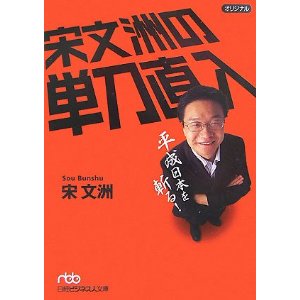
単刀直入
tan.tou.choku.nyuu

Literally: simple/single – sword – direct/frankness/repair – enter

Alternately: Charging into a mass of enemies with just one sword to protect you. Getting straight to the point. Being direct instead of roundabout. Saying something point-blank without niceties or politeness.

Note: There is a tension, in studying foreign culture, between essentializing and Otherizing them (“all Japanese social interactions are ambivalent; the Japanese are trained from birth to be inscrutable and indirect, to place politeness and social self-defense over all else”) and pretending that they are only a trivial variation on a theme (“everybody’s the same no matter where you go, right?”). In my mind this phrase highlights that tension: Japanese people can be direct instead of tactful or considerate when they want… but perhaps there is more danger felt in the act than in the relatively blunt and forward USA.

MoneyMoneyMoney

Would somebody write a book for businessmen based on the idea? You tell me.

Posted in Japanese, Yojijukugo | Tagged , , , , | 2 Comments

Directions, Part I

As a grad student taking two translation workshops and teaching two drill sections (first-year Japanese ), I don’t have a lot of time for writing. What I can do, and have been doing since A Flight of Words, is put up old work to help maintain a steady flow of material besides just the two Japanese projects I’m indulging in.

The following is my longest completed work at about 9,600 words. There are a number of things I’d probably want to do differently if I were writing it now, and in fact it underwent several minor edits when I dug it up today. It’s also one of my first attempts at actual plot, and is over a decade old: CDs were still a major medium for portable music! Finally, the story is long enough that I’ll be breaking it up into chunks, to be posted weekly. Please enjoy.

Warning, for those who need such things: this story depicts swearing, drinking, and other shenanigans.


 Directions

It was evening when they headed off, and Seth found himself recalling a chronic nightmare from his early teens. It had always been the same dizzying non-scene. Instead of the comfort of true dark it had been suffused with suffocating dimness; instead of the clarity of true cold there had been a damp chill; instead of the pleasure of solitude or company, he had been crowded by unfamiliar faces of people it seemed he should have known. Remembering, he could almost feel the unreality of dream coming over him. He wasn’t even drunk yet, although the evening would certainly culminate in a booth at the Welcome Mat. Now, not yet drunk, he found himself surrounded by half-light, chill, and strangers.

Who were these people? Most of them, he had known in high school—known them. They had made fun of each other’s faults and dreams, had eaten together at lunch and copied each other’s homework, already copied from awkwardly condescending nerds; they had told the track team to run Forrest run, told the football players to stick it and where, told each other that girl X was just a cheap ride anyway. They had known each other the way you’re supposed to know your clan. And now this.

Had Seth always been on the fringe? Had he held together with them because they were his people, or because there was nowhere else to go in the cramped world of high school? He had never thought about it before college, and thinking about it now, he didn’t know. Jeremy, the band geek, had become a steady-C music major, with a sudden Asian fetish that bordered on disturbing. Darner had started dabbling in some “urban dance” thing, taking himself and the way he moved too seriously and expecting others to as well. Even though, trying to swagger, he walked like a drunken, crippled penguin. Darner’s girlfriend Donna was mostly unchanged, but she had always been a pharmacist of sorts, and seemed to be expanding the range of drugs she handled now that she was away from home. Seth himself had given up black grunge sweats in favor of jeans and gray grunge t-shirts, but didn’t feel any different. There were a half-dozen others from the clan who might not have changed. But they weren’t here, and if anybody kept in touch with them, Seth didn’t know about it. There were others here now—Donna and Darner had picked up a couple warm bodies, and Jeremy seemed to meet an endless succession of wannabe band-girls—but who were they? Not Seth’s clan.

The group was on its way to see Dead Gun IV, in which people struck well-angled poses and then were blown up, or blew something up, or maybe said a line. Or all three, wearing designer shoes and brand-name clothing. The lines from the previews were good, at any rate. And one of Jeremy’s wannabes was on the verge of hooking up with Seth. She was a saxophonist. Jeremy had subtly rejected her because of her short hair, but she was hot enough that Seth was willing to see what happened when she’d had a few.

They were rattling down to the parking lot, where Seth’s secondhand compact and Donna’s pickup and one of the druggies’ cars waited. Jeremy had a truck too, of truly ancient years, but it had spontaneously ignited last month and he didn’t trust it now for anything more than a series of jokes. That was Jeremy, at least—not familiar, or even recognizable as a human being, but as a humorously paranoid relationship. Seth opened his mouth to say something funny and not really nostalgic at all.

Old friends

The young woman was sitting on a park bench under a tree, reading. She looked like she was in her late twenties, with dark hair that curled halfway down her back. She read by the illumination of a nearby streetlight, and the glow of it gave her an unearthly aura, a personal space inviolable to every force Seth knew. Her tanned skin shone softly: her hands, her face, her throat. She seemed to glance at him for a moment as he and the others passed by. Her eyes were distant, untroubled, dark; they were unexplored territory; in them grew virgin forests. She turned a page, reached out with one hand and lightly touched the tree trunk in a seemingly unconscious gesture, eyes on her book, so that Seth could not be sure she had ever looked up at all. That was the first time he saw her.

He forgot what he had been about to say and remained silent until they reached the theater and bought tickets.

The movie was unable to hold Seth’s interest, and he found himself restless even during the climactic battle. Walking out of the theater to the parking lot, he found that he had been developing a headache for at least the past hour, and that he was in a foul mood. He spat on the sidewalk. That was from high school, and one of those people remembered what it meant.

Jeremy said, “What, I thought it was ok.” The girls all nodded except Donna, who was still humming the theme off-tempo, which she always did for kicks. The other guys said several things in favor of the lead female character and her guns. One of Darner’s crew admitted that the kung fu had been weak, but argued that the grappling-hook scene made up for that easily. Seth spat again dismissively.

Darner chipped in snidely. “Oh, what are you now, an artist? You go to Dead Gun flicks for plot, hey?” It might have been a joke at the expense of the movie, but Seth didn’t care.

“I can’t believe you posers,” he said. “It was crap! I’ll pay to see the CG, but we did better shit than some of that with a potato gun in grade six. A little quality, please!”

Always, one person didn’t like the movie when everybody else did, or loved what the rest knew was an obvious bomb. It had never been Seth before. Mr. Kung Fu started telling him that anything with a fast-cut gun-and-machete fight at two hundred feet, on the side of an office building, was quality, and Seth turned on him and said “Yeah, if you ignore the jungle groove sound track. What the hell was that?”

“Sure,” sax girl said suddenly, “you go listen to your emo rock.”

There was laughter. The world was dim, cold, alien, and laughing at him. Seth’s whole body warmed fuzzily; the air constricted around him and then went loose. All the words he knew were meaningless. He went to his car as if it hurt his legs to walk the same asphalt as his former friends.

“Hey!” shouted sax-girl. “Hey, you giving me a ride or what?”

A few choice lines presented themselves, most of them involving keeping his car free of herpes virus. But he was sick of lines, and wouldn’t have spoken even if he could. He drove away in silence. They were no longer his people.

*

A month later, Seth’s life and therefore his mood had not improved appreciably. He stalked into his dorm room and threw his backpack onto his bed as the door, driven by weighted hinges, slammed shut behind him. “Well, this day was sh—”

His roommate Isaac tensed slightly, hunching over a textbook. “Don’t.”

He spat into the trashcan. “Why not?”

Isaac turned and glared. “We’ve been over the free speech thing. You may have had yet another bad day, but we all have bad days and I want my room to be a pleasant place.”

“Yeah? Well, it’s not ‘pleasant’ for me unless I can cut loose. You understand? You’re so… sterile. I can’t stand it.”

Seth sagged into his chair and put a pair of headphones around his neck. With a sigh, Isaac changed the subject. “So, what happened to make your day so lousy?”

“Lost my job.”

“So? I thought you said it was a ‘crap job’ you couldn’t wait to get out of.”

“Yeah, well, it kept me in school. I don’t find another soon, I’ll have to kill my savings just to pay the next fee bill.”

“I thought that you wanted to quit here because you hated everything about it. Wasn’t that why you refused to pick a major?”

Seth was rummaging through his CDs. “That was back when Dad was willing to pay for me to go to the technical school. When I failed English last semester, he almost disowned me. ‘You’re on your own now,’ he says. ‘If you got time to party and get piss-ass drunk, or whatever it is kids do these days, then you got time to study.’ He’s not going to pay for my education if there’s no return on the investment.”

“Makes sense to me.”

“It’s not like I could help it the professor was a rat bastard who hated me.” Choosing and inserting a disk, Seth started his player and turned the volume all the way up without putting the headphones on his ears. He put his feet against his desk and tipped back, apparently listening to the music through his neck.

“Last week you were talking about quitting school and just working. I thought you—”

“You think too damn much.” Seth slammed his chair back down. “I don’t have a damn job any more, do I?”

“You keep talking about your dad. What does your mom have to say about it?”

“She’s dead.”

“Oh.” Isaac looked down at his books. “I’m sorry.”

“Goddamn crazy dad sits around writing poetry to her and telling me to make something of myself even though he’s going all to pot.”

That shut Isaac up for a while, except for another mumbled “sorry.” Finally, he came up with a non sequitur. “I have a friend who works with the student newspaper; he could find you a little gig for the time being.”

“What? I don’t want any jobs at our paper. It sucks.”

Isaac snorted. “They don’t take people who’ve failed English anyway. But the office is always looking for people who live on campus, to do deliveries in the morning.”

“Shyeah, right.”

“Seriously. You get up at four, walk a quarter of a mile to Journalism. The printer people drop off the bundles.”

“Sure.”

Isaac plowed through the interjection. “Then you put them in the on-campus delivery truck and leave one bundle in the box at each building. Then walk back here. It takes an hour if you do it right, and they pay ten dollars a day. It’s the perfect extra-cash job.”

“You are so full—”

“That’s seven hundred a semester. That pays for the meal ticket at least. And ten dollars an hour is more than they pay the people who write the thing.”

“If it’s so good, you do it,” Seth said dismissively.

“I already have too much work to do, especially with training and classes at Serif. I can’t live on three hours of sleep a night.”

“So what about tuition?”

“I don’t know. I’m sure the Student Center could find you workstudy on campus if you’d quit whining and ask. Go to sleep earlier in the evening and you’ll be fine. You have most of your classes relatively early in the day anyway. ‘Early to bed and early to—’”

“Just shut your face. I’ll try it ‘cause I need some cash, but if I don’t like it, I swear I’ll wake you up every morning to say how stupid your idea is.”

“And I’ll give your beer to the hall monitor.”

“Bite me, you fucking puritan.”

Isaac smiled to himself.

(Continued in part II)

Posted in Long Fiction | Tagged , , , , | 4 Comments