Dungeon Design 101, Part 3

In part 1 of this essay I talked about using randomness to generate a dungeon of your own on the fly. That’s easy to say, but might you actually do it?

Three Methods, in Outline

First, there are online generators. Just adjust a few variables and bam (actually, click, but nu), dungeon. A quick search turned up this rather nice one by donjon, which also has a number of other potentially useful generators.

The benefits of this approach include instant map and layout, with (depending on what generator you’re using) room keys that may specify encounters, decor and treasure. The downsides include some difficulty in fitting those keys to what you want for your campaign world, in terms of content and atmosphere, largely due to a sort of generic feel.

Second, there’s the infinite power of Google. Search for a floorplan, decide on what kinds of things will be in it, do some image searches and start grabbing interesting ones to paste in. I can’t think of a better example than the first person I saw using this technique [http://dndwithpornstars.blogspot.com/2011/11/it-came-from-white-dwarf.html], Zak S.

This method is nice because it offers orders of magnitude more control than the previous while still saving you a lot of time and possible art-related stress. It also conforms nicely to almost any amount of time you care to spend on it. The downsides are that the stocking method requires a lot of on-the-fly DM judgments about stats, and that if you’re feeling picky it can take a really long time to find something that satisfies you.

Third, there are geomorphs. Using these is much like using a dungeon generator, but with greater ability to tweak, and infinite extensibility. As things currently stand, most geomorphs seem best suited to generating huge sprawling complexes. That said, if you’re only looking for a tiny cave, it should often be possible to just grab a likely-looking block and ignore the extraneous exits.

One More, in Detail

Fourth, especially if you’re at the gaming table without internet access and need to really make a dungeon on the fly, you may want to think of some rules for dungeon generation using dice. Note that even with the dice helping you, this method requires you to think fast on your feet, and it really really helps to build your random tables ahead of time. That said, here’s a quick example I just whipped up.

The PCs look through the entrance. What do they see? Roll d6:

1 – tiny room, 2 – medium room, 3 – large room, 4 – hall, 5 – grand hall, 6 – complex room; roll twice and combine the results in some way.

What’s there? Roll two d10s, this time. The first die:

1 – dangerous enemy or large crowd of weak enemies, 2 – moderate enemy or moderate crowd, 3 or 4 – minor encounter, 5 – normal animal(s), nonhostile, 6 – NPC(s), nonhostile, 7 through 10 – empty.

The second die:

1 – pit or other floor hazard, 2 – partitions, pillars, or something similarly space-blocking, 3 – trap(s), 4 – barren and open, 5 – liquid: a pool, well, etc., 6 – something weird in a mechanical or magical way, 7 – sparse but ordinary furnishings, 8 or 9 – normal furnishings, 10 – really cluttered. (Substitute vegetation, etc. for “furnishings” in a natural setting.)

Here’s the fun part. Compare the numbers on the two dice:
If they differ by 6 or more, there’s nothing else special about the room. Sorry.
If they differ by 5, any current inhabitants are already fighting or otherwise in a tight spot; if empty, there are signs that there was a recent battle or other danger here.
If they differ by 4, the furnishings and decorations are especially ornate (evens) or spartan (odds).
If they differ by 3, there’s a secret (door, compartment, etc.) or clue (for example, if you’ve decided the dungeon contains a dragon, there are some old flaked-off scales scattered around; if it has a basilisk, there’s a curiously lifelike statue).
If they differ by 2, there’s something technically ordinary that still stands out (fresh animal droppings, graffiti left by bored inhabitants, etc.).
If they differ by 1, there’s an extra trap or hazard.
If they’re the same, there’s a treasure!

Excellent, that’ll keep your players busy for a little while. But sooner or later they’ll want to find out what else there is, so quick, roll 1d3-1 for small rooms, 1d6-1 for medium rooms, and 2d6-2 for grand halls; that’s the number of (immediately visible) other doors (besides the one they came in by). For any given door, place a d6 on the table and roll another; comparing the number given by the second die to the corresponding face on the first die gives the location of the door. (For example, if you place the first die with the 6 facing down and then roll a 6, the door is a trap door in the floor. If you roll a 1, it’s in the ceiling. And so on.)

Want to make the door more consequential? Assume it’s not ordinary and roll a d6:

1 – locked, 2 – trapped, 3 – stuck, 4 – weird materials or nonstandard shape, 5 – alarmed or guarded, 6 – roll twice and combine.

I’m not saying this is all you’ll ever need for a dungeon. You can add more tables containing other details. You’ll probably want to adjust these tables to fit your needs and style even if you decide to use them. And even if you use them as-is, it won’t work too well without some improvisational ability, and perhaps a bestiary with multiple indices you can use to generate foes. But it’s better than nothing if you want to give the PCs some controlled space to explore.

Of course, these posts will have been most successful not if you just use my suggestions – although that would certainly be gratifying – but if my thoughts on the matter inspire you to create, and what you create makes your gaming fun and interesting.

Posted in Essay, Nonfiction, World-Building | Tagged , , , , , , , , , , | Leave a comment

Dungeon Design 101, part 2

I’ve thrown around a lot of theory, but how does that come together in practical terms? Here’s the outline it implies when trying to create a dungeon.

  1. Decide the dungeon’s purpose in play.
  2. Decide the dungeon’s identity within the game world.
  3. Using real-world references, random generators, or your own drawing skill, get a map.
  4. Stock the map with challenges, puzzles, rewards, and any other details you want to add.
  5. If inspired to do so, repeat steps 3 and 4 (adding new space and content, respectively) until satisfied.

1. Dungeon design should reflect its purpose. If it’s just there to contain a single encounter or treasure, or just as a random cave (to shelter from the rain in, for example) or building, it should be small and simple; a room or a handful of rooms. If it’s a megadungeon intended to take the players through several levels of gameplay, it should be a multi-floor complex with a complicated, interconnected floor plan, secret doors, traps, and foes and obstacles throughout.

Venues intended for combat should have interesting architecture: large open rooms with furnishings and features that can be used creatively (balconies and tables, pillars and pits). Venues intended for puzzle-solving should be built around the puzzles (perhaps taking a cue from computer games, in terms of room design). Venues intended for exploration should have lots of secrets and interesting features.

2. Think for a moment about the dungeon’s location, origin, and use; these will all inform both its layout and features.

Where is the dungeon? The surrounding terrain will be reflected in its design. For example, caves or underground complexes will often be made of the local rock – or need supports if built in soil. A fortified bridge over a waterway will be split, and defensible from both ends. Even a building in a city will vary depending on its surroundings: built on a slope, it might be partially embedded in the ground, so that the first floor is also a basement. In a densely packed city, buildings will be narrower and more vertical than in a scattered town.

How did the dungeon come to be? I don’t just mean how the space was first created – natural cave or animal burrow, or its construction – but also how it got to its current state. Perhaps a natural cave was worked and reinforced by its later inhabitants. Perhaps the castle has fallen into disrepair, with blocked passages and crumbling towers. Perhaps the mansion has passed through the hands of a dozen families and generations, with each adding or renovating a little according to their tastes and needs.

Be careful here. I’m not saying that each dungeon needs a complicated, complete history before you can start designing it. This step need be no more than a general feeling or a couple sentences, but anything at all will help you design and stock it coherently.

3. Whether you generate it randomly as you go or hand-draw it lovingly in several colors long before play starts, a dungeon will generally need to be mapped by the time the players are done with it. There’s nothing wrong with looking for maps other people have made and repurposing them for your dungeon, even tweaking them to fit your needs more closely. I recommend, for starters, the maps of the inimitable Dyson Logos. Especially if you’re trying to scatter a number of dungeons around a large map, this can save you a lot of time.

Let’s say you’d prefer to draw your own by hand. As with writing, it’s next to impossible to tell you how to draw a good map; that’s partially a matter of your own goals and style. If you want to learn how to draw maps to your satisfaction, though, here are the standard tips for would-be writers:

A. Find references. If you want to write, read a lot; if you want to draw maps, look at a lot of maps. Don’t just look, of course. Think about what you like and don’t like about them, and why. Not the art style – although that’s something you may want to try to copy, it’s also not necessarily going to be shown to the players – but the construction. Borrow good ideas, and poke at bad ones to figure out why they’re bad.

B. Practice. If you want to be good at making maps, make a lot of maps and expect most of them to not satisfy you. There’s nothing wrong with that: since it’s helping you refine your skill, the time’s not wasted, so at worst you’re only out a trivial amount of scratch paper and ink or pencil lead. When you’ve got some maps that you like the look and feel of, try running the players through them and see how it works out. This is also part of your practice. If you don’t play-test maps, it’s hard to get a feel for what works and what produces a satisfying session. Don’t worry if you make some maps that fall flat; the important thing is that you’re creating and learning and improving, rather than just sitting there wondering how to draw a nice dungeon.

C. Use feedback. Using what you’ve learned by looking at maps, drawing or stocking your own, and using them in play, think about what works for you, and how. Think about what the players liked, and what they rushed past or seemed bored, confused, or frustrated by. If you’re feeling really brave, ask them directly for constructive criticism. Keep all this new data in mind next time you try to create – but as before, don’t let it paralyze you; don’t be afraid of making mistakes.

4. Stocking your map should be relatively easy because it should follow from the other steps: the atmosphere, the enemies, traps, puzzles, interesting odds and ends, and loot or other rewards will often suggest themselves based on what you’ve already made. If you’re feeling stuck, though, try making a list of things that you can put in. Brainstorm for a while. Add things that specifically don’t match the rest of the atmosphere and then reconcile the contradiction, to make things a little more interesting. Which brings us to…

5. Don’t be afraid to go beyond your original design ideas, even if it means tweaking or completely overhauling the dungeon’s seeds from step 1! Maybe in brainstorming, you thought of something interesting you want to add, but the dungeon needs to be reworked for it to fit. There’s nothing wrong with doing that. If you can’t bring yourself to, well, then you’ve got the seed for another dungeon already growing; that’s great!

Next time: some examples illustrating what I mean.

Posted in Essay, Nonfiction, World-Building | Tagged , , , , , | Leave a comment

Dungeon Design 101

I was reading the Alexandrian post about the 5th Edition D&D announcement and was struck by a couple of commenters saying they wanted to see a guide to dungeon creation; that no such thing yet exists. This is a real shame, since one of the primary tasks of a DM is creating environments for the PCs to play in, and making a fun and useful one is hardly an intuitive process. Well, allow me to attempt to fill the need to some tiny extent.

Keep in mind that in this context, “dungeon” doesn’t just refer to an underground fortified construction; it’s the term for any set-piece area that the players explore on a local scale, often with a relatively high density of challenges for them to overcome and rewards for them to collect. “Dungeons” are usually clearly separated from the outside world in some way and subdivided into units – rooms, halls, open spaces, filled spaces. That said, dungeons can have a variety of purposes, and these should be the primary consideration when you design each one.

What kind of play is the party interested in? Exploration? Tactical combat? Puzzle-solving? Do they like short, fierce encounters with downtime in between, long running battles, or carefully-planned surgical strikes? Do they want to sneak past enemies or negotiate with them instead of fighting at all?

And nearly as importantly, what is the function of the dungeon in the campaign world? A temple or other religious location would be relatively accessible for its worshipers, even if well-hidden, and most will be open, with the construction focusing on central holy spots and relatively large public areas. A military installation, on the other hand, would be better defended, not only by its inhabitants but also as much as possible by its construction and location within the landscape. A animal’s home will be simple, with greater numbers of exits if it supports a large colony or if its inhabitants have natural predators. And so on.

Suddenly, a Dungeon!

Sometimes, a random encounter table produces something that would logically have a home base, and you need to create one on the fly. Sometimes, the party wants to do something that you’re not ready for yet and you need a quick distraction that you can pass of as a random encounter. Either way, there may be times when you want to design a dungeon in short order. I suspect that your best friend here is randomness. Need a floor plan or map? Do an image search. Find an online dungeon generator. Zak S. has some excellent advice on whipping up a dungeon in short order, or just making a really creative one in your spare time.

Let’s say you’re not online, though, and you need a dungeon right now. It’s time to break out the dice and let randomness guide you. I’m going to include an appendix at the end of this with an example of using dice rolls to create a dungeon on the fly, but for now think about some aspects of a dungeon that could be whipped up that way. In the meantime, there are some elements of design that should inform any dungeon, whether you’re making it up as you go or crafting it lovingly before you even have a campaign to use it in.

General Guidelines

1. Know the dungeon. Is this a natural cave? An animal’s den? If it’s an artificial structure, what is the culture of the people who made it… and of anyone that’s lived there since? This isn’t something you need to tell your players directly, but knowing a dungeon’s motif makes it easier to add detail on the fly, and can give the whole thing verisimilitude. Little details like the tools being made of bronze instead of iron, or the walls being decorated with a particular art style, can go a long way toward full player immersion in the world.

There’s more to this than just coherent flavor text, though: knowing a dungeon helps you draw the floor plan. If it’s a kind of building or locale that exists in real life, look at those for inspiration; otherwise think about what design choices the builders would have made. A place made with defense in mind will have narrower halls and more chokepoints and death-trap rooms (think of the inside of a gatehouse) than a place made mostly for living or practicing a trade in. Poor builders will leave more plain construction and smaller spaces than rich ones.

Knowing a dungeon also tells you what kind of challenges the players are likely to face in it. The tombs of wealthy kings will have lots of durable traps; well-known ones may have rival treasure-hunters or signs of previous incursions. Outlaw hideouts, on the other hand, are more likely to have lookouts, alarms, and hostile inhabitants.

2. Make each one interesting. Each dungeon, whether it’s a one-room cave with a bear inside or a sprawling high-tech compound full of guards and environmental defenses, should be distinct from the others the PCs – and the players – have encountered. In part this should follow from rule 1: if each dungeon has its own unique character guiding its setup in your mind, then the cumulative effect of all the little details, from mere wall decoration to the forms the challenges and rewards take, can add up to something memorable.

Beyond this, of course, it can be nice to go out of your way to give each dungeon a special feature. It’s divided into halves by a narrow passage or precarious walkway, allowing the inhabitants to set up a defensive chokepoint. It seals itself shut at intervals, limiting both intrusion and exit. Its only defense is one massive, elaborate trap. Or perhaps it’s full of tiny, harmless, infuriating booby-traps. It’s built around a central pit, pillar or other structure that allows for non-standard ways of traveling through it. It’s home to a foe or hazard that could wipe out the entire party if they don’t plan properly – and signs that that danger lies in wait.

That said, don’t worry if the “memorable thing” you planned isn’t what the party remembers. Maybe what stays with them longest is the random-encounter NPC they accosted to ask for directions, or the loot they came away with. That’s okay. But make sure that there’s something you can point to that distinguishes each of your set pieces from the others.

3. Put in useless things. In the service of both world verisimilitude in general and rule 2 in particular, you should be able to tell the players things about the dungeon that don’t give them XP, don’t have any obvious use in combat, don’t give bonuses to stats, can’t be easily sold. Put in things that are just there to be interesting, or mysterious, or realistic. This doesn’t mean that you need to calculate the population of each dungeon and make sure that there’s an appropriate number of chamber-pots. It does mean that if the players find a chamber-pot, they think of it as a piece of local color rather than vital key to some part of the plot to be investigated and taken.

I include here something that could also have been in rule 2: one of the tools that makes a dungeon unique and memorable is item or treasure that the players can find there, and nowhere else. This could be a plot-vital resource or McGuffin, or just a unique bit of flavor text: the treasure stash contains rare red pearls, for example.

4. Put in important things. Part of the appeal of RPGs is the feeling of progress and gain. If all they do is go into a place, kill some enemies, and then go to another place, no amount of colorful description on your part can keep the game fresh for very long. Every location should have something in it that makes the PCs glad they went, or interested in going back: a mystery, a puzzle, a tool, a toy, treasure, allies, information. (By “toy” I mean anything intriguing that the party can have fun fiddling with even if it isn’t a mystery or puzzle, such as a stage, a party hall, or just a nice fishing spot.)

5. It shouldn’t be too big. It shouldn’t be too small either, of course. But it’s better to leave the players wanting more than to make gameplay feel like drudge work. And it’s both easier and less wasteful to add new content – Oh look, a secret door that you missed earlier!; Oh look, a sinkhole opened up in the ground! – than to try to prune off areas that the PCs haven’t explored or noticed yet. When in doubt, leave things a little small; the worst that can happen is you’ll finish the dungeon earlier than expected.

This has gone a little longer than I had anticipated, so look for a part two in a few days with a process (hurrah more ordered lists!) and some examples.

Posted in Essay, Nonfiction, World-Building | Tagged , , , , | Leave a comment

History Online – An experiment in playing Microscope on the internet

Introduction:

Microscope is a social game which I should probably write a more thorough review of at some point. For the time being, let’s say it’s a group storytelling/improv-acting game that I’m entirely in love with. The more literature-nerdy you are, the more it’s likely to appeal to you. All you need is a few players, some note cards, and something to write with.

Sadly, I live in Japan, where local English-speaking acquaintances are in relatively short supply and often busy. I have friends willing to join me in a game online, but this raises the technical question of what to do about the note cards. The format demands something that can be updated in real time, so simply emailing a text document around would be too clunky to work.

Setup:

Two elements were needed. The first was a text medium to take over the role of the note cards: something that allowed maximum visibility of the history being created, allow new material to be inserted into the middle, and allow real-time updating that everyone could take part in and see. The second, an audio medium to allow smooth communication. Attempting to run the entire session by chat or email would, at best, eliminate the ability to play through scenes (the “improv acting” portion of the game) and at worst, bring the attempt to a grinding, anticlimactic halt.

My initial idea was to use Google Wave, given its billing as a real-time group text editing tool, but on the suggestion of one of the players, we switched to Trello, which I’ll cover in greater detail below. We began our session using a G+ video “hangout” for verbal communication, but technical problems with two people’s cameras forced us to switch to a group chat on Skype.

There were four players for the session. All of us had read the rules; two of us had played once before (together) with a different group when I first got the game. I was a little worried that this combination of firsts – unfamiliar technology supporting an unfamiliar style of gameplay using unfamiliar rules – could be disastrous, especially when you factor in the potential personality clashes that come with any social game.

Results:

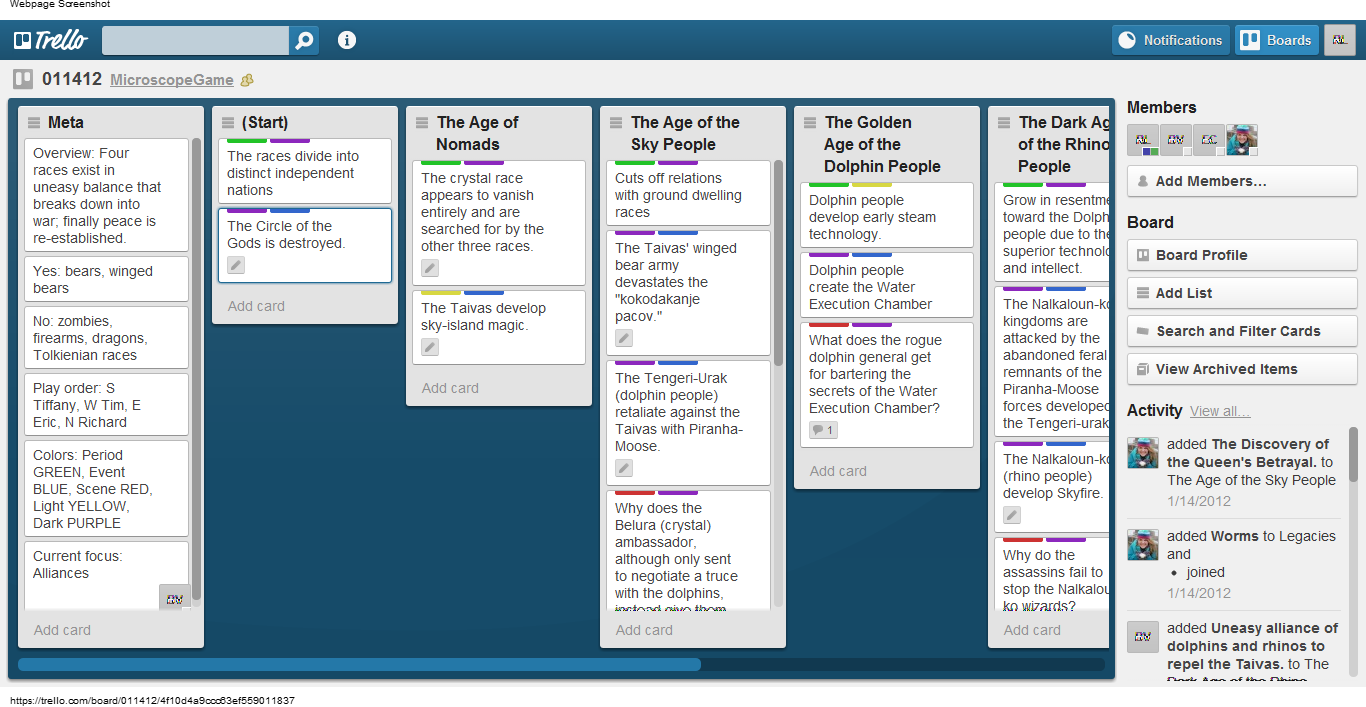
Kaynahara*, things went nearly as well as could ever have been hoped. Aside from a couple minor hitches, the technology performed so fluidly as to become invisible: a smooth, clean vehicle for the group storytelling. Although in moving from Google to Skype we lost our video connection, I at least never missed it; I spent all my time looking at the Trello “board,” so voice was sufficient. And in contrast to the vertical text-centric structure of Wave, the list-and-card structure, with its color tabs and other options, fit our needs to a surprising degree. I was left with the satisfied feeling of having been given truly useful tools before I had even realized I might want them.

Trello is a web-based application that I’d never heard of before this morning. According to the (incredibly sparse) Wikipedia page, its intended purpose is “project management.” Signup is free, and can even be done through your Google account. When you’re in you can create groups (“organizations”) and invite people to join, and you can create documents (“boards”) that invited members can freely edit.

Each board includes a set of “lists” that line up horizontally on the page; add enough and you get a scroll bar that pops up at the bottom. Each list can contain any number of “cards,” which themselves can hold notes and checklists, be voted on and given due dates, and be color coded. Members’ icons can be dragged to assign people to particular cards as well. Enough cards in a list, and it develops a little vertical scroll bar of its own rather than the entire page expanding. Lists and cards can be rearranged at will, even moving cards from one list to another.

We set things up with our palette and other administrative details of the game on the far left, and the legacies on the far right; the member-assignment function came in useful here. All the lists in between became our Periods. I was a little worried that the width would lead us to forget things out of sight and focus on a narrow band of the history, but that seems to have not been a problem. There was some bunching up of created elements, but that stemmed mostly from the flow of interest and the fact that we only got one Focus each.

Problems:

Trello was not without issues. While the interface was incredibly intuitive for the most part, it would have been a lot more daunting to get over the initial hurdle without the video on the front page… which becomes inaccessible if you’re signed in. It took us a while to figure out how to edit the titles of lists and cards (you have to click on the title – in the main window, for lists, but in the card-edit window for cards) and then wait a moment for an editing box to appear). Worse, if you try to use the “activity” item for notes, it seems that it can never be edited, only deleted and rewritten. Lists cannot be customized with colors or other elements the way cards can. The colors themselves were hard to find (hover on a card to see a down arrow on the right; click on that, then on “labels” in the list that pops out, and then click on all the colors you want to assign). And a couple of times, my typing was inhibited by lag; there might be limits to how much information the application can handle at a time.

Despite these problems, I was overall incredibly pleased with Trello’s performance. The visual structure followed what you’d get naturally from using cards on a tabletop. We also were able to pack in detail without cluttering the space, while retaining visual cues telling us where to look for information that wasn’t immediately obvious. We were able to use the color tabs to effectively distinguish Events from Scenes and light Tone from dark. Because Microscope depends on an order of play derived from the location of players in space around a table, we simply assigned one player to each cardinal direction and made a note of it in our administrative list on the left.

To the Future!

As well as the session went, here are a few things I’d like to do differently next time. First, it should have been relatively easy to work our little compass rose into something that made it more intuitively, visually obvious who was to the “left” and “right” of whom. We also could have added a card showing the current Focus (we lost track at one point during the game when everyone took a break) and Lens, taking further advantage of the member-assignment function. As it was, I felt the need to keep track of all that on a sheet of scratch paper by my computer.

Another thing I kept notes on was the character selection for Scenes; perhaps a temporary card (even a separate list, off to one side, to store those cards?) could have taken care of that for us. And finally, we had a relatively small number of acted Scenes and never used Push; how would we best take care of that without being able to see anyone’s fingers?

I’m not entirely sure about that. It would be best to preserve the flexibility of finger-voting, with strength of preference between one and five; it would also be best to keep it free of influence, so simultaneous voting is required. Trello’s built-in voting system doesn’t allow for either of these – perhaps it would be best to have a voting list, or a voting space on some pre-existing list, with each player creating a card of their votes and then adding them together on the count of three.

Beyond that, I’m sure there are a number of stylistic choices and minor adjustments that a group would need to work out. I suspect that the “card description” option – which didn’t catch my attention until after the session had ended – is better for notes than the uneditable “activity” item. It might be worth experimenting with giving each list a card below its title to contain detailed descriptions and a color tab for tone.

As with any social game, the ideal way to play Microscope is still in person, with full access to body language and tone of voice, unfiltered by electronic media. If you must play at a distance, though, the combination of Trello and voice chat is a close fit to your needs.

(This is how our completed game looked. Note that a significant portion of the content is not immediately visible: for example, the palette items, answers to the scene questions, and other notes are only visible if you click on the cards in the Trello board.)

Update

In the nearly two months since this was posted, I’ve played several more sessions of Microscope using the same combination. A couple games were interrupted by Trello’s site update schedule, but I’m happy to report that this was more of a break time than an outright inconvenience. And I have another screenshot showing how we’ve updated our play style.

This is how we were doing it later.

Note that we have added a card for the current Focus and Lens as well as a descriptive card  for each Period (green label). We have not managed to find an easy way to make the compass rose for order-of-play more intuitively graphical, nor have we started using cards to keep track of Scene data; I find myself still referring to notes on scratch paper for a number of things.

One peculiarity of the people I play with is that we have yet to use Push. I was wondering whether I should hold off on this update until we did, and worked out how to do the finger-voting online, but after two months and no clear gaming schedule I decided not to put it off any longer. It seems there are a number of ways this can be done; I’d love to hear from anyone else who has found something that works for them.

I will say that Trello continues to be a joy to use. Manipulating the elements on the field is a bit tricky to get the hang of without some help, but once you know how to do things, usage itself is intuitive and smooth. I have no real complaints about it, and recommend it to anyone interested in online history-building.  8^)

Posted in Nonfiction, Review | Tagged , , , | 9 Comments

Three Faiths, One Hamster

 The mad scientist carefully loaded his pet hamster into the rocket’s nose compartment.

“Master!” hissed his Igor. “Are you not afraid that this, too, will break up on liftoff? If Fluffywuff were to die in vain–”

The mad scientist polished his fingernails on the lapel of his lab coat. “Hush, Igor. I have complete faith in my calculations, and so should you.”

Andy waved goodbye to Betty. She flapped the envelope as a return wave and mouthed “Thank you!” one more time before rounding the corner.

Carol asked him, “Are you sure it was okay to loan her that much money?”

“She’s been a good friend as long as we’ve known her,” he replied. “I have faith in her.”

Guru Dwayne watched the approaching missiles with unexpected calm. From behind him, someone shouted “We’re doomed! We don’t have any fuel left, and we’re still inside the blast radius!”

“Nonsense!” admonished Dwayne, not even turning to see who had spoken. “My horoscope says I will find love and/or a new hobby next week, so we will surely survive. I have complete faith in the benevolence of the stars.”

Occasionally, I stick my neck out into the Science/Religion debate on behalf of Science. A common line of attack brought to the fore at some point during the exchange is to the effect that believing in the results of science is itself a kind of faith, and therefore no superior to the faith, the belief in specific doctrine X, of the religiously pious.

I can see the logic of the argument. I’ve never personally performed the Michelson-Morley experiment, for example. How can I be sure that it is accurate without being a firsthand witness? Is my acceptance of its accuracy therefore not a kind of faith? And if so, how can my “faith” be different from any other “faith”? And ultimately, how is science different from any superstition?

Let’s set that aside for a moment and look at a different example. How can a “day” not be the same as a “day”? Well, a day in summer is longer than a day in winter, right? That depends on whether by “day” you mean a 24-hour span of time, or a period during which the sun’s light is directly visible. …In short, yes: it is possible for a single word to have multiple uses, related in meaning but distinct enough to make a difference. In fact, it’s not just possible; it’s commonplace.

And it turns out that the “faith” equivalence argument outlined above is nothing more than a semantic ploy to muddy the waters. I can think, off the top of my head, of three meaningfully distinct uses of “faith,” as illustrated in the vignettes that open this essay.

1. The “faith” of the mad scientist might be better termed confidence. He’s not foolish enough to claim perfect infallibility, but the thorough exercise of reason based on all available facts forces him to draw a particular conclusion. In this case, that his rocket design will work correctly. Similarly, most of us have “faith” that the moon’s orbit of the earth will cause the tide to go in and back out, and that in Euclidean space the angles of a triangle add up to 180º. But these beliefs aren’t based on a politically successful historical authority; we believe them because reason indicates that it can’t be any other way. This is the “faith” of science, which I plan to explore more thoroughly in a later essay.

2. In contrast, Andy’s “faith” in Betty stands on shakier ground. While there is a solid body of evidence in their shared history to support his belief that she can and will pay him back, something unexpected could still happen to change that situation or reveal that he had been mistaken from the start. He is not so foolish as to deny that possibility, but after weighing the facts at his disposal, he decided to err on the side of trust. This kind of “faith” affords less certainty than the scientific kind, but in most daily situations it’s the kind we must depend on to avoid indecisive paralysis. We generally trust that our cars will run properly, for example, and that fellow drivers will obey the rules of traffic, and we only stop making this kind of assumption when faced with evidence otherwise.

3. But Dwayne’s “faith” is clearly far removed from both the scientist’s confidence and Andy’s trust, despite all three having used the same word to describe their feelings. Instead of calculating or weighing the evidence at his disposal, Dwayne specifically excludes a set of relevant and highly significant evidence because it conflicts with the pronouncement of an authority that he cannot bring himself to question – and this despite the fact that his authority is vague and self-contradictory.

Why would Dwayne refuse to accept evidence of his own senses, refuse to draw his own conclusions using his own capacity for reason? Does he suffer from crippling self-doubt, or is he simply disconnected from reality? Can this species of self-negation even truly take the name “faith”? If you must use the term, at least render it accurately: Dwayne’s kind of “faith” is blind faith – for who are so blind, as they say.

So the next time a religious fundamentalist accuses you of having “faith” in data and reason (or the next time you, as a religious fundamentalist, feel the urge to make such an accusation), the response is that no – scientists have confidence, and normal people have trust, and both of these are qualities that the blindly faithful surrendered into the void long ago.

Don’t agree with my reasoning here? I’d love to hear about it, as long as you remain civil and on-topic. Feel free to comment below; that which doesn’t get you banned can only make me stronger.  8^D
Posted in Nonfiction | Tagged , , , | 3 Comments

Faith and Reason and the Atheistprofessor Boogieman

In the beginning, Al Gore created the internet, and saw that it was good. But then people starting sending each other chain mails, and spam, and viruses, and making crappy Geospaces websites, and things have gone generally downhill ever since. Unless you’re a cat, I guess. One of the effects of the internet is that people of like beliefs can more easily congregate and reinforce (and re-enforce?) their beliefs with each other… even if that belief is completely insane.

It’s only natural that both the chain mail trend and the “mutual reinforcement” trend would make the jump to social media, like HIV jumping from monkeys to humans, and thus I saw this post on Facebook earlier today, reproduced in full. Original emphasis in caps; my emphasis in bold.

An atheist professor of Philosophy was speaking to his class on the problem Science has with GOD. He asked one of his new Christian Students to stand and . . .

Professor : You are a Christian, aren’t you, son ?

Student : Yes, sir.

Professor: So, you believe in GOD ?

Student : Absolutely, sir.

Professor : Is GOD good ?

Student : Sure.

professor: Is GOD all powerful ?

Student : Yes.

Professor: My brother died of cancer even though he prayed to GOD to heal him. Most of us would attempt to help others who are ill. But GOD didn’t. How is this GOD good then? Hmm?

(Student was silent.)

Professor: You can’t answer, can you ? Let’s start again, young fella. Is GOD good?

Student : Yes.

Professor: Is satan good ?

Student : No.

Professor: Where does satan come from ?

Student : From . . . GOD . . .

Professor: That’s right. Tell me son, is there evil in this world?

Student : Yes.

Professor: Evil is everywhere, isn’t it ? And GOD did make everything. Correct?

Student : Yes.

Professor: So who created evil ?

(Student did not answer.)

Professor: Is there sickness? Immorality? Hatred? Ugliness? All these terrible things exist in the world, don’t they?

Student : Yes, sir.

Professor: So, who created them ?

(Student had no answer.)

Professor: Science says you have 5 Senses you use to identify and observe the world around you. Tell me, son, have you ever seen GOD?

Student : No, sir.

Professor: Tell us if you have ever heard your GOD?

Student : No , sir.

Professor: Have you ever felt your GOD, tasted your GOD, smelt your GOD? Have you ever had any sensory perception of GOD for that matter?

Student : No, sir. I’m afraid I haven’t.

Professor: Yet you still believe in Him?

Student : Yes.

Professor : According to Empirical, Testable, Demonstrable Protocol, Science says your GOD doesn’t exist. What do you say to that, son?

Student : Nothing. I only have my faith.

Professor: Yes, faith. And that is the problem Science has.

Student : Professor, is there such a thing as heat?

Professor: Yes.

Student : And is there such a thing as cold?

Professor: Yes.

Student : No, sir. There isn’t.

(The lecture theatre became very quiet with this turn of events.)

Student : Sir, you can have lots of heat, even more heat, superheat, mega heat, white heat, a little heat or no heat. But we don’t have anything called cold. We can hit 458 degrees below zero which is no heat, but we can’t go any further after that. There is no such thing as cold. Cold is only a word we use to describe the absence of heat. We cannot measure cold. Heat is energy. Cold is not the opposite of heat, sir, just the absence of it.

(There was pin-drop silence in the lecture theater.)

Student : What about darkness, Professor? Is there such a thing as darkness?

Professor: Yes. What is night if there isn’t darkness?

Student : You’re wrong again, sir. Darkness is the absence of something. You can have low light, normal light, bright light, flashing light. But if you have no light constantly, you have nothing and its called darkness, isn’t it? In reality, darkness isn’t. If it is, were you would be able to make darkness darker, wouldn’t you?

Professor: So what is the point you are making, young man ?

Student : Sir, my point is your philosophical premise is flawed.

Professor: Flawed ? Can you explain how?

Student : Sir, you are working on the premise of duality. You argue there is life and then there is death, a good GOD and a bad GOD. You are viewing the concept of GOD as something finite, something we can measure. Sir, Science can’t even explain a thought. It uses electricity and magnetism, but has never seen, much less fully understood either one. To view death as the opposite of life is to be ignorant of the fact that death cannot exist as a substantive thing.

Death is not the opposite of life: just the absence of it. Now tell me, Professor, do you teach your students that they evolved from a monkey?

Professor: If you are referring to the natural evolutionary process, yes, of course, I do.

Student : Have you ever observed evolution with your own eyes, sir?

(The Professor shook his head with a smile, beginning to realize where the argument was going.)

Student : Since no one has ever observed the process of evolution at work and cannot even prove that this process is an on-going endeavor. Are you not teaching your opinion, sir? Are you not a scientist but a preacher?

(The class was in uproar.)

Student : Is there anyone in the class who has ever seen the Professor’s brain?

(The class broke out into laughter. )

Student : Is there anyone here who has ever heard the Professor’s brain, felt it, touched or smelt it? No one appears to have done so. So, according to the established Rules of Empirical, Stable, Demonstrable Protocol, Science says that you have no brain, sir. With all due respect, sir, how do we then trust your lectures, sir?

(The room was silent. The Professor stared at the student, his face unfathomable.)

Professor: I guess you’ll have to take them on faith, son.

Student : That is it sir . . . Exactly ! The link between man & GOD is FAITH. That is all that keeps things alive and moving.

P.S.

I believe you have enjoyed the conversation. And if so, you’ll probably want your friends / colleagues to enjoy the same, won’t you?

Forward this to increase their knowledge . . . or FAITH.

By the way, that student was Einstein.!

moments of stories…..

Here is my response.

1. Einstein was Jewish. The story claims that the student was Christian.

2. Jewish cosmology doesn’t have a “Satan” figure, in opposition to God and acting as the source of earthly evil. That’s something the Christians stole from Zoroastrianism.

3. Einstein went to university at a polytechnic school in Switzerland, studying physics and math; he took no such philosophy class. And the modern conception of “science having a problem with religion” simply didn’t exist at the time. They acted in separate spheres. Science was the logos that described the physical world in rational terms, religion was the mythos that described the metaphysical world in metaphorical terms.

4. Any conversation would have taken place in German. Either the dialog above is such a loose translation as to have no meaning, or it was originally written in English.

It turns out that this kind of story is a genre unto itself among certain Christian groups. They misunderstand and mistrust both higher education as a whole and science in particular, and so they invent these little vignettes about the “atheist professor” and the “clever student,” in which the professor inexplicably begins browbeating students into atheism but is somehow rebuffed and silenced by a trite, incoherent argument from the student. Story ends in Christian triumphalism, affirming blind faith over “the wisdom of the wise.” Unfortunately, the student’s argument is fatally flawed throughout.

The professor character opens with a theodicy; a question of how an all-knowing, -loving and -powerful deity could allow evil to exist. The student responds with a heat/cold analogy, implying that no evil truly exists; merely absences of good. But this is clearly false: “absence of good” is apathy, not evil. And human apathy is not the cause of genocide; human apathy is not the cause of babies dying in famine or thousands of innocents dying in natural disasters. Further, why would an omniscient, omnipotent and omnibenevolent deity allow even apathy to generate pain, suffering and death for innocents?

The student twists the argument a little, though; instead of arguing directly against the existence of evil, he suddenly claims that death does not exist because it is not a “substantive thing.” But by that standard, neither does life. “Life” as we know it is a whole collection of biological processes, and very hard to define. Life is genetic material replicating itself and generating various chemical reactions. Life is not a thing, but an extended event.

Death is, similarly, an event. The heart stops beating. The nervous system stops firing. Cellular respiration stops. The body’s musculature relaxes, its temperature drops, and later rigor mortis and finally decay set in. All of these signs are as real and measurable as the signs of life. And if the death in question was the death of an innocent, cut down by an “act of God,” then it doesn’t matter whether that divinity is finite or infinite, dual or unitary, knowable or unknowable. An injustice happened and the deity is at fault.

Perhaps this story is a mash-up of two or more pre-existing stories. That would explain why it starts with a Christian student and ends with a Jewish one. It would also explain why the student leaves off the theodicy question in mid-stream, askew, and suddenly starts attacking evolution. Again, the student’s argument is flawed.

Evolution has been directly observed. Aside from the famous case of the peppered moths, the evolution of bacteria and viruses is well-documented, including the origin of a new species capable of digesting plastics.

For that matter, the student goes on to attack the professor’s brain, but brains are also easy to confirm experimentally, even without killing the test subject. MRI shows us pictures of brains all the time. Trepanning and other cranial surgeries expose the living organ to direct eyesight.

It gets worse, though. The student implies that everything not directly observable is a matter of “faith”… but ignores the ideas of indirect evidence, interpolation and extrapolation. If a hallway has two video cameras, watching each end but not the middle, and you see on camera 1 a person entering the hallway, and on camera 2 the same person leaving the hallway, then you assume that they walked down the hallway, even without having observed the event in person.

Similarly, untold millions of man-hours of science have gone into the unearthing and analysis, not only of an increasingly extensive fossil record, but also increasingly sophisticated genetic analyses. All of the evidence points to the existence of evolution, both on the micro scale (changes in phenotype and genotype frequency within a population) and macro (the generation of a novel population). The “theory” of evolution is no more debatable than the “theory” of gravitation.

Finally, the professor’s last line is inaccurate. “I guess you’ll have to take [my lectures] on faith, son”? No. That’s BS written by a lazy, ignorant, fanatical Christian. Here’s science’s real answer:

‎”Why should you trust my lecture? Well, first, if your teachers did their job right, you should be able to follow the chain of logic and evidence that modern science is based on. Have you studied math? Have you studied the experimental methods by which we measure and test the world? If there is any link in that chain that you disagree with, or don’t understand, then all you need to do is rigorously repeat the experiment and the calculations, if you want to check the results. Don’t just take my word for it; check it for yourself.

“Science needs no faith. Science lives with doubt, deals with doubt, even thrives on doubt, because it is *people asking questions* that drives scientific progress. Someone thought that perhaps a luminiferous aether exists; the Michelson-Morley experiment set out to measure it and found that it does not. Medieval Europeans thought that the world was flat; Magellan circumnavigated the globe and proved that it was round. Science is not a story of faith; science is a story of people asking ‘Why?’ and ‘How?’ and ‘Are you sure?’ Will the sun rise tomorrow? Evidence suggests that it will, but if it fails to then we have something new to learn about.

“Scientists have opinions, yes, and opinions are flawed. Science is a world where disagreements lead to vigorous, rigorous fact-checking, which leads to growth. Darwin’s theory of natural selection was modified — it evolved, if you will — to take into account the increase of human knowledge. Darwin didn’t know about DNA, but because science is based on questioning, his theory was able to grow and become more accurate. Science doesn’t stagnate; it never relies on blind adherence to assure its survival.

“What is the difference between me and a preacher? I interpret DATA, and demand that you THINK. A preacher interprets literature, and demands that you stop thinking. The thing that keeps me alive and moving is not faith, but the joy and wonder of solving the puzzles and mysteries given to us by nature.”

Nu.

Posted in Nonfiction | Tagged , , , , , , | Leave a comment

Four Realms: The Complete Experience

  Preamble

In some ways the heart of role-playing games is that they are success-and-improvement simulators. (There are other hearts, of course, so RPGs are similar in that way to how certain dinosaurs are said to have been, but let’s not stretch the analogy further than we have to.) They simulate many other things, of course – tactical combat, gleeful mayhem, puzzle-solving, investigation, exploration – but the aspect of the tabletop RPG experience that has carried over most pervasively into video games of the same appellation is the part where overcoming challenges grants some form of in-game currency that translates into new and improved skills and other advantages.

The most common of these currencies is “experience points” (usually known as exp or XP). In some systems, when a character has accumulated a certain number of points, they “level up,” improving on their existing skills and possibly gaining new skills and powers. In systems without levels, of course, this is impossible; alternatives have to be found. For example, White Wolf allows characters to use a pool of points to buy upgrades to their various statistics. But even this “pool” system is a little too dissociated for my taste, though. If you have an adventure that forces you to learn a lot about knitting, there’s nothing there mechanically to keep you from investing the episode’s XP into, say, helicopter piloting.

  The Rule

The obvious solution is for each skill to have its own pool of XP. When that skill is tested in a meaningful way – when one would expect to see improvement in its use – then it gets an experience point for its very own pool. When the number of points in a skill’s pool exceeds the current level of the skill, then the pool is emptied and the skill’s level rises by one. This is automatic, so there can never be more points in a skill’s pool than in the skill itself. And each gain in skill takes progressively longer, giving us a nice learning curve.

Example: Pierre has a Pastry Chef skill of 5, and the Pastry Chef XP pool has five points in it. The next time Pierre has a learning experience, instead of the pool filling up to six, it empties and the skill rises to 6 instead.

When should a character get XP? In part, that’s up to the consensus in each gaming group, again following the two golden rules of It Should Make Sense and Be Consistent. But in general the character is more likely to have learned something from overcoming (or merely facing up to) difficult challenges, and in general a more thorough success is likely to leave the character knowing what to do (as opposed to merely what not to do) next time. Suffering a solid or worse failure, though, indicates that the character was out of their depth, or having a very off day, so XP should probably not come from that.

There are also temporal limits. There’s only so much new information a mind can process at a time, and muscle memory takes time to build up. Except in a few rare, extreme cases, skill XP should not be gained faster than about one point per week of in-game time. This doesn’t need to be the exact span; whenever the flow of events hits a natural pause or the story demands a “time passes” fast-forward, that’s an opportunity to assign XP and recalculate skills.

  Off-the-Job Training

What about training? After all, you don’t start teach someone to be a car mechanic by throwing them into a warehouse full of cars and let them start trying to fix things. You teach them the parts, their functions, and standard methods of dealing with common problems. So clearly skills can gain XP in situations other than skill checks. For system purposes “training” will include any guided, hands-on activity that could improve skill use that isn’t a skill check, from homework problems to paid internships.

In the back of my head I want to work out a detailed system of checks for trainer and trainee to pass for training to be successful. Does the teacher know the material well? Are they skilled at passing on their command of it to somebody else? Is the student ready, willing, and able to learn? In a realistic system, there’s definitely a place for a Teaching skill. But too much complexity would have no other effect than to prevent people from using, or wanting to use, rules for training.

Let’s break it down like this: the teacher makes a Teaching check each time-unit (week or so). If the check succeeds, then the student automatically gains an XP in the relevant skill. The check is against a static target of (15) + (the level of skill the student is training for) – (the student’s relevant attribute modifier). That final factor might be a little counterintuitive because of the negatives, but remember that a more talented student will (presumably) learn more easily. For kinesthetic skills – ballroom dancing or capoeira, for example – the relevant attribute should be Agility; for intellectual pursuits it should be Wit; for more intuitive or aesthetic fields, it should be Sense. How many skills a person can train at a time is up to the group and common sense.

Example: Pierre takes an apprentice. He has a Teaching skill of 4; she has dabbled in Pastry up to a skill level of 2, so she’s training for level 3. They’re both using their Sense modifiers; his is +1 and hers is +2. So his target is (15) + (3) – (2) = 16. His player rolls 10 and 1, plus 5 for skill and attribute, for a total of 16. A tie! Whether the apprentice gains an XP is up to the group, as long as they’re consistent in their ruling – perhaps the bare-bones success means that that training session took an extra-long time, or was unusually taxing. This is a good opportunity for creativity in interpreting the consequences of a roll.

  Bookworms Ahoy

There’s one last way to learn, I think, that bears distinction from the others: book-learning. As opposed to training, which I envision as hands-on, study is simply the absorption of data. When one engages in study, the source of information (generally a written text, but potentially far more exotic sources, from ancient wall-paintings to cybernetic neural links) will have a couple important ratings. First, it will have a skill level (or range of levels, for sufficiently expansive sources) depending on the difficulty of the material contains. For example, a calculus text would have a higher Mathematics level than a first-grade arithmetic primer. And second, it would have an obscurity rating; a measure of how difficult it is to extract useful information from the author’s style.

To gain XP from this kind of source, spend about a week of time studying, as with training. But instead of a teacher making a check, the reader makes a check of the skill being studied, using their Wit modifier, against a static target equal to the source’s obscurity rating. A successful check earns the character an XP in the relevant skill. There’s one wrinkle that comes in here, and it arises from the fact that it is challenging to learn anything new from a text simpler than one’s current understanding of a subject, or from a text far enough above it to be incomprehensible. If one’s target skill level is below that of the source, then all checks are increased in difficulty by one degree, i.e. five points. If one’s target level is above that of the source, on the other hand, then the difficulty rises by one degree for each point of difference.

Example: In addition to taking apprentices, Pierre has written a book on the pastry arts. It covers skill levels 2-5, with an obscurity of 17. Bill and Ted find it and decide to learn from it, so they take turns studying from it for several days. Bill and Ted have respective Pastry Chef skills of 3 and 6, and Wit modifiers of -1 and -2.

Bill’s aiming for a Pastry Chef skill of 4, which falls within the book’s range. His target is 17. He rolls 4 and 9, plus 3 for skill but minus 1 for Wit, for a total of 15. The book is too dense for him, and he leans nothing new. If he had been a complete neophyte (current level 0, target level 1), then the terminology in the book would have been much harder for him to wade through, for a target of 22 (17+5). Bill, on the other hand, is aiming for a skill of 7, two above the book’s range. Each point of difference is +5, so that’s a difficulty increase of 10. His difficulty is 27, so no matter what he rolls, there’s simply nothing there for him to learn that he doesn’t already know.

If Ted had tutored Bill, even using the book, then that would simply have added a teaching check for Ted to pass, doubling Bill’s opportunities to gain an XP that week but never allowing him to gain two points in the same span. Bill cannot teach Ted, because the latter has already exceeded anything he could teach him.

  Postamble

One thing I noticed is that in the current version of the training rules, student skill level has no bearing on the training. I’m not sure it feels quite right, but – first, I’m not sure how to compensate for it mechanically, and second, I suppose that the more skilled a student is, the less there is that anyone can teach them. Of course, this is offset in game terms by increased chances of success when practicing in a more hands-on way, so for now I suppose I won’t worry about it.

Okay, that wraps up skill experience. I want to include a parallel system for improving attributes as well, but this has gone pretty long already and I’m not clear exactly how I want it to work, so that will have to wait for another post. ‘Til then.

Posted in Nonfiction, Rules | Tagged , , , , , | 1 Comment

Four Realms: Introduction to Skills

  Apologia

Alright, I thought that I’d do things in a logical order and move from theory to the math of attributes. What is their normal range? What are the maxima and minima to be used in play? Given that I intend for attribute values to have an impact on skill checks, how great should that impact be? But instead I found myself running around in circles.

The basic idea is this: I had been planning on an absolute minimum of 0, a normal minimum of 4, an average of 10ish, a normal maximum of 16, and no absolute maximum. Attribute checks would be made by rolling a 20-sided die, a “d20.” But how realistic is it to effectively declare from the outset that just over half of all attribute checks would fail?

The answer to this was to use smaller dice – the d12, d10, d8, d6 and d4 – to simulate varying levels of difficulty. But in that case, it doesn’t make sense to me to have some rolls be impossible to fail, while the hardest difficulty remains, on average, at about half. So do I reduce the normal values for attributes? I’m still turning that over in my head for the time being.

But in the meantime, I don’t want things to come to a dead stop. So without further ado (the preamble above was only a couple hundred words, right?) let me introduce the meat of the system: skills.

  Skill Checks

Do you want to make a bookshelf? Hunt a deer? Win a boxing match? Compose a poem? Anything that people learn how to do is a skill. Each skill will have a number value indicating proficiency. To attempt an action, you roll 2d10 and add:

A. The value of the relevant skill,
B. A relevant attribute modifier (that is, a measure of the impact of an attribute on the task), and
C. Any situational bonuses or penalties that may apply.

Simple enough. To me the interesting part starts here: you have a number, but what does it mean? To find out, you need to compare it to some other number. If an active force is opposing you, then it also makes a roll, and the higher result wins (ties are allowed!) Otherwise, there should be a static target number to beat based on the situation in which the skill check is being made.

Keep in mind that the result is going to be the sum of A, B, and C above (all likely to be positive numbers) on top of a randomly generated value between 2 and 20 – inclusive and weighted toward an average of 11. This means that the vast majority of results are going to be above 10, and results in the 20s or higher will be relatively commonplace. So a static target of 10 would correspond to a simple task, the equivalent of writing one’s own name in one’s native language. A target of 20 would be a moderate challenge, within reach of anybody who cares to try but not guaranteed to succeed – assembling a ship-in-a-bottle, perhaps. 30 and higher would indicate specialist tasks that require training to succeed at, such as flying a plane in rough weather.

One note about attribute modifiers (element B above): the same skill can be used in conjunction with varying attributes according to the nature of the task. A Swim check to cross a rushing river would call on Strength, while a check using the same Swim skill to appraise a student’s form during lessons would demand analytical thought, and call on Wit. The only demands placed on players in choosing which attribute to use are first, that the combination makes sense, and second, that it be used consistently. There’s no meaning if each player just uses their best attribute modifier arbitrarily for all checks.

Special Situations: Passive and Extended Skill Use

It occurs to me that there may be some cases when an opposed check is made without one party actively taking part in it. Any given skill can (theoretically) generate a value that functions when the skill is not being actively used. This passive value can then be compared to static targets, or used as a static target for other characters’ rolls. For example, a Sight check would be used actively when searching for something, but still has a passive value when the character is just walking down the street, allowing the character to spot interesting things by the roadside or potentially detect someone following them, etc.

Mathematically, a passive skill value is the same as an active check, except that the die result is replaced with 10. On the one hand, this can mean a guaranteed success at certain tasks; on the other, the average result for 2d10 is actually 11, meaning that on average the passive value will be lower than an active check result. The range of situations in which passive checks are allowed, of course, is subject to the same common-sense rules as the application of attribute modifiers: it should make sense in context, and it should be applied consistently within a group’s gaming.

In some cases, I think it would be appropriate to call for extended tasks – skill checks that demand multiple rolls. Climbing a rope ladder into a child’s tree-house may only need one Climb check, but scaling the Cliffs of Insanity would be a grueling ordeal of many checks, where failing any one of them meant a fatal fall. Fun!

Incidentally, I mean to come back to this later in further detail after considering the matter more: how exactly will extended checks work? Does a given task demand a certain number of successes to be completed, and a certain number of failures, or degree of failure, end the task without it succeeding? Wait, what do I mean by “degree”?

Six Degrees of Success or Failure  (Disclaimer: due to settling during transit, number of degrees may be different from six)

One more aspect of comparing the result and the target (or opposing roll) that I’d like to touch on: it feels natural to me that if the result of the skill check – if the efficacy of the character’s actions – far outstrip the difficulty of the action, or catastrophically fail to match it, then the result in-world of the action itself will be far more dramatic than if the check is a marginal success or failure. So for each five points by which a check exceeds, or fails to match, its target, there is a greater degree of success or failure.

If there’s no difference between the two numbers, that’s a tie; and a tie is a victory for the status quo as a general rule. A difference of five points or less is a normal success or failure, and so on:

0: Tie
1-5: Normal
6-10: Solid
11-15: Significant
16-20: Dramatic
21+: Overwhelming

Greater degrees of success can, at times, bring greater benefits; greater degrees of failure can pile on additional detriments. Exactly what these are can be outlined later.

Example Numbers

Example 1: Andrew wants to whittle a likeness of a fish out of a piece of wood. It’s not a daunting task; let’s say the basic difficulty level for “fish” is 15. Andrew is a novice whittler with a skill level of 3, a Sense bonus (he’s playing it by eye) of +2, and a further +1 circumstantial bonus for, say, a nice set of tools to work with.

His player rolls 2d10, getting a 5 and a 10 (I’m making actual dice-rolls here to get our results), for a total of 10+5+3+2+1=21. He’s beaten the (static) target by 6 points, for a solid success. He’s managed to whittle a rather nice fish. Maybe next time he’ll try something more complicated.

Example 2: For a prank, Beth wants to sneak up behind Andrew and pop a balloon without him hearing her approach. She has to make a Stealth check that beats his passive Hearing score. The room is quiet but cluttered, so Andrew has no modifiers to his passive value, while Beth has a -1 penalty: if she’s not careful, she’ll trip and make a noise.

Andrew’s Hearing skill level is a moderate 4, so his passive value is 10+4+2 (Sense again) = 16. Beth’s Stealth skill level is 6 (she’s been doing this for a while) and her Agility attribute gives her a +1 bonus. Her player’s roll gives a 5 and a 7, for a total of 5+7+6+1-1=18. Her stealth is greater than his hearing, so she succeeds in startling him.

Example 3: Andrew and Beth are play-fighting with cardboard tubes. In a given exchange they compare their Cardboard Tube Fencing skill checks. Their skills are of equal level at 1; this isn’t a skill they spend a lot of time honing. Beth has a positional advantage on the sofa, giving her a +2 to the opposed check. His Agility, on the other hand, gives him a +1 bonus while her Agility modifier is 0.

Andrew rolls a 5 and a 1 for a total of 5+1+1+1=8. Beth rolls an 8 and a 4 for a total of 8+4+1+2=15. She’s beaten his check by 7, a solid success, and scores a very palpable hit with her cardboard tube.

That’s it for the skill introduction! I don’t know what order things will get done in, but here are some upcoming elements: a return to attributes, for the math of it all; a rule for extended skill checks; a detailed look at what skills will actually come into play; and another core element of the system, experience accumulation and the accompanying skill improvement. Later on, perks!

Posted in Nonfiction, Rules | Tagged , , | Leave a comment

Four Realms: Secondary Attributes

I can has PC! I, in fact, do has PC, and is currently using it to write. I therefore do hopes to be able to resume regular weekly-or-more postings on the Four Realms in addition to any other writing that may appear in the Land of Nu. I apologize for both the lapse and the inexplicable devolution into lolcat grammar at the head of this paragraph. Back to business:

What are secondary attributes? Well, if they end up being part of the system, then the eight values laid out in the previous post would be distinguished as primary attributes.  The primaries would be determined by the player through planning or random generation (I’m still considering how I want to go about that). Secondaries, like secondary colors, would be determined through combinations of the primaries.

In contrast, there are a couple of attributes I definitely plan to include; let’s call them cosmetic attributes just to make the distinction. All physical phenomena, including characters, should have Mass and Size. Players will sooner or later want to know if their characters can carry each other, or stuff each other into barrels to make a trip downriver, or the like. This will make it easy to resolve that kind of situation.

But do I want to use secondaries at all? On the one hand, they would add an extra layer of versatility to the system and put a damper on min-maxing (the practice of placing an overwhelming emphasis on some aspects of a character to the detriment of all others) by making attributes more useful in combination than alone. On the other hand, it would add a layer of complexity when part of my mission statement is to keep the essential skeleton of the system simple.

Part of the issue is that character creation should reflect and support the intended style of gameplay. The original D&D was very much focused on player exploration of an environment, on the ability of the players to encounter a situation, decide what they want to make of it, and then bring those goals to fruition. Characters were merely the medium through which players achieved this end. And the speed of character creation reflected this. One could make a handful of dice-rolls, choose a “class,” assign a sketch of a personality and some equipment, and be ready to adventure. Even if the group were mainly composed of veteran characters and the new one needed to be fit in, the relatively low power curve allowed for quick and simple character creation.

In contrast, by the advent of 3rd Edition D&D, the focus of play had shifted to personal narrative. Characters were no longer the expendable, replaceable tools through which players interacted with the world, they were the vehicles through which players attempted to spin epic fantasy narratives. In computer-game terms, play had shifted from SimAnt to The Sims, with a corresponding increase in the amount of time and thought that had to be invested in the creation of each character. In addition to the rolls and choices of the original game, one now needed to select character race, skills and “feats,” and a number of other options. Joining an adventure in progress meant either being outshadowed by everyone else in a much steeper power curve, or going through a correspondingly more involved creation process, choosing all at once the per-level upgrades that other players had been able to apply at a more leisurely pace. 4th edition was even worse, with players feeling the need to expedite the character-creation process by looking up forums online and simply picking out “builds” to use.

So what kind of game-play do I hope to encourage? On the one hand, I feel quite sympathetic toward designing a “realistic” combat system where lucky single hits can kill a normal person. This would encourage intelligent, careful gaming, and players would be strongly encouraged to use strategy, negotiation, and a variety of other tools to ensure the success and survival of their characters. On the other hand, mistakes will inevitably be made, or unfavorable dice-rolling will take its toll, and characters will die. I’m already committed to a relatively involved skill-based system; do I want to make the initial time investment even more of a burden by adding another layer of calculations? Yes, I do plan to allow for quick character creation by adding templates, but still.

In the hopes that the discussion will help me make a decision, or at least be of interest to readers, here is how I think secondary attributes would work out if I decide to include them.

Hardiness – When originally contemplating secondary attributes, I came up with a little distinction that I thought would be rather clever. There would be one stat called Life, which “measures the strength of the connection between the character’s spirit and the physical world.” And there would be another called Toughness, which would “describe the structural integrity of any object whether it is alive or not.” Physical objects, including nonliving monsters such as zombies or golemim, would have Toughness and thus be subject to being hacked to pieces while gaining a built-in immunity to anything that threatens Life.

This distinction, despite adding complication to everything, would allow for some interesting effects in gameplay. Manga-style depictions of samurai who fight even after having limbs lopped off (or, if you prefer, Black Knight situations) would be modeled by characters with a high supply of Life remaining even as their Toughness is whittled down. The opposite situation, low Life but high remaining Toughness, translate to an injury causing someone to go into shock and die despite minimal physical damage. I also had the vague idea that ghosts and other incorporeal spirits would have only Life (somewhat oddly) and no Toughness, but on reflection, their existence would probably be better based on Willpower or Potency.

If I use secondary attributes, Life would be the average of Health and Willpower, representing both the durability of one’s mortal coil and one’s desire to cling to it. Toughness would be the average of Health and Strength because pure (muscle) mass is part of the equation. Why the averages? Because for simplicity’s sake it would probably be better to keep all attributes in the same range.

If I don’t use secondaries, then… what? Life is modeled by Health itself, or by Willpower? (That would resolve the ghost issue, at least.) Toughness would be modeled by Strength, or maybe by Mass? But I don’t want to make Strength disproportionately useful, nor do I want to make a cosmetic stat so vital to a character’s survival; everyone would end up massive.

Perception – In earlier drafts of the project I was thinking of including a “perception” attribute. It would have been the average of Sense and Wit, and used when characters had a chance of sensing something without the players specifically saying “I look at X” or otherwise actively calling for information or a die roll. But now that I’m leaning toward the senses themselves being skills, and toward a “passive” value of each skill to be used in that sort of situation, a separate Perception value seems redundant. Scratch that, then.

Reaction – Remember when I said that “speed is a combination of one’s wits and sense, fast-twitch muscle strength and kinesthetic intelligence”? This “reaction” is what Speed is become. It would be, perhaps, the average of Wit and Agility. Without secondaries, how would I model this? Just Wit? Just Agility? Or would I just do without?

Mana – Or magic points, if you will. Do I even want to include these? Any magic system needs some sort of framework to prevent abuse, and a limited resource that must be spent (whether that be sanity, as in Call of Cthulhu, or mana points, or fatigue levels, etc.) is a common one. Would Mana be the average of Potency and Willpower? In a primaries-only system, I figure it would be a direct reflection of Potency. But the problem with either of these is that I like the idea of wizards gaining the ability to work greater feats of magic as they grow in skill. I like that Schmendrick becomes greater than he was. The base value could be increased by ranks in a relevant skill, I guess. For that matter, the same idea could be used with the other attributes to some degree or other: Toughness through intense physical training of some kind, for example.

I like that idea enough, and the two “hardiness” skills seem useful enough, that for now secondary attributes are in. There are quite possibly others that can be added that I hadn’t thought of yet, but for now we’re going with

Life (Life points, if you will, or even if you won’t, because I will). For things that are alive.

Mana (or “magic points”). For things that use magical energy.

Reaction (aka Speed). For when someone wants to do something before somebody else.

Toughness (or “hit points”). For things that aren’t falling apart.

And that’s the size of it for now! Join me next time, when I look at the numbers to be used in attributes and the true fiddling commences.  In the meantime, thoughts?  Criticisms?  Have I left out anything potentially useful from my gang of four?


Posted in Nonfiction, Rules | Tagged , , , | Leave a comment

Hello world! I’d been planning to post weekly in the Four Realms theme, but computer problems are currently making that impossible, unfortunately. I mean, I’m posting this note from a display model iPad in a store. Please bear with me; posts will resume as soon as I have a device of my own to work with again. Thanks!

Posted in Meta | Tagged , , | Leave a comment