At the DMV, but only on Saturdays and New Year’s Day

All the rest of the time: drag-racing

怠け者の節句働き
(Namakemono no sekkubataraki; “A sloth’s holiday labor”)

Definition:

On a day when most people are resting, someone who is usually lazy becomes a whirlwind of activity. (The concrete image is of a lazy person who, for some reason, makes a show of working on one of the sekku holidays – see below.) More generally, this phrase is used to express contempt for someone who normally doesn’t work.

Breakdown:

This saying is one long noun phrase, comprising a pair of conjoined noun phrases.

We begin at the end, with the verb 働く (hataraku) in conjunctive form and acting as a noun. This is compounded with, and modified by, the noun 節句 (sekku), the name of a specific group of seasonal festivals. This compounding forces the h at the start of hataraki to become voiced and sound like a b.

Moving several steps back, we find the verb 怠ける (namakeru), “to be idle,” “to neglect (work),” in conjunctive form, also acting as a noun. This is followed by and compounds with the noun 者 (mono), “person.” And in the middle, the associative particle の (no) tells us that the “idle person” is telling us an important detail about the “holiday work.”

Notes:

Traditionally there were five 節句 that punctuate the Japanese calendar: the seventh day of the first month, the third day of the third month, the fifth day of the fifth month, the seventh day of the seventh month, and the seventh day of the ninth month. They had roots in imperial court rituals (which in turn had roots in Chinese court rituals, because the Japanese imperial court modeled itself quite deliberately after China for a very long time). Several still exist today in the form of modern holidays, although the dates have been transplanted from the old lunar calendar to the modern solar (Gregorian) one.

In practical usage the phrase 節句働き will often leave the specificity of the 節句 behind and simply indicate work done on a day off… in some cases this may be as “crunch” or a make-up day for time lost. But in this case, the implication is that the person is working on a day of rest specifically in order to create a (false) impression of industry. In other words, this saying isn’t simply poking at an “exception that proves the rule”; it also carries an accusation of ugly dishonesty. “You’re not only lazy,” it says, “you’re also trying to take credit that you don’t actually deserve.”

A variant written form replaces 節句 with the much more obscure, but still valid, 節 without any change in meaning or pronunciation. However, replacing 句 with 季 (ki), “season,” is an error.

This phrase supposedly appears in some iroha karuta sets, although not one of the big three (Edo, Kyoto, or Osaka/Nagoya).

Example sentence:

明日のデートは楽しみだけど、その準備で三年ぶりに車の中の掃除をしている自分は、正に怠け者の節句働きをしていると認めざるを得なかった。

(Ashita no deeto wa tanoshimi da kedo, sono junbi de sannen buri ni kuruma no naka no souji wo shiteiru jibun wa, masa ni namakemono no sekkubataraki wo shiteiru to mitomezaru wo enakatta.)

[I was looking forward to the date. But as I got ready for it by cleaning out my car for the first time in three years, I couldn’t help but feel lazy and dishonest, like the kind of person who only ever works on holidays.]

Posted in Uncategorized | Tagged , , , , , , , | Leave a comment

A nested enumeration of pain

(Last night at around 9pm we had a ferocious storm that knocked out power until sometime in the wee hours of the morning, and I was unable to complete the posting on time. Please accept my apologies.)

五陰盛苦
go.on.jou.ku

Literally: five – negative/shadow – prosper – suffering

Alternately: The pain that comes from the “five skandha” – that is, the five roots of attachment to the material world, which gives rise to all suffering. This is the eighth, and the most obscure, of the “eight sufferings” of 四苦八苦.

Notes: The five skandha are expressed in Japanese as 色 (shiki), physical objects; 受 (ju), the senses received from the physical world; 想 (sou), mental impressions; 行 (gyou) desires; and 識 (another shiki), consciousness.

陰 may be replaced with 蘊 (un), “pile up.” It turns out that this is closer in meaning to the original Sanskrit, and I’m wondering if 陰 isn’t just a phonetic alternative rendition to the “real” version using 蘊.

Reading 陰 as in or 盛 as sei in this compound is considered an error, although these are both valid pronunciations in other contexts.

This one comes to us from the Saṃyukta Āgama (Japanese 『雑阿含経』= Zou agon kyou), one of a group of five early Buddhist scriptures that are mainly known through their Chinese translations.

Posted in Japanese, Yojijukugo | Tagged , , , , , , | Leave a comment

Sorry, thank you, sorry

No, please, I couldn’t possibly. Sorry. No, no, no. Thank you. Sorry.

礼も過ぎれば無礼になる
(Rei mo sugireba burei ni naru;
Even politeness, when overdone, becomes insolence”)

Definition:

An overabundance of manners and deference becomes rude. Even for something as valuable, and as fundamental to the proper functioning of society, as good manners, there can be too much of a good thing.

Breakdown:

We begin with the noun 礼 (rei), “ceremony,” “reward,” “thanks,” “etiquette.” This is followed by emphatic particle も (mo), here serving as “even,” and then the verb 過ぎる (sugiru), “to [sur]pass,” in a pseudo-conjunctive form* and taking the hypothetical suffix ば (ba), “if” or “when.” The following independent clause ends with the verb なる (naru), “to become,” in conclusive form. This is preceded by the directional particle に (ni), which tells us that what 礼 becomes is the noun 無礼 (burei), “rude[ness],” literally just a negation of 礼.

Notes:

The first image that popped into my head was an error: I imagined someone deliberately and mockingly using the forms of politeness inappropriately for the social context to give offense. But my sources paint a picture based on the practical downsides of extreme obsequiousness: even when no offense is intended, it can be a pain having someone checking in on your mood constantly, asking how you want things done, and so on.

*The classical base form of the verb is 過ぐ (sugu); 過 (sugi) was both the imperfective and conjunctive forms. In this case, it acts as the imperfective and takes the passive particle る (ru), which in turn takes conjunctive form as れ (re).

Example sentence:

「あの後輩は…気遣いできるのはいいんだけど…細かいところまで何度も聞かれるのはちょっと…。ほんと、礼も過ぎれば無礼になるよね。」

(“Ano kouhai wa… kidzukai dekiru no wa ii nda kedo… komakai tokoro made nando mo kikareru no wa chotto…. Honto, rei mo sugireba burei ni naru yo ne.”)

[“That underclassman… it’s good that they know to take other people’s feelings into consideration… but getting asked about every little thing is a bit…. Being too polite is a kind of being rude, you know?”]

Posted in Japanese, Kotowaza | Tagged , , , , , , | Leave a comment

But if you try sometime

求不得苦
gu.fu.toku.ku

Literally: want – not – get – suffering

Alternately: The pain that comes from not getting what you want. This is the seventh of the “eight sufferings” of 四苦八苦.

Notes: Despite being part of the same set as our previous “suffering” entries, this one appears in fewer dictionaries and seems more obscure in general. This one (also) comes to us from the Mahāyāna Mahāparinirvāṇa Sūtra, a.k.a. the Nirvana Sutra, Japanese 『大般涅槃経』= Daihatsunehangyou.

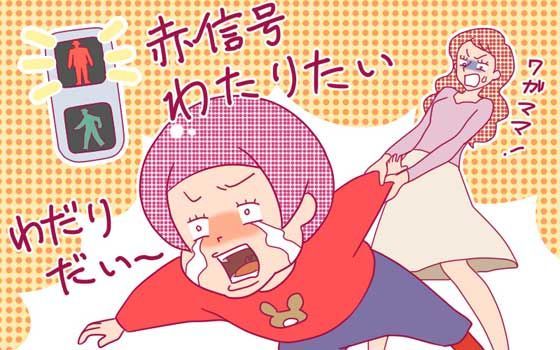
GuFuTokuKuWataru

“I want to cross during the red liiiiiiiiight~!” [source]

Posted in Japanese, Yojijukugo | Tagged , , , , , , , | Leave a comment

Failure to plan is planning to…

…murder thousands of your own citizens, if one of the things you’re supposed to plan for is an emergency situation!

遠慮なければ近憂あり
(Enryo nakereba kin’yuu ari; “Without forethought, worry is forthcoming”)

Definition:

If you don’t act and plan with an eye to the future, then worries and troubles will come sooner rather than later. Short-sighted tunnel vision will only cause harm, and this harm is not limited to the distant, abstract future: it will come soon.

Breakdown:

We begin with the noun 遠慮 (enryo), in this case “forethought” or “foresight” – that is, due consideration for the future. As is often the case, particles are elided. This is followed by the adjective なし (nashi) in perfective form as なけれ (nakere), with the conditional suffix ば (ba), “when[ever].” The following independent clause is similarly composed of the noun 近憂 (kin’yuu), “nearby worries,” and the copular verb あり (ari), in conclusive form.

Notes:

Many learners of Japanese know 遠慮 as a socially-oriented quality of modesty, tact, and forbearance for the sake of others, or of refraining from something. In this case, though, it works with the related meaning of “thinking ahead to the future.” Note that some people apparently read the 遠慮なければ clause as a rephrasing of the term 無遠慮 (buenryo), “selfish presumption,” “rudely saying and doing what you want without consideration for others,” which is clearly based on the social implication of 遠慮; keep in mind that for purposes of this saying, that interpretation is an error.

On a related note, those of you who tried looking up 近憂 probably didn’t find it in a normal dictionary; this is because it’s essentially a play on words: 遠 means “far,” and 近 means “near.”

While 近憂 won’t appear in dictionaries on its own, however, it does appear in the four-character compound 遠慮近憂 (en ryo kin yuu) – which has the exact same meaning and origin as this kotowaza, with only the presentation differing.

What is that origin? Why, it’s the good old Analects of Confucius, of course (『論語』, Rongo in Japanese), in the section 衛霊公 (Eireikou), on the foundation of proper morality for a public official. Yyyyyyup.

Example sentence:

遠慮なければ近憂ありが意味するところは生活状況により異なる。生徒なら進学の計画が必須であり、ビジネスマンなら経営計画であり、役人にはあらゆる災難に対応するための計画である」

(Enryo nakereba kin’yuu ari ga imi suru tokoro wa seikatsu joukyou ni yori kotonaru. Seito nara shintaku no keikaku ga hissu de ari, bijinesuman nara keiei keikaku de ari, seifu ni wa arayuru sainan ni taiou suru tame no keikaku de aru.”)

[“The meaning of the phrase ‘a lack of forethought brings trouble to the fore’ changes depending on one’s circumstances in life. For the student, a plan of studies is indispensable; for the businessman, a business plan; and for the government official, a plan for responding to every possible kind of emergency.”]

Posted in Japanese, Kotowaza | Tagged , , , , , , , , , , | Leave a comment

We meet again, Mr. Bond

怨憎会苦
on.zou.e.ku

Literally: resentment – hate – meet – suffering

Alternately: The pain of coming face-to-face with someone you detest, or at least dislike. This is another one of the “eight sufferings” of 四苦八苦.

Notes: While I’d have thought that all of the 八苦, or at least the latter four, would have their origins in the same text, that doesn’t seem to be the case: in contrast with last week’s yojijukugo, this phrase is attributed to the Lotus Sutra (Japanese 『法華経』 = Hokekyou).

OnZouEKuWhoosh

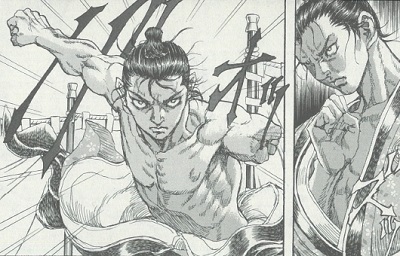
Please try to refrain from this kind of greeting, though! Source: a violent demon-fighting manga from 2015 titled 『衛府の七忍』 (Efu no shichinin)

Posted in Japanese, Yojijukugo | Tagged , , , , , , , , | Leave a comment

Be prepared!

And be clean in word and deed.

備えあれば憂いなし
(Sonae areba urei nashi; “If yes prep, no worries”)

Definition:

If you habitually take the time and effort to make sure you’re prepared for a worst-case scenario, then you’ll be a lot better off if and when such a scenario comes to pass. Forearmed is forearmed. When you succeed at preparing, you are preparing to succeed.

Breakdown:

We begin with the verb 備える (sonaeru), “to equip,” “to prepare,” in conjunctive form.* This allows it to act as a noun and, particle elided, it takes the verb ある (aru), “to exist,” “to have,” in imperfective form and followed by the hypothetical suffix ば (ba), “if” or “when.” The following independent clause comprises the noun 憂い* (urei), “trouble,” “distress,” “sorrow,” and the adjective なし (nashi), “[does] not [exist]” in conclusive form.

Notes:

This evergreen bit of advice comes to us from Chinese antiquity, specifically the Book of Documents (Chinese Shujing, Japanese 『書経』 = Shokyou), a 3,000-year old collection of rhetoric with the distinction of being one of the ancient Chinese “Five Classics.”

It should come as no surprise, then, that we’ve seen synonyms before.

There’s a relatively high level of orthographic variation to this saying. ある may be written as 有る and なし may be written as 無し, of course, but also urei may be written as 患い. None of these changes affects the meaning or pronunciation. Note, however, that replacing 備え with homophone 供え, “offering [to a god],” changes the meaning and is considered an error.

* Classically, the original verb for sonaeru is 備ふ (sonau), meaning “to gather [something] together without anything missing.” The conjunctive form then becomes 備へ, which orthographic shift later renders as 備え. Similarly, urei was originally the verb 憂ふ (ureu), “to worry,” “to grieve”; this takes the conjunctive form 憂ひ to act as a noun, and eventually becomes 憂い. Note that unlike 備ふ, which lives on today as the verb 備える, 憂ひ only seems to appear in modern usage as a noun.

Example sentence:

「来週の旅行のために口座から現金を引き出しておくつもり。備えあれば憂いなしというからさ」

(“Raishuu no ryokou no tame ni kouza kara genkin wo hikidashite oku tsumori. Sonae areba urei nashi to iu kara sa.”)

[“I’m going to take some cash out of my bank account for next week’s trip. More prepared is less worried, as they say!”]

Posted in Japanese, Kotowaza | Tagged , , , , , , , , , , | 1 Comment

Leaves from the vine

愛別離苦
ai.betsu.ri.ku

Literally: love – separate – detach – suffering

Alternately: The pain of being separated from your loved ones. This is one of the “eight sufferings” of 四苦八苦.

Notes: The separation in question is most often due to the loved one’s death, but may also be a result of mere distance and circumstances. In either case the separation is relatively stark; you don’t properly feel 愛別離苦 from a playmate going to use the restroom, for example.

This compound is somewhat unusual in that instead of its parts being grouped 2 and 2, it forms a 1-2-1 pattern: it names the suffering (苦) that comes of being parted (離別) from those you love (愛).

This phrase comes to us from the Mahāyāna Mahāparinirvāṇa Sūtra, a.k.a. the Nirvana Sutra, in Japanese 『大般涅槃経』= Daihatsunehangyou.

AiBetsuRiKuLuTen

Posted in Japanese, Yojijukugo | Tagged , , , , , , , , , | 2 Comments

Fire Down Below – … and Time …

Last week we looked at surface turns, and what the heroes left behind in town on the surface could do. This week, we’ll follow the ones who venture downward.

Divvying up Time: in the Underworld

For heroes on an expedition to the underworld, time is divided into nested layers of watches, vignettes, and rounds.

A watch is a span of several hours: about the length of time you can sustain a mild to moderate activity before stopping to rest, eat, and otherwise take a break and refresh – or if you prefer, the length of time you need to get a decent chunk of rest before your body really wants to stretch, move around a little, and relieve itself. In effect each day comprises six watches that correspond very loosely to “morning,” “afternoon,” and “night,” and expeditions will spend each watch on a set of broad activities, such as foraging for supplies or resting in a camp.

A vignette is what you use to zoom in on an activity that’s more discrete and intensive than what you could do in a watch, such as fighting, performing a ritual supplication to the gods, or searching a single smallish room-sized area. A vignette takes a few minutes and while I’m not going to put hard numbers on how many can fit into a watch, I’d also say that more than a couple vignette’s worth of excitement will probably leave your attempts at a watch-length action fragmented and non-viable.

Finally, a round is just a few seconds long; it’s what you use to parcel out the time for moment-to-moment actions when you need to add internal time structure to the flow of a vignette.

A Note about Space

At this point in the design process I’m not sure how I want to arrange the underworld. In concrete terms, it should be vast and labyrinthine. Characters should be carefully maintaining mental maps as they climb and crawl through claustrophobic tunnels and echoing caverns. I definitely want to convey more mystery, dread, and scale than even the most imposing of finite megadungeon maps could give, so each expedition will spend its watches schlepping, skulking, and squirming its way through an indefinitely large underground terrain where occasionally space and time contract and focus in on a limited (mappable) area for a vignette-level action to play out, but otherwise remains as broad and abstract as a landscape does in surface adventures.

Mechanically, perhaps something like a point-crawl or even a hex-crawl would be most appropriate. At this point I’m leaning toward the idea of procedural generation that would allow each campaign to take on a unique character as the characters, and their players, uncover various locations, then figure out what to do with or about each one and how to get to or around it efficiently.

Watch Actions

What can you do in a watch? Well, this is where you paint the broad strokes of your adventure, including travel, rest, and the various tasks that fill your active hours. For example:

  • Travel: The party can progress forward in a general way. You can spend a watch on the move, attempting to get further down and closer to wherever the Fire Down Below hides.
  • Scout: If you know about two neighboring points or locations of interest, or if you suspect that one exists in the vicinity, you can actively spend a watch turn looking for it. There will probably be some sort of skill check involved, but this would also be where the DM rolls on a random table to determine whether there actually is a way through, and what (if any) challenges the heroes will need to overcome in order to use it.
  • Work: Not every skill will require a full watch to use, but some definitely will. For example,
    • Use Create to jury-rig a known object. While objects made or repaired through Create on the surface are relatively reliable, anything you whip together out in the field is more prone to breakage and will never survive the end of the expedition.
    • Use Create to do field repair on a known object that has broken. Again, if you want this done really well, you need to invest a lot of time and attention back in the safety of town; objects repaired on the fly will generally last for one use and then break again.
    • Use Emote to commune with a given god or similar being, particularly one whose secret shrine you’ve discovered. Doing so successfully allows you to learn a god’s ways, perform devotions in return for boons, and then use rituals to spend those boons in return for favors.
    • Use Inspect to investigate something so big or complex that you can’t look it over in a mere vignette.
    • Use Scavenge to forage for food, usable materials for repairs, or find a good sheltered spot to rest in.
  • Rest: It feels like the simplest way to simulate a normal activity/rest cycle is through Afflictions: a watch spent working, or a vignette spent on especially intense action, will afflict the heroes with e.g. tired, then fatigued, then exhausted. (Then I guess further levels of exhaustion?) It’s possible to work a character to death by afflicting them until they drop, but this affliction is special in that you can reduce it by a level simply by spending a watch in rest and recuperation. This doesn’t have to be a full-night’s-sleep deal; I envision something closer to food, water, sitting or lying around quietly, interspersed with naps as needed. The underworld is not a place to pull a sheet up under your chin and zonk for hours on end, but you can still hole up to let your body’s biomechanical systems rebalance and repair.
Next week: Vignettes?
Posted in Rules, World-Building | Tagged , , , , , , , | 2 Comments

Barrelsplaining!

空き樽は音が高い
(Akidaru wa oto ga takai; “An empty barrel makes a loud noise”)

Definition:

If you strike an empty barrel, the sound it produces is high-pitched, sharp, and loud instead of the muted thump you’d get from a full one. Similarly, a human who isn’t filled with any meaningful amount of knowledge tends to produce lots of self-important talk despite their hollowness. Shallow waters run loud; empty vessels make the most noise.

Breakdown:

We begin with the verb 空く (aku), “to be open” or in this case, “to be empty,” in conjunctive form as 空き (aki) – which is odd, and we’ll look at in in depth later. In any case it seems to attach to, and modify, the noun 樽 (taru), “cask,” “barrel,” etc. The particle は (wa) marks this noun phrase as the topic of discussion. The following comment begins with noun 音 (oto), “sound,” marked as the subject of its clause by the particle が (ga), and finally as the predicate to this subject we get the adjective 高い (takai) in conclusive form.

Notes:

It’s okay to write akidaru in more compact form as 空樽 without any change in meaning or pronunciation. Similarly, the final noun and adjective may be rendered in a more old-fashioned form as 音高し (oto takashi), again without changing the meaning.

As mentioned above, the fact that we use akidaru strikes me as odd. The conjunctive form would normally be followed by a verb phrase or a full clause or sentence, not a noun, after all. And the prenominal form of the verb is nowhere to be sen. Yet there are many such phrases, including 空き缶 (akikan), an empty can, 空き殻 (akigara), an empty shell, and so on. My favorite of these is 空き店, which is hilarious because the final character means “store,” as in bookstore – but the pronunciation is akidana, where tana normally means a shelf – and an 空き店’s primary usage is referring to an empty house. Figure that one out!*

Anyway! Two reasons come to mind why 空き might be the way it is:

1. As we’ve seen before every now and then, the conjunctive form of a verb can act as a noun. Perhaps this 空き樽 is actually a compound noun.

2. Changing to ki in prenominal form would actually be appropriate for an adjective. Perhaps aki is simply being treated as an adjective; this would make the base/conclusive form into 空し (ashi).

There’s just one problem with that second theory: I can’t find any sources for ashi as an adjective. There is 空し, pronounced munashi, and there’s 空 (kara), which is a noun that’s almost always used in an adjectival sort of way, but nothing that would grammatically become aki on that front.

In brief, the most likely grammar for 空き樽 is a compound noun, where the first noun is a frozen conjugated form of a verb, which is being used in an adjectival way to modify its fellow noun.

*: This is actually because tana, written as 店, can refer to a merchant’s (rented) living quarters as well as to the shop proper, presumably from back in the day when a lot of people had ancestral homes out in a village somewhere but worked in the city, and found it efficient to live where they worked.

Example sentence:

「隣の稲田さんは、人としてはいいんだけど、自分の声に聞き惚れていて、音の高い空き樽になるきらいもたまにあるんだよ」

(“Tonari no Inada-san wa, hito to shite wa ii nda kedo, jibun no koe ni kikihoreteite, oto no takai akidaru ni naru kirai mo tama ni aru nda yo.”)

[“My neighbor Inada is a good person, but they really like the sound of their own voice, and they have this unpleasant tendency to talk a lot even when they know very little.”]

Posted in Japanese, Kotowaza | Tagged , , , , , , , | Leave a comment