Don’t be backhanded!

先手必勝
sen.te.hi-.sshou

Literally: before – hand – certain – win

Alternately: Who strikes first, wins. The early bird gets the worm. This phrase may be used to espouse a “first strike” mentality as a general philosophy, or to describe the particulars of a situation that calls for quick and decisive action. Often, but not universally, used in combat situations or simulations such as martial arts or board games.

Notes: In the karate community, there’s a countering bit of wisdom that says 空手に先手無し (karate ni sente nashi): “In karate, there is no ‘first strike.’” This can be interpreted in different ways, but one of them is that it actually doesn’t matter who moves first. This might be because block-attack combos are the bread and butter of your style, or it might be because of the value of waiting for your opponent to show their intention and then attacking into their prep. But in any case, the only thing that really matters is not who starts the action, but who finishes it.

SenTeGiGa

Posted in Japanese, Yojijukugo | Tagged , , , , , , | Leave a comment

Even for a pear of eyes

目に入れても痛くない
(Me ni irete mo itakunai; “Doesn’t hurt even if it gets in your eye”)

Definition:

To adore someone, especially a child or grandchild, beyond all reason. To dote on someone. Generally reserved for feelings toward “cute” things such as small children or, occasionally, pets.

Breakdown:

We begin with the noun 目 (me), “eye,” marked by the particle に (ni) as the target of the motion of the verb 入れる (ireru), “to insert,” “to put [something] in[to something].” This verb appears in conjunctive form and is followed by the emphatic particle も (mo), “even [if].” Finally we have the adjective 痛い (itai), “painful,” in conjunctive form and taking the negative adjectival suffix ない (nai), in sentence-final form.

Notes:

The adjective may be replaced, in some versions, with えずい (ezui), “unpleasant” – although this seems to be rare. Other versions make the placement even more explicit by making it 目の中に… (me no naka ni…).

While none of my written sources say this, and some of the usage examples I found explicitly contradict it, I’ve been told in person that this phrase is only really used regarding members of one’s own household or family – that the person doing the doting may be the speaker, or their parent or grandparent, and the object of the doting may be a child or grandchild, but that in any case it’s only used when everybody involved is related to the speaker in some way or other. You may take this assertion into advisement if you wish.

Example sentence:

「公園で娘さんを見守ってる山野さんの顔を見た瞬間、あ、目に入れても痛くないってこういうことなのかなって思った」

(“Kouen de musume-san wo mimamotteru Yamano-san no kao wo mita shunkan, a, me ni irete mo itakunai tte kou iu koto na no ka na tte omotta.”)

[“The instant I saw Mr. Yamano’s face while he was watching over his daughter at the park, I thought, Oh, is this what it means to be the apple of someone’s eye?“]

Posted in Japanese, Kotowaza | Tagged , , , , , , , | Leave a comment

Rubbing elbows ‘cross the pond

一衣帯水
ichi.i.tai.sui

Literally: one – garment – belt – water

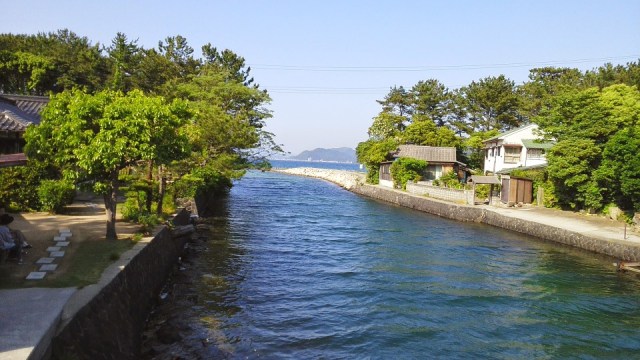
Alternately: A relatively thin strip of water, such as a river or narrow stretch of sea. By extension, two things that are very close together.

Notes: Unusually among four-character compounds, many of which can be broken into a pair of two-character terms, this one is structured 1-2-1: It describes a single (一) sash-like band (衣帯) of water (水). It comes to us from the History of the Southern Dynasties (南史, in Japanese Nanshi).

Several variants and synonyms of this phrase exist, including 一牛鳴地 (ichi gyuu mei chi), which is a distance close enough that you can hear a cow across it.

River Hagi Town Japan Sea

Posted in Japanese, Yojijukugo | Tagged , , , , , | Leave a comment

If this post is too long, I can’t say I wasn’t warned

雉も鳴かずば撃たれまい
(Kiji mo nakazuba utaremai;
“Even the pheasant, if it doesn’t cry out, won’t be shot”)

Definition:

Said in response to times when someone caused problems for themselves by speaking when it would have been prudent not to. An admonition against being outspoken, or against talking without considering the consequences one will face in response.

Breakdown:

We begin with the noun 雉 (kiji), the Japanese pheasant. This is marked with the particle も (mo) in its emphatic role, and then the verb 鳴く (naku), “to cry (out),” “to call.” The verb appears in imperfective form and takes the negative suffix ず (zu).

The grammar at this point drove me mad for a while, because in classical Japanese ず can be either the conjunctive or sentence-final form of the particle, but the hypothetical ば (ba) is preceded by the imperfective form, while the conditional ば is preceded by the perfective form. But the perfective form of zu is ne, while the imperfective form doesn’t even exist in classical grammar. This phrase shouldn’t even be possible, right?

It turns out that this ba is just a voiced version of the particle は (wa, at least nowadays). So what we get is less “if/when the pheasant doesn’t call,” and more “as for the case of the pheasant not calling.” (That said, this usage of ば apparently dates to the early modern period [source], and has been generally conflated with the hypothetical ba, so reading this as “if the pheasant doesn’t call” isn’t entirely incorrect either.) Anyway, in turn this implies that the zu is in conjunctive form and acting as a noun, for any completionists out there who may have been wondering.

This leaves us with “the pheasant not calling out” as a topic, and the comment on that topic being summed up in a single verb: 撃つ (utsu), “to attack” or, more relevantly, “to shoot.” This verb also takes the imperfective form, followed by passive-voice-marker suffix れ (re), and finally the negative suffix まい (mai) in sentence-final form.

Just to hammer home the point that this is post-classical grammar, my sources say that mai is a contracted form of classical suffix まじ (maji), which expresses “negative probability” or “negative determination” (i.e. it’s a more personal, subjective form of “no” than the absolute ず). The classical formulation would therefore be 撃たるまじ (utaru maji).

Notes:

As a 20th/21st-century (CE) American, I have a strongly negative reflex against the message here. But first, of course, it makes sense in a feudal context, where there are people walking around who literally have the legal right to cut most other people down on a whim. (And for anyone they can’t treat this cavalierly, there are always feuds, politics, and outright war to punish them for upsetting you.) But even in an individualistic modern context, there are still plenty of cases where tact and forbearance are beneficial virtues. So… take it as you will, I guess.

This saying’s endurance in Japanese is attested in part by the number of variants it has. Aside from a plethora of more-or-less synonymous kotowaza using other words, you can replace 雉 with 鳥 (tori, “bird”), or 撃つ with 討つ or 打つ (both utsu; “to shoot” and “to strike” respectively), and/or switch it around so the first half goes 鳴かずば→雉も. That said, apparently replacing まい with modern negative ない (nai) is considered an error, so look out!

(And yes, I’m aware that my long grammatical digression can boil down to “don’t try to force later constructions into a classical mold.” Still, there’s a chance that showing my work might help someone, somewhere, somehow, so there you have it.)

Example sentence:

「勇ちゃんの言うことに冷静に耳を貸すように頑張ってるけど、今回は我慢できない。久しぶりに厳しく叱ったら、あの子は雉も鳴かずば撃たれまいという事実に気付くかな」

(“Yuu-chan no iu koto ni reisei ni mimi wo kasu you ni ganbatteru kedo, konkai wa gaman dekinai. Hisashiburi ni kibishiku shikattara, ano ko wa kiji mo nakazuba utaremai to iu jijistu ni kidzuku ka na.”)

[“I try to listen calmly to whatever Yuu has to say, but this time I have to put my foot down. If I give a really stern lecture, for the first time in a long time, maybe they’ll notice the fact that sometimes it’s best to keep your mouth shut.”]

Posted in Japanese, Kotowaza | Tagged , , , , , , | Leave a comment

No rank, no file

It gets you off the grid!

無位無冠
mu.i.mu.kan

Literally: nothing – rank – nothing – crown

Alternately: An ordinary citizen. Having no special prestige from rank, title, official position, or status.

Notes: A variant phrase replaces 冠 with 官 (also pronounced kan!), “bureaucrat.” The meaning is essentially the same, although 冠 suggests aristocratic status while 官 emphasizes government office – keep in mind that the two were essentially indistinguishable for much of Japanese history.

MuIMuKanTou

The phrase seems to have been used by a number of pottery producers.

Posted in Japanese, Yojijukugo | Tagged , , , , , | Leave a comment

This post sponsored by Santana

Searchin’”

七度尋ねて人を疑え
(Nanatabi tazunete hito wo utagae;
“Search seven times, [then] doubt somebody”)

Definition:

When you’ve lost something, make sure to search for it as thoroughly as you can before you start accusing people of having taken it. Don’t start casting doubt on people until you’ve searched and searched and searched and searched and searched and searched and searched, so to speak.

Breakdown:

We begin with number-noun 七度 (nanatabi), “seven times,” followed by the verb 尋ねる (tazuneru), in conjunctive form. While this often means “ask” or “inquire,” in this case the meaning leans more toward “to investigate,” “to search for.” (The saying about avoiding doubt doesn’t demand that you start by grilling everybody!)

The second verb phrase, following the conjunction, begins with the noun 人 (hito), “person,” marked by the object-marker particle を (wo) as the object of the verb 疑う (utagau), “to doubt,” “to suspect,” in imperative form.

Notes:

The first part of this saying may also be rendered as 七度探して (either nanatabi OR shichido sagashite) without any change in meaning. Another version ups the ante even more by taking it to 十遍探して (juppen sagashite), “search ten times.”

This saying comes to us from an Edo-period story called the 開巻驚奇侠客伝 (Kaikan kyouki kyoukaku den) by noted author Kyokutei Bakin (曲亭馬琴). This was apparently his retelling of a number of Chinese stories such as the Haoqiu zhuan (好逑伝, in Japanese Koukyuu den) and the Nuxian Waishi (女仙外史, Josen gaishi).

Example sentence:

「やばっ、また傘盗まれた!」「この傘のこと?」「……あっ」「ほら、だから七度尋ねて人を疑えって言うだろ」「ごめん」

(“Yaba’, mata kasa nusumareta!” “Kono kasa no koto?” “…A’.” “Hora, dakara nanatabi tazunete hito wo utagaette iu daro.” “Gomen.”)

[“Oh, man, my umbrella was stolen again!”
“This umbrella?”
“…Ah.”
“See, that’s why they say you’re supposed to check and double-check before you start blaming people.”
“Sorry.”]

Posted in Japanese, Kotowaza | Tagged , , , , , , , , | 1 Comment

But it takes good theory to be “okonai alpha”!

(I was updating the kotowaza index when I discovered that I had doubled my use of the saying 目から鼻へ抜ける, so this “extra” post is intended to make up for the gap. Please enjoy!)

理屈上手の行い下手
(Rikutsu jouzu no okonai beta; “Good at theory, bad in execution”)

Definition:

When someone is good at reasoning or theorizing, but unable to put that theory into practice. All talk, no results.

Breakdown:

This kotowaza comprises two parallel noun phrases, joined by the associative particle の (no). The primary noun of the first half is 上手 (jouzu), “skillful,” attached to and specified by the noun 理屈 (rikutsu), “reasoning,” often with the nuance of petty rationalization rather than deep rigor. The primary noun of the second half is 下手 (heta), “unskilled,” attached to and specified (and changed phonetically) by the verb 行う (okonau), “to carry out [an action],” taking conjunctive form in order to act as a noun.

Notes:

The content and phrasing of this saying are both pretty similar to another one that we’ve seen before.

Example sentence:

「一年生の時は教授たちは皆理屈上手の行い下手だろうと馬鹿にしてたけど、先生のラボで働くようになってから味方が変わったよ」

(“Ichinensei no toki wa kyouju-tachi wa minna rikutsu jouzu no okonai beta darou to baka ni shiteta kedo, sensei no rabo de hataraku you ni natte kara mikata ga kawatta yo.”)

[“When I was a freshman I thought all the professors were good at theory and bad at execution, but my views have changed since I went to work in the lab.”]

Posted in Japanese, Kotowaza | Tagged , , , , , | Leave a comment

Some cows give milk; this one says “Mu”

無為無能
mu.i.mu.nou

Literally: nothing – do/benefit – nothing – ability

Alternately: Not doing anything, and not able to do anything. A complete lack of action, and of ability to achieve anything significant. Idle and incompetent.

Notes: Keep in mind that despite the obvious application in contemporary American politics, in Japan this expression is most likely to be used about oneself, as a humble expression of modesty.

MuIMuNoubita

And then there’s this yutz.

Posted in Japanese, Yojijukugo | Tagged , , , , , , , | Leave a comment

Challenge Accepted: The Museum Experience

Once again I’ve found inspiration in a passing comment on someone’s blog; in this case the source is a list of movies the writer found inspiring (for their tabletop RPG play), and the comment is in response to Indiana Jones and the Temple of Doom: “I would still like to find a way to turn it belongs in a museum into an XP incentive mechanism,” says Brendan.

Well, how exactly that would work depends on your normal XP paradigm, and in some cases it would probably only work if you keyed it into a specific campaign setup. For example,

  • If you’re running a strict old-school XP-for-gold game, then the simplest model is to plunk down a museum that pays out higher rates for relevant items than anyone else. This is nice because you can set up situations with rival buyers and let the players choose between the gold-and-XP boost from the museum and whatever benefits are offered by its rivals.
  • If you’re running a more modern game with “quest XP,” it’s even easier: you offer item-retrieval for the museum as a quest. This is nice because it allows you to decouple the XP and monetary reward structures, or even set them against each other: will the players sell this ancient necklace to a collector for 1,000 gp, or hand it over to the museum for 1,000 XP?

Moving further afield from standard D&D, in some cases you can bake it right into the campaign: An experience setup like the one in Apocalypse World  (or YAOSC!) might simply tell the players to “mark XP every time you return an artifact safely to the museum.”

It can get more specialized than that: you can set up a situation where the players not only need to put the treasure they collect in a museum, they also need to go back and repeatedly interact with the loot in order to level up. The most obvious such scenario, to me, is one where the “museum” is a library and the players are a tactical librarian strike force – sort of like in the Stand Still, Stay Silent webcomic! – who can improve their skills in between expeditions by studying the books they retrieve from the ruins of the Ancients.

Perhaps this can be generalized a little for monster-hunting: the PCs gain experience by bringing back captured or slain monsters and observing, analyzing, and dissecting them. At this point we’re getting to a degree of abstraction where the “museum” is actually more of a “research center,” but the basic idea is the same.

In the sci-fi version, you can use the monster-analysis idea above, except with captured/slain aliens and alien tech. Alternately, the PCs are cyborgs or Matrix-nauts, and their spoils include storage media that, through the right interface hardware, can be used to upgrade their skill set. (This might work best with a skill system that functions like a tech tree, with discrete jumps that add abilities wholesale.)

For a more esoteric twist, how about a campaign (using the system of your choice) in which the PCs are cultists, the “museum” is a shrine or temple to their deity, and instead of XP per se they receive boons from their deity in return for offerings?

Posted in Miscellaneous, Rules | Tagged , , , , | Leave a comment

An irony for many residents of DC

Especially the transients. You know who you are.

住めば都
(Sumeba miyako; “If you live there, it’s the capital”)

Definition:

No matter how inconvenient, old, noisy, or just plain bad your residence is, it still feels like you belong there. Once you’re used to a place, it feels easier to live in. “There’s no place like home.”

Breakdown:

This very simple phrase begins with the noun 住む (sumu), “to reside,” in perfective form and taking the conditional particle ば (ba), followed by the noun 都 (miyako), “capital city.” That’s it!

Notes:

Incidentally, you might expect that the final noun there is followed by an elided copula (the “to be” verb). But actually, a number of variants instead use longer, more poetic verb phrases. For example, 住めば都の風が吹く (sumeba miyako no kaze ga fuku), “If you live there, the wind of the capital blows [there].”

You can really see the old myopia of the aristocratic caste here, because all my sources list remoteness as the primary example of the kind of problem that you get accustomed to. This point is driven home more explicitly by holding out “the capital” as the exemplar of a place that’s good to live because it’s the heart of all the economic and cultural activity of the nation as well as the political.

Apparently some people mix this phrase up with 住ば都 (sumaba miyako, “if you live [somewhere then make it] the capital”) and taken it to mean “the only place to live is the capital.” This almost exactly reverses the saying’s intent and is an error.

Apparently this phrase comes to us from Xunzi, a.k.a. Xun Kuang (荀子, Junshi), via the Tale of the Heike (平家物語, Heike monogatari).

Example sentence:

「大学に入ってからずっと住んできたこの部屋は狭くて、寒くて、何とも言えない変な匂いもあるけど…なんでか引っ越したくないな。住めば都か」

(“Daigaku ni haitte kara zutto sunde kita kono heya wa semakute, samukute, nan to mo ienai hen na nioi mo aru kedo… nande ka hikkoshitakunai na. Sumeba miyako ka.”)

[“This apartment I’ve been living ever since I came to college is cold, and tiny, and it has this indescribably weird smell… but for some reason I don’t want to move out. I guess home is where your stuff is.”]

Posted in Japanese, Kotowaza | Tagged , , , , , , , | Leave a comment