Even a blog of a thousand posts begins with a single keystroke

千里の道も一歩より
(Senri no michi mo ippo yori; “Even a road of a thousand ri, from one step.”)

Definition:

“A journey of a thousand miles begins with a single step.” Even the most daunting undertakings begin with a simple action – and progress to the end through the accumulation of simple actions. Any task can be started with a small step using tools close to hand, so don’t get paralyzed by the idea that you need to start with something that’s out of reach. This is another expression of the idea that steady effort can overcome almost any obstacle – all one needs to do is begin, and then continue, to work.

Breakdown:

This is technically not a complete sentence, but it can function as one with the addition, or assumption, of a final verb or copula. We begin with the number-noun combination 千里 (senri), “one thousand ri.” The associative particle (no) connects this to the noun (michi), “road.” This noun phrase is rounded off and marked with the particle (mo), “also” or “even.” And finally you have another number-noun, 一歩 (ippo), “one step,” marked with the directional particle より (yori), “from.”

Notes:

Apparently some versions end with から (kara) rather than より, although the meaning is unchanged. As noted above in the breakdown, some versions actually provide a verb, such as 始まる (hajimaru, “begin”) or 起こる (okoru, “occur”). It seems that versions with verbs tend to favor より for the particle.

Another borrowing from classical Chinese, this saying is derived from the final entry in a passage from Laozi in which a whole series of images along the same theme are given.

In a funny way, writing up this post reminded me of the feeling I had when I first decided to do this kotowaza project almost two years ago (!). That said, it’s not like I was intending a thousand-ri journey. I didn’t know how many posts I’d end up making; the vicissitudes of the fall semester could easily have killed the project. I just wanted to spend more time writing and more time engaging with Japanese. And yet here we are, still in the early stages of a 五十音 sub-project within the broader kotowaza-post series. I guess we’ll see where this goes from here!

Example sentence:

奈菜は千里の道も一歩より始まるのだからと思って、引っ越しの第一歩としてゴミ拾いをすると決めた。

(“Nana wa senri no michi mo ippo yori hajimaru no da kara to omotte, hikkoshi no daiippo to shite gomihiroi wo suru to kimeta.”)

[“Keeping in mind that even a journey of a thousand miles begins with a single step, Nana resolved to gather up any trash lying around as her first step to moving house.”]
Posted in Japanese, Kotowaza | Tagged , , , , | Leave a comment

Toddler cognitive / linguistic development, part 4

The kid has acquired glottal stops! For several days now, he’s been saying “niʔnn” (like a slurred “neaten”). The word appears to be entirely of his own invention, but we’ve figured out that he uses it when he wants to go outside.

Now that I think about it, that may not be entirely correct. His original usage may have been relatively inchoate, and our act of trying to interpret and respond to what he was saying may have shaped his usage. That’s an aspect of language-learning and -use that I’ve never really considered before, and I find myself wondering if it plays any significant role in phenomena like semantic drift.

The other use is in button (“baʔnn”), which he applies to both buttons (he said it while I was buttoning up his shirt) and to buckles (he uses it in reference to his stroller and booster seat). This raises an interesting question as well: is he using one word for two things because it’s close enough to both of them phonetically for him? Is he lumping them both into the same cognitive category, so that both buttons and buckles fall under a category of fasteners that he calls “baʔnn”?

Currently his big craze, phonetically, is about beeps. He takes note whenever a truck, bus, or other piece of machinery makes one of those high-pitched beep-beep-beep sounds, like the backing-up noise. He repeats it when he hears it, and he makes it when he’s playing with toy trains and trucks. It’s really interesting seeing what catches a kid’s attention!


One final point of interest. His mother taught him the word mimi for “water.” At first I thought that this was standard Japanese baby-talk for mizu (, “water”), but later she revealed that she made it up and taught it to him as an experiment! He’s really taken a shine to it, either way. He used to use his version of the Japanese word for “drink” (飲む – nomu – which he pronounced “moo”) for liquids, but that’s been supplanted by “mimi.” So “mimi” now applies not only to all potables and to puddles of water, but also to snot. If the kid runs up to you and says “Mimi! Mimi!” in an excited way, it’s up in the air whether he wants a drink, found or spilled some water, or wants you to wipe his nose!

Posted in Musing, Nonfiction | Tagged , , , , | Leave a comment

Telling it like it do be

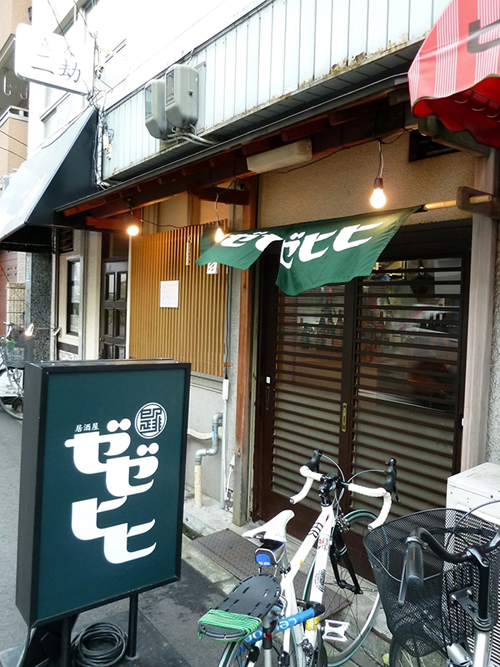
是是非非
ze.ze.hi.hi

Literally: correct – correct – mistake – mistake

Alternately: Fairness; honesty; impartiality. Calling correct things correct and mistaken things mistaken, objectively, instead of allowing one’s biases to become involved.

Notes: May also be written with the repeating mark as 是々非々. Keep in mind that in addition to the “meanings” given above,  can also be rendered in English as “this,” “justice,” etc. depending on the situation; can be a negation prefix.

ZeZeHiHiInShoku

The name of, among other things, an izakaya bar in Osaka and a ramen shop in Asahikawa, Hokkaido. Why would this phrase be associated with food, though? TILII NOSH?

Posted in Japanese, Yojijukugo | Tagged , , , , , , | Leave a comment

Clowns to the left of me; jokers to the right

過ぎたるは猶及ばざるが如し
(Sugitaru wa nao oyobazaru ga gotoshi;
“Too much is the same as not enough.”)

Definition:

Overdoing something is ultimately the same as not doing it enough. For most human endeavors there is a happy medium range, and going beyond that range is no better than failing to reach it. You can have too much of a good thing, and it can be just as bad as a lack.

Breakdown:

We have a complete, and grammatically complicated, sentence! It ends with the auxiliary verb 如し (gotoshi), “the same as,” “like,” in sentence-final form. (It make take a moment to realize that it is in fact a verb, because it inflects as if it were an adjective.) It’s preceded by the particle (ga), which in classical Japanese serve the function more familiarly filled, to modern learners, by (no). But what is its actual grammatical function, besides being “the thing that precedes 如し”?

I believe that the function is actually a normal noun-association. Bear with me for a moment. The connects our auxiliary verb to the preceding verb, 及ぶ (oyobu), “to reach.” This verb is in the imperfective form so that it can be attached to the negative suffix ざり (zari), itself in attributive form. And all of the above is shown by the topic-marker particle (wa) to be modifying the verb 過ぐ (sugu), “to pass,” “to exceed.” This verb is in the conjunctive form, and appended by the auxiliary verb たり (tari), again in attributive form. Meanwhile, between the and the second verb we find (nao), an adverb that in this case means something like “likewise” or “too.”

You may note that there are no nouns in this sentence, but that the verbs are not being treated grammatically as we would normally expect. The attributive form here seems to be signaling that the verbs are to be treated as nouns. (It’s not clear to me offhand whether this was simply how nominalization was signaled in classical Japanese, or whether it’s shorthand for a structure similar to modern [verb]+こと.) But in the end, we can take the above and render this saying as “Overdoing is the likeness of not reaching,” and in that light our no-like ga makes sense to me.

I am of course open to hearing from any Japanese grammarians who have a more accurate explanation!

Notes:

It’s acceptable to leave out the nao; this doesn’t significantly change the meaning.

This is another kotowaza derived from the Analects; in this case, from the Xian Jin (先進) chapter.

There are a number of variant sayings on the same theme. Several of them are more situation-specific, e.g. declaring that over-politeness is the same as impoliteness, or that too much prudence is a form of foolishness.

Example sentence:

「どんなに野菜は健康にいいと言っても、過ぎたるは猶及ばざるが如く、毎日サラダばっかり食べるなど、やっぱりちょっと...」

(“Donna ni yasai wa kenkou ni ii to itte mo, sugitaru wa nao oyobazaru ga gotoku, mainichi sarada bakkari taberu nado, yappari chotto….”)

[“It doesn’t matter how good vegetables are for you; you can have too much of a good thing, and just salad every day is a bit much!”]

Posted in Japanese, Kotowaza | Tagged , , , , , , | Leave a comment

If you die in a dream, do you wake up?

酔生夢死
sui.sei.mu.shi

Literally: drunk – life – dream – death

Alternately: Idling one’s life away. Wasting one’s life. Living as if drunk; dying as if in a dream.

Notes: Apparently some people write the homophone 無死 instead of 夢死. This is an error, as the former is a modern term referring to having no outs in baseball!

The source on this is a bit confusing, but it seems to come from an elementary-level textbook called the 小学 (Xiaoxue) from 12th-century China, in which the saying is attributed to Cheng Yi in a section called 嘉言, “wise sayings.”

SuiSeiDoiTsu

A deep, classical philosophical issue that’s still being discussed… by German metal bands.

Posted in Japanese, Yojijukugo | Tagged , , , , | Leave a comment

Magic Monday – What HAS it got in its pocketses?

Conjurer’s Pocket

Proving once again that convenience is more highly prized than safety, this rote carries several risks but is still used to reduce the weight of several logistical considerations, whether the magician is on the road or just simplifying routine tasks at home. The magician marks some of their possessions and leaves them in a specially-prepared receptacle; later they may be called to hand in an instant across almost any distance. However, the threads that connect the “pocket” and the hand may be seen in the Shadow, especially near each end of the connection.


Preparing the receptacle has a difficulty of d8 and requires an investment of a point of fatigue, which may not be recovered as long as it remains active as a “pocket.” Marking an object has a difficulty of d6, and similarly requires an investment of a point of strain, which may not be recovered for as long as the object remains marked. Calling an object to hand requires no spell roll, but may require a d6 Concentration check, and costs one point of strain per step of distance, starting at no cost from within the same room. The cost to call an object can be decreased by a step, but this increases the receptacle and marking difficulties by one step each. Returning an object costs the same as calling it, and always demands a Concentration check.

Anything that can interact with the Shadow – including other magicians who know this spell, if they notice the signs that it’s in use – may notice and interact with the pocket’s thread(s), including cutting them or attempting to intercept a called object. Generally this sort of shenanigans requires a challenge roll between the magician and whatever is interfering. In extreme cases, beings within the Shadow may even attempt to follow the thread into the mortal plane!

(One inspiration, among several.)

Posted in Rules, Setting, World-Building | Tagged , , , | Leave a comment

A stance askance

斜に構える
(Sha ni kamaeru; “take a diagonal stance”)

Definition:

To behave as if the situation isn’t serious; to adopt a (mockingly) aloof attitude, especially toward an opponent or problem. To view things in an ironic or cynical light.

Breakdown:

Technically this verb phrase, by virtue of having a verb, could serve as a complete sentence… it probably won’t, though.

We have a noun, (sha), “diagonal,” and a verb, 構える (kamaeru), “to set (something) up.” They’re connected by the locational/directional particle (ni).

Notes:

This idiom comes from kendo (Japanese swordplay), describing a stance in which the sword is held at a downward angle, below waist level. Unlike many stances, this makes it difficult both to threaten a quick and deadly strike against one’s opponent and to defend oneself readily. Thus, the implication is that one isn’t taking one’s opponent seriously as a threat.

Example sentence:

斜に構えて真剣勝負をしてくれない相手は速攻で倒せるほどの力を持つ選手であった。

(“Sha ni kamaete shinken shoubu wo shite kurenai aite wa sokkou de taoseru hodo no chikara wo motsu senshu de atta.”)

[“S/he was an athlete who was strong enough to immediately knock down any opponent who adopted a dismissive attitude instead of fighting seriously.”]

Posted in Japanese, Kotowaza | Tagged , , , , | Leave a comment

You get what you do, so do wisely!

自業自得
ji.gou.ji.toku

Literally: self – business / performance – self – get

Alternately: You reap what you sow. When you act, you will get results according to your actions. This is generally used in negative situations, to point out that someone suffering the consequences of their choices really should have seen it coming.

Notes: This is a Buddhist teaching, apparently derived from the “Meditation on the Correct Teaching Sutra.”[http://www.nichirenlibrary.org/en/wnd-1/Appendix/G]

[Media: I get that this video is a joke; I just don’t get anything else about it. Maybe that’s just my fault for failing to study Japanese culture thoroughly enough.]

Posted in Japanese, Yojijukugo | Tagged , , , , | 3 Comments

Magic Monday – In tribal Tal, ground grasp at you

Clutch of the Soil

A signature spell of the adepts of the Tal, in the dry north. The caster shapes a hand (and part of an arm) out of the ground and causes it to move as if it were an extension of their own body. While its most famous use is in dueling, many practical applications present themselves.


The base difficulty is d6, and for each point of strain taken, the earthen limb has one point of size. The cost can be halved, once, by increasing the difficulty by a step. The Strength and HP of the limb are double that of the caster, while the Dexterity is equal to the caster’s. All of these qualities together can be increased by two in return for a one-step increase in the spell’s difficulty, or any of them can be raised on a one-for-one basis by increasing the cost in strain.

The spell can be maintained and manipulated – performing skill checks and other rolls as appropriate, with difficulties increased by two steps for fine manipulations – for as long as concentration is maintained. After the spell ends, though, the release brings fatigue equal to the number of rounds it was maintained. (Again, this cost can be halved by increasing the difficulty.)

Posted in Rules, Setting, World-Building | Tagged , , , , , | Leave a comment

Just the right number of cooks?

三人寄れば文殊の知恵
(Sannin yoreba Monju no chie;
“If three people gather, the wisdom of Manjusri”)

Definition:

Two (or more!) heads are better than one. When ordinary people consider an issue together as a group, they can produce more great ideas than one person alone, even a genius. Human minds work best by bouncing ideas off of each other. This is a Buddhist phrase that invokes the transcendent enlightenment of the bodhisattva Manjusri, known in Japan as Monju.

Breakdown:

We begin – from the left, today – with the number-noun combination 三人 (san-nin), “three people.” As is often the case, one could add the subject-marker particle (ga), but it’s elided here. The verb that the three people perform is 寄る (yoru), “to approach” or “to gather,” in subjunctive form.

The above noun and verb form a subordinate clause that points to a noun phrase comprising the nouns 文殊 (Monju), the Bodhisattva’s Japanese name, and 知恵 (chie), “knowledge” or “wisdom,” joined by the associative particle (no), here taking on a possessive meaning. This one isn’t quite a full sentence, although all it needs to fulfill modern sensibilities is a verb or copula of some form at the end.

Notes:

Its’ probably best not to use this saying in reference to people who are considered above average or to whom you want to show respect. Keep in mind the nuance that gathering together raises the quality of the thoughts of ordinary people.

Bodhisattvas are people near Buddhahood, who aspire to helping others escape the illusory material world that we live in… in super-simplified terms, “Buddhist saints.” Manjusri is a bodhisattva associated with “transcendent wisdom” – out of the reach of someone struggling on their own, but possible to achieve, this saying claims, by discussing issues with others.

This kotowaza is to a degree antonymical to the warning against too many navigators. The conflict can be reconciled two ways, I think. First, one can take them together as arguing for a moderate number of collaborators – not so few that one person’s limits become the project’s limits, but not so many that consensus becomes impossible. Or second, one could stress the difference between knowledge or understanding in its ability to benefit from multiple inputs, and leadership’s ability to benefit from consistency.

Finally, note the misogynistic counterpart 女三人寄れば姦しい (Onna sannin yoreba kashimashii), “If three women gather together, it gets noisy.”

Example sentence:

三人寄れば文殊の知恵というので、まずグループを集めてブレインストーミングをしたいと思っています」

(Sannin yoreba Monju no chie to iu no de, mazu guruupu wo atsumete bureinsutoomingu wo shitai to omotteimasu.”)

[“Like they say, three heads are better than one, so I think first I’d like to get the group together and do some brainstorming.”]

Posted in Japanese, Kotowaza | Tagged , , , , , , , | Leave a comment