Not at all like Pi Day plus Shemini Atzeret

Well, a new semester is starting! My wife’s gotten into grad school, and I’ll be writing my thesis and doing a translation project and taking a course or two, and we have a one-year-old kid. Whee!

盆と正月が一緒に来たよう
(Bon to Shougatsu ga issho ni kita you;
“As if Bon and the New Year came together”)

Definition:

A lot of good things happening all at once. An insanely busy time. The Bon festival is a big holiday with aspects of Halloween and Thanksgiving (it honors the spirits of the dead; it’s a time when many people travel to visit their families), which means good share of both celebration and work – especially if you’re a festival organizer or plan to participate in one of the dances. New Year’s Eve and Day are also a festival time, with large family meals and dressed-up visits to Shinto shrines. If they both happened at the same time, well….

Breakdown:

(bon) is literally a tray, as in 盆栽 (bonsai). Here, though, it refers to the Bon – or Obon, with the honorific – festival. Next is the particle (to, pronounced “toe”), which has a few disparate functions, but in this case is used to collect multiple nouns into a single group, equivalent to the English “and.” It joins to 正月 (shougatsu), literally “correct month” but more commonly referring to the New Year, or to the first three days of the new year.

The grouping of proper nouns above is connected to a following verb phrase by the subject-marker particle (ga). Before the verb we get the adverbial phrase 一緒に (issho ni), “together,” comprising noun 一緒 and particle , which is here simply to convert the noun into an adverb. (This is the same as being attached to allow certain nouns to act as adjectives.) The verb part is 来る (kuru), “to come.” The form it takes here is commonly taught as simple past in plain (as opposed to polite) speech, but is perhaps more properly described as denoting that an action has been completed.

Finally, the よう (you; rhymes with “dough”) at the end is an auxiliary verb that marks the whole saying as supposition rather than fact – “as if,” in English.

Notes:

一緒に can be replaced by 一時に (ichiji ni, “at one time” – as in time the dimension) or 一度に (ichido ni, also “at one time” – as in the counter word for number of occurrences) without any significant change in meaning. Some people apparently replace 正月 with the more general 祭り (matsuri, “festival”), although I prefer the specific over the generic version.

Example sentence:

「あの家族は、六人兄弟で皆四月生まれらしい。バースデーパーティーは、盆と正月が一緒に来たような気分だろうな」

(“Ano kazoku wa, rokunin kyoudai de minna shigatsu umare rashii. Baasudee paatii wa, Bon to Shougatsu ga issho ni kita you na kibun darou na.”)

[“There are six kids in that family and apparently they were all born in April. The birthday parties must feel like the New Year and Bon festival coming at the same time.”]

Posted in Japanese, Kotowaza | Tagged , , , , , | Leave a comment

I didn’t think so.

奇想天外
ki.sou.ten.gai

Literally: strange – thought – heavens – outside

Alternately: A truly bizarre idea. Something fantastical, novel, unique, unthinkable. A violation of common sense or standard thinking.

Notes: In contemporary America, in which novelty is highly valued – perhaps even above elements such as style and workmanship – and things can be “so crazy they just might work,” this might seem to be a phrase of high praise. It is not. (It’s not that bad either; it just may not be as positive as you think it is.)

INCONCEIVABLE!

I nearly went with an un-captioned picture of Vizzini giving more of a sly grin, but this version seems less obscure. …Yes, I’m aware of the spelling error. What can you do.

Posted in Japanese, Yojijukugo | Tagged , , , , | 3 Comments

Magic Monday – Nothing says “keep out” quite like it

Shun-Rune

A vicious spell that requires a blood sacrifice. The caster must kill a living being, or find a fresh kill, and allow its blood to spill on the ground. They must dip a finger in the blood and draw the Rune on a flat surface. While its power fades as the blood dries and it becomes ineffective a day after it was drawn, the Rune’s presence will repel members of the species it was created from.

The base difficulty is d8 and the minimum cost is one strain per meter in radius of the space created. Members of the affected species within the radius but separated from the Rune by an opaque barrier feel uneasy and agitated, taking a temporary point of strain each turn. Those within the radius with direct line-of-sight to the Rune take two points of strain each turn. Those looking directly at, or touching, the Rune take three each turn. A break roll always results in the victim fleeing the area. If the Rune blocks a doorway or similarly “controlled” area, attempting to pass it automatically results in a break roll.

Posted in Rules | Tagged , , , | Leave a comment

Give me a pass at Cave Pass

I learned this one a long time ago when I was studying for the Kanji Kentei and came to . It’s got an interesting little bit of history bundled up in it, which I like.

洞ヶ峠を決め込む
(Horagatouge wo kimekomu; “Staying put in Horagatouge”)

Definition:

Waiting to see how the wind is blowing before making a move. Checking to see which side in a conflict is winning and then throwing in with them. Double-dealing. Being a fair-weather ally.

This saying is tied to the Battle of Yamazaki, where Toyotomi Hideyoshi faced down Akechi Mitsuhide after the latter’s betrayal of Oda Nobunaga. The story goes that Tsutsui Junkei, a nominal ally of Akechi, kept his men at the eponymous pass while he observed which way the battle seemed to be going, then switched allegiance and threw his lot in with the Toyotomi side when it became clear that they were going to win.

Other sources remark that while the story is dramatic and memorable, it is also likely false: historians apparently believe that Tsutsui’s forces were some distance away and would not have made it to the battle in time to throw their lot in with either side. I suppose it’s possible that their absence, bitterly noted by an Akechi ally and later spun out of context, is the germ of the story and this saying.

Breakdown:

洞ヶ峠 is a proper noun, the name of a place called Hora-ga-touge. (hora) is a cave; (touge) is a mountain ridge or pass. The character is an odd beast. While it looks like the katakana phonetic character (ke), it’s actually a sort of contraction symbol that can stand in for several other characters, most of which take more strokes to write. In this case it stands for (and is pronounced the same as) the particle (ga), which in older grammar served the associative function filled in modern Japanese by (no). The place name would therefore be literally rendered as “Cave Pass.” It’s marked as the direct object of the following verb by the particle (wo).

The second major term in this kotowaza is the compound verb 決め込む (kimekomu). It comprises the conjunctive form of the verb 決める (kimeru), “to decide” and the sentence-final form of 込む (komu), “to be crowded,” “to go into,” “to do thoroughly.” The compound’s meaning is a bit more complicated, though: it can mean “to assume / to pretend that something is true” or “to (intentionally) persist in doing [something].”

Notes:

This saying can be evoked simply by the place name 洞ヶ峠; in some dialects the place name is apparently used to indicate a liar.

You can read more about here.

Example sentence: (Note that I changed the final verb to a negative form!)

「あいつもこの事件に巻き込まれてしまったから、俺らも、洞ヶ峠を決め込まずにあっちの見方になるしかないと思う」

(“Aitsu mo kono jiken ni makikomarete shimatta kara, orera mo, Horagatouge wo kimekomazu ni acchi no mikata ni naru shika nai to omou.”)

[“Since that guy got caught up this business, I guess we have to join that side too, instead of just hanging back and seeing how things turn out.”]

Posted in Japanese, Kotowaza | Tagged , , , , , , , , | 4 Comments

Pros and cons. Merits and demerits. Ayes and byes.

是非善悪
ze.hi.zen.aku

Literally: justice / correct – injustice / incorrect – good – bad

Alternately: Good and evil; right and wrong; the good and bad parts of something.

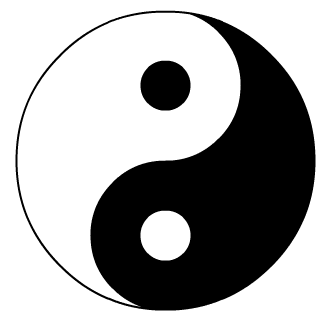
Yin-Yang

Sure; why not?

Posted in Japanese, Yojijukugo | Tagged , , , , , | Leave a comment

Magic Monday – Moving Monday, Travel Tuesday

(My apologies for the late post! We’ve spent the last couple of days moving to a new residence – only about a hundred miles away, which is relatively close by American standards, but still a complex undertaking – and I ended up without the open time that I had hoped to use for the final edit and posting. Please accept this belated but thematically appropriate offering.)


Traveler’s Charms

This is another family of rituals, akin to the Guardian Charms. A black stone from a river, hung around the neck on a thread of braided horsehair, can prevent heat stroke. A green or blue river stone kept under the tongue can prevent death from thirst. Carrying a coin with a hole drilled through the middle in one pocket and a knotted sheaf of dry grass in another, whether the pockets are in a saddlebag or worn by a human bearer, can keep carried supplies from going bad. A ball of wool or cotton, wadded around some of the bearer’s hair and tied with undyed thread, can prevent blisters and chafing if attached to an anklet or one’s footwear.

Each of these charms costs one strain and three fatigue to create and an hour to craft, has a base difficulty of d4, and lasts for up to one month, or until the bearers spends more than two nights in the same location. Increasing the difficulty by one step doubles the maximum duration for both travel and sojourn; doubling the cost in strain decreases the difficulty by one step.

Posted in Rules, Setting | Tagged , , | 1 Comment

Urgent news straight from the source!

Here’s another flatulence-related saying! Enjoy!

屁と火事は元から騒ぐ
(He to kaji wa moto kara sawagu;
“Farts and fires make noise from the source”)

Definition:

The one who caused a problem often complains about it the most. “The one who smelt it, dealt it.” The person who passed gas is often the first and loudest to complain about a smell, and the person or household that caused a fire (for example, by letting their cooking-fire get out of control) is often the one that makes the most fuss about there being a fire.

Breakdown:

We begin with our main noun from last week, (he, like “heh”), a fart. It is joined by the conjunctive particle (to, like “toe”) to compound noun 火事 (kaji), “conflagration” – literally, “fire thing.” These are collectively signaled to be the topic of discussion by the topic marker (wa).

Next we get the noun (moto), “origin,” “source,” “foundation.” The particle から (kara) marks it as the start or origin point of something. And finally, that something is given as the verb 騒ぐ (sawagu), in sentence-final form. Sawagu has a range of related meanings, but relevant to this context are “to make noise” and “to panic,” “to make a fuss.”

Notes:

Not a lot to add on this. There are a couple of variations on this saying with the same meaning. There are a surprising number of further fart-related sayings and idiomatic expressions as well, but any more than two would probably be pushing my luck. I leave the rest as an exercise to the reader.

Example sentence:

「え~、臭っ!誰かおならした?」 「太郎や、屁と火事は元から騒ぐって言うんじゃない? 」 「ああ...」

(“Eee, kusa’! Dareka onara shita?” “Tarou ya, he to kaji wa moto kara sawagu tte iun ja nai?” “Aa….”)

[“Egh, that reeks! Did someone fart?” “Tarou, don’t they say that ‘The one who smelt it dealt it‘?” “Ah….”]

Posted in Japanese, Kotowaza | Tagged , , , , , , , | Leave a comment

A yojijukugo for spiders?

傍目八目
oka.me.hachi.moku

Literally: side / bystander – eye – eight – eye

Alternately: People observing something from outside can understand it better than those directly involved. An objective viewpoint gives the best grasp of a situation.

Notes: This phrase comes from the game of Go, in which it is said that observers (傍目) watching a game can see how it will progress eight moves ahead of what the players can figure out (where each move involves placing a stone on an “eye” of the board, hence 八目).

Media: There weren’t a lot of visual media that illustrated this particularly well, so please just enjoy this eponymous video by “Team 3”:

Posted in Japanese, Yojijukugo | Tagged , , , , , | 2 Comments

Magic Monday – And that’s how you get a rabbit out of a hat!

Spirit Call

Spirit-calling is a magical tradition widely practiced in the Clanlands to the east of the Sianin Mountains. It requires substantial indoctrination before it can be practiced properly. When a would-be conjurer’s training is complete, a sponsor must perform a Spirit Call for the seneschal of a given type of animal spirit. (In the absence of a sponsor, the seneschal may be sought out in Dream, in a manner similar to the quest for an Animal Mask). The seneschal bears a scroll which the new conjuror must sign in blood. This covenant can only be sealed with one totem species, so would-be conjurors are advised to choose their sponsor wisely.

Thereafter, by shedding a drop of blood and calling out, the conjuror may summon a spirit of that animal type from Dream. If one knows the proper names, one may call specific individuals, or even a group all at once. The spirit animals summoned can speak the conjurer’s language and will usually cooperate, although it is wise to speak to a spirit with appropriate manners. (The bulk of a conjuror’s training is in this etiquette, and in the names and ranks of the various spirits.) Spirit animals may fight for their ally, help with a task, or even bring magical powers to bear on a problem. But none will fight to the death, because if killed, a spirit will never be able to manifest in the mortal realm again. In return for these services, the conjuror’s dream-self may be called on at times to aid his or her totem species in that realm.

The initial contract requires the permanent sacrifice of at least one hp, but the harm done when making a Call is negligible. The strength of the spirit summoned is proportional to the amount of strain taken while making the call: calling a small, weak individual might result in one strain, while at least twenty are necessary to call the seneschal… and more powerful beings exist who might be called. The base difficulty is d8. For each hp beyond the first in the initial sacrifice, the base cost in strain is reduced by one (to a minimum of one fatigue); for each doubling of the initial hp sacrifice, the base difficulty is reduced by one step.


This “spell” was actually inspired by the animal-summoning ninjutsu techniques used in the Naruto anime and manga. It’s an interesting setup that, at least by the time I stopped spending time on the series, had never really been discussed in detail.

Posted in Rules, Setting | Tagged , , , | 1 Comment

Shutting the something door after the something has escaped

This is the classiest kotowaza I’ve introduced yet, no doubt!

屁を放って尻窄める
(He wo hitte shiri subomeru;
“Loosing a fart and [then] clenching your butt.”)

Definition:

Locking the barn door after the horses are gone. This kotowaza refers to frantic attempts to fix or hide an error or embarrassment after it is too late to stop it from happening. The image is of someone trying to suppress a fart after it has already escaped. One of my sources claims that the saying is an admonition to admit your mistakes rather than trying to cover them up.

Breakdown:

(he, pronounced like “hey”) is a fart. (By extension, it can also mean “something worthless,” and there are a number of derogatory phrases and compounds that use this association, including 屁理屈 – herikutsu – “fart reasoning” – to indicate quibbling or sophistry.) Anyway, the is marked as the object of a verb by the direct-object marker (wo). The verb in question is 放る (hiru). Normally this character is associated with the verb 放つ (hanatsu), “to release,” “to set free,” “to fire an arrow,” but with the hiru reading it specifically refers to expelling something from the body: flatulence, defecation, or giving birth. (Cf. the rough English-language idiom “poop out a baby.”)

放る is in conjunctive form, attaching it to the second half of the sentence, which is another object-verb pairing. The noun is (shiri), which as you might expect means “rear end” (I’m not just speaking euphemistically: a 川尻 – kawajiri – is the mouth of a river; a 目尻 – mejiri – is the outer corner of the eye). Here we skip a repeat of , but its action is implied by the parallel structure. And finally the verb 窄める (subomeru), “to narrow (something),” “to fold (an umbrella),” “to purse (one’s lips),” in sentence-final form.

Notes:

The verb 窄める can also be pronounced tsubomeru, although that reading seems to be less common for this saying. It is also acceptable to change the final verb to its imperative form, 窄め (subome). Some people apparently replace with (ana), “hole,” but this is considered incorrect.

Amazingly enough, this little gem also shows up in the Edo iroha karuta set. Its usage, in various forms, is attested since the mid-1600s.

Example sentence:

「はい、宿題提出!」 「しゅ… ええと、宿題、ありましたか?」 「分かってるくせに!この前、君がちゃんとメモ帳に書いたのを見ていたぞ。ごまかしても、屁を放って尻窄めるに過ぎない」

(“Hai, shukudai teishutsu!” “Shu… eeto, shukudai, arimashita ka?” “Wakatteru kuse ni! Kono mae, kimi ga chanto memo-chou ni kaita no wo miteita zo. Gomakashitemo, he wo hitte shiri subomeru ni suginai!”)

[“Alright, turn in your homework!” “Home… um, there was homework?” “As if you didn’t know! I watched you write it down in your notebook. Trying to trick me now is just clenching your butt after the fart is out.”]

Posted in Japanese, Kotowaza | Tagged , , , , | Leave a comment