Pets, utensils, and maybe even people!

猫も杓子も
(Neko mo shakushi mo;
“Even cats and serving-spoons”)

Definition:

Everyone and everything. “All that and the kitchen sink.” “Everyone and their brother.” Everything at hand, thrown together in a jumble without distinction. I get the impression that this phrase is primarily used to refer to large groups of people who share in a behavior or quality.

Breakdown:

This simple phrase consists of a pair of nouns, each followed by the emphatic particle も (mo). The first noun is 猫 (neko), “cat,” and the second is 杓子 (shakushi), a traditional serving spoon.

Notes:

杓子 is often translated as “ladle” (including by me, in a previous post) but this is a bit misleading. The original bamboo spoon appears to be more flat and paddle-like, although there’s also a design that amounts to a tiny cylindrical cup at the end of a long stick, and modern usage has expanded to include Western-style ladles as well.

The origins of this phrase are unclear. Theories have been advanced suggesting that the terms are corruptions of phonetically similar words, that both cats and serving-spoons are common and accessible in many households, that shakushi are shaped similarly to cats’ paws, or that it comes from a collection of anecdotes about the famous Zen monk Ikkyū, appropriately titled 『一休咄』 (Ikkyuu-banashi, “Tales of Ikkyū”).

Example sentence:

「ピクニックに友達を数人だけ誘ったはずなのに、いつの間にか猫も杓子も集まった賑やかなパーティーになってしまった

(“Pikunikku ni tomodachi wo suunin dake sasotta hazu na no ni, itsu no ma ni ka neko mo shakushi mo atsumatta nigiyaka na paatii ni natte shimatta.”)

[“I’m pretty sure I only invited a handful of friends to the picnic, but at some point absolutely everyone showed up and it turned into a noisy party.”]

Posted in Japanese, Kotowaza | Tagged , , , , , , , , , | 1 Comment

Cheers to that

拍手喝采
haku.shu.ka-.ssai

Literally: “musical beat” – hand – shout – gather

Alternately: Applause and cheering. Vigorous praise and approval.

Notes: 喝, in and of itself, is interesting. One dictionary I use translates it as “scold,” but a little deeper investigation suggests that this comes from Zen teaching, when students were “scolded” with sudden shouts. Meanwhile, a 喝食 (which can be pronounced kashiki, kasshiki, or katsujiki) is just a call to meals.

Sword and sheath

Supercell’s Hakushu Kassai Utaawase is the title of the opening song of one of the releases of the Katanagatari anime

Posted in Japanese, Yojijukugo | Tagged , , , , , , , , | Leave a comment

To an idiot with a hammer, EVERYTHING looks like a nail

小人閑居して不善をなす
(Shoujin kankyo shite fuzen wo nasu;
“The mean, when idle, accomplish ill”)

Definition:

Idle hands are the devil’s workshop. Mean-spirited or narrow-minded people will do harm when given free time and left to their own devices.

Breakdown:

We begin with the noun 小人 (shoujin), literally “small person,” by extension “small-minded person,” “mean person.” Particles are elided, but one may imagine the shoujin as the topic or subject of the sentence. What follows is noun 閑居 (kankyo) “idleness,” turned into a verb by attaching the verb する (suru), “to do,” in conjunctive form as して (shite, rhymes with bidet). This is followed by a second clause in an implied conditional or hypothetical relationship, beginning with the noun 不善 (fuzen), literally “not-good,” i.e. “evil deeds,” or more gently “mischief.” This is marked by the particle を (wo) as the object of the verb なす (nasu), “to accomplish,” “to do,” which appears in conclusive form. 小人 carries forward as the implied subject of the verb.

Notes:

There’s a distinct classist sort of prejudice embedded in the history of this phrase: 小人 can refer to the “common folk” and in that sense is considered an antonym of 君子 (kunshi), the “wise prince.” That said, the same could be said of English: “mean” means “cruel” now, but used to mean “common,” while even “villain” comes from a term meaning “farmhand.” It turns out that rich people deciding baselessly that they’re the good guys, while the common folk are morally deficient, is an old and widespread phenomenon. Somewhat ironic, given that the rich tend to be far more idle (and to cause far more harm on a per capita basis!) than everyone else.

In any case, in modern usage this kotowaza has lost the classist nuance, and is mostly a warning against the dangers of lazing around rather than working.

It is acceptable, but rare, to write nasu as 為す. Interestingly, kankyo was originally written as 間居, but now 閑居 is the standard rendition in Japanese. On the other hand, writing fuzen as homophone 不全 (“incomplete”) is an error; so is pronouncing 小人 as shounin.

This phrase comes to us from the Confucian text, the Great Learning (Japanese 『大学』 = Daigaku). The Japanese rendition actually says …為せば至らざる所なし (naseba itarazaru tokoro nashi), “when [the mean accomplish ill], there is no place they will not arrive.” That is, there is no limit to the bad things a bad person will do if given the time; no lengths they won’t go to. (This longer version is not used as a saying.)

Example sentence:

小人閑居して不善をなすというけど、悪徳な資本家達は引っ切り無しにパーティーやらゴルフやらの暇つぶしばかりをしているくせに、庶民のための公的支援は絶望しそうなくらいに妨害してくる」

(Shoujin kankyo shite fuzen wo nasu to iu kedo, akutoku na shihonka-tachi wa hikkiri nashi ni paatii yara gorufu yara no himatsubushi bakari wo shiteiru kuse ni, shomin no tame no koutekishien wa zetsubou shisou na kurai ni bougai shite kuru.”)

[“They say that idle hands are the devil’s workshop, but it still brings me to despair how the robber barons keep blocking public assistance in spite of the way they’re constantly just killing time with parties and golf and the like.”]

Posted in Japanese, Kotowaza | Tagged , , , , , , , , | Leave a comment

The quick and the subtle

当意即妙
tou.i.soku.myou

Literally: appropriate – mind / idea – instant – strange / delicate

Alternately: Clever; quick-thinking. Able to handle a situation (appropriately!) as soon as it arises.

Notes: This configuration is based on the Buddhist phrase 当即妙. In this case, 位 refers to a (sometimes metaphorical) “position” rather than a mental state as 意 does, and the overall meaning is something more like “achieving enlightenment despite being a layperson.” From this came the meaning “quickly grasping the truth of a situation,” and a generalization to quick thinking or wit.

Compare near-synonym 臨機応変.

Replacing 意 with homophone 為 (“make,” “do,” “serve as” etc.) is considered an error.

Elemental horoscope chart

The quality of Gemini, according to this horoscope chart – apparently the Twins are a “flexible wind” sign. Source.

Posted in Japanese, Yojijukugo | Tagged , , , , , , , | Leave a comment

Like a dash of cold water

年寄りの冷や水
(Toshiyori no hiyamizu; “Cold water for the elderly”)

Definition:

This phrase describes a situation in which an elderly person is doing something more aggressive or showy, or even dangerous, than is appropriate for their physical condition. The image is of someone sufficiently advanced in years that they have lost some of their resistance to the cold, who nonetheless insists on bathing in, or even (gasp) drinking*, water that isn’t heated.

Breakdown:

This relatively simple noun phrase centers on its final character, the noun 水 (mizu), “water.” This is preceded by the transitive verb 冷やす (hiyasu), “to chill [something],” in prenominal form.

Going back to the beginning, we find the noun 年 (toshi), “year.” This is followed by, and compounded with, the intransitive verb 寄る (yoru), “to approach,” or “to gather together,” also in prenominal form and acting as a noun. The compound 年寄り, perhaps prefixed with an お (o), is a polite term for “the elderly.” These two noun phrases are joined by the associative particle の (no).

Notes:

Related phrases expand the list of things that old people shouldn’t do to include tree-climbing (木登り = kinobori), walking around outdoors at night (夜歩き = yoaruki), and boasting of one’s strength (力自慢 = chikarajiman). Closer to home, hiyamizu may be written as 冷水, without the intervening kana, without any change in meaning or pronunciation.

This is the to entry in the Edo iroha karuta set. It is attributed to a kabuki play titled 『善悪両面児手柏』 (Zen’aku ryoumen konote gashiwa).

* Multiple sources call out cold water as bad for drinking – and I made fun of this, above – but there is at least hypothetically a logical explanation: one source claims that the “cold water” in question was water taken from the Sumida River during the Edo period. Untreated water (especially from an urban waterway that contains a nontrivial amount of human waste, industrial waste, and garbage) can make you very sick, after all. While it was believed that water from the middle of the river was harmless, and young people could drink it without obvious harm, elders with relatively weak immune systems were in fact encouraged to boil the water first rather than using it “cold.”

Example sentence:

「あの九十二歳のおばあさんがフルマラソンを走ってるのを見て、年寄りの冷や水だと思って不安になったけど、なんと、おばあさんが俺より速くゴールに着いて元気そうでびっくりした」

(“Ano kyuujuunisai no obaasan ga furumarason wo hashitteru no wo mite, toshiyori no hiyamizu da to omotte fuan ni natta kedo, nanto, obaasan ga ore yori hayaku gooru ni tsuite genkisou de bikkuri shita.”)

[“I saw that 92-year-old woman running the marathon and it made me worry; I thought it was too much for someone her age. But, I mean, she finished more quickly than I did, and was still full of energy; it was quite a shock.”]

Posted in Japanese, Kotowaza | Tagged , , , , , , , , | Leave a comment

As clean and pure as burnished bronze

Yes, bronze is an alloy. You know what I mean.

清廉潔白
sei.ren.ke-.ppaku

Literally: pure – pure – clean – white

Alternately: Someone’s heart and mind – and their actions in the material world! – are unselfish and fair, moral and ethical. Working to do good for good reasons; having nothing to be ashamed of.

Notes: It’s a state that I wish more people out there in the world at least aspired to, rather than looking for ways to attack and smear it in order to avoid the pain of self-improvement.

Yes, patina is oxidation, which is another form of "impurity," and is green rather than white. We're talking about the guy, not the statue.

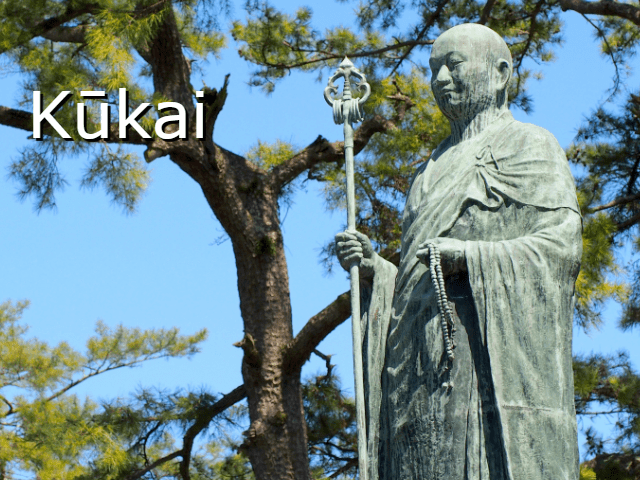
Our old friend 弘法! I’m sure he had a lot of human flaws, but… well, it is at least nice to have good ideals.

Posted in Japanese, Yojijukugo | Tagged , , , , , , | Leave a comment

What part of the law is this possession?

正直の頭に神宿る
(Shoujiki no koube ni kami yadoru;
“A god dwells in the head of the honest”)

Definition:

Honesty is the best policy. A benevolent spirit will protect, inspire, even possess those who are honest in their dealings. Note that here “honesty” seems to stand in contrast with “cheating” or “trickery” rather than simply with “lying.” The exhortation is to be fair and straightforward in all your interactions with others.

Breakdown:

We begin four characters in with 頭 (here pronounced koube), “head.” The associative particle の (no) indicates that the head “belongs to” the noun 正直 (shoujiki), “honesty,” or by extension “an honest person.” This noun phrase is marked by the particle に (ni) as the location of the verb 宿る (yadoru), “to stay in,” which appears in conclusive form. While any further particles are elided, this verb takes as its subject the noun 神 (kami), “spirit,” “divinity.”

Notes:

Many students of Japanese will want to read 頭 as atama, but 頭 – and to an extent 首, which is semi-interchangeable – have had many readings over the years including kashira, kabu, kubi, and koube, which seems to be associated with the Heian era. (This said, though, bear in mind that phonetic similarity doesn’t necessarily mean that the above readings are variations on a theme; it’s thought that they have distinct etymologies.)

There are a number of variants and synonyms for this phrase. One makes the person explicit instead of rendering them as just a head by declaring that 正直者に神宿る, where 正直者 is shoujikimono, “an honest person,” another rearranges the word order with 神は正直の頭に宿る, moving the “god” to the front and making it the topic with particle は (wa).

Example sentence:

正直の頭に神宿ると言うし、嘘偽りの無い生活を送ろうと頑張ってるけど、汚職やら詐欺やらあるから…何と言うか、正直な社会にもなって欲しい」

(Shoujiki no koube ni kami yadoru to iu shi, uso itsuwari no nai seikatsu wo okurou to ganbatteru kedo, oshoku yara sagi yara aru kara… nan to iu ka, shoujiki na shakai ni mo natte hoshii.”)

[“The gods help an honest person, as they say, so I’m doing my best to live a life free of lies and deception. But there’s still corruption and scams, so… how should I put it? I’d like an honest society.”]

Posted in Japanese, Kotowaza | Tagged , , , , , , , | Leave a comment

The preeminent hobby of the times

Only in small part due to the weather, sadly.

蟄居屏息
chi-.kkyo.hei.soku

Literally: “hibernation of insects” – exist; reside – fence – breath

Alternately: Staying indoors and keeping quiet. Waiting inside with bated breath.

Notes: This was apparently also the name of an Edo era punishment for samurai who had committed certain crimes; essentially, house arrest.

I'm a little concerned about the white things scattered around

Now imagine a blizzard outside

Posted in Japanese, Yojijukugo | Tagged , , , , , , , , , | 2 Comments

Keep in mind for next year

Seriously, try to avoid travel during a pandemic, even if it’s for love.

惚れて通えば千里も一里
(Horete kayoeba senri mo ichiri;
“If you travel while in love, even a thousand ri feel like one.”)

Definition:

If you’re traveling to meet with someone you love, then even the longest road feels short; even a thousand-ri trip would feel like a brief stroll. More broadly, we gladly do things for those we love without care, where otherwise it might feel like going to a significant amount of trouble.

Breakdown:

We begin with the verb 惚れる (horeru), “to fall in love (with),” in conjunctive form and followed by the verb 通う (kayou), “to commute,” in conditional form (or if you will, in perfective form and taking the conditional suffix ば, ba). The next clause begins with number-noun 千里 (senri), “one thousand ri,” with the emphatic particle も (mo). Last comes the number-noun 一里 (ichiri), “one ri,” with anything else elided.

Notes:

My sources tell me that this comes from a “popular song” (俗謡, zokuyou), although details such as its name (if it had one) or even the time period of its origin remain unclear. However, they do note that the song continues 逢わずに戻ればまた千里 (awazu ni modoreba mata senri, “but it’s another thousand ri if you can’t meet and have to go home again.” Yikes.

Example sentence:

「あの人は作家志望だって知ってたけど、私のために叙事詩まで書いてくれるなんて意外、というか、なんか信じられない。本当に惚れて通えば千里も一里みたいだね」

(“Ano hito wa sakka shibou datte shitteta kedo, watashi no tame ni jojishi made kaite kureru nante igai, to iu ka, nanka shinjirarenai. Hontou ni horete kayoeba senri mo ichiri mitai da ne.”)

[“I knew they wanted to be an author, but it caught me off guard that – or maybe, I kind of can’t believe that – they’d go and write a whole epic poem for me. I guess it’s true that love makes all tasks lighter.”]

Posted in Japanese, Kotowaza | Tagged , , , , , , | Leave a comment

My friend Dan

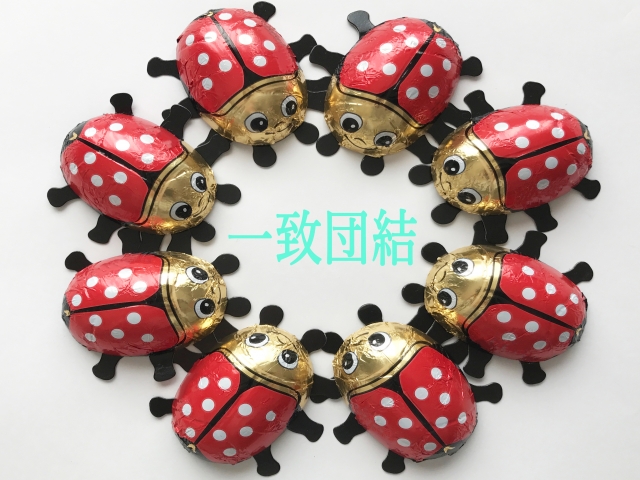
一致団結
i-.cchi.dan.ketsu

Literally: one – do – group – bind / join

Alternately: Many people joining and working together for a common cause.

Notes: This is a compound of compounds. 一致 is “agreement,” “union,” while 団結 is “grouping together,” “teaming up.”

Cute candy arrangement or terrifying cult? YOU DECIDE!

Band together! Drive out the aphids!

Posted in Japanese, Yojijukugo | Tagged , , , , , | 2 Comments