Kenshi’s gambit

背に腹は代えられぬ
(Se ni hara wa kaerarenu; “The belly can’t take the place of the back”)

Definition:

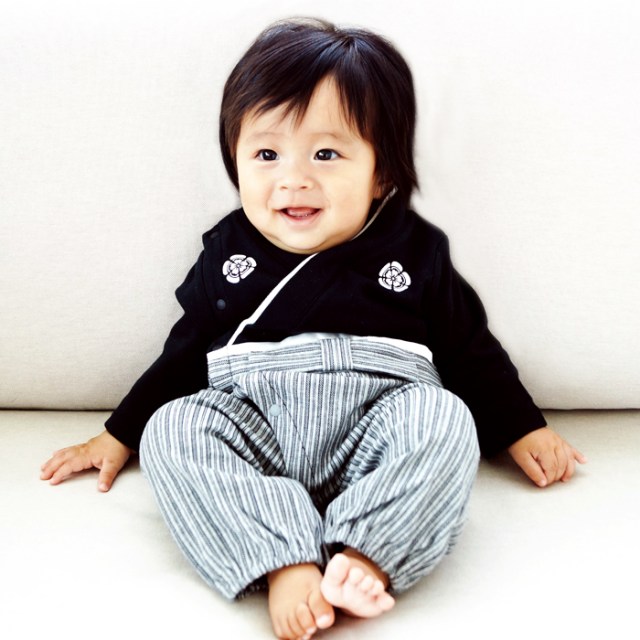
If something is vitally important, then other things may need to be sacrificed on its behalf, even if they are also important in their own right. Sometimes you’re forced to choose the lesser of two evils or use a gambit. In a swordfight you don’t want your back to get slashed or stabbed, but it would be even worse to turn and protect your back by taking the hit in your vitals. In a darker sense, this phrase may be used to justify “looking out for number one” – focusing on protecting and taking care of yourself without spending any time considering how others are faring.

Breakdown:

The ruling verb in this brief phrase is 代える (kaeru), “substitute,” “replace,” in a negative potential form. The particle に (ni) identifies the thing (not) being substituted for as the noun 背 (se), “back” (as in the posterior half of the human body). And the thing (not) being substituted in is the noun 腹 (hara), “belly”; this is marked by the particle は (wa), apparently simply for emphasis. (An unemphasized version would probably use を, wo.)

Back up a bit. The negative suffix in use here is ず (zu); ぬ is its prenominal form. Yet its use here occurs at the end of a sentence rather than before a noun; there isn’t even an implied noun. What’s going on?

It seems that it’s nothing more than codified confusion. There’s another ぬ out there, a perfective suffix that might be translated as “~ has ~ed.” (For example, this is what we see in the Ghibli movie title 『風立ちぬ』).

Notes:

The whole phrase may be contracted to just 背より腹 (se yori hara, “belly before back”). Some versions may expand 背 to 背中 (senaka), use kana か or kanji 替 (both ka) in place of kanji 代, and/or replace the final ぬ with modern negative ending ない (nai), all without any change in meaning. However, replacing the particles to make 背 (se wo hara ni) reverses the image and is an error.

This is the se entry in the Edo iroha karuta set.

Trivia of the day: the Hebrew phrase בטן גב (beten-gav), literally “back-belly,” refers to lounging around, especially sunbathing.

Example sentence:

「バイトも睡眠も犠牲に出来ないし、背に腹は代えられないので、今学期は残念ながらスペイン語の授業は落とさせていただきます」

(“Baito mo suimin mo gisei ni dekinai shi, se ni hara wa kaerarenai no de, kongakki wa zannen nagara Supeingo no jugyou wa otosasete itadakimasu.”)

[“I can’t sacrifice work or sleep, and something must give, so I’m requesting permission to drop my Spanish class this semester.”]
Posted in Japanese, Kotowaza | Tagged , , , , , , | Leave a comment

Yeets, and shoots leaves

百発百中
hya-.ppatsu.hyaku.chuu

Literally: hundred – emit – hundred – middle

Alternately: Hitting the center of the target with every arrow or bullet fired. A 100% hit rate. Metaphorically, a person with plans or, especially, predictions that never fail.

Notes: This compound comes to us from the Zhan Guo Ce (『戦国策』, Sengokusaku, which we’ve seen before). The story goes that Yang You Ji (養由基, Japanese You Yuuki), a legendary archer from the state of Chu, walked a hundred paces from a willow tree and loosed a hundred arrows from his bow, striking a different leaf on the tree with each one.

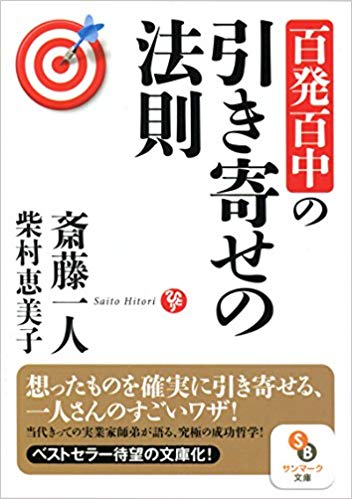
HyaPpatsuISsatsu

A book about how to become infallible by proactively causing your predictions to come true. A positive spin on the Texas sharpshooter fallacy, perhaps.

Posted in Japanese, Yojijukugo | Tagged , , , , , , , | Leave a comment

Wagahai wa Sam de aru

馬には乗ってみよ人には添うてみよ
(Uma ni wa notte miyo hito ni wa soute miyo;
“Try riding a horse; try accompanying a person”)

Definition:

It’s often difficult to understand the true nature of something without experiencing it firsthand, so don’t criticize or judge until you’ve tried something out for yourself. You don’t know the quality of a horse until you’ve tried riding it; you don’t know the quality of a person before you’ve seen how they behave. “Before you judge someone, walk a mile in their shoes,” but also “the proof of the pudding is in the eating” or “don’t know it ‘til you’ve tried it.”

Breakdown:

This saying is a pair of parallel phrases.

In the first phrase, the primary verb is 乗る (noru), “to get on,” or by extension, “to ride,” in conjunctive form. It’s followed and connected to the verb みる (miru), “to see,” or by extension, “to try something out and observe the results,” this time in imperative form. The particle に (ni) specifies the verb’s location or target as the noun 馬 (uma), “horse,” and the particle は (wa) follows ni to create a contrast and strengthen the parallel structure of the saying.

In the second phrase, the primary verb is 添う (sou), “to meet” or “to accompany.” As before, the verb is in conjunctive form and followed by an imperative form of miru; again preceded by a locative ni and contrastive wa. In this case, the noun is 人 (hito), “person.”

Notes:

This kotowaza allows for a number of variations. It’s considered acceptable to switch the order of the phrases, to replace 添う with 会う (au, “to meet”), or to replace 乗って with 乗りて (norite), a grammatically equivalent form closer to classical grammar, and so on.

The grammar in this one is kind of wonky. I glossed over it above, but 添うて is not what I would have expected for a conjunctive formation of 添う. The classical grammar that gives us 乗りて should produce 添いて, while the more modern grammar that gives us 乗って should produce 添って. It took some searching before I found that 添うて is an example of ウ音便 (u-onbin), i.e. a “euphonic shift to u,” and in this case is an intermediary stage between the classical and modern forms. The same shift is also responsible for 会うて, as seen in the previous paragraph, as well as further examples such as 思うて and 問うて.

This saying apparently comes to us based on a passage in our friend 『毛吹草』 (Kefukigusa).

Example sentence:

馬には乗ってみよ人には添うてみよというから、今年は夏休みの間、趣味に合わなさそうな本でもまずは読んでみようと思う」

(Uma ni wa notte miyo hito ni wa soute miyo to iu kara, kotoshi wa natsuyasumi no aida, shumi ni awanasasou na hon de mo mazu wa yonde miyou to omou.”)

[“They say you’re supposed to try things for yourself before judging, so during summer vacation this year, I think I’ll try reading some books that don’t seem like they’d match my tastes.”]

Posted in Japanese, Kotowaza | Tagged , , , , , , , , | Leave a comment

Get out of the blazing heat

円転滑脱
en.ten.katsu.datsu

Literally: round – revolve – slide – remove

Alternately: Able to change one’s words and actions in response to other people’s mood or situation, and thus get stuff done without ruffling feathers unnecessarily. Dealing with things skillfully. Adaptable; versatile; suave; smooth.

SPHERES

Picture this, except as a human personality

Posted in Japanese, Yojijukugo | Tagged , , , , , , | Leave a comment

Magic Monday – the Sword of Eternal Guard

The Sword of Eternal Guard

An ancient master forged this steel gladius-like blade and enchanted it so that it could not leave the hand of its wielder so long as a single enemy remained within ten paces. And even now, the enchantment holds true: anyone who draws the sword and holds it in their hand can not be disarmed, no matter how skilled or determined their opponent. They can not be made to drop it by accident, by shock or exhaustion, sweat or grime,  or even loss of consciousness, nor can they lay it down and thus fall into a trap. The hand itself can be separated from the arm, yes, and some wielders have chosen this escape.

The Sword of Eternal Guard is considered cursed by those who know its history.

The very air swarms with invisible disease-spirits. And although these are vanishingly small, and undetected by mortal senses, and although they are easily repelled by the fortress-walls of skin that defend the body, the enchantment on the Sword still responds to them and refuses to let it be parted from the flesh of its bearer’s hand.

It is a good blade, and its magic prevents it from dulling, rusting, or breaking, no matter what is asked of it. It can be sheathed, so it is not necessarily a constant danger. But a wielder does tend to find themselves invited to fewer parties than they might have been otherwise.

Posted in World-Building | Tagged , , , , | Leave a comment

More comfortable than a high horse

I say it’s high time

枕を高くして寝る
(Makura wo tataku shite neru; “To sleep with your pillow high”)

Definition:

Having nothing at all to worry about. Complete and utter peace of mind. Care-free and able to sleep easy.

Breakdown:

This simple sentence begins with the noun 枕 (makura), “pillow,” marked by particle を (wo) as the object of the verb する (suru), commonly “to do” but in this case perhaps closer to “to make.” In between object and verb comes the adjective 高い (takai) in conjunctive form, which allows it to attach to and modify the verb. Suru is also in conjunctive form, which allows it to lead in sequence to the verb 寝る (neru), “to lie down” and by extension, “to sleep.” This appears in conclusive form.

Notes:

寝る may be replaced with 眠る (nemuru, “sleep”) or 臥す (fusu, “lie down”). For what it’s worth, the original text uses 臥 while contemporary Japanese seems to strongly favor 寝.

This saying comes to us from the Zhan Guo Ce (『戦国策』, Japanese Sengokusaku, English Strategies of the Warring States), a collection of anecdotes set in the Warring States period. The story goes that Zhang Yi came to the king of Wei and used this line as part of an argument that he should ally with and become subject to Qin. Readers may recall that this was part of a broader, ultimately successful strategy by the Qin to divide and conquer the other Chinese states of the time. But… why was Zhang talking about pillows?

Supposedly, if you were in the field on a military campaign, you might rest your head on your quiver (most likely a flat box rather than the round tubes we tend to picture now) to more easily hear the sound of approaching armies transmitted through the ground. In peacetime, in contrast, you could pamper yourself with a more substantial (and thus “higher”) pillow because there was no need to be on guard.

Example sentence:

「一度でも枕を高くして眠りたいけど、今は魑魅魍魎が跋扈する時代だから無理かな」

(“Ichido de mo makura wo takaku shite nemuritai kedo, ima wa chimimouryou ga bakko suru jidai dakara muri ka na.”)

[“Just once I’d like to have the peace of mind for a good night’s sleep. But we’re living in a time when all sorts of ghouls and monsters just do whatever they want, so maybe it’s not possible.”]

Posted in Japanese, Kotowaza | Tagged , , , , , , , , , | 1 Comment

The opposite of Genji

天真爛漫
ten.shin.ran.man

Literally: heavens – true – inflamed – involuntary

Alternately: When a person’s thoughts and feelings show on the surface of their words and behavior. Simplicity; naivete; unaffectedness. Wearing one’s heart on one’s sleeve. Keep in mind that in contemporary Japan, this compound and the quality it describes are heavily associated with (stereotypes of) femininity and youth.

Notes: This is a compound of compounds. 天真 refers to a person’s character that is natural, unguarded, or “pure”, while 爛漫 is something like “shining forth.”

In some cases 爛 may be replaced with homophone 瀾 (“large waves,”), which we’ve actually already seen once. That said, the former (with the fire radical 火 rather than water radical 氵) seems to be preferable. Also, replacing 真 with homophone 心 (“heart”), or 漫 with homophone 慢 (“ridicule,” “laziness”) is an error.

This phrase comes to us from the Chuo geng lu (『輟耕録』, Japanese Tekkouroku), an extensive collection of all sorts of writings from mid-14th century CE Chinese scholar Tao Zongyi (陶宗儀, Tou Sougi).

Tiny yakuza boss is honest about his feelings!

A rare male example

Posted in Japanese, Yojijukugo | Tagged , , , , , , , | Leave a comment

Child development: the self-propelled tomato

As some readers may already know from other sources, The Kid has a little sister now. Not too long after she was born I looked at her round, red face and thought, Oh, a tomato. So now one of her nicknames is Tomato Princess.

As is common with babies, for most of her life so far she hasn’t been especially mobile, having developed basic rolling technology (mostly to the right-hand side) and little else. In the tradition of her primate ancestors, she’s often tried to grab on to things with hands and feet alike, and when something solid is nearby she’ll reach out with all four limbs to facilitate a roll.

All this began to change a few weeks ago when we went to the library and she watched first-hand as another kid, just two months older, went crawling around and even standing up by using the bookshelves as a pull-bar of sorts. At the time this didn’t seem to have much of an impact, but little sooner had we come home than the Tomato Princess began trying to work out how to crawl.

Early results were hilarious and cute, but ineffective. She had apparently noticed that being on all fours instead of your belly was a key part of the technique, but decided to go with hands and feet rather than hands and knees. So she would plant her hands against the floor, straighten out her legs, and rise up… only to find that she was stuck.

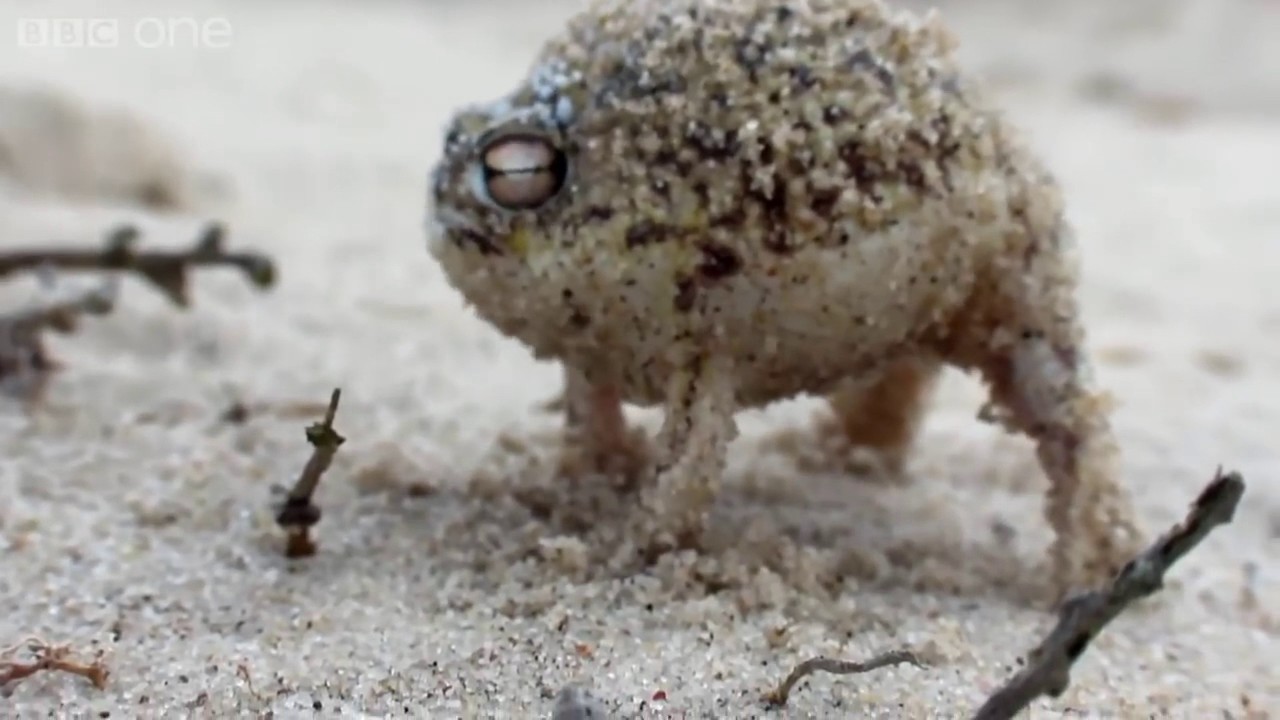
She had enough strength and know-how to lift her body off the ground, but was missing some component that would have allowed her to pick up one limb at a time and move it forward to effect actual locomotion. Once up, in other words, all that she could do was stand there, straight-armed and splay-legged, becoming increasingly frustrated (and increasingly vocal about her frustration) until forced to lower herself back down. The overall effect was reminiscent of the desert rain frog from that BBC video:

Since then, she’s tried squinching (lifting up her rear and then straightening out again, inchworm-style), and then just this past weekend finally developed the art of dragging herself around on her belly again – partially with her elbows, with a sort of kick-swimming motion from behind for extra propulsion – again, somewhat froglike in form, now that I think about it.

This led to a sudden, startling increase in mobility. It felt as if one minute she could move herself an armspan or two in pursuit of something shiny (like a phone screen), and the next, she was wandering from room to room, looking curiously at electric outlets just out of reach overhead and picking up a healthy load of dust with her clothing.

The rest of us are caught between apprehension (the season of babyproofing the home has come upon us at last!) and enthusiasm (I’m repeatedly reminded of this kotowaza). I guess it’s just another reminder that things are always changing.

Posted in Musing, Nonfiction | Tagged , , , , | Leave a comment

As opposed to strawberry fields

(…which I’m told are forever)

滄海変じて桑田となる
(Soukai henjite souden to naru; “The sea becomes a field of mulberries.”)

Definition:

The world is full of dramatic changes. If you stop paying attention to something for a few years, when you next notice it, it will be as different as if land had risen out of the depths of the sea and been cultivated as a mulberry orchard.

Breakdown:

We begin with the noun 滄海 (soukai), “ocean.” Any particles have been elided. Next is the intransitive verb 変じる (henjiru), “to change (into),” to transform,” in conjunctive form. Following this, we find the noun 桑田 (souden), “mulberry field,” marked by the particle と (to) as the result of the verb なる (naru), “to become,” which appears in conclusive form.

Notes:

桑田 is also a family name, commonly read as Kuwata or Kuwada. Note, however, that the correct pronunciation for this phrase allows a play on words with both the beginning and end states using words that start with sou.

This kotowaza reportedly comes to us from the Shenxian Zhuan (『神仙伝』, in Japanese Shinsenden), a 4th century CE Daoist text purporting to be contain the biographies of various supernatural beings. Perhaps as a result of its antiquity, the saying can take a number of forms, including four-character compound 滄海桑田 (soukai souden), contracted noun phrase 滄海の変 (soukai no hen), or simple reversal 桑田変じて滄海となる (souden henjite soukai to naru).

Note that mulberry trees themselves take about a decade to grow from seed to fruiting maturity, so the depicted change is more dramatic than if the sea-bed had simply become a grassy field.

Example sentence:

滄海変じて桑田となる、いつの間にかスーパーコンピュータが手のひらに入るほど小さくなってしまいました」

(Soukai henjite souden to naru, itsu no ma ni ka suupaakonpyuuta ga te no hira ni hairu hodo chiisaku natte shimaimashita.”)

[“The world is always changing; at some point supercomputers became small enough that they could fit in the palm of your hand.”]

Posted in Japanese, Kotowaza | Tagged , , , , , , , , , | 1 Comment

The natural state of heroes

疲労困憊
hi.rou.kon.pai

Literally: tire(d) – labor – distress – fatigue

Alternately: Complete and utter exhaustion. As tired as one can be.

Notes: This is another compound of redundant terms for emphasis: both 疲労 and 困憊 mean “exhaustion,” “fatigue,” “weariness.” I should probably mention that the first term is by far the more common, and I’ve never even seen the final character before in my life.

憊 is read on its own as hai; be careful when voicing it in the compound, because bai (which some people might guess) is considered an error.

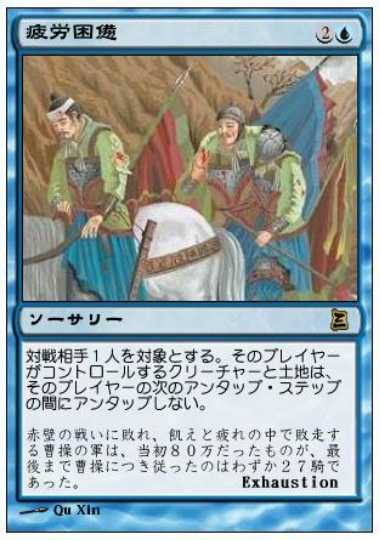
HiRouKonPaiMaHou

A Magic card that keeps an opponent from refreshing the lands and creatures they’d used over the previous turn.

Posted in Japanese, Yojijukugo | Tagged , , , , , | Leave a comment