Yoko ni nattara?

蟷螂の斧
(Tourou no ono; “The mantis’ axe”)

Definition:

The weak standing up to the strong, often with the implication that they didn’t really think through how great the difference in strength would be. A praying mantis that senses threat will rear up and wave its axe-like arms, even at foes who are many times larger than itself.

Breakdown:

This simple noun phrases uses the associative particle の (no) to link the noun 蟷螂 (tourou, a rare Chinese-style-pronunciation term for what is more commonly known as kamakiri), “praying mantis,” and the noun 斧 (ono), “axe.”

Notes:

Tourou may also be written as 螳螂. More importantly, the outsize foe being faced may be specified: 蟷螂斧を以て隆車に向かう – note the change in particles – (Tourou ga ono wo motte ryuusha ni mukau), “The mantis, holding an axe, faces a [large vehicle].”

(This is kind of tricky. The longer version may have fallen out of favor in part because 隆車 is simply not a Japanese word. A little searching returned results for modern motorbikes, cars, and ATVs… in Chinese. My sources say that the 隆車 is some kind of large wheeled vehicle, but anything more specific, or a proper English translation, is beyond the scope of this post.)

Anyway, the image of a praying mantis rearing and showing its hooks to an onrushing cart is a pretty evocative image of standing up to someone more powerful than oneself. Here’s to hoping it works out alright.

This saying comes to us from the Han shi waizhuan (韓詩外伝, in Japanese Kanshi gaiden), a sort of midrash to the Classic of Poetry.
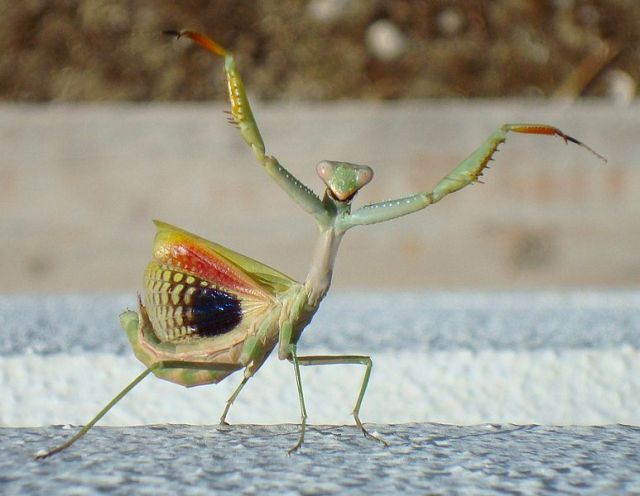
TouRouNoOno

Rar!

Example sentence:

「かつて、金持ちに立ち向かう者は僅かの間蟷螂の斧を振るってから潰される嫌いがあった。ああいう時代にはもう絶対に戻りたくない」

(“Katsute, kanemochi ni tachimukau mono wa wazuka no aida tourou no ono wo furutte kara tsubusareru kirai ga atta. Aa iu jidai ni wa mou zettai ni modoritakunai.”)

[“There used to be this awful tendency that anyone who stood up to the rich would stand against impossible odds and then be crushed. The last thing I want is to return to those times like that.”]
Posted in Japanese, Kotowaza | Tagged , , , , , , , | Leave a comment

A harder love

A harder love than frost

I love the autumn:
The smell of leaves’ new colors,
The golds, yellows, reds,
The play of warmth and coolness,
The wonder of birds in flight.

You are my autumn.
You are bright leaves on green grass.
You are sharp, fresh air.
You’re the pleasure of motion,
Bringing all these together.

You are that bright flame
Shielded tenderly from wind,
Touched to those bright leaves.
In the cool of the evening,
You are that strong, warm burning.

They say it’s an end,
A cold end to color, but
I love the autumn.
I love it knowing the cold,
Knowing what the fire is.

Reaching into flame,
Brown leaves of skin blow away
In cool autumn light.
Knowing, I reach out my hand.
Autumn – take it if you will.


(Another poem from the archives. Maybe I’ll tell you about it when you’re older.)
Posted in Poetry | Tagged , , , , | Leave a comment

Turns out it doesn’t matter, though

All you need to do is get mad at the people who caught you doing the crimes!?

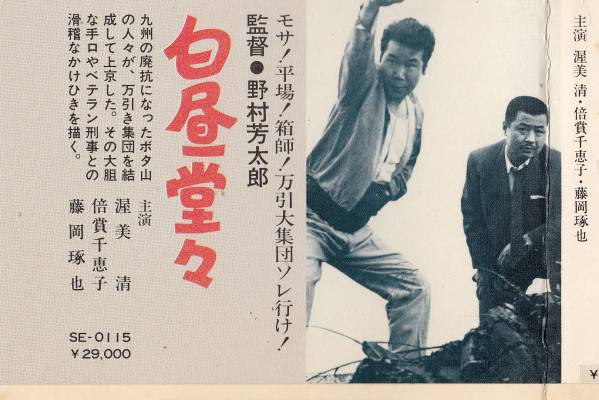
白昼堂々
haku.chuu.dou.dou

Literally: white – noon – public hall – [kanji doubling mark]

Alternately: (Doing something bad) in broad daylight.

Notes: This relatively recent coinage comes to us from the title of a 1966 crime novel (and the film it was made into in 1968) by Yuuki Shouji (pen name).

As always, the doubled character may also be written out fully, if that’s your jam.

HakuChuuDouGa.jpg

This one.

Posted in Japanese, Yojijukugo | Tagged , , , , , , , | Leave a comment

Beasts Forged for your Viewing Pleasure

A recent post by Noisms reminded me of The Forge, and of course I was inspired to go fiddle around myself for a while. So, just in time for Halloween, please enjoy these four monsters that probably fall somewhere on the spectrum between “terrifying” and “okay.”

Forge 102318

Phase Ape: A perfectly ordinary ape, with gray hair and iridescent eyes, except it can phase through ordinary matter at will. As a rule a Phase Ape is savvy enough to be effectively immune to physical attacks and to magical attacks that create physical effects (e.g. fire, lightning). It can only be hit (on a successful attack roll, as normal) when caught by surprise or if the attacker carefully matches their timing.

Bleak Pusher Bird: A perfectly ordinary raven, about as intelligent as any other corvid, capable of mimicking a handful of words of human speech, except it generates an aura of soul-crushing depression. The Bleak Pusher isn’t going to be any more hostile than any other 99% perfectly ordinary raven, but you still don’t want them around because taking almost any action is going to require a roll (saving throws of increasing severity, in D&D terms). It starts with the big stuff, but if you hang around within the bird’s range for a couple of days it starts to affect breathing, and then you’re in real trouble. You’ll likely be adventuring — Nevermore!

Druid Cobra: A perfectly ordinary cobra, except it can empathically command plants. They’re not intelligent by human standards; they don’t have language; they just desire that the local vegetation hides them from enemies and entangles their prey, and it does so to the best of its ability.

Mute Child Adder: A perfectly ordinary snake, just venomous enough to be a mild threat to a healthy adult, except it has the face of a human child. They don’t have human larynges, though, so they can’t really talk. As a rule they look pretty cute, sweet even, at least until they open their mouths and you see the teeth.

Posted in Miscellaneous, World-Building | Tagged , , , , , | Leave a comment

But what if your horse leaks intel to the Russians?

What do you do when the work environment at the stable drives away all the competent grooms?

蹴る馬も乗り手次第
(Keru uma mo norite shidai; “A kicking horse depends on the rider”)

Definition:

Even a violent, difficult-to-handle person can be talked to and dealt with successfully by the right person, or using the right methods. In theory at least, there’s a way to approach and defuse almost any situation no matter what kind of person you’re dealing with. The analogy is of a horse who tends to kick, asserting that even they can be ridden by someone who gives them appropriate training.

Breakdown:

The primary noun is 馬 (uma), “horse,” here preceded and modified by the verb 蹴る (keru), “to kick,” in prenominal form. The horse is marked by the particle も (mo), “also” or “even” – its usage here implies that the example of the horse is perhaps a bit extreme or unusual, which quality in turn demonstrates the universality of the following rule.

This rule is expressed by the noun 手 (te), literally “hand” but in this case meaning “person who does a thing.” (See also 相手 aite, 選手 senshu, 歌手 kashu etc.) The “hand” is preceded and modified by the verb 乗る (noru) in conjunctive form, allowing it to function as a noun and effectively, as far as I can tell, making 乗り手 into a compound noun. This feels a bit odd, but is a common structure in expressing “a person who does a thing” in a general sense, where e.g. 乗る人 (noru hito) using the prenominal form, expresses “the specific person who is riding.”

Any further particles are elided, and we are left with nominal suffix 次第 (shidai), “depending on,” to tie the horse and rider together (grammatically).

Notes:

Some variants will talk about 癖ある馬 (kuse aru uma), horses with (bad) habits, or even 人食い馬 (hitogui uma), horses that “eat” (bite) humans!

Example sentence:

蹴る馬も乗り手次第と何度も警戒されてるけど、上村さんはまだ一度も柔道の試合で負けたことがないから、どんな場所でも無敵だと言わんばかりの態度をとる人でした。

(Keru uma mo norite shidai to nando mo keikai sareteru kedo, Uemura-san wa mada ichido mo juudou no shiai de maketa koto ga nai kara, donna basho de mo muteki da to iwan bakari no taido wo toru hito deshita.)

[He had been warned time and time again that there’s a way to deal with any opponent. But since Uemura had yet to lose a single judo match, no matter where he went, he struck an attitude as if he had nothing to fear from anyone.]

Posted in Japanese, Kotowaza | Tagged , , , , , | Leave a comment

Which Mad Pursuit

Which Mad Pursuit

I forget the words you said but
I could feel my heart in my neck
beating oh-no; oh-no; oh-no
Running now, remembering,
it keeps that time and my legs,
my body following, running oh-no,
chase oblivion.

Coming when I’m not looking,
cautiously, behind the fierce sun
that drowns the world in white
until all that’s left is my heart—
Oblivion, I haven’t found you yet.

And you, my heart, would you leave,
run away beyond my legs,
catch Oblivion,
find your way to her
where the rest of me,
mind and body, can’t go?

My legs have stopped running.
You seem close enough to reach out to but
nothing moves but light and I
have chased this world of burning light,
caught it, and nothing else.


(Another poem from the archives. A friend recently reminded me about poetry, and sent me digging through my backup to see what might be worth posting for posterity)
Posted in Poetry | Tagged , , , | Leave a comment

Miss Clavel ran fast, and faster

When you’re afraid of a disaster, don’t just sit still, that’s all I’m saying.

疾風迅雷
shi-.ppuu.jin.rai

Literally: rapid – wind – swift – thunder

Alternately: High winds and a violent thunderstorm. By extension, any situation that develops rapidly or changes violently.

Notes: Replacing 迅 with homophone 甚 (“exceedingly”) or 雷 with homophone 来 (“to come”) is an error.

This compound comes to us from the Book of Rites (礼記, in Japanese Raiki), a collection of disparate writings that eventually became one of the foundational texts of Confucianism.

ShiPpuuManGa

The name of a manga series by Moriyama Matsuro about… Shinsengumi yakuza? Jerks? Jerk Shinsengumi yakuza with hearts of gold, no doubt. And I guess they go fast, too.

Posted in Japanese, Yojijukugo | Tagged , , , , , | Leave a comment

Thus was slapstick monetized

転んでもただでは起きない
(Koronde mo tada de wa okinai;
“Even falling down, they won’t get up as they were”)

Definition:

Cunning and greedy; angling to get some sort of profit even from a mistake or setback; like someone who slips and falls, then looks for something to pick up while they’re on the ground. Although it can have admiring overtones, it tends to be used as a cutting remark about someone’s greed or about their tendency to go with whatever seems the most advantageous.

Note that saying is not used of someone who profits through hard work or recognized talent; the nuance is of someone managing to enrich themselves by finding some trick, loophole, or angle.

Breakdown:

We begin with the verb 転ぶ (korobu), “to fall down,” in conjunctive form and followed by the particle も (mo). The latter often means “also,” or by extension “even,” but here the ~ても form implies emphasis: falling down is an extreme example of the kind of misfortune that the person might try to extract benefit from. This is followed by adjectival noun ただ (tada), often translated as “free” but in this case meaning something more like “as is.” This is followed by particle で (de) denoting a state, and then particle は (wa) indicating an implicit contrast: the state of the person who fell is not “as it was” by the time they 起きる (okiru), “to get up,” a verb here found in negative sentence-final form.

Notes:

This one doesn’t seem to have a standard version. You can do without the で in では, although that may be less common nowadays. Some variants use the older negative suffix ぬ (nu) instead of ない.

Example sentence:

「あの上田さん?うーん、頑張り屋さんというか転んでもただでは起きない人というか、どんな目に遭っても必ず最後は利益を出してるから、ちょっと気になる人だ」

(“Ano Ueda-san? Uun, ganbariya san to iu ka koronde mo tada de wa okinai hito to iu ka, donna me ni atte mo kanarazu saigo wa rieki wo dashiteru kara, chotto ki ni naru hito da.”)

[“Oh, that Ueda-san? Umm, well, I don’t know whether it’s because they work hard or whether they just find a way to benefit even from failure. But no matter what happens they always end up turning a profit, and it’s caught my attention.”]

Posted in Japanese, Kotowaza | Tagged , , , | Leave a comment

The benefits of bold-face fine print

(I thought this was scheduled to pop automatically yesterday, but… it wasn’t, and I was remiss in failing to check. My apologies for the delay.)

胆大心小
tan.dai.shin.shou

Literally: gall bladder / courage – big – heart / mind – small

Alternately: Not being fearful when it comes to taking action, but also paying attention to the fine details. Both bold and careful; proactive and meticulous.

Notes: A variant replaces 小 with 細 (sai), “small (detail).”

This compound comes to us from the Old Book of Tang (『旧唐書』, in Japanese Kutoujo), a history form the “Five Dynasties and Ten Kingdoms” period about the Tang era.

TanDaiDorama

From a live-action drama called 胆大心小頑張ります – Tandai shinshou ganbarimasubut I feel like the main character’s barber could have used a little less 胆大 and a little more 心小.

Posted in Japanese, Yojijukugo | Tagged , , , , , , , | 1 Comment

Just avoid immovable objects

…and you’ll be fine. Right?

断じて行えば鬼神も之を避く
(Danjite okonaeba kishin mo kore wo saku;
“If you do things decisively, even demon-gods will get out of the way”)

Definition:

If you take decisive action backed by strong determination, there is little that can stand in your way. Where there’s a will, there’s a way – and there’s an unstoppable force pushing you down the way, so anything in your way had better get out.

Breakdown:

We begin with the adverb 断じて (danjite), “decidedly,” attached to and modifying the verb 行う (okonau), “to carry out (an action).” The verb is in perfective form and takes the conditional suffix ば (ba), “when.” The above dependent clause leads us to an independent clause beginning with 鬼神 (kishin), “demon god(s)” or “fierce god(s).” This noun is followed by particle も (mo), in this case “even.” Next comes the noun 之 (kore), “this,” marked by the particle を (wo) as the direct object of the verb 避く (saku), “to avoid,” in sentence-final form.

Notes:

In modern orthography, kore is usually written in hiragana as これ, while “to avoid” is usually 避る (sakeru), but the forms shown here are considered correct for the kotowaza. Meanwhile, replacing 避く with homophone 裂く, “to tear,” is an error.

This saying comes to us from the 『史記』 (Shiki in Japanese; the Records of the Grand Historian). The story goes that after the death of the first Qin emperor, an official named Zhao Gao (趙高, Chou Kou in Japanese) orchestrated a series of plots and assassinations and is credited (or blamed) for playing a big part in the fall of the Qin dynasty. Due to this association, the saying originally had a negative connotation – the sense that strong-willed malice can’t be stopped or checked, a rather chilling thought given contemporary circumstances as I write this – but it has since become an exhortation to give things your all when you really want to do them.

Example sentence:

「故郷の人々の幸せを守るために、市長に立候補している種田さんが当選する見込みは正直なところ高くはないが、断じて行えば鬼神も之を避くと信じて最後まで頑張ろうと決意したそうだ」

(“Furusato no hitobito no shiawase wo mamoru tame ni, shichou ni rikkouho shiteiru Taneda-san ga tousen suru mikomi wa shoujiki na tokoro takaku wa nai ga, danjite okonaeba kishin mo kore wo saku to shinjite saigo made ganbarou to ketsui shita sou da.”)

[“To tell the truth, the chances that Ms. Taneda, who entered the race for mayor in order to protect the happiness of the people of her home town, will actually be elected are not high. But it seems that she has decided to fight to the very end in the belief that nothing can stand in your way when act with sufficient determination.”]

Posted in Japanese, Kotowaza | Tagged , , , , , , | Leave a comment