Nosce te ipsum

彼を知り己を知れば百戦殆うからず
(Kare wo shiri onore wo shireba hyakusen ayaukarazu;
“When you know your opponent and yourself, you need not fear a hundred battles.”)

Definition:

If you know the strengths, weaknesses, and situation of yourself, your allies, and your foes, then you need never fear defeat even through a hundred battles. Information and awareness, especially self-awareness, are vital to success.

Breakdown:

We begin with a conditional clause, marked by and ending with the suffix ば (ba). The conditional suffix applies to two verb phrases, both using the particle を (wo) to mark a noun as the object of the verb 知る (shiru), “to know.” In the first phrase, the noun is 彼 (kare), often translated as “he” but in this case meaning “that person,” or in this context, one’s opponent in battle. In the second phrase, the noun is 己 (onore), “self.” In the first phrase, the verb is in conjunctive form, allowing it to connect to the second. And in the second, it’s in perfective form, connecting with a ば that is conditional rather than hypothetical – that is to say, in Japanese it’s a “when” ba rather than an “if” ba.

The latter part of the saying comprises the number 百 (hyaku), “hundred,” the noun 戦 (sen), “battle,” and the adverb 殆うく (ayauku), “barely,” “with danger,” in negative sentence-final form.

Notes:

殆 is no longer a standard character for “dangerous,” nor is ayauku a standard reading for this character. Although 危 is not in the original text, using it is apparently not considered an error in contemporary Japanese.

As you may well have expected, this saying comes straight from Sun Tzu’s The Art of War – specifically the third chapter, on “strategic attack” (謀攻).

Example sentence:

彼を知り己を知れば百戦殆うからずというのに、あの政治屋はスリルのために戦争ごっこしたがってるみたいだな。人のことはおろか、己のことすら知らないくせに」

(Kare wo shiri onore wo shireba hyakusen ayaukarazu to iu no ni, ano seijika wa suriru no tame ni sensou gokko shitagatteru mitai da na. Hito no koto wa oroka, onore no koto sura shiranai kuse ni.”)

[“They say that when you know your opponent and know yourself, you need not fear a hundred battles – but that politician seems to want to play at war just for the thrill. Even though – much less knowing others – he doesn’t even know himself.”]

Posted in Japanese, Kotowaza | Tagged , , , , , , | 2 Comments

No words, but four characters

言語道断
gon.go.dou.dan

Literally: say – language – road – sever

Alternately: Outrageous; scandalous; inexcusable; absurd; unreasonable; terrible; something so far beyond the pale that you don’t even have words to describe how crazy it is. Mostly used for bad things.

Notes: This compound comes to us from a Buddhist phrase in the Vimalakirti Sutra (維摩経, Yuimakyou) pointing to the impossibility of explaining Enlightenment using mere words; the insufficiency of language to describe higher reality.

There exists a commonly-used homonym to the first half of this compound in the form of 言語 (gengo), “language,” but in this compound the characters can only be read as gongo. Similarly, while some people write the latter half as homophone 同断, this is considered an error, because 同 (“the same”) makes no sense in context, while 道 refers to the act of expressing something with words.

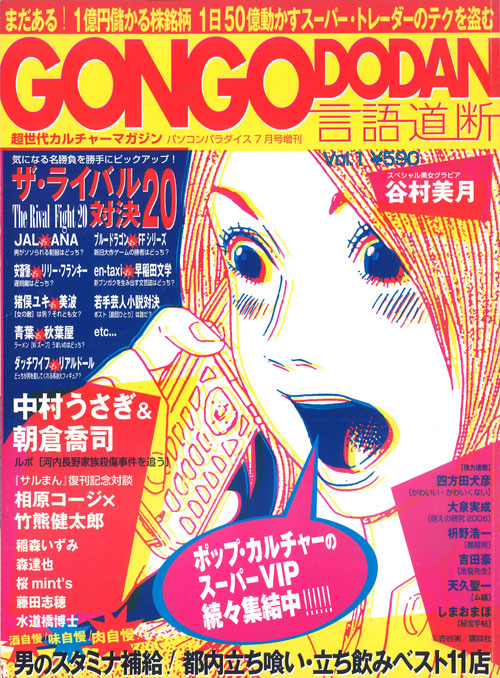
GonGoCover

Also the name of an apparently crappy and short-lived culture mag.

Posted in Japanese, Yojijukugo | Tagged , , , , , | Leave a comment

Magic Monday – Physical magic – I’m’a cut you!


Hamonnoah Hahd (Embladen; Spirit Sword; Psiblade)

Physical adepts of the Fells often fight bare-handed, and when resorting to weapons they often fight with sticks instead of metal weapons. That doesn’t mean they can’t cut things when they need to, though; this technique allows the practitioner to extend their personal energy into an object and surround parts of it with an aura of “sharpness.” In Felsian hands, a mere twig may be as dangerous as a dagger, a stick like a sword, or a staff like a spear. While that much is widely known through tales, it often comes as a surprise when a high-ranking adept reveals that almost anything can be embladened, and the surprise is often fatal.


The base difficulty of this technique is d6, and the base cost depends on the size of the tool being embladened: one strain for hand or smaller; two for arm; three for chest, and so on. The sharpness may be turned on and off at will, but as long as the technique is maintained, all the practitioner’s rolls have their difficulty increased by a step. Any material hard enough to take an edge normally, such as many woods, can be embladened relatively easily, an edge can be added to almost anything. Soft objects may be embladened by increasing the difficulty and cost by one each, and even amorphous non-object substances such as bread dough can be empowered, albeit through a two-step difficulty increase and doubled costs. Royal practitioners learn the secret of embladening parts of their own bodies, although this adds a cost of harm according to the size: one point for a finger-sized part, two for hand-sized, and so on.

Posted in Rules, Setting | Tagged , , , | Leave a comment

Please be true please be true please be true

天知る地知る我知る人知る
(Ten shiru chi shiru ware shiru hito shiru;
“Heaven knows; earth knows; oneself knows; people know”)

Definition:

Secrets and crimes will eventually come to light. Even if you think something is completely hidden, the gods of the heavens and the earth know about it. You know about it, naturally. And anybody else complicit in your misdeed knows about it as well. That’s a lot of room for leaks getting out. So you’d better do things properly and ethically, no matter how well you believe you can hide your crimes.

A little bit of the feel is perhaps captured by the English phrase “Three can keep a secret, if two of them are dead.”

Breakdown:

The quadruple-repeated verb phrase at work here is 〇知る, where the 〇 is a noun and 知る (shiru) is the verb “to know.” The four nouns are respectively 天 (ten), “heaven,” 地 (chi), “earth,” i.e. this mortal realm, 我 (ware), “I,” “self,” and 人 (hito), “person,” i.e. people other than oneself, or in this case specifically a second person being addressed.

Notes:

This phenomenon is also known as the 四知 (shichi), the “four knowings.” Somewhat ironically, a couple of variants exist that add more possible knowings. Other nouns that can be used in place of 人 include 汝 (an archaic character meaning “you,” with several possible pronunciations), and 子 (usually meaning “child” but here also meaning “you,” and pronounced shi). Similarly, 地 can be replaced with 神 (shin), “god(s).” Finally, the whole can be represented in brief by just the first two, “天知る地知る.”

This saying apparently comes from an anecdote in the Book of the Later Han, a history describing several centuries of imperial reigns and biographies of important figures for about the first two centuries CE. A public official tries to bribe the scholar Yang Zhen (楊震), saying “It’s night and we can’t be seen, so nobody will know.” Yang refuses the bribe, replying “Heaven knows, the earth knows, I know, and you know. Don’t say nobody knows.” (Presumably, he follows this up by slipping on a pair of shades and striding off without a backward glance as his would-be buyer explodes in flames.)

Example sentence:

「内緒だから大丈夫って言われても嫌だよ。天知る地知るだろう」

(“Naisho dakara daijoubu tte iwarete mo iya da yo. Ten shiru chi shiru darou.”)

[“I don’t like it even if you say we’ll be fine because it’s a secret. The heavens and the earth know too, you know.”]

Posted in Japanese, Kotowaza | Tagged , , , , , , , , , , , | Leave a comment

Tidal waves just sneaking right up on ya there

天災は忘れた頃にやってくる
(Tensai wa wasureta koro ni yatte kuru;
“Disaster comes when it has been forgotten”)

Definition:

Don’t let your guard down, because disasters always seem to strike exactly when you’re doing just that. The last catastrophe has faded from memory, attention is focused on new problems, and old safeguards are being relaxed – and then when you’ve gone and made yourself vulnerable, the old disaster strikes again. You forget the last major earthquake or tsunami, and the next one strikes. You take drinkable water and breathable air for granted and dismantle the EPA, and suddenly your tap runs with heavy metals again. The generation that stopped fascism dies out, and their children put a new fascist in power. So even – especially! – when it seems like certain problems of the past have been overcome and put to rest, it’s imperative to continue guarding against them.

See also the four-character compound 油断大敵 and last Sunday’s kotowaza. The price of safety, as they say, is eternal vigilance.

Breakdown:

We begin with the noun 天災 (tensai), “(natural) disaster,” marked by the particle は (wa) as the topic of discussion. The next noun is 頃 (koro), “approximate time,” marked by the particle に (ni) as the time when something happens. What happens? やってくる (yatte kuru), “it comes,” with the “it” in question being our disaster. And at what approximate time does it come along? When 忘れる (wasureru), “to forget,” in past tense. Note that by adding yaru (in its conjunctive form yatte) to kuru, the latter verb changes from a simple arrival to one that has been approaching for some time.

Notes:

Some versions of this saying replace 災 (sai), “disaster,” with 害 (gai), “harm.”

This saying is attributed to physicist (and earthquake researcher), author, and essayist Torahiko Terada.

Example sentence:

「筋トレで怪我をして、一か月まるまる休んだけど、またやり始めたその次の日に全く同じ筋肉をまた怪我したんだ。マジだ不幸だ!」 「不幸じゃなくて油断だったんじゃない?天災は忘れた頃にやってくるっていうからね」

(“Kintore de kega wo shite, ikkagetsu marumaru yasunda kedo, mata yarihajimeta sono tsugi no hi ni mattaku onaji kinniku wo mata kega shitanda. Maji de fukou da!” “Fukou ja nakute yudan dattan ja nai? Tensai wa wasureta koro ni yatte kuru tte iu kara ne.”)

[“I injured myself doing weight training, but even though I rested a whole month, after I started again the very next day I hurt the exact same muscle! Can you believe the bad luck?” “Is it bad luck, or were you not careful? They do say that the next disaster strikes when you’ve forgotten the last one.”]

(Here we are on the very last day of the week, but as promised, here’s a make-up saying! Expect your regularly-scheduled Sunday kotowaza tomorrow!)

Posted in Japanese, Kotowaza | Tagged , , , , , , , , | Leave a comment

Giving oneself a (winning) hand

得手勝手
e.te.ka-.tte

Literally: acquire – hand – win – hand

Alternately: Doing whatever you want without regard for other people. Caring only about one’s own needs, desires, or convenience. Selfish or willful behavior.

Notes: While toku is a valid reading of 得 in some contexts, it can only be pronounced e here. This yojijukugo joins a long list of terms, like 我田引水 and 独断専行, that criticize disruptive or excessive self-interest.

ETeEPo

Like, did you ever think about what they want?

Posted in Japanese, Yojijukugo | Tagged , , , , , | Leave a comment

Magic Monday – The Sorcerer’s Valet

Servant-Spell

While many magicians preserve traditions of living within a community and working with their hands, others – especially the wealthy and antisocial – isolate themselves and try to meet their daily needs with magic as often as possible. The Servant-Spell is a common tool for these: it imbues an inert object with a spirit appropriate to a desired task, which animates the object for the following twenty-four hours. In general, the task is simple and appropriate to the object animated: a broom that sweeps on its own; a chest or table that carries things around; a stylus or quill-pen that takes dictation. As a rule, the servant can be commanded to start or stop its task, to follow its master or go to a visible location, or just wait. A group of servants may also be created at once, and can act in concert; servants created separately are unfortunately not especially aware of each other nor prone to cooperation.


The base difficulty of the servant-spell is d8; if the object is ill-suited to its task (e.g. a broom asked to carry), the difficulty rises by at least one step. If the object is already enchanted and bonded to the caster, or is set to work entirely within the caster’s place of power (in which cases the object being lost or leaving the area will render it inert), the difficulty decreases by a step. The base cost is four strain or fatigue, plus two more for each additional object imbued. The caster may also sacrifice a point of Constitution per object to make a servant-spell permanent. A rare version of the spell imbues an intelligence equivalent to a young child and forces a single object into an appropriate shape for a task when possible, such as by adding arms and legs to it. This version increases the difficulty by two steps and doubles all energy costs.

Posted in Rules, World-Building | Tagged , , , | Leave a comment

Gird your loins, or your chin

勝って兜の緒を締めよ
(Katte kabuto no o wo shimeyo;
“When you win, tighten your helmet-strap”)

Definition:

A warning to not let down one’s guard even when things seem to be going well or when one seems to have won a fight. Always push all the way through to the finish line. “It’s not over ‘til it’s over” – and don’t be too sure that something’s actually over. Don’t count your chickens before they hatch.

Breakdown:

We begin with the verb 勝つ (katsu), “to win,” in conjunctive form. This allows it to connect to the following clause. This begins with a noun phrase comprising 兜 (kabuto), “helmet” and 緒 (o), “cord,” connected by the associative particle の (no). The particle を (wo) marks this noun phrase as the object of the verb 締める (shimeru) in imperative form, making the entire phrase into a command.

Notes:

This saying apparently comes to us from third-century BCE Confucian philosopher Xun Kuang.

Example sentence:

「あの悪法が不成功に終わってしまったからもちろん嬉しいけど、勝って兜の緒を締めよう。油断したら今度の結果はどうなるかわからないから」

(“Ano akuhou ga fuseikou ni owatte shimatta kara mochiron ureshii kedo, katte mo kabuto no o wo shimeyou. Yudan shitara kondo no kekka wa dou naru ka wakaranai kara.”)

[“Naturally I’m happy that that evil law failed, but even in victory let’s fix our helmets. There’s no knowing how it will go next time if we let our guard down.”]

(Note: It has come to my attention that last week’s kotowaza did not go up on the site. To make up for the omission, please expect two kotowaza posts this week, arranged to avoid overlap. In the meantime, enjoy a topical example of usage!)

Posted in Japanese, Kotowaza | Tagged , , , , , , | 2 Comments

Maybe later; not yet and not now

古今無双
ko.kon.mu.sou

Literally: old – now – nothing – pair

Alternately: Something is unmatched from the past to the present. A quality (often, but not always, greatness) is unequaled at any time in history, right up to the present moment.

Notes: 古今 does not simply mean “past and present,” as one might guess from the characters’ meanings; it refers to the entire span of time. There are a number of four-character compounds beginning with 古今, including several synonyms to this one. (For example 古今無比 (~.hi), in which the character 比, which replaces 双, means “compare.”)

KoKonYuuKa

This yojijukugo appears in a war song from the very early Meiji Era, at the time of the Satsuma Rebellion. Something like it is being sung by this anime girl, because that’s new.

Posted in Japanese, Yojijukugo | Tagged , , , , , , | 1 Comment

Magic Monday – God-eaters – The Stars

The Stars
(The Dancers of the Astral Plain; the Lights)

Description: It turns out that the world really is ringed in a shell, nest, or shield of rotating crystalline spheres. The innermost face of these – which we call the “sky” – is a vast landscape of shimmering gray, also known (despite the presence of woods, hills, ravines, and several features analogous to nothing terrestrial) as the Astral Plain. Here wander the stars: shining beings in humanoid, beastlike, or entirely alien shapes. By day they usually grow dimmer and go about recognizable business such as sports (and other hobbies), resting, socializing, even fighting, although they also tend to move along a fixed track through the landscape of the sky. By night they dance and shine, bright enough to be seen from our world below.

Each star has a fixed shape and a largely fixed color, although its light varies in intensity over the course of the day and in accordance with its moods.

Worshipers: Yes, notably the Asteri Magi. While any one star’s influence on the mortal world below is relatively slight, priests have found ways to call on groups of stars in return for certain boons. Still, the earth and sky are separated by a vast and seldom-traveled gulf, so anything that happens to a given star would only be noticed after the fact, when certain invocation rituals began to fail consistently.

Servitors: No. Each star is relatively solitary in its strange geometrical habits, although some have warm relations with each other or with other, non-star inhabitants of their land.

Confrontation: At night, the stars dance uncontrollably and seem oblivious to their surroundings, but are immune to all non-magical harm. In the day, they tend to take offense to hostile actions, and fight to defend themselves as a non-astral being of the same shape would. Stars tend to be scattered across the landscape of the sky and seldom come to each other’s aid, except for the more social groups, such as the members of some constellations.

Aspect: Energy; cosmos; other aspects vary from star to star. Those present at defeat may boost any one attribute, save, or survival meter by +1, or gain one skill point.

Powers – Tier 1: The character gains a faint glow. This is too dim to be useful in the dark (although it does complicate attempts at stealth), but the glow spreads to encompass any magic items or magical beings the character is directly touching.

Powers – Tier 2: The character may adjust the strength and hue of their light with a thought. Although it can never be extinguished entirely, it may be dimmed until it is only noticeable in pitch darkness, or brightened to the intensity of full daylight. The character’s sensitivity to magic increases as well, giving a +4 bonus to all Sense (Sixth) checks.

Powers – Tier 3: A character who has lost more than half their Humanity may voluntarily enter the star-dance while under (or on) the open sky at night. As with all stars, this leaves them in a near-helpless trance until morning, but invulnerable to non-magical harm.

Powers – Other: Each star has their proper track in the sky, and finds following this track restful and pleasant. Characters who have absorbed star-power technically have a track of their own, are always intuitively aware of where they should be in the sky, and are relieved of strain, harm, and fatigue at the rate of one point per hour regardless of activity while following their assigned orbits. If such a character dies, a portion of their essence rises to the Astral Plain and takes its place as a new star.

Example Checks: As long as a character who has absorbed any of the Lights’ essence is in the Astral Plain, every night they must check or join the star-dance until morning. The initial difficulty of the Humanity check to resist dancing is d4, but this permanently increases by one step for each star slain after the first, and for each dance danced while in the Plain. If the difficulty ever increases beyond d100, then the character irrevocably becomes an ordinary star and is retired as a PC. Star-dances performed on the terrestrial sphere don’t count in this calculation.

Notes: Some stars are notably more puissant than their fellows, with a unique ability or effect. (Examples: can control the motion of fire telekinetically; immune to magic; everyone in the star’s presence must speak the truth; anyone directly touching the star loses the ability to sense it in any way thereafter except when in direct contact.) These exceptional Lights grant an extra +1 bonus to any one value of the DM’s choice for characters present at defeat.

Posted in Rules, Setting, World-Building | Tagged , , , , | Leave a comment