Nuts to you

Limited numbers of them, though

朝三暮四
chou.san.bo.shi

Literally: morning – three – evening – four

Alternately: Being fooled by the promise of profit or advantage into missing the fact that a difference or change is superficial only. Greed leading someone into failing to realize that a new situation or proposal is functionally identical to an old one.

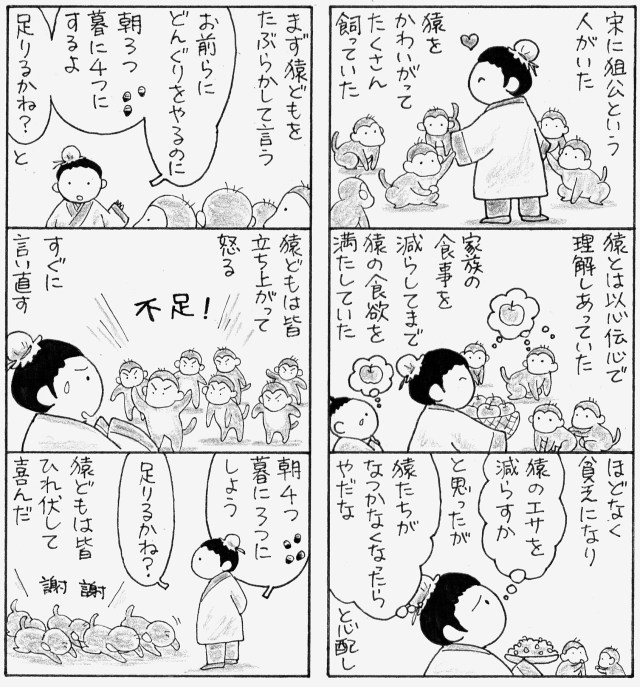
Notes: This comes from a story from the Spring and Autumn period in China. There was a man who made a living training monkeys, but he fell on hard times and had to reduce their food ration. He told them that they could only have three nuts in the morning and four in the evening (sources differ on whether these were acorns or chestnuts). When the monkeys objected, he switched it to four in the morning and three in the evening. The monkeys were mollified by the morning number increasing, and assented. The yojijukugo is traced back to two texts, the Zhuangzi and the Liezi.

I’m not sure if there’s a related saying in Chinese or Japanese to describe a situation where, for example, one political party blames a loss of manufacturing jobs on “foreigners” and promises to restore them through xenophobic and isolationist policies, knowing full well that the jobs were lost to automation and can’t be replaced. The essence of 朝三暮四 is that the result of two different policies are identical, but in this case, the xenophobic party is objectively more harmful to everyone, including the fools who support them.

This compound may also take the second-offer form of 朝四暮三 or the flipped form of 暮四朝三.

chousanmanga

A comic dramatizing the story, from this blog. The creator apparently specializes in illustrating classic texts for high school students.

Posted in Japanese, Yojijukugo | Tagged , , , , , | 1 Comment

Magic Monday – YAOSC Character Creation

As long as at least one member of your group (the GM) knows the rules of YAOSC and is able to guide the rest of you in play, all you need to do is create a character and you should be ready to go! Describe your character’s behavior in naturalistic terms; the GM should be ready, willing and able to translate this into game terms, and direct you in making rolls, as necessary.

Characters have “levels” (which are different from skill levels), and the default starting level is zero. Zero-level characters may die easily in a combat-centered campaign, and it never hurts to have a henchman or helper. Depending on the mood and danger level of the campaign, you could begin play by creating two or even more characters. After their first adventure concludes, one of them will then advance to first level, and main-character status. Here’s what you need to create a zero-level character:

0. Flesh out the Character

This is step zero because it can happen at any point during the character-creation process. Perhaps you have an idea that you will attempt to bring to fruition as the character develops. Perhaps one of the dice rolls or choices detailed below will inspire you. Perhaps your character will be nothing more than “Joan the Fighter” until play begins and her actions and words begin revealing who she really is. All of these options are fine.

1. Generate Ability Scores

Each character’s inherent talents are modeled by six ability scores (Constitution, Dexterity, Intellect, Presence, Sense, and Strength). These fall into a range from 3 (extremely weak) to 18 (extremely strong). Generate them by rolling 3d6 six times and assigning one result to each ability score, in whatever order you want.

+ Constitution (Con) is a character’s ability to endure physical hardship including harm, poison, disease, fatigue, extreme environments, and other unpleasant situations. A high Constitution makes a character tougher and harder to kill.

+ Dexterity (Dex) is a character’s coordination and fast-twitch muscle capacity. A high Dexterity helps the character avoid harm and makes them better at finesse-based tasks.

+ Intellect (Int) is a character’s ability to quickly take in and analyze information. Intellect is good for skills based on knowledge and abstract concepts, such as academic subjects or magic.

+ Presence (Pre) is a character’s sense of self and ability to project it in social situations. While good looks may be part of the equation, far more of it depends on poise, confidence, assertiveness and centeredness. Presence influences most social interactions, including the character’s ability to lead others, and the mind’s resilience.

+ Sense (Sen) is a character’s wisdom, sensibility, trust in their “gut,” and ability to pay attention to the world around them. Sense aids artistic skills and can be beneficial in a wide variety of circumstances.

+ Strength (Str) is a character’s slow-twitch muscle capacity and force output. It influences power-based tasks including hitting hard and carrying large loads.

Each ability score, depending on its value, will modify various values or rolls in a wide variety of contexts. Unless otherwise noted, use the modifiers from the following table:

Score

[-1]

[-2]

3

4/5

6~8

9~12

13~15

16/17

18

[+2]

Mod

[-8]

[-5]

-3

-2

-1

0

1

2

3

[+1]

Numbers in brackets are outside of the range possible for normal humans: any scores higher than 18 are inhuman or supernatural; scores of 1 or 2 indicate some terrible and unusual trauma. Scores above 18 increase their modifier by 1 for every 2 points the ability score increases. So 18 and 19 give a +3 modifier, 20 and 21 give +4, and so on.

2. Choose Species

Basic YAOSC assumes a relatively standard fantasy-adventure setting, and its default choices for species are humans, halflings, elves and dwarves, with humanity as the default species. For simplicity’s sake, we’ll assume for now that all characters are humans, and introduce rules for other species later on.

3. Choose Class

YAOSC assumes that every potential adventurer has an area of expertise, or natural talent, that can be honed through training and the rigors of the adventuring lifestyle into one of four tracks: the mystical, the arcane, the adept, or strength of arms. This is reflected in your choice of “class.”

+ Priests serve the divine forces of the world, hoping to draw their favor or divert their wrath. Priests often demand that their companions worship, or at least honor, their chosen deities, but in return offer miraculous healing or other boons. Priests may perform and direct devotions, and channel the rewards and miracles of their patron gods. They can be moderately adept in both combat and mundane skills.

celticfairytale00jacorich_0245b2

+ Sorcerers study arcane secrets that allow them to manipulate the hidden forces of nature. Although not traditionally well suited to combat or outdoor living, they are welcome in adventuring parties for the potency of their spells and depth of study they command. Sorcerers are able to work magic by all available methods, where most people can only take part in rituals or activate the powers stored in magical items.

undine00lamo_0119s

+ Specialists form the backbone of an adventuring party. While they cannot master magic, call upon the power of the gods, or match warriors in combat prowess, the breadth and depth of skills they bring to the table can benefit any group they work with.

acrobats

+ Warriors are an adventuring party’s muscle. Masters of arms and armor, they are the most skilled class when it comes to stopping enemy attacks and dishing out damage, and are made tough and resilient by their training.
11306750896_92e6afbae7_occ

Congratulations! By rolling some dice and making a couple of choices, you’ve done most of the work of character creation. You should have a character sheet by now – a piece of paper with enough space to record all the relevant information – with your results from steps 1-3 (and perhaps 0) on it, and all that’s left is to fill in some numbers.

4. Record Survival Meters

Each character’s durability is measured with three meters. These describe his or her ability to take a beating, to withstand fatigue, and to bear psychological stress. If the corresponding wear and tear ever get too high, your character will have to make a special roll to see how they respond to the punishment, and will probably spend at least the rest of the scene out of action.

+ Hit Points (HP) show how much damage your character can take before it becomes overwhelming. Too much damage can give you a penalty to your actions due to pain, or cause you to drop, in shock and at risk of long-term injury, disfigurement, or death.

Roll a die to determine your starting HP: Sorcerers roll 1d6, Priests and Specialists roll 1d8, and Warriors roll 1d10. Then add your Con modifier. If it’s negative, this decreases your HP! But even if your Con modifier is negative and you roll low, you can never start with less than 1 HP in your meter: change any results of 0 or lower to 1.

+ Endurance Points (EP) show how much energy your character can expend before they have to stop or slow down and rest. Too much fatigue can leave your character in a state of exhaustion, in which case they’ll probably be useless until they can recuperate.

Roll dice to determine your starting EP. (Humans roll 2d6) Then add your Str modifier. Again, there is a minimum: you can never start with fewer than 2 EP.

+ Stability Points (SP) show how well your character’s mind can stand the strain of the violence, fear, weirdness and magic that accompany the adventuring lifestyle. Too much strain can give you a penalty to your actions due to distraction, or cause you to break and become useless until you find your balance again. Breaking in this way can end a character’s adventuring career as surely as death, so be sure that your character finds a way to cope or unwind after stress.

Humans begin play with 3 SP. In addition, Sorcerers and Warriors add 1, Priests add 2, and Specialists add 3. (So for example, a human Sorcerer begins play with 3+1 = 4 SP). Add your Pre modifier and the level of your Concentration skill. [Edit: I’ve decided to remove this as part of the process of firming up the details of how magic works.] The minimum starting value is 3 SP.

5. Record Saving Throws

Some situations will call for characters to make a special check called a saving throw (“save” for short) to avoid all or part of a bad situation. For example, disease, poison, a hostile spell, or falling rocks may all call for saves. Usually this check is rolled with a d10, although easier or harder saves may call for different dice. There are four types of saves:

+ Corruption – These throws resist relatively slow developments that would interfere with the body’s normal functions, including poison, Chaos, and magical effects such as polymorph.

+ Evasion – These throws resist anything that can be avoided through agility and athletic ability, including many traps, area affects, off-guard attacks, and magical effects such as blasts of flame.

+ Psychic – These throws resist mental stresses, including torture, madness, and magical effects such as enchantment or control.

+ Shock – These throws resist sudden, extreme stresses to the body, including massive damage, compression or decompression, and magical effects such as death magic.

Each save starts with a value of 1, with the following adjustments. When you are finished, change any results of 0 or below to 1: there is always a chance, however small, of making a save.

  • Corruption: Add your Con modifier. Then, if you are a Specialist, add 1.
  • Evasion: Add your Dex modifier. Then, if you are a Warrior, add 1.
  • Psychic: Add your Pre modifier. Then, if you are a Priest, add 1.
  • Shock: Add your Str modifier. Then, if you are a Sorcerer, add 1.

6. Record Skills

Skills are some of your most important tools in play. For a starting character, you won’t have many choices to make yet: you begin with only the “default” levels in most skills. Depending on your class, you may have a few free points to assign. Otherwise, simply note the default level for each skill – it may be a numerical value or equal to an ability modifier. If you want to start play right now, you can skip this step. Look up (and record) a given skill’s default when you first want to use it.

deerhead

7. Record Miscellaneous Detail

Your character will have some other numbers that describe them and their capacities: sight distance, movement speed, and physical descriptors such as mass, height, and so on. Some of these are pre-determined, especially by your choice of species; others can be assigned as you desire, rolled randomly, or even left alone until you need to know them.

8. Record/Buy Equipment

Your class (and perhaps species) will come with a default equipment package. Record the gear and monetary reserves listed there on your character sheet. Alternately, if you are familiar with the campaign world and have the time and inclination, go ahead and choose your own equipment a la carte. Note the monetary value of the starting package(s) and translate that into equipment of your own choosing.

When you’re done with that, you’re ready to play! Remember to note changes on your character sheet (in pencil), and remember that at the end of your first adventure, one of your characters will advance to first level and need some adjusting: their survival meters, saves, and skills will all improve, and you’ll have some choices to make. You’ll probably use some resources and find some treasure, which can be saved for your own use or spent on training, hiring helpers, or buying new equipment. With luck you’ll find something in the campaign world that engages your interest and leaves you wanting to come back and experience some more. Good luck, and have fun!

wingedbearb

All art public domain images by Telecanter.
Posted in Rules | Tagged , , , , , , | 1 Comment

They say he only likes it when you pat his belly

仏の顔も三度
(Hotoke no kao mo sando; “Even the Buddha’s face, three times”)

Definition:

Even the most gentle person will become angry if you treat them poorly on a frequent enough basis (often used in reference to rude behavior). Even the patience of a saint will eventually be tried. Everyone has a limit to how much improper behavior they can put up with, especially directed at their own person. You can only go so far.

Breakdown:

This is not a complete sentence, although the full version is. We begin with the noun (Hotoke), the Buddha, and use the associative particle (no) to show possession of the noun that follows – (kao), “face.” The resulting noun phrase is marked with (mo), often translated as “also” or “too,” but here something closer to “even.” Finally, we get number-noun 三度 (sando), “three times.”

Notes:

Some versions of this saying add まで (made) “[up] to,” at the end, expressing it more clearly as an upper limit. The full saying continues with ~三度撫づれば腹立つ (~sando nazureba hara tatsu); oddly enough, this reveals that stroking the Buddha’s face (in an affectionate way) is his trigger. Other versions replace with 地蔵 (Jizou), the bodhisattva Kshitigarbha.

This is the entry of the Kyoto iroha karuta set.

The source of this saying is apparently 冥途の飛脚 (translated into English as The Courier of Hell), a love-suicide story for the puppet theater by famous playwright Chikamatsu Monzaemon.

Example sentence:

「また約束を破ったのか。仏の顔も三度までというものだ」

(“Mata yakusoku wo yabutta no ka. Hotoke no kao mo sando made to iu mono da.”)

[“So you broke another promise? That’s it, there are limits to even the Buddha’s patience.”]

Posted in Japanese, Kotowaza | Tagged , , , , , | Leave a comment

Of petards and self-inflicted hoisting

自縄自縛
ji.jou.ji.baku

Literally: self – rope – self – bind

Alternately: Falling into your own snare. Painting oneself into a corner. Suffering because you’ve locked yourself into a (bad) situation through your own words and actions. Stripping away your own freedom of action.

Notes: We’re done with the 五十音 ordering! Later on I plan to run through all the characters again in いろは order, but for now I’m taking a bit of a breather from those strictures by introducing random compounds (and, on Sundays, kotowaza) that catch my fancy. Today’s compound is a more admonishing cousin to 自業自得.

This yojijukugo can also be used as part of a longer and more explicit phrase, 自縄自縛・に陥る (ni ochiiru), “to fall into one’s own trap.”

It might seem not entirely inappropriate, but replacing 自縛 with homophone 自爆 (self-explosion, self-destruction, suicide bombing) is considered an error.

jijoubutwhy

These guys and their cheerfully literal rendition are, like, 90% of the image search results for this phrase. Oh, Japan.

Posted in Japanese, Yojijukugo | Tagged , , , , , | 1 Comment

Campaign Idea: The Worst Year

Inspired by this Reddit post. For best effect, keep a record or campaign journal… but keep it hidden from the players. (At least until it’s all over.)

Start a campaign normally in the late summer or autumn, but in a relatively challenging situation. Set things up so that the PCs can make some progress each time they play (unless the players are okay with struggling in a grimdark campaign), but also confront them with just a little more than they can handle. As the seasons progress through the decay of autumn into the death that is winter, ramp up the challenge and threat the party faces.

Confront them with threats in two places at once and force them to choose what to save and what to lose.

Confront them with challenges too tough to beat; situations they have to retreat from.

Introduce them to a foe who specifically, but indirectly, targets them and thwarts their goals in a way that seems to anticipate their plans. If they raid a dungeon, their nemesis has been there already, laid traps, and taken the primary treasure. If they have a base of operations, their nemesis raids it while they’re away. If they have an ally, their nemesis tries to hurt the ally, or turn the ally against them. Their nemesis sponsors rival adventuring parties to win the prizes they want and, later, starts sending goons and assassins after them directly. Build this foe up into a Big Bad.

Have the Big Bad confront the party close to the end of the calendar year, preferably when they’re weakened from some other challenge. Even though they’ve never met before, it’s clear that this enmity is personal for their nemesis. The Big Bad is powerful, maybe powerful enough to defeat the whole party single-handedly, but has over-prepared just to make sure. Don’t cheat, but do become a “killer DM” for a session and let the Big Bad seriously try to kill every single member of the party. Don’t be afraid to unleash an unfair amount of firepower, and don’t be afraid to have the Big Bad prepared to nullify the party’s favorite tactics and abilities.

The Big Bad does seem to have one weakness, though: one of their minions is specifically guarding a magical artifact of some kind, such as a distinctive magic wand. It seems to be their foe’s ace in the hole. And here’s the one bit of railroading you’ll need to engage in: if the PCs target this artifact and seem likely to succeed, the minion panics and activates it (at them). If the PCs are all defeated, or scatter in panic, then the last thing they see is the minion getting over-excited and activating it at them in the apparent belief that it will decisively end the battle in a gratifyingly dramatic way. There’s a sudden burst of light and noise, infinite indescribable colors and tones.


Then the PCs wake up, and everything is fine. Everything is back to normal. They’re unscathed. Was it all a dream? What’s going on? If anyone survived the Big Bad’s TPK attempt, give them a bonus (keeping their experience level?), but otherwise strip them back to their starting conditions – no XP, no special equipment. Nothing but memories of catastrophe. (If you normally keep a public campaign record and decided to keep on doing that in order to avoid tipping your hand early, this is when you hide it.)

Give them some quiet time to explore. It turns out that somehow, they “time-slipped” back to the start of the year, months before they began adventuring. But they still remember everything that happened, and they’re free to act on that knowledge. Make sure that they realize that events are repeating (innocuous events, not the fall’s threats) and let them figure out that if they don’t act, they’re headed for a repeat of their previous disasters.

Now let them campaign normally, at a more “normal” challenge level. It’s easier to pick and win their battles. This time, nobody is anticipating their actions and moving to cut them off. Nobody is laying traps, stealing their prizes and attacking their weaknesses. They have time to gain resources and lay plans against the various threats that, in the first run-through, forced them to cut their losses and perform triage.

Let them hunt for their nemesis. Let them anticipate and foil their enemy’s plans, steal or destroy their enemy’s resources, and take out their enemy’s allies. Set it up so that the enemy is hidden or unavailable for a while (perhaps this nemesis didn’t arrive in the region until the fall, when their first adventure started? Perhaps their nemesis’ identity was secret?), but if you can, start showing them signs that their nemesis is on the move again.

Do you have a secret campaign record? Good. Use it to ensure that plenty of parallels pop up between the first and second runs through, especially once the autumn starts. But the players should be laying plans and making decisions the same way their characters are: on the basis of flawed and fading memories. A big part of the fun here should be the guesswork and problem-solving that goes into “doing it right” the second time around.

Eventually they’ll find their foe and force a confrontation. This time, the enemy isn’t overprepared. This time, the enemy doesn’t have an intimate knowledge of their abilities and tactics. This time, the players will likely be able to choose the time and place instead of getting ambushed. This time, the PCs will have a lot of tools that the enemy had last time they met. Let the dice fall where they may, but this time, the party is likely to win.

No matter what the PCs managed to anticipate, though, their enemy does have one tool both times: that mysterious artifact. And with a final desperate action, their nemesis activates it… but at themselves instead of at the party. And your players’ enemy disappears in a familiar flash of infinite indescribable colors and tones.


And that’s one way to run your players through a stable time loop with minimal railroading. It’s an ambitious project, but one that sounds like a lot of fun if you can pull it off.

Posted in Miscellaneous, World-Building | Tagged , , , , | Leave a comment

Magic Monday – YAOSC Skill Rules

Skill use basics

YAOSC, like all RPGs, is based on talking: the players describe what they want their characters to do and how they want them to do it, and the GM  describes the results. When there’s doubt about whether a given action will succeed or not, the fundamental tool is skills. Each player character has a list of skills with a rating for each, and rolls a check or challenge for the one most appropriate to the action being taken.

For checks, the GM chooses a die size based on the difficulty of the task. Dice scale according to the following progression: d2, d3, d4, d6, d8, d10, d12, d20, d30, d100. The default skill check die is a d6, although many other rolls will scale from a different base die size. Circumstances may change the difficulty by a number of “steps” up or down this scale; in many cases, players may choose their difficulty by setting the parameters of the task they want to accomplish. Other circumstances may add a bonus or penalty to the skill’s level.

Each skill has a level based on its default, the number of points the character has invested in improving it, and relevant situational modifiers. A check succeeds when the number rolled on the die is less than or equal to the skill level, and fails when it’s greater.

In contrast, in a skill challenge each character involved rolls two dice (2d10 is the default) and adds their skill level to the result. If one result is higher, it wins the challenge. Unlike checks, which are pass/fail, challenges can result in a tie.

Skill levels

Each skill begins at a default starting level. This may be zero – or some other numerical value – or it may be based on an attribute modifier. YAOSC will likely provide a list of “standard” starting levels, but these may be customized to fit the needs of a given setting or campaign.

Some skills may provide specific advantages at certain levels. For example, many combat skills allow trained warriors to perform special maneuvers. This compartmentalization is intended to make skills more interesting and useful than simply a series of increasingly big numbers. It is also intended to allow some activities (such as combat) to have a basic set of simple rules, for ease of use, with options for a deeper experience (and ways to make a character more distinct and special) available for unlocking as the players gain system mastery.

Skills can be trained, of course. Characters can increase their skills’ levels by investing points – some gained as a reward for increasing their character’s level; others gained during the course in play through in-world activities and events such as training or magical augmentation.

Each skill can be simple, normal, difficult, or forbidden – depending on the character’s race and class. (Like many details of the skill list, this factor can be adjusted to meet the needs of a given campaign, or ignored entirely.) Normal skills cost two points to increase by one level; simple skills, one point, and difficult skills, four. If a skill is forbidden to them, the character can’t invest points in it, and can’t use it at all unless it has a default level greater than zero.

Degrees of success (optional rule)

Sometimes you may want to know not just whether you succeeded or failed, but how well you succeeded or how hard you failed. In this case, for each four points by which the roll beat (or missed) the score it needed to succeed, the GM may count an extra degree of success or failure, and apply extra benefits or hindrances accordingly. For example, beating an opponent’s roll by 4-8 points (one degree) in a combat challenge may allow the victor to increase their damage die by a step, or failing a spellcasting check by 9-12 points (two degrees) may cause two extra problems for the character beyond simply failing to cast a spell.

Simulating dice you don’t have

Not everyone has a full set of polyhedral dice of all the above sizes. In cases where a limited selection of dice is available (and you can’t use an app or an online tool like this or this) here are some useful tricks:

  • A d2 is essentially a coin flip; it can be simulated by choosing odds (1) or evens (2) on any other die.
  • A d3 is half of d6, so you can simply roll d6 and round up.
  • For a d4, you can roll a d6 twice. Each die will result in a low number (1-3) or high number (4-6). Read low+low as 1, low+high as 2, high+low as 3, and high+high as 4. Alternately, roll a d6 any number of times until it produces a result from 1 to 4.
  • For a d8, use the same method as the d4 but add another roll. LLL=1, LLH=2, LHL=3, and so on in binary fashion.
  • For a d10, roll 2d6. As above, the first d6 determines “low” or “high,” but in this case “low” is 1-5 and “high” is 6-10. The second die determines the value within those ranges, ignoring a result of “six” (because that would produce either 6 out of 1-5, or 11 out of 6-10, which is invalid).
  • For a d12, roll 2d6 as above, but don’t ignore the “six” rolls – instead, your possible ranges of results for the second die are 1-6 and 7-12.
  • For a d20, combine the d4 and d10 simulation methods.
  • For a d30, use the d10 method, except that the first die produces six ranges (1-5, 6-10, 11-15, 16-20, 21-25, and 26-30) instead of simply “high” and “low.”
  • For a d100, roll or simulate two d10s. The first produces the tens digit, and the second produces the ones digit. Count “00” as 100.

If all that seems a little too mathematical for you, then I sympathize, but you’re really going to have to get some dice.

Posted in Rules | Tagged , , , , | 1 Comment

The topical commentary almost writes itself

鬼の空念仏
((O)ni no sora-nenbutsu; “An oni‘s empty prayers”)

Definition:

A cruel and cold-hearted person putting on a show of benevolence, compassion, or charity. A bad person behaving uncharacteristically well. Like a demon making making a big show out of praying, but only in order to get out of trouble or otherwise benefit in some way.

Breakdown:

This is a simple noun phrase. We start with (oni) a Japanese “demon” or “ogre,” generally used in kotowaza as an exemplar of evil. The associative particle (no) links the oni to a noun comprising (sora), “empty,” and 念仏 (nenbutsu), “Buddhist prayer.”

Notes:

Two of the entries of the iroha karuta sets begin with . This phrase is not one of them, but it struck me as useful, so here it is.

This phrase may be shortened to 鬼の念仏, but if is used, make sure to pronounce it sora – in some contexts kara would be an appropriate reading, but here that would be considered an error. Compare a variety of expressions including 空言 (soragoto), “lie,” 空泣き (soranaki), “crocodile tears,” 空寝 (sorane) “pretending to be asleep,” and my favorite, 空耳 (soramimi), “mishearing,” or specifically misinterpreting song lyrics for humor.

Example sentence:

よく先生の前で苛めっ子達が苛められたクラスメイトを褒めて見せるが、鬼の空念仏に過ぎない自分のための言葉だ。

(“Yoku sensei no mae de ijimekko-tachi ga ijimerareta kurasumeito wo homete miseru ga, oni no soranenbutsu ni suginai jibun no tame no kotoba da.”)

[“In front of the teacher, the bullies often make a show of praising the classmates they bully, but it’s nothing more than self-serving hollow piety.”]

sorapatriotism

Also this blatantly insincere self-aggrandizing BS.

Posted in Japanese, Kotowaza | Tagged , , , , , , , | Leave a comment

Male and female, he folded them

In order to pour drinks prettily!

雄蝶雌蝶
(o).chou.me.chou

Literally: male – butterfly – female – butterfly

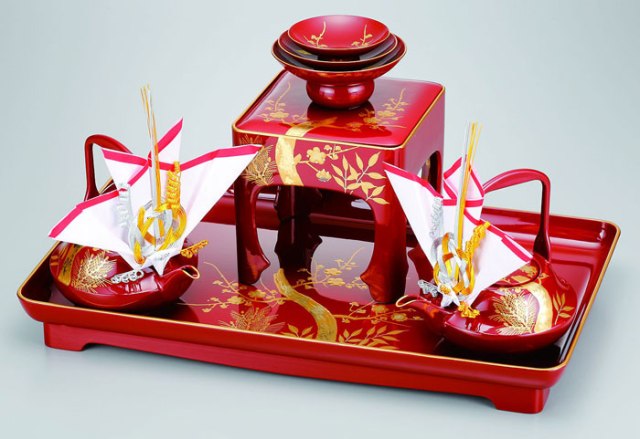
Alternately: This noun phrase describes a pair of origami “butterfly” shapes sometimes attached to the decanters used for pouring sake during traditional Japanese wedding ceremony. By extension, the child whose job it apparently was to pour the drinks. Alternately, the prosaic reading of “male and female butterflies.”

Notes: It was harder than I had thought to find a four-character compound starting with . Most Japanese words that classically began with use the Japanese reading, while compounds tend to use Chinese readings – for example, used to be をに, but in yojijukugo it tends to be read as (ki). Fortunately both (“male”) and (“man”) can be read as , so here we are.

omechousetto

You can see a pair on sale here for 2200 yen (about US$19.36 as of this writing).

Posted in Japanese, Yojijukugo | Tagged , , , , | Leave a comment

Dance like nobody’s watching

縁の下の舞
((e)n no shita no mai; “dance below the veranda”)

Definition:

Working hard to support someone from out of sight; doing a thankless task. By extension, someone in an unacknowledged position who is nonetheless of use and help. A power behind the throne. An unsung hero.

Breakdown:

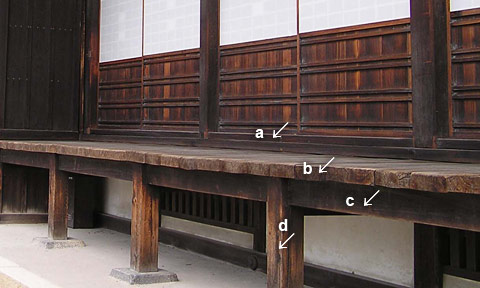
This is a noun phrase. The dominant noun is (mai), “dance.” This noun is connected by the associative particle (no) to the noun (shita), “below,” which in turn is connected by to (en), which can mean many things, but in this case refers to the raised walkway that runs around the outside of each building in a traditional Japanese estate-home.

whatisen

The most relevant part is (b). You can see that there’s ample space below – the floor is a good meter off the ground.

Notes:

This is one of two possible entries for the Kyoto iroha karuta set. (The other is 縁と月日.) An apparently more common, but less evocative, saying of the same meaning is 縁の下の力持ち ((e)n no shita no chikaramochi) – literally “a powerful person below the veranda.”

This phrase apparently originates with a particular dance, in the style of the old Imperial court, held at the Shitennou Temple in Osaka in honor of the spirit of Prince Shōtoku on the anniversary of his death, the 22nd day of the second month of the old lunar calendar. The dancers did not actually ascend up to any stage, and so the dance was held at ground level – where it would be difficult for those inside the building to see. It used to be believed that the spirits of deceased emperors needed to be kept appeased lest they inflict their wrath on the nation, so from this dance was born the image of someone doing vital work despite being out of sight.

Example sentence:

「あの金権政治家、本人は何の腕もないからきっと、彼の成功を支えるために多くの人が縁の下の舞を必死に舞ってるに違いない。可哀そうに」 「ある意味でね。でも、自業自得とも言えるかも」

(“Ano kinkenseijika, honnin wa nan no ude mo nai kara kitto, kare no seikou wo sasaeru tame ni ooku no hito ga en no shita no mai wo hisshi ni matteru ni chigainai. Kawaisou ni.” “Aru imi de ne. Demo, jigoujitoku to mo ieru kamo.”)

[“That plutocrat has absolutely no skills whatsoever. A lot of people must be working thanklessly behind the scenes for ‘his’ successes. I feel sorry for them.” “In a way, yeah. But you can probably say they’re getting what they asked for.”]

Posted in Japanese, Kotowaza | Tagged , , , , , , | 1 Comment

Like installing screen doors in a sub

(sandwich)

縁木求魚
(e)n.boku.kyuu.gyo

Literally: connection / border – tree – request – fish

Alternately: An unreasonable or impossible implementation of a goal. A methodology so flawed that it cannot possibly succeed. For example, climbing a tree in order to catch fish. (Not in order to hang a fishing line or net into the water from, mind you: to catch fish in the tree.)

Notes: is the first character in the entries of all three traditional iroha karuta sets, so I’m guessing that classical orthography would render the modern “en” reading as ゑん here. This compound is certainly of sufficiently ancient lineage, apparently originating in one of the recorded dialogues between Mencius (of 孟母三遷 fame) and King Hui of Wei.

A more Japanese rendition of the same four characters, using kanbun reading, is 木に縁りて魚を求む (ki ni fuchidorite sakana wo motomu).

babymetalband

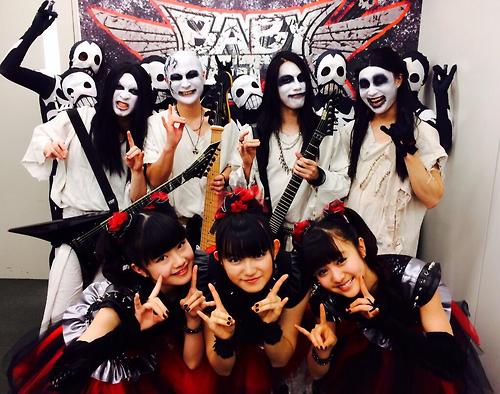
For some reason, the name of a blog that devotes its space both to explaining Excel tricks and to following the exploits of famously teen-girl-fronted heavy metal band “BABYMETAL.”

Posted in Japanese, Yojijukugo | Tagged , , , , , | 2 Comments