Magic Monday – The greatest needs; the greatest gifts

Voron’s Pocket Opens

In times of great need, a magician who knows the proper secrets may call upon a being known as Voron for a gift, an object that can help them solve their most pressing problem. The gift is not always what is wanted – a wounded fighter might receive a lowly disguise instead of the weapon they request – but it will always be helpful.

Who, or what, is Voron? No credible accounts can say anything about it for sure. But some sages believe that it is always just around the previous corner, patiently waiting, listening to the hunger of the world.


The base difficulty of the call to Voron is d6, and the base cost is two each of strain and fatigue. Each subsequent time in a magician’s existence that they attempt to request a boon, the difficulty rises by one step and the cost doubles.

Posted in Rules, Setting, World-Building | Tagged , , , | Leave a comment

And all for want of a horseshoe nail!

(Really, it goes backwards to the movement of the solar accretion disk… and beyond as well.)

(大)風が吹けば桶屋が儲かる
((Oo)kaze ga fukeba okeya ga moukaru;
“When the (strong) wind blows, bucket-makers prosper.”)

Definition:

A well-known saying that refers to unintended consequences or unexpected ripple effects (Rube Goldberg effects, perhaps) of a situation or event. If a strong wind blows, (the Japanese believed), blowing dust and junk would fly into people’s eyes and blind them. A common way for blind people to make a living was to play the shamisen, so shamisen schools would be filled with new students. Shamisen are traditionally covered with cat-skin (!), so the cat population would decrease. This would allow the population of vermin such as mice and rats, to increase. Since these chew holes in buckets, bucket-makers would see an uptick in business and become wealthier – on money ultimately blown into their pockets, so to speak, by that strong wind.

Breakdown:

This kotowaza comprises two clauses, so we’ll do each of those, in order, from right to left.

The first clause’s verb is 吹く (fuku), “to blow,” in hypothetical form. The subject-marker particle (ga) connects it to the noun (kaze), or in some versions of the saying, 大風 (ookaze) – “wind” and “gale,” respectively.

The second clause’s verb is 儲かる (moukaru), “to be profitable,” in sentence-final form. Again the subject-marker particle connects verb to noun, and in this case the noun is 桶屋 (okeya), where (ya), literally “roof,” indicates a maker and seller of something, and (oke) are round wooden vessels like buckets, barrels, and tubs.

Notes:

It seems that the regular-wind (kaze) version of this saying is more common than the “great wind” (ookaze) version. I would have used this saying for ka, then, except I’d already selected the ka entry in the series. Look forward to that, next week!

Example sentence:

「昨夜いっぱいセルフィーを撮ったせいで、新しい傘を三本買わないといけない って、大風が吹けば桶屋が儲かるだね」

(“Sakuya ippai serufii wo totta sei de, atarashii kasa wo sanbon kawanai to ikenai… ‘tte, ookaze ga fukeba okeya ga moukaru da ne.”)

[“Because I took a lot of selfies last night, now I have to buy three new umbrellas… there’s a ‘for want of a nail‘ for you.”]

Posted in Japanese, Kotowaza | Tagged , , , , , , | Leave a comment

Mama no more!

The kid’s linguistic development continues! He recently learned “down,” and right now it’s probably his most commonly used word. (Naturally, he also uses “down” to mean “up.”) He also says “town” almost every time we go out, although what he’s trying to communicate with that sound is a complete mystery. He’s started saying “Bai!” for bye-bye, and responds to several prompts with はい (hai), the all-purpose Japanese word of acknowledgment. He responds to instructions for various tasks such as picking up an object, throwing it away, bringing it to you, etc. When prompted with various animal names in English or Japanese, he can make an appropriate noise: “Woo woo” for dogs, “Möw” for cats, “Ouoooooooo” for wolves, and so on.

As you could probably guess from the title, though, I’m particularly pleased about one recent advance: I am no longer “mama,” but “papa.”

As I mentioned before, he’s had the phonetic capacity to say “papa” for a while now. His mother could even get him to say it just as a sound. We would even occasionally hear him whispering “papa” to himself, as if considering the concept. But there was a span of time in which anyone asking him to call me “papa” would lead to him stubbornly insisting that I was in fact a “mama.” But it wasn’t until last week or so that we had a real breakthrough.

It was while we were brushing our teeth together after dinner. We’ve been standing him on the counter by the bathroom sink so he could see himself and us in the mirror, but that evening he decided that he really would rather be exploring all the stuff on the counter than anything dental-care-related. So I moved him. This made him sad, and so he reached out to me doing the little grabby-hand motion that means he wants to be picked up, and in a plaintive voice he said

“Mama!”

I put on a questioning expression and pointed to his mother. And again he reached out to me and said

“Mama!”

And again I pointed to his actual mama. And again he reached out to me and said

Papa?”

So I picked him up. And there have been a couple of times since when he may have slipped up, or when it was unclear who he was talking to, but ever since I’ve pretty consistently been “papa.” Which is nice!

Posted in Musing | Tagged , , , | Leave a comment

Who’s a good boy?

温厚篤実
on.kou.toku.jitsu

Literally: warm – thick – serious / kind – truth / reality

Alternately: Calm, kind, and sincere. Gentle and serious. A good and honest person.

Notes: This compound may have come from the I Ching, and be associated with the 26th hexagram… although this connection is only asserted by one of my sources and may be apocryphal; another source attests its use, in Japanese at least, only since 1843.

OnKouKenSeki

There weren’t really any image search results of people for this one, whatever that says about human nature. Here’s a dog taking care of a baby.

Posted in Japanese, Yojijukugo | Tagged , , , , , , | 1 Comment

Magic Monday – Now you see it

Illusion (The Painter’s Spell)

This extremely versatile spell changes the appearance of something – from a tiny object or detail, to an entire landscape. The Illusion spell is extremely limited, in that it cannot produce sounds, smells, or other non-visual sensory impressions. At the same time, there are some who devote their entire lives to mastering it. The great difficulty of working with Illusion is that the caster must visualize the image they want to create, with great precision and attention to detail – and if one wishes to fool any observers, an artist’s powers of observation are required. As such, much of the time this spell is used for entertainment or minor cosmetic touches.


The base difficulty of Illusion is d6 for a hand-sized object or smaller, and the base cost is one strain plus one strain per minute for as long as it is maintained. Increasing the size or the time unit by one step also increases the difficulty by one step. In addition to the normal spell-casting roll, however, the caster must also roll a Craft (Illusion) challenge; anybody seeing the illusion opposes this roll with their Perception (Sight) and if they win, they notice an odd or out-of-place detail, the illusion is potentially revealed. Attempting to cover large or shifting areas or objects may penalize the caster’s check; interacting with the reality covered by the illusion will usually give a bonus to the observer.

Posted in Rules | Tagged , , , , | 2 Comments

Forte vs. foible for fiercely forceful fencing

I’m sure you can find a way to make this one topical to Valentine’s Day, whether you’re feeling optimistic, satisfied, or cynical.

得手に帆を揚げる
(Ete ni ho wo ageru; “Raise one’s sails to one’s forte”)

Definition:

Acting when luck gives you a chance to show off your skills. Taking advantage of the opportunity when fate or happenstance plays to your strengths. When the wind blows in your direction, simply raise your sails and ride.

Breakdown:

The governing verb here is 揚げる (ageru). Like 上げる and 挙げる (also pronounced ageru), this verb means “to raise,” with the distinction that the character is often used for things that are hoisted up such as flags, luggage, and ships’ sails. The direct-object marker (wo) connects the verb to the noun (ho), “sail.” All that was very straightforward; it’s the last (first, really) little bit that may take some time. The character by itself is “get,” and (te) is “hand,” but putting them together gets you the noun 得手 (ete), indicating someone’s strengths – that is, the things they’re good at. The particle (ni) seems to be used here in a pseudo-directional sense, since another version replaces 得手 with the more consistently metaphorical 追風 (oikaze or oite), “tailwind.”

Notes:

As mentioned above, one variant replaces “forte” with “tailwind.” Other variants cut off the verb and end with ; others replace the verb with 上げる or even 掛ける (kakeru), “to hang.”

This kotowaza is the entry in the Edo iroha karuta set, in which the verb may take the classical sentence-final form 揚ぐ (agu).

Example sentence:

「何が得意かと聞かれると決まって数学だと答える山田君だから、数独となると、喜んで得手に帆を揚げるかもしれないと思って、誕生日のプレゼントで『ポケット数独』を上げることにした」

(“Nani ga tokui ka to kikareru to kimatte suugaku da to kotaeru Yamada-kun dakara, suudoku to naru to, yorokonde ete ni ho wo ageru kamoshirenai to omotte, tanjoubi no purezento de Poketto suudoku wo ageru koto ni shita.”)

[“It’s Yamada, who always says he’s good at math, so I thought that with sudoku he’d probably be really into it since it plays to his strengths, so for his birthday present I’m getting him Pocket Sudoku.”]


PS. I lost about an hour reading Wikipedia articles on sailing terminology while preparing this post. Apparently focusing is not especially an 得手 for me.

Posted in Japanese, Kotowaza | Tagged , , , , , | Leave a comment

The family business

依怙贔屓
e.ko.hi.iki

Literally: depend / rely on – depend / rely on – ally / strength – breathe through the nose / exert strength

Alternately: Favoritism. Bias. Taking sides with one’s friends, relations, or allies in a situation where one should be impartial or objective. Nepotism, for example.

Notes: While the first character of this compound is in the general-use set; the latter three are all “rare.” One of my dictionaries even specifies the final as referring to an exertion of strength in aikido practice. Nonetheless, the compound itself is relatively well known (when spoken, if not when written).

Note that the first character is pronounced e here, even though it is commonly read i; and that the final character is technically supposed to be read as simply ki, but that phonetic drift has rendered it as iki.

ReiBlink

Realistically speaking, it’s much worse in Shinji’s case.

Posted in Japanese, Yojijukugo | Tagged , , , , , | 1 Comment

Magic Monday – Seeing the unseen; smelling the unsmelled

Wizard Eyes (Submerge in Wind)

It is said that the most powerful and skilled of magicians have senses that surpass those of normal men and women. And this is true, to a degree: any good practitioner of magic will train their ability to notice details and subtle distinctions that most people overlook, and develop a feel for the flow and flavor of magic in an area as well. However, the extent of reputation for keen perception is largely based on this spell. Developed by the Sage of Blue Tower from the northern rock country known as the Tal, this magic is thought to involve allowing one’s conscious mind to approach one’s Shadow self, and take that self’s senses into account while making one’s observations of the material world. Would-be magi should beware, though: without training, maintaining this contact for too long leads quickly to madness. Magi of the Order almost exclusively augment their sight, and use a version of this spell (which they named “Wizard Eyes”) that changes the user’s eye color in dramatic ways.


In practical terms, this spell adds the caster’s skill score in Sixth Sense to their score in some other perception skill. The base difficulty is d8, and the base cost is one strain per task, assuming it lasts for less than about a minute. (This length can be doubled, increasing the difficulty by a step for each doubling.) Extended tasks cost two strain for the second time unit, three for the third, and so on.

feminineclearherald

Stanky old wizard eyes!

Posted in Rules, Setting | Tagged , , , , | Leave a comment

Bogwood blooming

埋もれ木に花が咲く
(Umoregi ni hana ga saku; “Flowers blooming on a buried tree”)

Definition:

Unexpectedly returning to fame, wealth, power, etc. after an extended time of obscurity, exile, or general misfortune. Just as a tree that has fallen and sunk into the earth is assumed to be dead, we assume that the career of someone who has fallen out of the public eye is over. Regaining the spotlight is akin to the fallen and buried tree suddenly sprouting leaves and flowers again.

Breakdown:

Right-to-left again! Our governing verb is 咲く (saku), “to blossom.” The particle (ga) marks the noun (hana, “flower”) as the subject of this verb. The particle (ni) here marks location or something like giving – “to” in the sense of “unto,” if you will. And the location or recipient of the flowers is (ki), “tree,” modified by the verb 埋もれる (umoreru), “to be buried/covered,” in prenominal form. Some dictionaries translate umoregi as “bogwood” or “bog oak,” although it hardly has to be actual oak.

Notes:

In related sayings, the buried tree may be exchanged for an old tree (老い木; oiki) or a withered tree (枯れ木; kareki). Some versions of these may elide the particle .

The saying appears to be derived from a passage in the Tale of the Heike.

Example sentence:

「もう死んだかと思っていた作家が、二十年ぶりに傑作を出すとは、埋もれ木に花が咲いたんだね」

(“Mou shinda ka to omotteita sakka ga, nijuunen buri ni kessaku wo dasu to wa, umoregi ni hana ga saitanda ne.”)

[“For an author – who I thought was maybe dead – to put out a new masterpiece after twenty years… it’s like flowers blooming on a fallen and buried tree.”]

Posted in Japanese, Kotowaza | Tagged , , , , | Leave a comment

The existential chaos of “tide comes in, tide goes out”

右往左往
u.ou.sa.ou

Literally: right – travel – left – travel

Alternately: Disorder. Moving back and forth without clear aims or results. Much confusion and going to-and-fro. My sources seem to disagree about whether it’s primarily referring to one person in a state of confusion, or many people together in a state of chaos, so either situation is probably okay.

Notes: It seems that some versions of this compound voice the sa, pronouncing it as za, but even if considered legitimate, this is extremely rare and should probably be avoided.

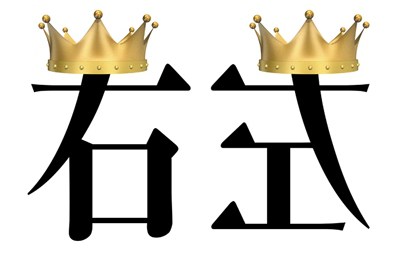
If writing this compound by hand, make sure not to leave out a single stroke and write as ; the meaning and pronunciation are both completely different.

UKingSaKing

It’s a pun! (王 – also pronounced ou – is “king.”) Appropriate, too, since the 左 is backwards.

Posted in Japanese, Yojijukugo | Tagged , , , , , | 2 Comments