Extrapolator extraordinaire

Sherlock Holmes again!

一を聞いて十を知る
(Ichi wo kiite juu wo shiru; “Hearing one; knowing ten”)

Definition:

Having great powers of reasoning and understanding. Learning one part and understanding the whole. Hearing just a little bit about something is enough for the person so described to realize quite a bit more. “A word to the wise is sufficient.”

Breakdown:

This sentence comprises a pair of parallel verb phrases in sequence. Each has a number (grammatically, a noun) and a verb, and connects them with the particle (wo), marking the number as the object of the verb. In the first phrase, the noun is (ichi), “one,” and in the second, it’s (juu), “ten.” What one does to “one” is 聞く (kiku); “to hear,” in conjunctive form. What one does to “ten” is 知る (shiru), “to learn about,” “to be(come) aware of,” “to know,” etc.

Notes:

Some versions of this kotowaza replace 知る with 悟る (satoru), a related term with connotations of Buddhist enlightenment. Others attach the counter (koto), “(abstract) thing,” to the lone numbers and 十 and make 一事 and 十事.

This saying comes from the Analects of Confucius. It’s based on a longer passage in which Zi Gong is questioned and praises fellow disciple Yan Hui (apparently considered Confucius’ favorite and best disciple), saying “He hears one thing and understands ten, while I hear one thing and only understand two.” It is included in the Osaka iroha karuta set.

Example sentence:

一を聞いて十を知るくらいに理解力がある先輩に憧れて、毎日勉強にコツコツ励むことを決意した次郎であった。

(Ichi wo kiite juu wo shiru kurai ni rikairyoku ga aru senpai ni akogarete, mainichi benkyou ni kotsukotsu hagemu koto wo ketsui shita Jirou de atta.)

[Wanting to be like his senior, whose powers of reasoning allowed him to take one fact and deduce ten others, Jirou resolved to study hard every day.]
Posted in Japanese, Kotowaza | Tagged , , , , | 2 Comments

An apple a day… may help.

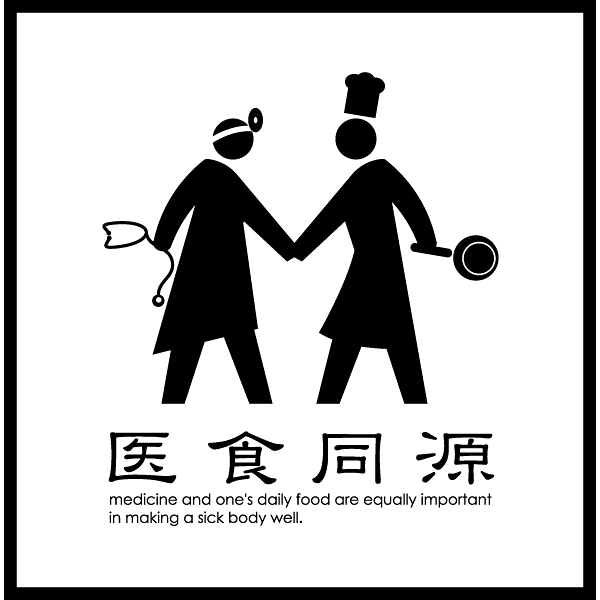
医食同源
i.shoku.dou.gen

Literally: medicine – food – same – source

Alternately: Just as medicine is used to cure diseases, eating well is key to maintaining one’s health. The best defense against ill health is a proper balanced diet (as an every-day practice).

Notes: Some versions of this saying use (yaku), “medicine,” instead of . It seems that the version is the original Chinese idea, while the version was created and used in Japan based on it. Apparently some people use (also pronounced i, but meaning “clothing”) in place of . This is plainly an error.

IShokuShake

Today’s compound commemorates the treaty that ended the great doctor-chef wars of the 18th century. How quickly we forget the lessons of the past.

Posted in Japanese, Yojijukugo | Tagged , , , , , | Leave a comment

Magic Monday – Bigger than baby steps

Small Steps (Unseen Travel; Shadow Travel)

This odd but versatile spell involves repeated physical entry and exit into and from the Shadow (the spiritual reflection of the material plane). It reduces the difficulty and stresses of this passage by making each trip very brief: the span of a single step. Fortunately for the magician, a single step in the Shadow can be warped into several meters’ distance (“room” scale) in the mortal world. In practical terms, the magician steps out of sight in one location and appears somewhere nearby, even if such a transit should have been impossible. One odd side-effect of the method is that the magic works best if the precise moments of appearance and disappearance are unobserved, so many magicians will take pains to step through a doorway or behind an obstacle in order to use Shadow Travel.


The base difficulty is d8, and the base cost is one strain plus one strain per step taken; the caster may take such a step at any time as long as they are concentrating to maintain the spell. If at any time a step is observed by a sentient native of the mortal plane, another check must be made with the difficulty increased by a step in order to successfully take that step, so to speak. Observers who are within arm’s reach may make a Dexterity check at d12 to follow the caster, appearing a pace behind them in the new location. The caster may purposefully bring any number of others with them in this manner at the cost of two strain per traveler per trip; this version of the spell raises the difficulty by three steps. Difficulties are reduced by two steps, and strain costs reduced by one (to a minimum of one point at casting) in a wizard’s place of power.

Posted in Rules | Tagged , , , | Leave a comment

Darker than Black… is not a sequel

青は藍より出でて藍より青し
(Ao wa ai yori idete ai yori aoshi;
“Blue comes from indigo and is bluer than indigo.”)

Definition:

“The student has surpassed the master.” Alternately, hard work and study can lead to greater levels of ability than innate talent. Cloth colored with dye made from the plant “dyer’s knotweed” is a more brilliant blue than the flowers of the plant itself.

Breakdown:

We have two nouns here, and both of them are color names: (ao), and (ai). The first is generally translated as “blue,” although in contrast to English “blue” it refers to a spectrum of what Americans tend to think of as lighter blues and greens – a “green” traffic light is ao, as is the pale green of young plants. The latter is a darker blue, perhaps shading into purples – usually translated as “indigo.” In a concrete sense, ai is both the color of dye derived from “dyer’s knotweed,” and the name of the plant itself.

This saying begins with the noun ao and marks it as the topic of the rest of the sentence with the particle (wa). Next comes , marked by the particle より (yori). In modern Japanese, this is mainly a comparison word meaning “more than,” but in this case it carries the older directional sense of “from” or “out of.” Similarly, the character that comes next is most familiar to students of modern Japanese as 出る (deru), but in this case takes the older form 出づ (idzu), here in conjunctive form. Our first clause is therefore “ao comes from ai.”

The second clause begins with and again marks it with より, here in its more familiar comparative form. And finally we get 青し (aoshi), the adjectival form of “blue,” in sentence-final form.

Notes:

The second clause is also the name of a manga and anime series, a relatively stock risqué-yet-chaste “harem” romance for boys.

This saying is derived from the writings of Xunzi (aka Xun Kuang), a 3rd Century BCE Confucian scholar. The original version adds that ice is colder than the water from which it is made.

Example sentence:

青は藍より出でて藍より青しと言うが、お前が俺の相手になるなんて、十年早いぞ」

(Ao wa ai yori idete ai yori aoshi to iu ga, omae ga ore no aite ni naru nante, juunen hayai zo.”)

[“They talk about how ‘The student surpasses the teacher,’ but you’ll need about ten more years before you can face me.”]

Posted in Japanese, Kotowaza | Tagged , , , , , , , | Leave a comment

A scene in every horror movie ever

I’ve done themed posts several times in the past, picking a yojijukugo or kotowaza based on the number of the post, or some event or holiday happening around the same time. This is the start of a new sub-project, in which I go through the 50-syllable set in order, from あ to わ (or even を, if I can find appropriate entries, perhaps using classical orthography… but ん is simply out, I’m afraid). For purposes of this ordered sub-project, I’ll be counting voiced and unvoiced syllables as a single unit, so for example a “ki” entry could start with き or ぎ; “fu” could be ふ, ぶ, or ぷ.

暗中模索
an.chuu.mo.saku

Literally: darkness – middle – imitation – rope / search

Alternately: Groping around in the darkness. Searching for something blind, without any leads. Trying various things out without any clues beyond what one learns through trial and error. Mosaku is “searching by hand,” and anchuu is “in the darkness.”

Notes: The third character may also be written as without any change in pronunciation or meaning. This seems to be the version used in China, as well.

The origin of this compound seems to be in a text called the Sui-Tang jiahua (『隋唐嘉話』), although casual searching reveals little further information not written in Chinese.

DIGITAL CAMERA

Be careful what you find.

Posted in Japanese, Yojijukugo | Tagged , , , , , , | 1 Comment

More words; more mamas

There’s been a bit of a breakthrough on the “mama” front.

First, let’s take stock of the kid’s cognitive and linguistic development. He’s picking up more words, for starters. He clearly understands the names of meals (he gets excited when he hears them, and makes an “eat” sign), various animal names in both English and Japanese, and some verbs including “give” – if asked to get something and give it to someone, he can complete the whole task without further prompting.

He’s adding more sounds and words to his spoken vocabulary as well. He’s incorporated spoons and other utensils into his “pen” rubric. He can saw “Wow!,” and uses it when discovering things. He learned “poo,” but uses it to describe anything diaper-related (including the diaper itself), which had us confused for a while.

He’s adding more whole (multi-mora) words as well. Earlier most of his words were the “b” sound plus a vowellish garble (“berry” is still something like “büüü”), and the most complicated structure he produced was “mama.” Now he can say “beep!” (learned from a truck storybook one of his uncles gave him) and even, when he’s finished eating, “done.”

Over the winter holiday, he met his extended family and (as expected) referred to both his parents, both his paternal grandparents, and his assembled aunts and uncles and their SOs universally as “mama.” He produced the “pa” sound, but only one at a time. When encouraged to call me “papa,” he gets stubborn and makes a point of saying “mama.” He knows full well what he’s doing, and asserts his chosen titles for us with some energy.

There’s one little episode I forgot to mention last time. It happened over Thanksgiving break; he slept with us in a double bed, between us. One night I woke up in the small hours of the morning to find him awake and sitting up between us. He reached over and touched his mother and said “mama,” as if to himself. Then he reached over and touched me and said “mama” again. He seemed to be confirming or reaffirming something to himself – our identities, perhaps, or our presence, more likely.

Recently there have been cracks in the armor. A couple of times he’s been coaxed into saying “papa,” although as soon as he’s asked to apply the word to me, he realizes what we’re doing and refuses to say anything but “mama.” And just yesterday morning, his mother asked him to give something to me, and he came over and said “papa” as he handed it off! Again, he realized his mistake and clammed up quickly afterward, but we were excited enough about it to, I hope, provide some positive reinforcement. Progress!

Posted in Musing, Nonfiction | Tagged , , | Leave a comment

Magic Monday – A spell for finding Nemo?

Old Salt Song

This song, or chant, is an example of hedge-magic: a ritual, or slow-cast spell, primarily preserved and practiced by common folk rather than academics or specialists. Every fishing village or port town along the coast of the Budov Sea has at least one family whose job is to sail out with the boats and sing this song, because its effect is to attract fish. Order scholars have studied it, of course, and noted that there are regional variants with more or less pronounced effects on various forms of sea life, but the basic effect is universal.


The base difficulty of this spell is d4, and the base cost is one fatigue per hour. (Various other checks may be required to sing successfully over long periods or in rough seas.) Although the exact effects depend on local availability of fish, in general fish will gather in the area. Skill checks to catch fish gain a +1 bonus if the song is sung for at least an hour, +2 if it is sung for about half the day, and +3 if it is sung all day long.

[Ernie is a master wizard]

Posted in Rules, Setting | Tagged , , , | Leave a comment

[Star Trek reboot reference]

This is why I check after every post goes up to make sure everything actually went as scheduled.

一寸先は闇
(Issun saki wa yami; “One sun ahead is darkness”)

Definition:

What lies before us, even an inch away, is darkness (metaphorically). The future is unknowable.

Breakdown:

We begin with a number-noun combination, but in this case the noun is a unit of measure, the sun (pronounced like “soon”), just over 30mm (or a little more than an inch). Note that the compond formed from (ichi), “one,” and (sun) runs the consonants together into issun rather than ‘ichisun‘ as a beginning student of Japanese might expect. The compound modifies another noun, (saki), which can act as different parts of speech and take on a variety of related meanings, but in this case means “(what lies) ahead” or “the future.” This entire noun phrase is marked by the topic particle (wa), but all the comment we get on the topic once it has been established is another noun, (yami), “darkness.”

Notes:

Some versions of this saying add の夜 (no yo) to the end, making it “one sun ahead is a dark night.” This suggests a possible origin to the phrase in Japan before the introduction of Western gas and electric technology, when nights tended to lack public lighting and all was pitch dark unless you carried your own light.

Some people replace 一寸 with 一瞬, “an instant,” but this demetaphorization is incorrect.

This saying is included in the Kyoto iroha karuta set.

Example sentence:

ヤンキーとはちょっと違うが、一寸先は闇だから今夜か明日にでも死ぬかも知れないと言いながら学校をサボる男の子であった。

(“Yankii to wa chotto chigau ga, issun saki wa yami dakara konya ka asu ni de mo shinu kamoshirenai to iinagara gakkou wo saboru otoko no ko de atta.”)

[“He wasn’t exactly a delinquent, but he was the sort of boy who’d skip school, saying ‘Nobody knows what the future holds, so we might die tonight or tomorrow.’”]

Posted in Japanese, Kotowaza | Tagged , , , , , | Leave a comment

♪ Whatever you want, is fine by me…. ♫

Great for next time you want somebody to choose where to eat, perhaps!

付和雷同
fu.wa.rai.dou

Literally: attach – harmony – thunder/lightning – same

Alternately: Having no thoughts or opinions of one’s own. Bonelessly going along with whatever other people around you are doing. The meaning of always following others instead of having one’s own opinion is actually contained within 付和; the 雷同 simply emphasizes the meaning by adding the image of things trembling in response to a thunderclap.

Notes: may be replaced with without any change in meaning or pronunciation. (Homophonous substitutions 不和 or 雷動, however, are incorrect.) Also, the first and second halves of the compound may switch places, although this is much less common.

The origins of this compound can supposedly be traced back to the Book of Rites, a 9th-century text that gained prominence in the Confucian canon.

NoFuWaRaiDouGuy

This was the most interesting result I could find near the top in Google Search. It’s, um, the profile picture on the blog of some biker guy who wrote a post titled “「NO」付和雷同.” Not the most topical image… it has a certain je ne sais quoi, though.

Posted in Japanese, Yojijukugo | Tagged , , , , , | 3 Comments

Magic Monday – Forget-me-do

Reap Memory

This ritual allows memories to be extracted wholesale from the victim’s mind. The magician must speak with the victim on multiple occasions for a significant amount of time (at least about half an hour), on each occasion making some reference to the memory and following it with a specific phrase of the magician’s choosing. Eventually, any stimulus that would trigger the memory being recalled instead recalls that phrase. A particularly insidious variant allows the memory to be absorbed by the magician. Specific limited events (a brawl, for example, but not a siege) or facts may be affected. This ritual may be enacted upon oneself with the aid of a mirror. Although the implications of this magic can be terrifying, and spies have been known to use it to extract information from targets, it has also proven moderately effective as a therapeutic tool for dealing with trauma.


The GM sets a threshold for the memory. Recent, fleeting memories may have a threshold of one point; old memories tied deeply into someone’s psyche may have thresholds of a dozen points or more. During each conversation, the base difficulty is set by the caster; the target must make a Psychic save against the base difficulty. Each failed save counts as one point toward the threshold; once this number is reached, the memory is erased and replaced. Each conversation costs one point each of strain and fatigue for the magician; they can lower the casting difficulty from the base by a step by doubling the cost. Each degree of success beyond regular on the casting, or a critical failure on the save, adds another point toward the threshold. A critical failure on the casting makes the target aware of the process if they weren’t already. An aware target resisting the spell gains +2 to all their saves. Attempting to gain the memory being extracted raises the difficulty by a step and increases the costs in strain and fatigue by one each.

If the ritual is successfully completed, any long-term strain effects associated with the memory are removed, but any event that forces the subject to confront an obvious gap in their memory inflicts at least one point of temporary strain, and in extreme cases may cause an immediate break roll.

Posted in Rules | Tagged , , , | Leave a comment