Round ’em up!

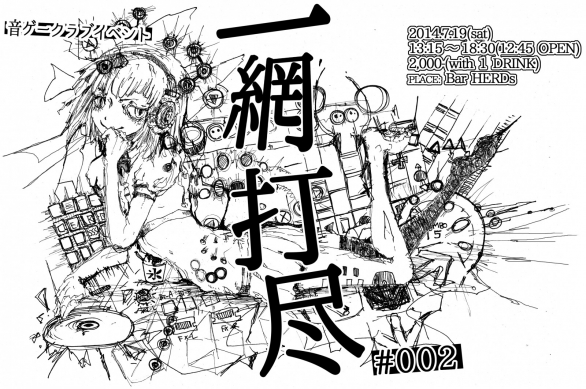
一網打尽
ichi.mou.da.jin

Literally: one – net – hit – use up

Alternately: Arresting an entire criminal organization at once. Catching all the bad guys in one net.

Notes: This one seems to come from the Song Shi.

Event poster

The name, it seems, of an event? At a gay bar?

Posted in Japanese, Yojijukugo | Tagged , , , , , | Leave a comment

Magic Monday – The pinnacle of anti-faerie tech

Dread Seal

It is said that the creatures of the Twilight realm fear iron and will not touch it. This spell is the enchantment behind that belief, laid upon an iron seal of disturbing shape. The caster must weave the enchantment for a day and bathe the seal in the blood of a fae creature. Thereafter, no faerie will willingly come within the same space as the Seal, and will become nervous when nearby. Such creatures will not take a path that the Seal guards, nor will they approach a person wearing it, nor will their magic have any effect in its presence. (Clever ones may still find ways around its protection, and often do so specifically to attack the bearer.) Any fae creature that touches the iron will be harmed; forcing extended contact between one and the Dread Seal will break them both.

The grueling ritual required to forge the Dread Seal fills the strain and fatigue meters, causing the caster to break down temporarily, when it is complete. The stresses also permanently cost a point of Strength. The base difficulty is d12; this can be raised by a step to decrease the cost in strain or fatigue by a point.

Posted in Rules, Setting | Tagged , , , | Leave a comment

An autumn all the more lovely for being free of raiders from the north

This isn’t a kotowaza in the normal sense of an adage or precept; it’s just an expression. But I’ve loved it since I learned it, and thought I’d take this opportunity to share.

天高く馬肥ゆる秋
(Ten takaku uma koyuru aki; “High-heavened, horse-fattening fall”)

Definition:

Just what it says on the tin: this noun phrase describes a pleasant fall weather, characterized by high, clear skies under which, presumably, horses can freely roam their pastures and fatten themselves on long autumn grasses. Alternately, a poetic way to sing the praises of autumn in general, as represented by this kind of weather.

Breakdown:

The noun (here ten, but in on its own ama) is a very old term for the sky, with a connotation both of the sky as residence of various gods and of reference to the imperial throne. 高い (takai) is the adjective “high (up),” here in conjunctive form, meaning that it connects to the following phrase without modifying it directly. Next we have a verb phrase comprising the object (uma), “horse,” and the verb 肥ゆ (koyu) in prenominal form. As this form indicates, all of the above acts as modifier for the final noun (aki), “autumn,” making the entire expression into a compact and lyrical noun phrase.

It pleases me deeply that I was able to make an English translation capturing some of the sense of alliteration and rhythm that the original gave me (even if alliteration is nowhere near as important in Japanese as it is in English).

Notes:

Certain kinds of correspondence in Japan employ set seasonal phrases – I saw a lot of them in newsletters and PTA reports and so on when I was teaching there – and this is one such seasonal phrase. I would recommend checking usage carefully before throwing it into your own correspondence, especially in this age of relatively casual online interaction, but it can be used to express the wish that someone is enjoying good weather for the season.

Apparently some people mistakenly use 越ゆる instead of 肥ゆる. This strikes me as an error more likely arising from computerized auto-kanji rather than human error, since “an autumn that goes beyond a horse” makes very little sense.

The origins of this phrase are fascinating. Apparently it comes to us in our current form from the poetry of Du Shenyan, but that it comes from a warning passed down in parts of what is now China about harvest-time raids by the horse-riding Xiongnu people. Eventually the Xiongnu raiding threat disappeared, and the phrase took on its current usage of simply praising pleasant fall weather.

There are two yojijukugo forms of the same expression, 天高馬肥 (ten.kou.ba.hi) and 秋高馬肥 (shuu.kou.ba.hi). They won’t be getting their own Wednesday posts, but I thought I’d mention them in passing.

Example sentence:
(this week, taken directly from an online example rather than created by yours truly)

天高く馬肥ゆる秋、皆様にはますますご壮健のことと拝察いたします。」

(Ten takaku uma koyuru aki, minna-sama ni wa masu masu gosouken no koto to haisatsu itashimasu.”)

[“In this high-heavened horse-fattening fall, I humbly presume that my letter finds you all in better health than ever.”]

Posted in Japanese, Kotowaza | Tagged , , , , , , , , | Leave a comment

There’s no sense crying over every mistake. You just keep on trying ’til you run out of cake.

試行錯誤
shi.kou.saku.go

Literally: test – go / conduct – disordered – error

Alternately: Trial and error. Solving a problem through repeated attempts.

Notes: This seems to have been directly translated from the English “trial and error.”

Science? Science!

She double-blinded me with repeated controlled trials! Or she lost her graduated flask. One of those.

Posted in Japanese, Yojijukugo | Tagged , , , | 1 Comment

Magic Monday – What would you do for a Klondike Bar?

Feast of the Corrupter

This is a slow, insidious enchantment that was responsible for much distrust of the magically-skilled, before the rise of the Slakiv Empire and the Order of Magi. Yet the promise of functional immortality is considered so great an enticement that only a few agents of the Order are even entrusted with knowledge of its existence.

The magician must prepare a series of meals, using certain herbs and salts in the process and investing part of their life force into the result. When the result is fed to the target, their resistance is weakened, until eventually they become an unknowing receptacle for a portion of the magician’s spirit. After this point, if the magician ever dies, then their spirit reunifies itself in the thrall’s body. The host’s own spirit is ejected, as if they had died in the magician’s stead.

The base difficulty of the food-ritual is d10; the cost each time is d4 each of harm, strain, and fatigue. Each time they consume the meal (at most once per day), the victim loses one point of their Corruption save. When it reaches zero, they must begin making Corruption saves at increasing difficulty (d2 the first time, d3 the next, and so on) until they fail, at which point the spell is complete.

Posted in Rules, Setting | Tagged , , , , , | Leave a comment

On canine tautologies

(In other news, water is wet.)

犬が西向きゃ尾は東
(Inu ga nishi mukya o wa higashi; “If a dog faces west, its tail points east.”)

Definition:

Self-evident. Blatantly matter-of-fact. Something is so obvious that it’s barely worth mentioning. Since a dog’s tail is on the opposite end of its body from the face, if the dog faces one direction, then yes of course its tail points in the opposite direction, thank you very much.

Breakdown:

We begin with the noun (inu, “dog”). It is marked as the subject of a verb by the particle (ga). Next, though, we get another noun: 西 (nishi, “west”). This is the direction of the following verb, so grammatically we might expected nishi to be marked with (non-motion) directional particle (ni), but here the particle is elided and unnecessary. After this we come to the verb: 向く (muku, “to face/turn toward”). It’s actually in conditional form and would properly be 向けば (mukeba), but has been compacted into a more slangy form.

The second half of the phrase is very compact. We have two nouns: (o, “tail”) and (higashi, “east”), joined by the particle (wa). The structure is parallel to 犬が西 in the first half: the particle has changed because we’re looking at a parallel repetition, becoming wa to emphasize the contrast between “the dog (overall) faces west” and “the tail points east.” And because the parallel structure renders it unnecessary, we find the verb elided entirely.

Notes:

There doesn’t seem to be anything particularly striking about this one. But then again, perhaps it should be self-evident?

Example sentence:

「空が曇ってても、朝は来るよね?ママ」 「そうよ。犬が西向きゃ尾は東っていうでしょう。」 「じゃあ、もし南に向かったら?」

(“Sora ga kumottete mo, asa ha kuru yo ne? Mama.” “Sou yo. Inu ga nishi mukya o wa higashi tte iu deshou.” “…Jaa, moshi minami ni mukattara?”)

[“Mama, morning will come even if the sky is cloudy, right?” “That’s right. Just like if a dog faces west, its tail points east.” “…What if it faces south?”]

New Perspective Shibe

…Except this dog. [Source]

Posted in Japanese, Kotowaza | Tagged , , , , , , , | Leave a comment

What goes up, must come down.

A continuation.

盛者必衰
jou.sha.hi-.ssui

Literally: prosper – person – inevitable – decline

Alternately: All those who prosper will see their fortunes wane. Even those who attain worldly success and glory will eventually fall or fade away, due to the mutable and impermanent nature of the world. Again, sic transit gloria mundi, although the nuance is different from last week’s phrase.

Notes: The first two characters (盛者) may be pronounced joushashousha, or shouja without any change in meaning. This probably stems from older Japanese lacking the marks used by modern Japanese to show whether a consonant has been voiced or not.

This week’s offering is from the second line of the Tale of Heike’s famous opening:

沙羅雙樹の花の色、盛者必衰の理を顯す
(Sara souju no hana no iro, joushahissui no kotowari wo arawasu)
(“The color of the flowers of the shala tree express the truth that all who rise must fall.”)

It must be said, however, that the Heike Monogatari is quoting the Humane King Sutra, an important Buddhist text in East Asia.

And here’s a song that explicitly rejects the teaching, while punning on 理 (kotowari, “truth,” “justice”) and 断り (kotowari, “rejection”). Perhaps we should check in on their fortunes periodically.

Posted in Japanese, Yojijukugo | Tagged , , , , , , , | 1 Comment

Magic Monday – Maker’s Mark?

Making-Song (Chant of the Shaper)

Craftsmen and artisans may invoke the Shaper in times of need or inspiration, pushing their bodies far beyond normal limits at the risk of their sanity. In the common imagination this chant is most often shouted by blacksmiths, keeping time with their hammer-strokes, or crooned by basket-weavers over their piles of reeds. But the Making-Song is most useful to artists initiated into the mysteries of the Shaper’s cultic practices.

The base difficulty is d8. For as long as the caster sings (or chants, or otherwise vocalizes) the Song, all fatigue taken in connection with artistic or artisanal creation (whether through exertion or long hours) is converted into strain – which cannot be removed until after the current project is completed! Raising the difficulty gives a +2 bonus to crafting rolls per step; e.g. work may be done with a +4 bonus if the Song is attempted at d12. Failure fills the target’s EP meter, but puts them to sleep in place of a normal Exhaustion roll.

Posted in Rules | Tagged , , , , | Leave a comment

The gods help those who don’t bug them?

This one is dedicated to all those who just had to push the big red button. Incidentally, it’s somewhat antonymical to last week’s kotowaza.

触らぬ神に祟り無し
(Sawaranu kami ni tatari nashi; “Untouched gods won’t curse you.”)

Definition:

If it ain’t broke, don’t fix it. It’s best not to get involved. Let sleeping dogs lie. If you simply leave well enough alone, you’ll be able to avoid a lot of trouble.

Breakdown:

First we find the verb 触る (sawaru), “to touch.” Here it’s in the imperfective form to take the negative auxiliary verb (zu), itself in prenominal form. To be honest, I was confused about this for a while – I was expecting a conditional, and was ready to translate the expression as “If you don’t touch [it], the gods won’t curse you.” But that would have been wrong: the prenominal indicates that the negated verb modifies the following noun, giving us “untouched gods”! Thank goodness for grammar, eh?

Next we have (kami), “spirit” or “god.” The particle (ni) marks it, in this case with its directional function to indicate “from.” This is followed by another noun, 祟り (tatari), from the verb 祟る (tataru), “to curse,” “to haunt,” “to cause a bad outcome.” And finally we get the adjective of negation 無し (nashi) in sentence-final form.

Notes:

This is the sa entry of the Osaka Iroha karuta set.

Example sentence:

「死にたいのかよ?触らぬ神に祟り無しって言うだろう?」 「どの道もう触ったし、もう仕方ないから、手伝ってください!」

(“Shinitai no ka yo? Sawaranu kami ni tatari nashi tte iu darou?” “Dono michi mou sawatta shi, mou shikata nai kara, tetsudatte kudasai!”)

[“Do you want to get yourself killed? Don’t they say to let sleeping dogs lie?” “In any case they’re awake now. There’s no helping it. So won’t you please help?”]

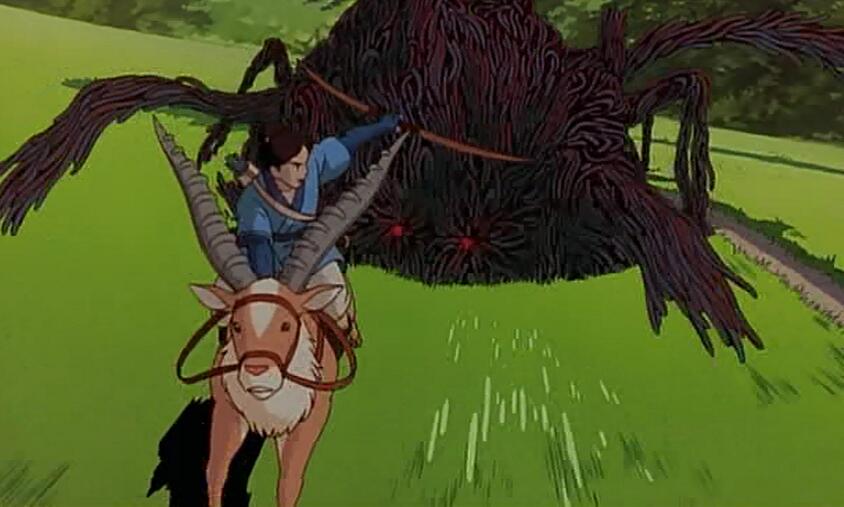
Mononoke-hime tatarigami

Come on, Ashitaka, what was I JUST talking about? [Source]

Posted in Japanese, Kotowaza | Tagged , , , , , , | 2 Comments

“And all the heat in the universe / is gonna coooool doooown”

Doubly topical! This week we’re reading a section of the Tale of the Heike for class.

諸行無常
sho.gyou.mu.jou

Literally: many / various – go – no – ordinary / always

Alternately: Nothing lasts forever. All worldly things are transient. Sic transit gloria mundi.

Notes: This yojijukugo is from the famous opening line of the Heike Monogatari:

祇園精舎の鐘の聲、諸行無常の響き有り
(Gion shouja no kane no koe, shogyoumujou no hibiki ari)
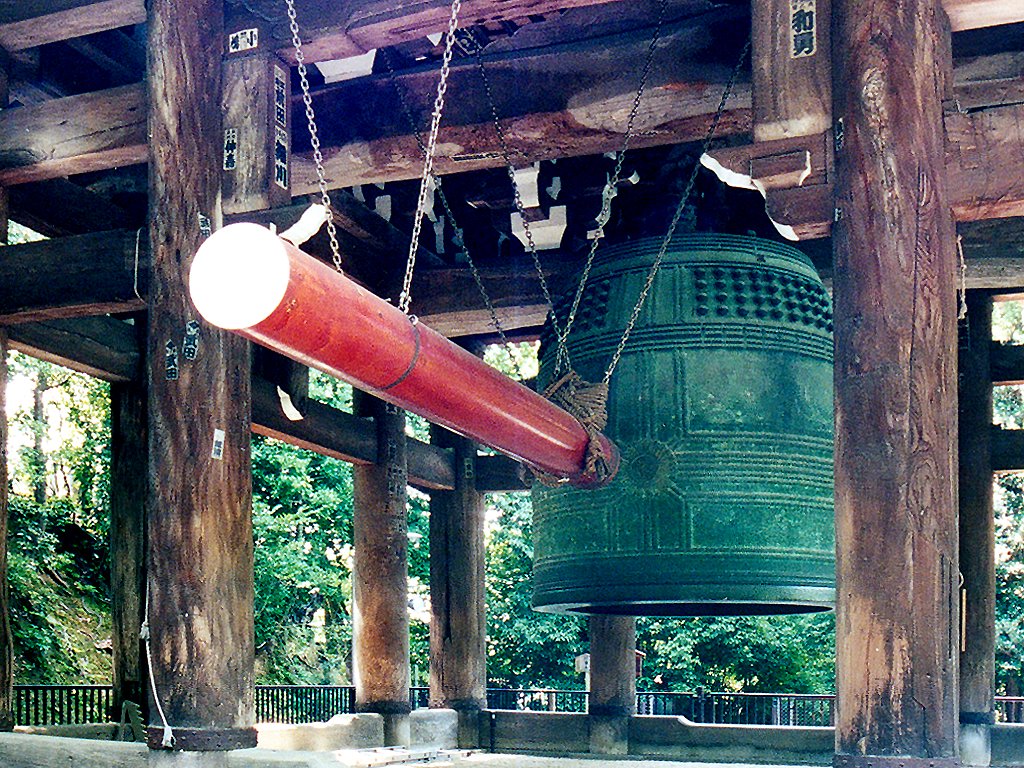
(“In the voice of the bells at the Gion Temple, there is an echo of the impermanence of all things.”)

A big Japanese Buddhist temple bell

Bells like this one, at Chion-In in Kyoto. Apparently the largest bell. (Source.)

Posted in Japanese, Yojijukugo | Tagged , , , , , | 1 Comment