Half- …hiding it

Continuing the theme of hiding from last week:

頭隠して尻隠さず
(Atama kakushite shiri kakusazu; “Hiding the head, not hiding the butt.”)

Definition:

This saying refers to a situation where somebody has done something wrong, or has a flaw or failing of some kind. They believe that they have hidden it and won’t be found out – but they only managed to conceal part of the problem; the rest is plainly visible and they only look all the more the fool for it. A mocking kotowaza.

Breakdown:

Two nouns and two verbs. (atama) is “head,” or by extension the top, front, beginning, leader, or brains of something. (shiri) is “rear end,” or by extension the underside, end, or consequence of something. 隠す (kaku.su) is still to hide or conceal; in classical Japanese, the (.shi) form is conjunctive, with the assertive/perfective helper particle (tsu) also in conjunctive. The (.sa) form is imperfective, followed by the negation-particle (zu) in sentence-final form.

Notes:

This kotowaza is mildly notable for its inclusion in the Edo Iroha Karuta card set. (Which, now that I think about it, I may look into and mine for more sayings.)

It is said to have come from China, and is based on the belief that a pheasant (, kiji), when chased, will hide its head in the brush but leave its tail visible. An equivalent that is probably better-known to most Americans is the (mistaken) belief that a frightened ostrich will hide its head in the sand, leaving the rest of its body plainly visible -although when we talk about ostriches we tend to imagine them as hiding from an unpleasant truth, rather than trying and failing to hide something from others.

Example sentence:

「健ちゃん、クッキー食べたでしょ」 「ううん、食べてない」 「ほら、口はちゃんと拭いてても、クッキー箱は床に置いたままで、頭隠して尻隠さずよ」

(“Ken-chan, kukkii tabeta desho.” “Uun, tabetenai.” “Hora, kuchi wa chanto fuitete mo, kukkiibako wa yuka ni oita mama de, atama kakushite shiri kakusazu yo.”)

[“Ken, you ate some cookies, didn’t you.” “…Nooo, I didn’t.” “Look, even though you wiped your mouth off well, with the cookie jar left on the floor like that, it’s like hiding your head and leaving your butt showing.”]

Posted in Japanese, Kotowaza | Tagged , , , , , , | Leave a comment

Fiddling with XP, part 2: Something old, something new

Previously I rambled for a while about XP systems, and how my ideal would be granular and world-associated – i.e. the way it works makes sense from an in-world perspective as well as a meta, mechanical one. Assuming a D&D-style class-and-level system, though, here’s the kind of thing I’d like to see. (Note that this was heavily inspired by Peter Dell’Orto’s XP house rules for his GURPS Dungeon Fantastic campaign.)

At the end of each session, expedition or mission, everyone who participated gets a base award. The recommended value is three points, although this can be adjusted based on the length of the session and the needs of the campaign. This value is adjusted based on how the party fared, and given to each participating player (i.e. it is not divided up between them).

Losing materiel penalizes the award by one point. Some small expenditures may be tolerated for the opening moves of an extended campaign, but in general a party that expends significant resources without profit probably hasn’t learned much.

Losing personnel penalizes the award by one point. NPCs who die in the line of duty do not have to be counted (although there should be social repercussions within the game world for parties who regularly sacrifice their followers), but if any PCs die, the party probably hasn’t learned much. Horror themed campaigns may set the bar a little higher, only imposing a penalty if two or more PCs die in the same time period.

+ Victory gives a bonus point. If the party has completed a major mission, fully explored a moderate-sized dungeon, defeated a recurring villain or slain an especially fearsome beast, they have probably learned something. A victory bonus is based on major party goals, and is not necessarily tied to victory in battle, or even the defeat of an opponent.

+ Being awesome in play gives a bonus point. Clever plans pulled off without a hitch, bold or dramatic moves that snatch success from the jaws of failure, and other bits of play that impress the DM indicate that the party is learning. Note that lucky dice rolls, or long shots that count on them, do not earn a bonus point: getting lucky with the dice in a tense situation is reward enough.

+ Unlocking achievements gives a bonus point. If the party reaches some interesting milestone in their adventures, they are probably learning and the DM may reward them with another XP. Mapping a whole dungeon, finding all the special sites hidden in the forest, and other accomplishments that don’t readily fall under the “victory” or “awesome” headings may merit this bonus.

* * *

In addition, each player has the potential to adjust their individual reward: at the start of play, anyone who wishes may choose a goal under one of the rubrics of Acquisition, Challenge, Conquest, Discovery, or Exploration (see below). The goal should be specific, and it is recommended that all players discuss their options and choose character goals that don’t conflict with each other. (It’s fine to have everyone select the same goal: that just means everyone will be on the same wavelength for a while.) Achieving your specific goal through play gets your character another bonus XP when awards are made, but carries a risk.

If through poor play the character fails to get closer to their goal (or gets further from it!), their individual XP reward is penalized by one point. In effect, making an individual-reward goal is placing a bet of one XP that it can be accomplished. (Note that failure resulting from DM caveat rather than poor choices on the player’s part should not be penalized; the player backs their stake with their skill and engagement in the game-world and story.)

* Acquisition means getting something material or useful: a great treasure hoard, a legendary magic sword or ring, a castle or tract of land, a formula for a spell, the broomstick of the Witch of the West. If the character ends the session with it in their possession, they get a bonus XP. Remaining empty-handed – or worse, allowing the treasure to be stolen by someone else, or the castle burned and sacked – merits a penalty.

* Challenge means performing some great feat. Crossing the Mountains of Madness, bringing the world-egg to its hatching-place, and the like. Some “challenges” (e.g. slaying the beast that haunts the moors) may be more accurately represented another way (e.g. as “conquest”), but it’s not a huge deal: “challenge” is intended as a catch-all category for goals that don’t fit neatly elsewhere, but the only reason I made categories at all was to get players thinking about different kinds of goals they could pursue. Failure implies that the character has not learned how to meet the challenge yet, and results in a penalty.

* Conquest means overcoming opponents. This may be through combat (slaying the dragon, taking the head of the bandit king, routing an opposing army) or other means (humiliating the vizier and seeing him driven from the court; convincing the princess to marry a suitor of your choosing instead of your rival’s son). Defeat or stalemate means the character cannot yet overcome their enemies, and results in a penalty.

* Discovery (in contrast to Exploration) means solving a mystery. Understanding a riddle, learning the identity of the Masked Man, finding the source of the corruption in the village, tracking the werewolf to its lair. Penalties are imposed if the players stymie themselves, muddy the waters, or do something so catastrophic that the puzzle is no longer solvable. (Probably no bonus should be given if they stumble into the answer through sheer dumb luck, either; keep in mind that these XP rewards are for good play and are given to show that the character has improved and therefore become better able to meet their goals.)

* Exploration means finding new things. In a megadungeon this might be a matter of getting to the lowest level, mapping most or all of one extensive level, or uncovering a hard-to-find or hard-to-reach location. A penalty may be applied if the character does nothing but retread old ground, or if they cause a pathway that they had planned to explore to become closed to them.

Finally, the group may choose to award one final bonus point to an MVP: if some character saves the party, advances their goals dramatically, or simply manages to entertain everyone with engaging play, the other players may reward them with an extra XP. This is a player-side version of the “awesome” bonus that the DM can award.

 * * *

What are the consequences of this system? Well, in an absolute train wreck, it means that a player can get zero XP. A base of three points, minus penalties for materiel and personnel losses, would have the DM giving a group reward of one point to each player (note that the group award is never zero); a player who bet on some goal and lost would have thrown away even that single point.

On the other hand, in case of a brilliant session full of amazing play, the party might get a base of three, all three bonuses from the DM, and on top of that an individual might fulfill a goal and be voted MVP, for a total of eight points. But for most sessions I would expect to see an average player getting four or five points: slightly above the base of three, because there are more opportunities for bonuses than penalties, and most gaming settings are conducive to a few small victories per session with only occasional setbacks.

Which brings us to the question of progression. Think about the charts from last time: what kind of curve do we want? It would be simple to make it linear: just keep the amount needed for each level increase the same. An exponential curve is similarly easy: just double the requirement each time, as in Original D&D. The problem with the former is that it yields no curve for the “learning curve,” and the problem with the latter is (since rewards stay about the same throughout) that each time you advance in level, you know that you’ll need to play as many sessions as you have already, all over again, plus one, before you see the next advancement. This seems like it would become a drag quickly… and it still fails to replicate a real-world learning curve.

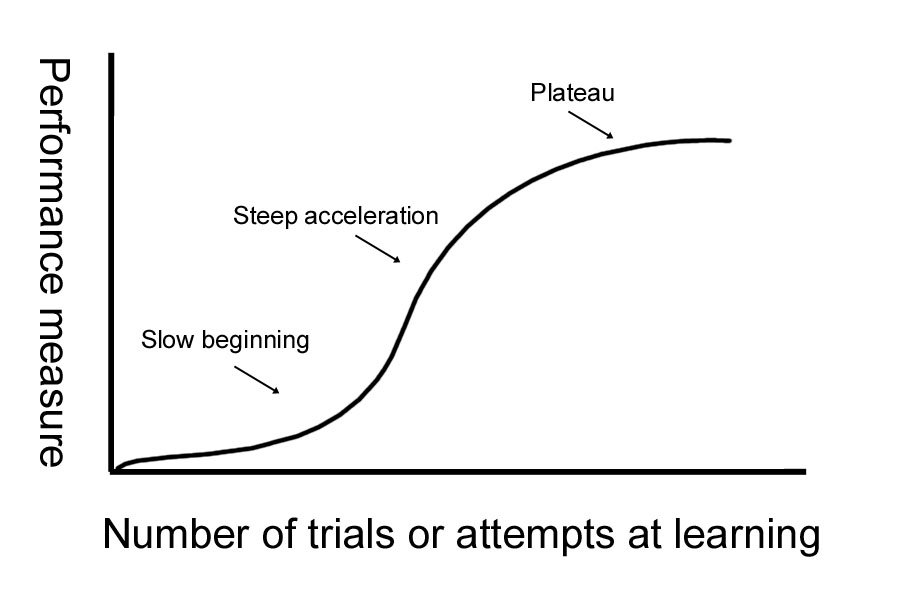
…On that note, what is a real-world learning curve like? Google tells me it looks like this:

It actually looks very much like an arctan (x) graph

From here, by way of Google Image Search.

Note the slow start as well as the indefinitely extensible plateau. Most versions of D&D actually do away with the slow start by relegating it to backstory: it has been pointed out that once upon a time, first-level fighters were called “veterans,” implying that getting from mundane zero-level status to any kind of class and level at all meant building up enough experience to reach the rapid-advancement part of the curve. In in-world terms, that’s good stuff: implied character history can be a hook for roleplaying. A certain minimum of competence is necessary to hook players into the heroic power fantasy, too.

But the more options a system offers and the more variables it takes into account, the more time people need to get used to it before they can start making meaningful decisions. In this age of computer-based RPGs, part of the fun for many players is tinkering with a complex system, figuring out “builds” that allow them to squeeze the maximum effectiveness out of a given style or aesthetic of play. But for a beginner who just wants to grab a sword and hunt down some beasts, a streamlined introduction to play is good, and a breaking-in period that allows them to make informed decisions when they reach their first level-up is better.

(One alternate approach here is the one taken by roguelikes: a high-turnover situation with frequent character death that allows for experimentation on the fly without needing to worry about one bad investment having long-term repercussions… but most beginners probably aren’t interested in an experience where they die and die and die again, even if death does come less frequently over time as they gain competence. There’s a reason roguelikes are still a niche in the computer-based gaming world!) 

The next question is, where do we want to put the turning points in the curve? Well, the last couple of editions of D&D-product have been explicitly divided by design into “tiers” of play (a division that some would argue has been included, implicitly, from the very beginning). It makes sense for the first tier to be your slow start, your second tier to be your rapid advancement, and everything after to proceed at a more sedate pace. Where you draw the dividing line depends on the particulars of the system, but most D&Ds would probably put the turning points at around 5th and 10th levels respectively.

Just as a very rough approximate example, then, let’s say this: twenty-five XP (between three and seven sessions or missions, for all but the most disastrous players) to go up a level at first, slowly decreasing by 5 every couple of levels to a minimum of ten (two to four sessions/missions). After that, just ten XP per level until 10th – and then for each level beyond that, five more (i.e. about one extra session) than the previous one.

Level 1 2 3 4 5 6 7 8 9 10
XP req. 0 25 25 20 20 15 15 10 10 10
Total XP 0 25 50 70 90 105 120 130 140 150
Level 11 12 13 14 15 16 17 18 19 20
XP req. 15 20 25 30 35 40 45 50 55 60
Total XP 165 185 210 240 275 315 360 410 465 525

That gives us a progression that looks like this:
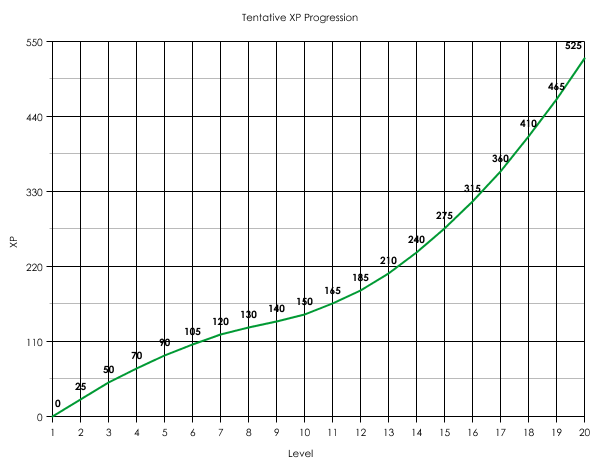
Don't expect this one to be a final version. I'm proud of it for now, though.

Flip the x and y axes to get the arctan-ish shape of the “learning curve.”

Today’s post is already closing in on 2000 words, so that’s enough for now. Next time I’ll explain my choices in greater depth and throw in some more possible add-ons for the rules governing rewards – concerning not just XP, but treasure as well. Fun!

Posted in Rules, World-Building | Tagged , , , , , | Leave a comment

Fiddling with XP, Part 1: The Past and Present

Improvement over time is such an integral part of role-playing games (in general) that it has become the de facto indicator for RPGness in computer games. And there are plenty of different systems. I’m partial to one in which using a skill or trait in question leads to improvement for that skill or trait in particular, at a rate that starts out high and then plateaus out, like real-world learning or training tends to. I haven’t seen any games that use this specific system, though, outside of my own head.

A lot of games will give you “experience points” (XP, by any of a variety of names) for a generic pool that can then be spent piecemeal to improve various aspects of the character, even including social elements such as contacts and allies. While this is relatively dissociated compared to what I described above, it has the advantage of being convenient, simple, and abstract: players are free to customize their characters as they please without too much fuss and without needing to keep track of whether they managed to support every mechanical choice made with a corresponding choice during play.

D&D and similar class-and-level based systems take the abstraction a step further, and assume that all characters who share a class will improve certain traits in essentially identical ways. Player choice and control are reduced in favor of further simplification and convenience. Once a critical mass of XP has been amassed, a whole array of traits increase together. The trend in D&D itself has been a move back in the direction of customization: proficiencies and later skills, feats, even increasingly flexible “multiclassing” all step away from the one-size-fits-all approach inherent to class-and-level.

The question I want to look at now is not all that stuff, though; it’s the amount of XP involved.

D&D numbers always struck me as inflated-feeling: going from first level to second has long required over a thousand XP, regardless of which edition you use or which class you play. Original D&D required from 1200 (for thieves) up to 2500 (for magic-users and monks) for that initial step. That said, you couldn’t just divide everything by 100 and be done with it: it looks like the smallest XP reward for defeating a monster was a mere five points. What’s more, most XPs were expected to come from treasure on a one-for-one basis, meaning any reduction in the experience table would require the entire economy – from treasure values to the prices of goods and services – to be reworked. While I don’t know how they came up with the numbers they did, I assume that Gygax and Arneson had some sort of internal justification for the choices they made.

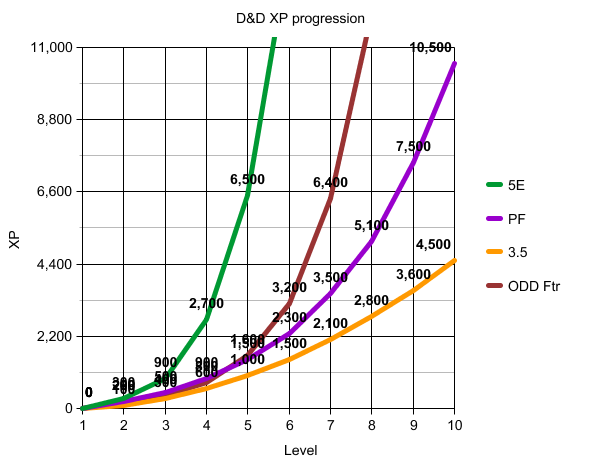
But the XP/level curve has fluctuated quite a lot since D&D was first published. Here’s a comparison between OD&D, 3.5, and the newly released 5th Edition “Basic” versions, as well as Pathfinder – first over the first ten levels, then up to twenty.

(Note 1: All values other than those for 5th Edition have been divided by ten for purposes of comparison. The new XP totals are smaller than those for past editions by an order of magnitude. But I assume that progression is NOT supposed to be ten times as fast – which means rewards will be proportionally smaller as well. What I am interested in comparing is not absolute magnitude, but progression.)

(Note 2: The first chart uses the OD&D Fighting-man as a representative progression, and extrapolates the 10th level value by assuming it will double, as seems standard. The second chart does NOT extrapolate further: instead it uses the monk progression from Supplement II, as it has highest number of explicitly-marked levels. So be careful when using the red lines as a point of comparison for the rest of the data; they’re not the same.)

Can you read the numbers? I have a hard time, to be honest.

Once more, with feeling

One thing that jumps out at us is how steep the curve for the new D&D is: it outpaces all of the others for a long time, passed by the OD&D monk at 14th level and by the Pathfinder progression, barely, at 20th. (Contrast this especially with the 3.5 progression, which is practically flat compared to everything else under consideration.) But we can’t really say much based on the curve without knowing how XP rewards will work.

We get a bit of a clue to those in this column by Mike Mearls. Here we see expected combat-based rewards varying depending on the difficulty of the encounter and the party level, but another irregularity is immediately apparent: Mike notes that “As a rule of thumb, the game assumes that characters of a particular level can defeat a total number of creatures with an XP value equal to two hard encounters before needing to take a long rest” [emphasis mine].

Looking at the chart he provides, we see that two hard encounters gives about 300 XP… which is enough to take a character from first to second level! I have to assume that XP from an encounter is supposed to be divided equally between all members of a party, since potentially going from level 1 to 2 on your very first day seems extreme, and would throw a monkey wrench into the learning curve of any beginners; they should be allowed to settle in and get a feel for the mechanics they’re working with before needing to make decisions for the leveling-up process. This leads us to the question of how long a high-level party is expected to take to level up: going from level 19 to 20 requires 50,000 XP, or about 16 level-appropriate “hard encounters.” And of course the question remains: what will XP be rewarded for? I prefer a system, like the old XP-for-gold, that rewards clever play rather than mere combat.

Well, I’m not actually here to judge 5E, not when the full rules haven’t even been released yet and without any experience of how the rules actually work in play. I kind of got caught up in hunting down numbers and making graphs and then speculating about their implications (it’s weirdly satisfying), but what I actually want to talk about – and will, next time – is an alternate approach to XP, to be thrown on the heap with the rest of my private assemblage of quirky potential house rules.

Posted in Miscellaneous, Rules | Tagged , , , | Leave a comment

Talons and Talents

This week’s kotowaza was recommended by a friend. If any of my readers have further suggestions or requests for specific sayings, please feel free to contact me!

能ある鷹は爪を隠す
(Nou aru taka wa tsume wo kakusu; “The skilled hawk hides its claws.”)

Definition:

The wise keep something in reserve. It can be useful to be underestimated. Those who know the most say the least. Don’t try to show off. A good saying for brash and insolent youths, intermediate learners eager to show off their skills to beginners, and anyone trying a little too hard. Also useful in an oppositional situation, as a warning against revealing all your resources to the other side too soon, since doing so would reduce your tactical and strategic options and increase theirs.

Breakdown:

is skill, talent, or the function of something (or by extension of the first meaning, Noh drama). The verb ある in this case indicates possession; modern grammar would admit an additional particle such as (ga) or (no) between the noun and verb in order to make the function explicit. These words together, then, become an adjectival phrase modifying (taka), the Japanese falcon or hawk: it is a skill-having hawk. is as usual the topic-marker particle; as with last week, context can lend a contrastive note to its use.

(tsume) is a claw, talon, fingernail, hoof, or equivalent. By extension it can also refer to a hook, clasp, pick, or plectrum. 爪先 (tsumasaki – note the vowel change) refers to the tips of the toes in general. is our good old object marker for the final verb 隠す (kakusu), to hide or conceal.

Notes:

The saying comes from how supposedly, a hawk’s talons are concealed from its prey until it attacks, allowing it to catch them off guard more effectively. While this doesn’t seem to be entirely true out in nature (it’s easy to find images of hawks with feet clearly visible), the image and its applicability to a martial human society are clear enough.

You may at times see replaced by . The latter character means “brain” and so the saying still seems to make a certain amount of sense (“The smart hawk hides its claws”), but this is a kanji error. It is not an accepted alternative.

More legitimately, the kanji may be replaced with katakana タカ, as this is relatively common practice with animal names. The entire phrase 能ある鷹 may also be condensed to 能鷹 (nouyou), a compound noun essentially meaning “skillhawk.” There are a number of more extensive variations on the basic saying, replacing the hawk with a cat, or with a dog that doesn’t bark and scare away its prey.

Example sentence:

「全然威張らない彼なのに、そんなに上手だったか。能ある鷹は爪を隠すもんだね」

(“Zenzen ibaranai kare na no ni, sonna ni jouzu datta ka. Nou aru taka wa tsume wo kakusu mon da ne.”)

[“So even though that guy doesn’t talk himself up at all, he’s that good? It’s that ‘the skilled hawk hides its claws‘ thing, I guess.”]

Posted in Japanese, Kotowaza | Tagged , , , , , | 1 Comment

The Tomb King’s People

What does this picture say to you? I found it here as part of a run of undead-themed images, all labeled “Tomb King,” but this was at the top. And I’m glad it was; the rest of the series is a collection of moldering pharaohs and relatively run-of-the-mill skeletal warriors. If I had seen one of those first – especially the Egyptianish ones – I probably would have parsed the whole thing differently and overlooked whatever it is that caught my eye about this image in particular.

What did catch my eye? Is it the halo, carefully centered in its own bit of negative space? Something about the expression on the skull’s face? Or just the fact that even with the armor and wings and all, this guy has incredible posture? Whatever it was, my first thought was that despite the black, the ornate armor, and the skeleton heads, this isn’t a bad guy.

The standard fantasy trope for skeletons is that they’re bad, or at best mindless combat opponents. In either case, something to be killed. …Re-killed. Broken into pieces. Stopped. Something along those lines. Antihero or even sympathetic treatments have been given to intelligent undead like vampires or ghosts; even to zombies. But not skeletons. You can see where I’m going with this.

What if there were a community of skeletal people somewhere? Just hanging out, playing board games, pondering the meaning of life, trying to find dresses that make them look fat. Neither inherently evil nor automatically hostile to outsiders – although, understandably, wary – and with interests on both the individual and group levels that go beyond merely guarding the tombs they were interred in against intrusion.

Dickish Barbarian vs. Peeved Skeletons

From Three Word Phrase – for a weird bonus, see this one too.

You could have an isolated skeleton community somewhere to be traded and otherwise interacted with, like any other little town or camp in the game world: an abandoned graveyard or mausoleum, for example. Or they could be integrated into a larger, more cosmopolitan, community, such as a skeleton ghetto in a metropolis or a skeleton faction in a megadungeon.

There’s a lot you can do with this. The Tomb King can be a wise and just ruler, doing his best to protect his people, or a dangerous and petty tyrant the other skeletons want to overthrow. Skeletons can give the party quests or aid. PCs who make friends or enemies among the skeletons can find this helping or hindering them in some catacomb miles away or a different level of the dungeon. They could be given skeleton-specific magic, tools, or information.

Skeletons are going to have different priorities than living things do. They have different needs and wants, advantages and disadvantages. They have different rewards to offer to those who aid them, and different strategies for dealing with threats. And most of all, they have a different perspective on “life” – or on existence, rather. All in all, it seems like a good opportunity to add a faction to the play area that isn’t just another demihuman or beast-man race.

Posted in Miscellaneous, World-Building | Tagged , | 1 Comment

The Post that Sticks Out


出る杭は打たれる (Deru kui wa utareru; “The post that sticks out gets hammered down.”)

Definition:

It is best to keep one’s head down and not attract too much attention. Someone whose ability stands out will become the target of others’ jealousy. Someone who is full of themselves will be humbled by the censure of their peers. Depending on your point of view and the specifics of the situation, this can be negative (a bitter, even Randian comment about how the mediocre will attempt to drag down their betters) or positive (a warning against hubris in a world where even those who see the farthest do so only because they stand on the shoulders of giants).

Breakdown:

The verb 出る is literally “to go out,” and is incredibly common in Japanese, in a wide variety of uses and combinations. In this case, context allows us to understand that it is being used to mean “stick out,” since presumably the in question are not mobile, nor are they being launched through the air. The verb is acting adjectivally, modifying the noun , “stake,” “post,” etc. is, as usual, the topic-marker particle, but we can see a hint of its contrastive use here: the post that sticks out, as opposed to all the other posts, gets hammered, and they do not. Finally, the verb 打つ, “to strike,” in its passive form. Rendered literally, the phrase becomes “As for out-going post, struck.”

Notes:

出る can be expanded into 差し出る (sashideru), which more explicitly indicates “sticking out” or “jutting out.” can be replaced with (kugi, “nail”), although the former seems to be the original term.

The origins of this kotowaza remain unclear to me, although there seems to be a general consensus that the posts in question are involved in rice agriculture, perhaps marking the boundaries of fields. I believe I read once that the expression comes from as far back as the Chinese Water Margin epic, but please don’t take my word for it without further research.

Example sentence:

「ふむ。出る杭は打たれると言うから、しばらく黙って周りの人の意見を聞いてみよう」

(“Hm. Deru kui wa utareru to iu kara, shibaraku damatte mawari no hito no iken wo kiite miyou.”)

[“Hm. Since ‘the post that sticks out gets hammered down,’ let’s be quiet for a while and listen to the opinions of the people around us.”]


Posted in Japanese, Kotowaza | Tagged , , , , | 1 Comment

Divine/Arcane Divide

I’ve added Ten Foot Polemic to my RSS feed, and spent a little while trawling back through the archives. While there are a few things there that aren’t entirely my cup of tea, it’s creative and inspiring enough that I recommend the read.

That said, I’m going to start this relationship by disagreeing with the writer on a particular matter of taste. In his “Tweaking the Cleric / On Magic” post, Young is discussing his version of the arcane/divine magic dichotomy, and says:

I like wizard magic to be chaotic and horrible with a good chance of going wrong and screwing over yourself and others. Magic comes from Outside and is Wrong and it Fills You and if you don’t vomit out the spells to purge it from your mind and soul it will burn you out and drive you mad. Wizard magic is Chaotic because its very nature is to it disrupt reality and ruin the natural order of things.

By contrast, I want clerical magic to be more reliable and dependable and safe. It comes from Within and is Good and you Channel It Through You and it lights the way and heals the sick and it purges the unnatural and it makes things whole. Cleric magic is Lawful because its very nature is to heal reality and maintain the natural order of things.

On its own merits this is cool, consistent and coherent, very atmospheric, and in keeping with the LotFP rules that he seems to be building on. It’s also in keeping with the Law v. Chaos (or Civilization v. Wild, Church v. Faerie/Paganism, etc.) dualism that has been part of D&D since its inception. It brings to mind Three Hearts and Three Lions almost immediately.

The problem, for me, is right there in the Church part. For most of its existence, the real world’s (Christian) Church has done untold damage to the native peoples and cultures of every land it touched. I don’t like the Christianity that grimly subsumed as many cultural traditions as it could and consigned the rest to the side of Evil in its cosmic war. It declared, “If you’re not with us, then you’re against us.” It used that declaration to justify genocide and barbaric destruction.

And I feel that, if you gloss over that complicated and tragic history by buying into its post-facto triumphal good-versus-evil narrative, something important is lost. I have an immediate and deep negative reaction to the Christianish vision of a fantasy world where “good” magic is all Church magic, and all other magicians are mere fools riding the crest of Chaos for a while before it inevitably destroys them. I strongly prefer a fantasy world where magic comes from many sources; some more powerful than others, some more dangerous to deal with than others.

This is reflected in the house rules that started this blog. Instead of a unified Church, I present a world with myriad gods of Earth and Dream, with people (clerics and druids) engaging in worship to ask them for boons or avert their wrath. And in the role of wizards I present not unstable walking wellsprings of Chaos, but rather students and shapers of natural forces.

I have little use for alignment systems as a mechanic. But if I had to make a choice, in terms of D&D cosmic alignments, priests are more Chaotic and wizards are more Lawful.

Clerics and druids obey the inscrutable demands of sentient beings for no reason other than that those beings are unimaginably more powerful than humans, hoping that after sufficiently diligent service those beings will reward them with favors. These priests may have purely altruistic motives, and honor only gods who seem benevolent to human society, but in the end they’re still following the whims of alien intelligences. Their minds are full of taboos and observances that must be acted on without any hope of knowing why. (I say this as a practicing, if not intensely devout, Jew.)

Wizards, on the other hand, are fantasy-world scientists. Natural philosophers, if you will. They chart and study the patterns of nature and attempt to harness them. Like priests, they may do this for personal gain or for some greater good, but in the end their primary tools are observation and reason (implying that Int would be a good choice for their primary stat, eh?), and they don’t necessarily serve any masters – meaning they must justify their actions in some way.

Wizards’ minds are full of diagrams, patterns, complex mathematics, lists and correspondences… and the more thoroughly they know the why of any given, action, the less likely it is to accidentally explode in their faces. That ties back to the “fantasy scientist” angle: arcane magic is still dangerous! Real science has killed lots of people while humanity was refining its understanding of engineering, mining, chemistry, radiation, rocket science, and any number of other fields. There’s still room in this view for mad wizards hiding in towers, or necromancers sneaking into morgues at night for parts. It’s just that madness unto death isn’t the inevitable end of anyone who sets foot on that road.

All this theory could be plugged into D&D or some variant with little mechanical effect. (Alternately, it could be played up with rule tweaks and changes such as Devotions-based casting, as seen here). I mostly hope that this view, standing in contrast to how magic seems usually to be presented in the OSR community, is interesting and coherent enough to make a few people step back and look at the issue from a fresh perspective.

Posted in Essay, Miscellaneous, Nonfiction, World-Building | Tagged , , , , , , | 3 Comments

Walk, don’t run, said the tortoise to the hare

Given that my wife gave birth to a healthy boy four days ago, it might seem a little surprising that I’m able to post this. The secret, in this case, is that the post was essentially completely written a week ago; I’m just stealing ten minutes to clean it up and post it now. Next week is an altogether different story….

Intro:

Please take a couple minutes to watch this video. It is the cutest presentation of a kotowaza you will ever see in any language.

急がば回れ (Isogaba maware; “If in a hurry, go around.”)

Definition:

If you’re in a hurry, don’t try to take shortcuts that you normally would not; they’ll only end up putting you in danger or wasting your time. It’s faster to travel by a known route, even if it is longer and seems like it will take more time. Similar to the English “Haste makes waste,” although it approaches the concept from an opposite angle. While – as the video linked above demonstrates – the term is also used as the Japanese translation of the song title “Walk Don’t Run,” the latter is not a good English translation for the Japanese phrase outside of that specific musical context.

Breakdown:

Here we have a very pithy phrase, arguably comprising nothing but two verbs. 急ぐ (isogu) is “to hurry, to rush” (although note that the adverbial form 急に, kyuu ni, simply means “suddenly” rather than “hurriedly”). The ba here is a hypothetical marker, not the conditional ending some students of Japanese might first expect. 回る (mawaru) commonly refers to rotation, but can also mean “to go around (to several places).” Here we find it in imperative (command) form.

Notes:

回れ can also be written 廻れ; as usual with this kind of thing, the alternate is simply an older/rarer character.

Supposedly the saying comes from Karahashi Bridge over the Seta River in Shiga prefecture, one of Japan’s “Three Famous Bridges” of yore. While it was possible to make a trip from the harbor at Yabase up to Ootsu by boat, and this was potentially faster than walking, winds could slow the boat trip and throw one’s travel plans into confusion. Therefore, walking (by way of Karahashi Bridge) was the more reliable option.

This origin story is accompanied by a fuller version of the phrase, 武士のやばせの舟は早くとも急がば廻れ瀬田の長橋 – Mononofu no Yabase no fune wa hayaku tomo isogaba maware Seta no Nagahashi – “Although the warriors’ boat from Yabase is fast, if you’re in a hurry, go around [by] the Long Bridge of Seta.”

Example sentence:

「いくら近道だと言っても、この道は思ったより渋滞しているね。急がば回れで、国道で行こう。」 

(Ikura chikamichi da to itte mo, kono michi wa omotta yori juutai shiteiru ne. Isogaba maware de, kokudou de ikou.)

[No matter how much of a short-cut it’s supposed to be, this road is more congested than I thought. In the spirit of “more haste, less speed,” let’s take the highway.]

Posted in Japanese, Kotowaza | Tagged , , , , | 5 Comments

Buddha dunno

I said earlier that I wasn’t interested in presenting English sayings that had been translated into Japanese. This one falls close to that category, but sufficiently distinct that I feel it’s worth talking about.

知らぬが仏 (Shiranu ga Hotoke; “Unknowing is the Buddha”)

Definition:

Similar to the English saying “Ignorance is bliss,” this kotowaza often takes on a negative nuance. But it can also have a more pragmatic tone. Sometimes there’s something that would make you angry or worried, but there’s nothing you can do about it. If you already know there’s nothing to do but control your emotions – but it’s more Buddha-like if you don’t to go any pains to find out. Alternately, not going out of your way to learn about things that would upset you can be an important part of the Buddhist virtue of detachment from this illusory world of suffering.

Breakdown:

知る (shiru) is a verb, “to come to know.” (nu) is in this case the attributive (prenominal) form of the negative ending, meaning that a noun has been left out (probably 者 – mono, “person”). (ga) is the subject marker particle, and (Hotoke) is the Buddha, or at least a buddha or the buddha-state. I suspect that there was originally an ending after the noun, probably the copular なり (nari), but without having found any sources for the saying’s origins, I can’t say for certain.

Notes:

Nothing special that hasn’t already been touched on above, this time.

Example sentence:

「え、お兄さんのプリンを食べても大丈夫?」 「見つからない限り。『知らぬが仏』だ」 「どうかな」

(“E, oniisann no purin wo tabetemo daijoubu?” “Mitsukaranai kagiri. ‘Shiranu ga Hotoke‘ da.” “Dou ka na.”)

[“Eh, is it really okay to eat your (older) brother’s pudding?” “As long as we’re not found out. Ignorance is bliss, after all.” “I wonder….”]


Posted in Japanese, Kotowaza | Tagged , , , , , | Leave a comment

Kuukai Revisited

弘法筆を選ばす (Koubou fude wo erabazu; “Kuukai doesn’t choose his brush.”)

Definition:

A master produces masterpieces regardless of what they are given to work with. Quality comes from skill, not merely from good tools. If you find yourself unwilling to start a project because you’re afraid you don’t have the best tools for the job, this is the kotowaza for you. Being a good illustrator isn’t a matter of having the right pens or pencils; being a good musician is a matter of dedication, not of having top-notch instruments (just ask David Grohl!). The saying also makes a good response if someone blames shoddy workmanship on bad tools instead of taking responsibility and aiming to improve.

Breakdown:

We have a verb this time! The phrasing is, again, very compact: we start with the proper noun 弘法, followed by (fude, “writing-brush”), the object-marker particle (wo), and the verb 選ぶ (erabu; “to choose,” “to select”) in its archaic/literary negative (zu) form. A more literal rendition might read “Kuukai not-choose brush.”

Notes:

選ぶ may also be written as 択ぶ without any change in meaning or pronunciation. It also seems common for people to stick the topic-marker particle (wa) in after the name.

My source gives an “opposite” saying, 下手の道具立て (or 道具調べ) (Heta no dougu-date/dougu-shirabe, “The unskilled fuss over their tools.”) While the focus of this kotowaza certainly stands in direct contrast to Kuukai’s, I feel like the basic message is similar: mastery is in focusing on your performance rather than on the tools.

All that being said… there’s a story that directly contradicts the kotowaza. Supposedly at one point Kuukai sent the emperor Saga a set of four brushes with instructions on brush choice depending on calligraphic style, causing a prince to comment that the (already extant!?) kotowaza was mistaken. The internet goes on to tell me that Kuukai was actually relatively picky about his brushes, the ability of a master to pick “the right tool for the right job” being a natural and indispensable part of mastery.

Example sentence:

「またフェンシングの試合で負けちゃった!新しいブレード買わないと」 「ブレードのせいじゃないでしょう。『弘法筆を選ばず』だよ」

(“Mata fenshingu no shiai de makechatta! Atarashii burēdo kawanai to.” “Burēdo no sei ja nai deshou. ‘Koubou fude wo erabazu‘ da yo.)

[“I lost in another fencing tournament! I have to buy a new blade.” “It’s not the blade’s fault. ‘A good craftsman doesn’t blame his tools,’ you know.”]


Posted in Japanese, Kotowaza | Tagged , , , , , , , | Leave a comment