The hobbit of peppers

山椒は小粒でもぴりりと辛い
(Sanshou wa kotsubu de mo piriri to karai;
“Japanese peppers are small but painfully spicy”)

Definition:

This saying metaphorically describes someone who is physically small, but still formidable due to well-honed talents and a fierce spirit, surprising strength, or other exceptional qualities. Don’t underestimate someone just because they’re small.

Breakdown:

We begin with the noun 山椒 (sanshou), a close relative of the more famous Sichuan pepper, marked as the topic of discussion by the particle は (wa). The comment on this topic begins with the noun 粒 (tsubu), “grain,” “particle,” compounded the prefix-noun 小 (ko), “small.” This is followed by conjunction でも (demo), “but,” “although.” The phrase that follows begins with onomatopoetic adverb ぴりり (piriri), “tingling,” “stinging.” This is followed by the particle と (to) in its function of marking the adverbial use of onomatopoeia. Finally, we have the adjective 辛い (karai), spicy,” in conclusive form.

Notes:

山椒 may also be read with a short final vowel, as sansho, although in my sources this appears to be the less-common rendition.

A related saying points out that while a needle is small, it’s not something you can just swallow. Yikes. That said, the peppercorn version describes a level of ability that’s not to be sneezed at; it would be an error to use it to describe something harmful or dangerous despite its small size.

Example sentence:

「あの子だったら、大臣や偉人さえ説得できるらしい。山椒は小粒でもぴりりと辛いもんね」

(“Ano ko dattara, daijin ya ijin sae settoku dekiru rashii. Sanshou wa kotsubu demo piriri to karai mon ne.”)

[“They say that she can even turn the great and the powerful to her cause. ‘Even the smallest person can change the course of the future,’ eh?”]

Posted in Japanese, Kotowaza | Tagged , , , | Leave a comment

What about Stitch Seizen?

理路整然
ri.ro.sei.zen

Literally: logic/truth – road – organize – “in that way”

Alternately: Of someone’s thoughts or speech: coherent, cogent, rational; following a coherent thread or throughline from premise to conclusion. The nuance in modern usage seems to be of someone presenting a case that is clear and minimizes the barriers to getting agreement from others, especially in a business context.

Notes: This is another compound of compounds; 理路 refers to a line of reasoning, and 整然 refers to something being in proper order.

Replacing 然 with homophone 全 (“whole,” “all”) is an error.

This compound is considered an antonym of 支離滅裂.

RiRoFlowchart

The big picture is easy; the hard part is deciding what real-world considerations belong in which step of the flowchart

Posted in Japanese, Yojijukugo | Tagged , , , , | Leave a comment

Sometimes the baby poops when you want to nap

月に叢雲花に風
(Tsuki ni murakumo hana ni kaze; “clouds to the moon; wind to the flower”)

Definition:

Good things are all too vulnerable to disruptions. The moon is covered by clouds; flower petals are scattered by the wind; what you thought would be a thriving democracy is hollowed out and devoured by greed and corruption, hate and fear. Good results depend on a degree of luck, so things don’t always go the way you want or intend.

Breakdown:

This kotowaza comprises two parallel phrases; each uses directional particle に (ni) to apply its second noun to its first. In the first phrase, 叢雲 (murakumo), “gathering clouds” or “a bank of clouds,” is applied to 月 (tsuki), “the moon.” In the second, 風 (kaze) is applied to 花 (hana), “flower.”

In some cases, the two parts may be separated by a comma.

Notes:

Two of the traditional pleasures of nature noted in Japanese culture are the harvest moon, known as 名月 (meigetsu), and a seasonal rotation of flowers (the most famous being cherry blossoms in the spring). Unfortunately, moon-viewings are vulnerable to inclement weather, while cherry blossom is known for shedding its petals quickly.

A related, phrase simply says 花に嵐 (hana ni arashi), “a storm to the flower.” A more general one says 好事魔多し (kouji ma ooshi), “good thing, many demons.”

叢 overlaps in meaning and in its kun reading with 群, so writing 叢雲 as 群雲 is also considered acceptable and does not change the meaning or pronunciation.

Some people apparently use this saying to express when two people’s personalities don’t mesh well, but this is considered an error.

Example sentence:

「せっかく有給休暇取って、弁当のために高い食材も買って、あんだけ頑張って料理したっていうのに、ピクニック当日になって春一番かよ!」 「月に叢雲花に風だね」

(“Sekkaku yuukyuu kyuuka totte, bentou no tame ni takai shokuzai mo katte, andake ganbatte ryouri shitatte iu no ni, pikunikku toujitsu ni natte haru ichiban ka yo!” “Tsuki ni murakumo hana ni kaze da ne.”)

[“Seriously? After I went and took some of my paid leave, and bought expensive ingredients, and worked that hard to make a nice boxed lunch, when the day of the picnic comes we have the first big storm of spring?” “Yeah, things don’t always go the way you want.”]

Posted in Japanese, Kotowaza | Tagged , , , , , , | Leave a comment

When Debate Club has fewer rules than Fight Club

喧々諤々
ken.ken.gaku.gaku

Literally: noisy – [doubling mark] – outspoken – [doubling mark]

Alternately: A furious uproar; large numbers of people voicing their opinion without restraint or consideration for others.

Notes: Naturally, this may be written with repeated characters instead of the doubling mark. Closely related phrases include ones that replace 喧 with 侃 (kan, “strong”) or 諤 with 囂 (gou, “noisy”), although my sources indicate that those came first and 喧々諤々 was a later formation.

KenKenGakuGaku

A more polite and honest, but no less white, version of Kitsune News

Posted in Japanese, Yojijukugo | Tagged , , , , , , , , , , | Leave a comment

When the bones are bad

…the rest is needed

骨折り損の草臥れ儲け
(Honeori zon no kutabire mouke;
“Bone-breaking loss and a profit of weariness”)

Definition:

Working hard without any reward. Bone-breaking labor with no fruits but exhaustion. A wasted effort or thankless task.

Breakdown:

It turns out that this whole kotowaza is a noun phrase build of subsidiary noun phrases, most of them derived from verbs. We begin at the end with the verb 儲ける (moukeru), “to earn,” “to profit,” in conjunctive form and acting as a noun. This is preceded and modified by the verb 草臥れる (kutabireru), “to be exhausted,” “to wear out,” in conjunctive form and acting as a noun. Associative particle の (no) connects this noun phrase to the noun 損 (son), “loss,” “harm”; this is preceded and modified by a compound noun comprising the noun 骨 (hone, rhymes with Monet), “bone,” and the verb 折る (oru), “to fold,” “to break,” in conjunctive form and, you guessed it, acting as a noun. Backing up a bit, we see that one of the effects of being in a compound is that son is voiced as zon.

Notes:

Note the (ironically twisted) rhetorical contrast between 損 and 儲け (loss and profit, or expenditure and return).

The kanji for 草臥れる are apparently derived from the ancient Chinese text Classic of Poetry (詩経, Japanese Shikyou), which at some point describes a tired person lying down (臥) on the grass (草). The Japanese phonetic root is from the same source as 朽ちる (kuchiru), “to rot (away).”

This phrase is the ほ entry of the Edo iroha karuta set. The latter half (草臥れ儲け) may also appear on its own as shorthand for the entire phrase.

Example sentence:

「子供の時、学校での勉強は骨折り損の草臥れ儲けだと思ってたけど、図書館で過ごした平日の夕方は極楽みたいな時間でした」

(“Kodomo no toki, gakkou de no benkyou wa honeori zon no kutabire mouke da to omotteta kedo, toshokan de sugoshita heijitsu no yuugata wa gokuraku mitai na jikan deshita.”)

[“When I was a kid, I thought that studying at school was a colossal waste of effort, but the weekday evenings I spent at the library were like paradise.”]

Posted in Japanese, Kotowaza | Tagged , , , , , , , , | Leave a comment

What was I saying? Ah, yes.

閑話休題
kan.wa.kyuu.dai

Literally: leisure – talk – rest – topic

Alternately: “But setting that aside….” A phrase used to put an end to a digression, aside, or idle chatter, and return the listener’s attention to the main topic or thread of conversation, or the main plotline in storytelling. A more casual way to express the same thought would be それはさておき (sore wa sate oki).

Notes: This phrase comes from a passage in the famous 14th century Chinese historical novel Water Margin (Japanese 水滸伝, Suiko den).

閑 may be replaced with homophone 間, “interval,” without any change in meaning – note that both 閑話 and 間話 can refer to “idle talk,” although the latter compound seems to be less commonly used in current Japanese.

KanWaKyuuDaiBake

One of the “scene change” panels from the original Bakemonogatari anime

Posted in Japanese, Yojijukugo | Tagged , , , , , , , | Leave a comment

Giving trash the bird?

掃き溜めに鶴
(Hakidame ni tsuru; “A crane on a dunghill”)

Definition:

An especially talented or beautiful person amid mundane folk. A rare gem amid dross; a beautiful crane that has incongruously alit on a midden-heap.

Breakdown:

We begin with the same composite noun as last week: 掃き溜め (hakidame), a “pile of waste.” This is followed by the noun 鶴 (tsuru), “(Japanese) crane.” In between, the locational particle に (ni) places the crane on (or in, or at) the heap. And anything further that might have extended the thought or completed the sentence is elided, although see below.

Notes:

This saying is sourced to a senryuu poem*, a close relative to haiku: 掃溜へ鶴宿下りの総模様 (hakidame e / tsuru yadoori no / soumoyou). While I hesitate to provide a translation at this point, some discussion has suggested that the implication is of someone returning to their family home from their work home (which in Japan, almost always means returning to a relatively isolated village or estate from the capital) and finding themselves out of place, although the meaning has evolved somewhat in the intervening centuries.

(*At this point, it’s unclear to me who actually wrote it.)

Example sentence:

「教頭先生が言ってたけど、この中学校の男子の半分ぐらいが自分だけが掃き溜めの鶴だと思ってるせいで毎週二、三回、喧嘩が起きているらしいよ」

(“Kyoutou-sensei ga itteta kedo, kono chuugakkou no danshi no hanbun gurai ga jibun dake ga hakidame no tsuru da to omotteru sei de maishuu ni, sankai, kenka ga okiteiru rashii yo.”)

[“According to the vice-principal, there have been fights breaking out two or three times a week because about half the boys at this middle school believe that they alone are the crane on the dunghill.”]

Posted in Japanese, Kotowaza | Tagged , , , , , , | Leave a comment

Sal mirabilis

博引旁証
haku.in.bou.shou

Literally: extensive – pull – to the side – evidence

Alternately: As one member or side of a dispute or controversy, supporting one’s case by citing an extensive body of examples or material. Presenting a solid, perhaps overwhelming, amount of evidence.

Notes: This practical yojijukugo is a compound of compounds; 博引 refers to using a wide array of materials or examples to explain something; 旁証 refers to presenting evidence.

Note that the 旁 character is rare these days; it can be (and often is) replaced with close relative 傍 without any change in pronunciation or meaning.

Witnesses

Not a Japanese example, but too topical to pass up.

Posted in Japanese, Yojijukugo | Tagged , , , , , , , , , , | Leave a comment

A midden of lucre

掃き溜めと金持ちは溜まるほど汚い
(Hakidame to kanemochi wa tamaru hodo kitanai;
“Dunghills and money get dirtier as they accumulate”)

Definition:

The more money someone has, the more money they want; an increase in wealth tends to bring increasing greed and selfishness rather than contentment.

Breakdown:

We begin with the verb 掃く (haku), “to sweep,” in conjunctive form. This connects it to 溜める (tameru), “to accumulate (something).” This verb is also in conjunctive form, but here the form allows it to act as a noun. (One could also argue that haki is acting as a noun as well, making this phrase a compound noun.) Put together, 掃き溜め refers to a heap of trash or manure.

Jumping forward just a bit, we find the noun 金 (kane), “metal,” especially “gold,” or by extension, “money,” compounded with another verb-derived noun; this one from 持つ (motsu), “to have.” A money-haver, of course, is a rich person. This compound noun is joined to the hakidame with exclusive-and particle と (to, pronounced like “toe”), i.e. “this and this (and not particularly any others).” The category of these two things is then marked as the topic of conversation by particle は (wa).

The comment on this topic is the adjective 汚い (kitanai), “dirty,” in conclusive form. This is preceded and modified by noun ほど (hodo), “degree,” “extent,” which links the dirtiness to the verb 溜まる (tamaru), “(something) accumulates,” in prenominal form.

Notes:

A variant saying switches and replaces things a bit, giving 金持ちと灰吹きは~ (kanemochi to haifuki wa…), the dirty things in this case are “rich people and ashtrays.”

Example sentence:

掃き溜めと金持ちは溜まるほど汚いと言うから、貧乏から抜け出して、単純に生活に困ることのない暮らしができればそれでいいと思ってた。けど、このことわざをよく考えてみると、どんな程度であれ、お金を持てば困ることが増えていくということなんじゃないかと思う」

(Hakidame to kanemochi wa tamaru hodo kitanai to iu kara, binbou kara nukedashite, tanjun ni seikatsu ni komaru koto no nai kurashi ga dekireba sore de ii to omotteta. Kedo, kono kotowaza wo yoku kangaete miru to, donna teido de are, okane wo moteba komaru koto ga fuete iku to iu koto nan ja nai ka to omou.”)

[“They say that like a trash heap, money only gets dirtier the more you pile on, so I thought that it would be best if you could just get enough to escape from poverty and simply live without any worries. But thinking about the saying, I realize that no matter how much money you have, it only gives you more to worry about.”]

Posted in Japanese, Kotowaza | Tagged , , , , , , , | 1 Comment

In truth, I’m feeling feint

虚虚実実
kyo.kyo.jitsu.jitsu

Literally: empty – empty – truth – truth

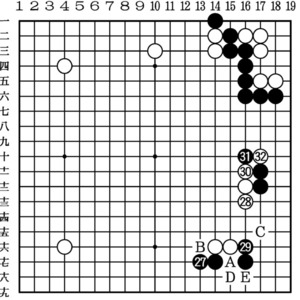
Alternately: Two sides in a fierce battle, using every strategy and wile they can think of. Striving to avoid your enemy’s strengths (実) and attack their weaknesses (虚). Alternately, using a mixture of truth and falsehood in an attempt to draw out someone’s true feelings.

Notes: The second of each doubled character may be replaced with the doubling mark 々… but please use it for either neither of them, or both; don’t use it with just one kanji and leave the other.

Igo

Just a regular newspaper Go puzzle

Posted in Japanese, Yojijukugo | Tagged , , , , , , , , | Leave a comment