Keeping the mood, and the pocket, light

軽薄短小
kei.haku.tan.shou

Literally: light – dilute – short – small

Alternately: Of a thing: small and light. By metaphorical extension, a person whose character is shallow; a hollow person with no substance to them.

Notes: The physical meaning has apparently become widespread since around the 1980s, as a positive trait to be sought after in goods such as electronics.

KeiHakuTanShouJo

The watch, or the woman? You decide! (Actually it’s from an ad for Skagen “hybrid smartwatches.” So… yeah, you decide.)

Posted in Japanese, Yojijukugo | Tagged , , , , , , | Leave a comment

Magic Monday: AI Magic 3

Week 3: Magical Happyfun Singalong Time

This is the old magic, the magic of voice and drum. Words are magic, and math is magic, and some spells combine these in the sorcery of song. Strict GMs may require a Perform check.

Song of the Unworthy

This tuneless, amelodic ditty is something you must croon to yourself, murmuring and stumbling as if trying to recall a song that you haven’t heard or sung in many years. As long as you can keep this up, you are Beneath Notice. Others are technically aware of your presence, but they don’t care, and so as long as you do nothing but slip unobtrusively by while singing, your presence will go as unremarked-on as if you had been invisible and soundless. Even animals are affected, if they are social enough to be able to assign relative importance or standing to others around them.

Call to the Daring

This bold paean draws others to you: it promises danger and excitement; worthy challenges and proportional rewards. In a fight it draw the attention of all; brave or opportunistic foes will seek you out, while the most cowardly or reluctant will flee. In a less hostile situation the Call will draw willing followers and helpers, although your cause must be appealing to them if you want them to stay; the attraction ends with the last note of the song.

Song of the Ball

This magical children’s rhyme summons a sphere of shining energy that takes on physical properties specified and adjusted as desired in the lyrics. It can be thrown, kicked, bounced, and otherwise treated like an ordinary toy ball. Advanced magicians can learn how to make it hover, stick to various materials, split into multiple smaller balls, and other tricks along those lines.

Song of Distraction

This rhythmic chant, contrary to what one might expect from its name, grants you deep focus. The Song doesn’t even need to be loud enough for anyone to hear, but as long as you are chanting, there is little that can break your concentration. Heat, cold, pain, sights and sounds that should fill one with horror or joy, hostile magic; none of these will penetrate the still, calm circle of the Song. It is said that for a master magician, even Death can be held at bay.

Song of the Darn

This practical tailor’s tune, easy peasy, repairs holes, tears, or similar damage to a piece of fabric.

Song of Blord

It is not clear who, or what, Blord is: extradimensional wanderer or occasionally-corporeal spirit, fae trickster or elder god. Whatever it is, this inhuman hymn incites a localized manifestation of Blord’s essence. Normal physical and even magical rules gradually lose their power as events and things alike descend from ordinary to unusual, to magical realism, through surrealism and careen toward abstract impressionism. Only those who know (and join) the hymn, or those especially skilled at the reality-manipulation of lucid dreaming, have any chance of surviving unscathed even this long, and beyond this point, arcane tidal forces seem to set in and the Song forcibly ends itself as something catastrophic befalls the singer. It is not recommended that you use this Song even a moment longer than is absolutely necessary.

Song of Goom

This lilting, arrhythmic air summons a funny, fuzzy, chubby little energetic pet something for a brief time. It is playful and friendly and seems to especially love children; the perfect companion for an afternoon’s entertainment while the adults concentrate on more serious work.

Singing only the stressed syllables, with certain alterations, changes this spell into the Song of the Doom Goom. This variant also summons something that, while “fuzzy” and “chubby” in a certain sense of the words, and definitely “energetic” and “playful,” is dramatically less “funny” and “friendly” and is certainly not recommended for children.


Posted in World-Building | Tagged , , , , , , | Leave a comment

Like borrowing a cup

(Not a cup of sugar, mind you. Just a cup.)

人の褌で相撲を取る
(Hito no fundoshi de sumou wo toru;
Doing sumo in someone else’s loincloth”)

Definition:

Using something that belongs to someone else for your own benefit or profit. Taking advantage of somebody else’s tools, work, or other resources for personal gain. This saying does not apply to situations such as support that someone else offered unlooked-for. It carries a strong implication of using the people around you in an underhanded way to cheat or cut corners. Like borrowing somebody else’s ritual sumo garment to compete in, perhaps because you were too lazy or stingy to just buy one of your own.

Breakdown:

We begin four characters in, with the particle で (de). In this case, the particle marks the means by which an action is performed, and that means is the noun 褌 (fundoshi), “loincloth.” What loincloth in particular is specified by using associative particle の (no) to connect it with noun 人 (hito), “person.” (In this case, the term takes on the nuance of “some random person,” “somebody else (whom you wouldn’t have expected to be involved).”

Moving in the other direction, the verb phrase performed with someone else’s loincloth starts with the noun 相撲 (sumou), “sumo wrestling.” The particle を (wo) marks this as the direct object of the actual verb; the proper verb in Japanese for “doing” sumo turns out to be 取る (toru), literally “to take,” here in conclusive form.

Notes:

Alert readers will remember seeing the character 褌 with a different reading not too long ago.

This saying comes to us from 『滑稽四十八癖』(Kokkei shijuuhachi guse), an 1885 text by comic writer Shikitei Sanba (式亭三馬). (The work’s title may ring a bell as an allusion to the extended form of this saying.)

Some variants make the nuance of 人 explicit by replacing it with 他人, “another person,” “others.” This compound may be pronounced tanin or, as above, hito. In the context of this kotowaza, sumou can also be written 角力, apparently without any change in meaning pronunciation.

Example sentence:

高校の間ずっと人の褌で相撲を取るように、エッセイを書くことになったら、友達から借りた資料だけで書いていたジョンは、大学生になってすぐ単位を落としてショックを受けた。

(Koukou no aida zutto hito no fundoshi de sumou wo toru you ni, essei wo kaku koto ni nattara, tomodachi kara karita shiryou dake de kaiteita Jon wa, daigakusei ni natte sugu tan’i wo otoshite shokku wo uketa.)

[John, who through all of high school had ploughed his fields with other people’s calves by only using materials borrowed from his friends when it came time to write an essay, received a shock when he failed a class immediately after entering college.]

Posted in Japanese, Kotowaza | Tagged , , , , , , , , , , , | Leave a comment

Gettin’ biblical before the match

緊褌一番
kin.kon.ichi.ban

Literally: tense – loincloth – one – [ordinal counter]

Alternately: To brace yourself mentally for something. To prepare to face difficulty or hardship, or at least a high-level competition of some sort. Literally, to gird one’s loins.

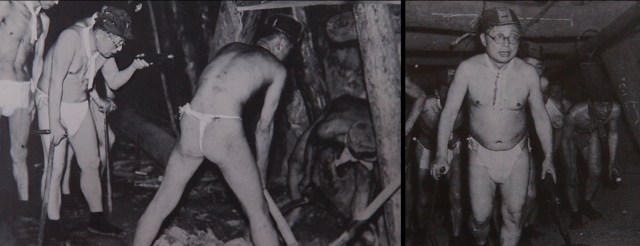
Notes: 緊褌 refers to tightening up one’s loincloth; the 一番 refers to the seriousness of the situation, or of the person’s emotional state as they prepare. The character 褌 on its own can be read as fundoshi, a term that might be familiar to sumo enthusiasts.

KinKonTanKou

Miners wearing fundoshi in a northern Kyushu coal mine in 1947; source.

Posted in Japanese, Yojijukugo | Tagged , , , , , , , , | 1 Comment

Magic Monday: AI Magic 2

Week 2: Unnatural nature

Why would you, the discerning magician, be satisfied with normal plants and animals when you could make things weird?

Conjure Bark

You enclose yourself, or somebody you touch, in a magical semblance of a tree, which takes on a size, species, and character matching those of the person so enchanted. The one enclosed can see, hear, smell, and sense temperature in their area, and the magic supports them as if they were a tree until they choose to move, at which point the bark disappears completely. Some believe that remaining within the bark for long enough will change you into a tree in truth, albeit one that bleeds when cut.

Plant of Peace

For this long-term enchantment you nurture a plant of almost any type with frequent attention, feeding it with words of support and encouragement. When it blooms, any who come close enough to smell the flowers’ scent is drained of all hostility and desire for violence or conflict; when it bears fruit, all who partake while resting beneath it will see all of their wounds, fatigue, and trauma melt away overnight. Cutting out and consuming the heart-root will kill the plant, but cures the patient of all poison and disease.

Charm of the Cods

You craft a charm of wood seasoned with fish oil. Whosoever bears this charm will find fish of that type drawn to them and made docile, as if out of the deepest affection. Useful to fisher-folk; perplexing to anyone finding themselves plied with piscine pals on an arid plain or mountain peak.

Conjure Mare

You summon an ordinary, healthy horse from somewhere; it responds to commands and other stimuli as normal. The horse is always female. Any who eat the flesh of this horse will be plagued by terrifying, or in extreme cases lethal, horse-related dreams.

Date Wards

You bless a number of fresh dates during a harvest ritual, associating each individual fruit with the name of a specific disease or malicious spirit. Anyone carrying that fruit on their person will be untouched by whatever was named for as long as the date remains fresh and unspoiled. If dried, the dates provide a normal amount of nutrition.

Curse Clam

Meditating on an unprovoked injustice that was visited on you or someone close, you invoke a certain undersea spirit and dive for a clam. If the spirit takes your case the clam will contain a single deep-red pearl, which you must openly present to the offender. The pearl will thereafter follow them, appearing in odd places at odd times no matter what they do for the next year. If within that time they do as much as possible to correct the injustice, the pearl will turn black and become an ordinary gem; if they do not, it will turn into a dull ball of chalky white and they will die. Willingly sleeping with the pearl at hand will give them dream-visions of what must be done to expiate the curse.

Darkworm Colt

You summon something that has more or less the shape of a horse, and more or less acts like a horse, but is clearly not composed of anything like an actual horse. It can be called at any time or place that is at least as dark as dusk, and remains until exposed to sunlight or released from service. It is best to dismiss this beast before it becomes hungry.

Posted in World-Building | Tagged , , , , , | Leave a comment

The fish not taken

By Robert Frost?

釣り落とした魚は大きい
(Tsuriotoshia sakana wa ookii; “The fish that got away is big”)

Definition:

The things that you lost your chance at, or failed to get, seem all the more appealing because of the pain of missing out. The fish that you nearly caught but let slip feels like it was especially large and desirable. A sort of “the grass is always greener.” The opposite of “sour grapes.”

Breakdown:

We begin toward the end, with the topic-marker particle は (wa). The noun marked as the topic of discussion is 魚 (sakana), “fish.” What kind of fish is specified by a compound verb: 釣る (tsuru), “to fish,” in conjunctive form and coupled with 落とす (otosu), “to drop” or “to lose,” in past tense, which allows it to attach to and modify a noun. And finally, the comment on this fish-that-was-fished-up-and-then-dropped takes the form of a single adjective in conclusive form: 大きい (ookii), “big.”

Notes:

Contrast this with the English-language expression about the fish that got away being magnified by lies on the fisher’s part, either to inflate their own prowess (at nearly having landed something truly impressive) or hide their faults (at having allowed an ordinary catch to escape).

Some versions replace the compound verb with 逃した (nogashita), “let escape.” The character 魚 can also be read as uo without any change in meaning. There are a number of synonymous phrases as well; two of them specify catfish or eel as the lost catch, while especially tragic ones extol the wisdom or beauty of lost children.

Example sentence:

釣り落とした魚は大きいという恐怖に付け込んで、今しかないような投資機会と見せかけた詐欺がそのとき流行っていました。

(Tsuriotoshita sakana wa ookii to iu kyoufu ni tsukekonde, ima shika nai you na toushi kikai to misekaketa sagi ga sono toki hayatteimashita.)

[There was a scam popular at the time that took advantage of people’s fear that the chances they missed were the best ones by dressing itself up as a now-or-never investment opportunity.]

Posted in Japanese, Kotowaza | Tagged , , , , , , , | Leave a comment

On the up and up and away

立身出世
ri-.sshin.shu-.sse

Literally: stand up – person – go out – society

Alternately: Success in society; specifically, establishing oneself in a high (and well-paid) position. Achieving fame and fortune.

Notes: This is a repetition-type compound; both risshin and shusse refer to “success in society.”

While the first image this phrase calls to mind for me is of the cursus honorum that classical or feudal aristocrats were expected to rise though, it apparently came into popular use in the early Meiji era, when the advent of democracy and the deconstruction of the old social order led to a dramatic increase in social mobility.

RisshinMahou

This very odd MTG card seems to read the characters more literally as a sort of resurrection.

Posted in Japanese, Yojijukugo | Tagged , , , , , | Leave a comment

Magic Monday: AI Magic 1

(I’ve mentioned before that I’m a fan of Janelle Shane’s “AI weirdness” blog. Recently, I followed a link to this old post, in which the neural network created a list of spell names for D&D, and this has inspired me to challenge myself to write up appropriate-feeling spell descriptions for as many as possible.
Unlike the more serious Magic Monday spell posts, which present provisional stats for YAOSC one spell at a time, this will be a collection of descriptive outlines chosen as inspiration and whimsy dictate, then assembled and assigned a theme ex post facto.)

Week 1: Low-hanging fruit

Readers may notice that I’m starting in the middle of the list and picking names that could go completely unremarked-on in normal RPG material.

Song of the Door

You sing of two places that you know well, and of the connections between them (even if these connections only exist in your mind and emotions), and then step from one to the other regardless of the intervening distance. Others who are in physical contact with you, or who are nearby and are woven into the song by name, may also make the transit. A condensed variant allows you to slip through to the other side of a single obstacle, such as a wall or closed door, that you touch.

Icon of Thorns

You craft an elaborate calligraphic sigil, then cover it and pierce through the cover into the icon with a metal pin. When the pin is removed and the sigil uncovered, all who see it are held in place as if caught in the middle of a dense thorn-hedge: they may move, but only a little at a time, and with great pain and effort. Because the thorns only exist within the viewer’s mind, only those who can see and comprehend symbols are affected. Even the heaviest of armor is no defense, but a victim who loses consciousness may be carried away freely. The sigil slowly loses its potency over time after being uncovered.

Star Warper

You reach up toward the night sky and seem to pluck out a star. The result is a shining, iridescent marble that dissipates quickly if it leaves your hand, but is unaffected by forces such as wind and water or void magic. At a thought, the light may be dimmed to a mere glimmer (by which only its bearer can see clearly) or brightened to a beacon. The starlight is hateful to faeries and undead, who avoid it, but attracts creatures from Dream.

Stone of Death

You bind up all your negative emotions into a curse placed on a stone, which becomes poison to all who touch it. You may only curse one stone at a time, and as long as you maintain the curse, your body will not recover from any wound, disease, or poison, and you can not craft any other curse magic.

Summon Storm Bear

You summon a Storm Bear. Wise magicians will summon their first Storm Bear in a secure area, politely ply it with gifts, and negotiate the terms of future service. As long as you uphold your end of the agreement, so will the Storm Bears uphold theirs. 99 out of 100 sorcerers recommend well-insulated clothing.

Spirit Boating

If you spend a day and a night placating and honoring the spirits of any and all who have drowned in a given body of water, for the next month you may call upon those spirits to bear you across it. When the time comes you may step out and be carried away at a brisk pace as if standing on an unseen punt in a smooth but rapid current. You may bring others with you, but only if they participated in the original ceremony.

Death of the Sun

DO NOT CAST THIS SPELL.

SunDeath

Posted in World-Building | Tagged , , , , | Leave a comment

A flaw for lions

自慢は知恵の行き止まり
(Jiman wa chie no yukidomari; “Pride is the dead end of wisdom”)

Definition:

When pride has taken root, arrogance follows and prevents further advancement. A lack of proper humility and modesty blinds people to their own faults and weaknesses, which prevents them from actually addressing those weaknesses and thus growing stronger. Improvement depends on not being so full of yourself that you see no need or room for improvement.

Breakdown:

We begin with the noun 自慢 (jiman), “pride” or “boasting,” marked as the topic of discussion by the particle は (wa). The comment on this topic is a noun phrase beginning with noun 知恵 (chie), “sense,” “wisdom,” or in religious terms, “insight that leads to (Buddhist) enlightenment.”

Next comes a noun built of compounded verbs. The first verb is 行く (yuku), “to go,” in conjunctive form. This is followed by and combined with 止まる (tomaru), “to stop (moving),” also in conjunctive form, which allows it (and thus the whole compound) to function as a noun. As a whole, 行き止まり (yukidomari; note the voicing on the to) refers to “the point at which something stops.” This noun is connected to the preceding 知恵 by the associative particle の (no). At the end one may imagine an elided copula or other sentence-completing structure.

Notes:

行き may also be read as iki without any change in meaning.

This isn’t our first kotowaza warning that pride gets in the way of excellence.

Example sentence:

自慢は知恵の行き止まりだと悟って、「自分は何も知らない」と言い張ったソクラテスは、結局のところ、少しも自分の才能をひけらかさなかったのでしょうか。

(Jiman ha chie no yukidomari da to satotte, “Jibun wa nani mo shiranai” to iihatta Sokuratesu wa, kekkyoku no tokoro, sukoshi mo jibun no sainou wo hikerakasanakatta no deshou ka.)

[Realizing that pride is the end for wisdom and asserting that “I know nothing,” wasn’t Socrates ultimately showing off his own ability, just a little?]

Posted in Japanese, Kotowaza | Tagged , , , , , , , , | Leave a comment

Feet of clay, tongue of wood

Mouth of gold; break the mold

金口木舌
kin.kou.boku.zetsu

Literally: gold / metal – mouth – tree / wood – tongue

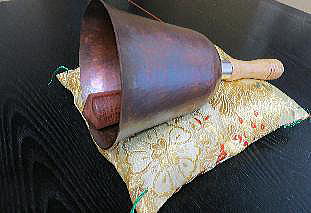
Alternately: Someone who leads the people through skillful (spoken) expression. A guide or leader of public opinion. The image is of a metal bell with a wooden clapper, as was apparently used in ancient China as notice of official pronouncements.

Notes: 木 may also be pronounced moku, although this seems to be less common.

This phrase comes to us from the Fayan, (『法言』, Hougen in Japanese) a.k.a. the Model Sayings, a 2000-year-old collection of writings in the form of, let us say, Socratic dialogues, except the Socrates is actually poet Yang Xiong (揚雄, You Yuu).

木鐸

The original social-media influencer

Posted in Japanese, Yojijukugo | Tagged , , , , , , , , , , , | Leave a comment