How many grets before they start repeating?

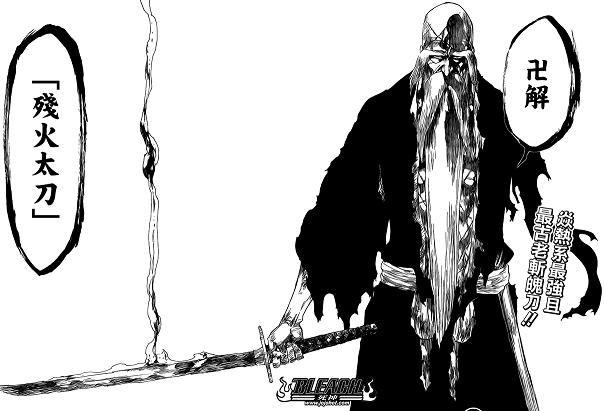
千恨万悔
sen.kon.ban.kai

Literally: thousand – regret / resentment – ten thousand – regret / repentance

Alternately: Overwhelming feelings of regret about the past.

Notes: Some versions may not use 万, but rather the archaic form of the same character, 萬.

Both 千 and 万, instead of being taken literally, are used here to refer to large numbers or magnitudes; 千万 is a pretty common way of expressing something’s extreme nature. This plus the doubled synonymous kanji makes this into an emphasis-through-repetition type yojijukugo.

SenKonBanKai

I tried to read this series, then I regretted it deeply. (卍解 is read “bankai” here.)

Posted in Japanese, Yojijukugo | Tagged , , , , , , , | Leave a comment

Harding ain’t that easy

そうは問屋が卸さない
(Sou wa tonya ga orosanai; “Wholesalers don’t give that kind of discount”)

Definition:

Things won’t go the way you want. Things aren’t going to be as easy as you expect. A line that you give people when they expect more than is realistic. The image is of someone going to the wholesaler with inflated expectations of what kind of a discount they can get.

Breakdown:

We begin with the adverb そう (sou), “in that way,” marked as the topic of discussion and set up with an implied contrast (to a different way) by the particle は (wa). The comment that follows begins with the noun 問屋 (tonya). The term is commonly translated as “wholesaler,” although historically it can also refer to private shippers of goods, warehouse managers, and to the warehouses themselves. 問屋 is marked by the particle が (ga) as the subject of a verb. And the verb in question is 卸す (orosu), which originally meant “to grate” but by extension came to refer to selling things at (discounted) wholesale prices.

Notes:

Some versions may use the older negative ending 卸さ (orosanu).

Incidentally, 問屋 can also be pronounced toiya. In fact, you’d expect toiya to be correct, given that the root of this “spelling” is in the verb 問う (tou). It appears that tonya is the Edo-dialect pronunciation… but somehow it became standardized, and is the correct reading for this saying.

Example sentence:

「前任者のことを個人的に嫌いだから、契約解除しようとしているのかい?そうは問屋が卸さんぞ」

(“Zenninsha no koto wo kojinteki ni kirai dakara, keiyaku kaijo shiyou to shiteiru no kai? Sou wa tonya ga orosan zo.”)

[“So, what, just because you personally hate your predecessor, you’re trying to get out of the contract? It’s not that simple.”]

Posted in Japanese, Kotowaza | Tagged , , , , , | Leave a comment

Like, the opposite of Solla Sollew

多事多難
ta.ji.ta.nan

Literally: many – thing – many – difficult

Alternately: A pile-up of events, especially problematic ones, and especially ones that are difficult to resolve. Unending troubles. More euphemistically, having a lot going on in one’s life.

TaJi2017

From a Japanese article – bear with me – about China’s Xinhua news agency having deemed 2017 to have been a year of 多事多難

Posted in Japanese, Yojijukugo | Tagged , , , | 1 Comment

It makes them inside

天は人の上に人を造らず人の下に人を造らず
(Ten wa hito no ue ni hito wo tsukurazu hito to shita ni hito wo tsukurazu;
“Heaven does not make people above people, does not make people below people”)

Definition:

All humans are born equal, and should not be discriminated against on the basis of arbitrary social groupings such as caste, class, or occupation.

Breakdown:

We begin with the topic-marker particle は (wa) marking the noun 天 (ten), “heaven,” meaning the whole sentence is about what Heaven does (not do). The following comment is divided into two complete clauses, each ending in the verb 造る (tsukuru), “to make,” in imperfective form and taking the negative suffix ず (zu). The cute part is that zu is both the conjunctive form and the sentence-final form of the suffix, so the two 造らず are actually grammatically different while looking identical.

In each case, the particle を (wo) marks the preceding noun 人 (hito), “person,” as the direct object of the verb. Meanwhile, the 人 in each case is preceded by the locational particle に (ni). And what are these locations? In the first case, 人 (hito, “person”) の (no, associative particle) 上 (ue, “above”), and in the second case, 人の plus 下 (shita, “below”).

Notes:

This saying comes from 『学問のすゝめ』 (Gakumon no susume, note the kana-doubling mark in place of the second su), An Encouragement of Learning, a series of pamphlets produced beginning in 1872 extolling the virtues of study and hard work, both as individual self-improvement and for the betterment of a nation, by writer Fukuzawa Yukichi.

Example sentence:

「真の平等の実現はまだまだ先になるだろうと思われますが、天は人の上に人を造らず人の下に人を造らず、先ずは法律上の平等を目指すことが政治家の義務の一つのであると思っております」

(“Shin no byoudou no jitsugen wa madamada saki ni naru darou to omowaremasu ga, ten wa hito no ue ni hito wo tsukurazu hito no shita ni tsukurazu, mazu wa houritsujou no byoudou wo mezasu koto ga seijika no gimu no hitotsu no de aru to omotte orimasu.”)

[“It seems that there’s a long way to go before true equality can be realized, however, as Heaven maketh not man above man, nor below, I believe that one of the duties of the statesman is first to aim for equality under the law.”]

Posted in Japanese, Kotowaza | Tagged , , , , , | Leave a comment

Odds and tips

枝葉末節
shi.you.ma-.ssetsu

Literally: branch – leaf – tip – node/joint

Alternately: Peripheral, relatively inconsequential things. The leaves and branches of a matter, rather than the trunk.

Notes: Some versions may replace 節 with 端 (tan, “edge”).

ShiYouStuff

UNIMPORTANT (relatively)

Posted in Japanese, Yojijukugo | Tagged , , , , , | Leave a comment

If brains were bombs

…would it blow your mind?

目から鼻へ抜ける
(Me kara hana e nukeru; “From the eyes to the nose”)

Definition:

Able to understand things or grasp a situation almost immediately. Quick-witted; quick on one’s feet. Highly intelligent.

Breakdown:

We begin with the noun 目 (me), “eye,” followed by the noun 鼻 (hana), “nose.” The directional particles から (kara) and へ (e) mark the former as the origin, and the latter as the destination, of some verb of motion. The verb in question is 抜ける (nukeru), “to come out” or “to pass through.”

Notes:

The fascinating thing about this saying is that apparently nobody knows where it comes from or what it really means, but everyone’s got a theory. One source suggests that the short distance between eyes and nose illustrates the speed of understanding at work. Another guesses that it’s a reference to the span between seeing something one wants and the breath that accompanies springing into action. Another focuses on understanding, drawing a line between visual discernment and “sniffing out” the truth of a situation.

Some versions use に (ni) in place of へ, without any change in meaning. Another version expands the saying to 目から入って鼻へ出る (me kara haitte hana e deru), “Coming in from the eyes and going out from the nose.” This may or may not affect your thoughts about the above proposed explanations.

This saying is considered synonymous with 一を聞いて十を知る.

Example sentence:

目から鼻へ抜けるほど理解が素早い真由さんですら困っているのなら、相当難しい問題なんだろう」

(Me kara hana e nukeru hodo rikai ga subayai Mayu-san de sura komatteiru no nara, soutou muzukashii mondai nan darou.”)

[“If even quick-witted Mayu is having trouble, it must be a seriously difficult problem.”]

Posted in Japanese, Kotowaza | Tagged , , , , , | Leave a comment

Your yore on my mind

旧態依然
kyuu.tai.i.zen

Literally: olden times – condition – depend on – “sort of thing”

Alternately: Something remains as it was, without any development or progress. Unchanged… or even if it did change, not improved in any way as a result.

Notes: This is another compound of compounds: 旧態 is “the way things used to be,” while 依然 is “the way it was at the start.”

Replacing 態 with homophone 体, “body,” or replacing 依然 with homophone 以前, “before,” is considered an error.

KyuuTaiKimu

There was a whole lot of hullabaloo, and then nothing changed.

Posted in Japanese, Yojijukugo | Tagged , , , , | Leave a comment

Hey, simulation!

麻の中の蓬
(Asa no naka no yomogi; “Mugwort amongst hemp”)

Definition:

If you spend time with good people you’ll be influenced and inspired by them, and become a better person yourself. This is the positive-oriented counterpart to last week’s 朱に交われば赤くなる. The Asian mugwort plant is twisty and bushy, while hemp plants grow straight and tall, and apparently growing among the latter helps the former to do so as well.

Breakdown:

This noun phrase begins with the noun 麻 (asa), “hemp (plant),” joined by the associative particle の (no) to the noun 中 (naka), “middle.” This compound in turn is joined by another の to the noun 蓬 (yomogi), “mugwort.”

Notes:

The first two nouns may be compounded into 麻中 (machuu); alternately, the verb つるる (tsuru, “to stand in a row with,” in prenominal form) may be changed in to get 麻につるる蓬 (asa ni tsururu yomogi).

This saying comes to us from the writings of our friend Xunzi / Xun Kuang.

Example sentence:

「自分も麻の中の蓬になろうと思って、いい友達を探そうと決心した」

(“Jibun mo asa no naka no yomogi ni narou to omotte, ii tomodachi wo sagasou to kesshin shita.”)

[“I felt that I should also try to better myself through association, so I decided to look for good friends.”]

Posted in Japanese, Kotowaza | Tagged , , , , , , , | Leave a comment

Fight fiercely, Harvard

(“Lehrer” means “teacher”)

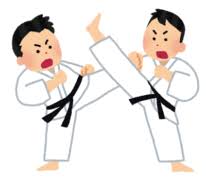
力戦奮闘
riki.sen.fun.tou

Literally: power – battle – invigorated – fight

Alternately: Fighting as hard as you can. By extension, working as hard as you can. Strenuous effort.

RikiSenKaraTe

I’m mostly sure you can 力戦奮闘 even without an opponent, but this is pretty cute!

Posted in Japanese, Yojijukugo | Tagged , , , , | Leave a comment

When birds make you of a feather

Any reference to communism exist solely in the mind of the reader

朱に交われば赤くなる
(Shu ni majiwareba akaku naru;
Who associates with vermilion will turn red”)

Definition:

People change to match their environments, for better or for worse. You grow to be like the people you associate with, so be careful when choosing your friends and associates. Mostly used in a negative sense, counseling someone to avoid bad influences. Apparently from the stain left on the hands of people who handled dyes.

Breakdown:

We begin with the noun 朱 (shu), which describes the brilliant red made from cinnabar, or by extension any especially vivid red. Next is the directional or locational particle particle に (ni), in this case acting as “with,” followed by the verb 交わる (majiwaru), “to associate [with],” in hypothetical form. The following clause begins with the adjective 赤い (akai), “red,” in conjunctive form. This allows it to connect to the verb なる (naru), “to become,” in sentence-final form.

Notes:

This saying apparently comes from the writings of 3rd Century CE poet Fu Xuan, where it’s part of a longer saying that couples it with a parallel assertion that being close to an ink stick will turn things black.

People misremembering this saying may replace 交わる with 混ざる (mazaru, “to be blended [with]”), or 赤くなる with 赤になる or 朱色になる (aka ni naru or shuiro ni naru). All of these are considered errors.

Example sentence:

朱に交われば赤くなることを恐れて、庶民を避けて貴族としか関わらない芸術家達が闇に手を染める時代であった。

(Shu ni majiwareba akaku naru koto wo osorete, shomin wo sakete kizoku to shika kakawaranai geijutsukatachi ga yami ni te wo someru jidai de atta.)

[It was an era when the artists, fearing that touching pitch would defile them, avoided the common folk and only associated with the upper class – and were corrupted.]

Posted in Japanese, Kotowaza | Tagged , , , , , | Leave a comment