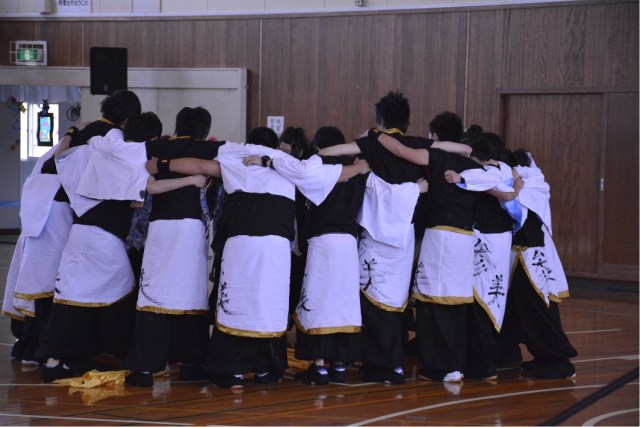
A gathering of silver threads

The Little Mermaid II

百川帰海
hyaku.sen.ki.kai

Literally: hundred – river – return (home) – ocean

Alternately: Things that were scattered or disparate coming together, like how rivers and streams start here and there but all end up in the sea. By extension, a large group of people in accord with each other, especially in terms of feelings or opinion.

Notes: This saying comes to us from the Huainanzi (淮南子, Enanji or Wainanshi in Japanese), a mid-Han-dynasty essay collection.

HyakuSenChiimu

Maybe not a large enough crowd to really illustrate the phrase, but you get the idea.

Posted in Japanese, Yojijukugo | Tagged , , , , , | 1 Comment

But humans turn to face our predators

苛政は虎よりも猛し
(Kasei wa tora yori mo takeshi;
A cruel government is more terrible than a tiger”)

Definition:

The harm done by bad governance is worse than that done by a ravenous tiger. People fear wild nature, but often it poses less of a threat to us than corrupt, broken, or misused human social structures such as tyrannical governments.

Breakdown:

We begin with a relatively rare noun, 苛政 (kasei), “despotism.” The particle は (wa) marks this as the topic of discussion. The comment on this topic begins with the noun 虎 (tora), “tiger,” marked by the particles より (yori), “more than” and も (mo), often “also” but in this case acting as an intensifier, and then the adjective 猛し (takeshi), “harsh,” “fierce,” “violent,” in sentence-final form.

Notes:

This saying comes from a story in the Book of Rites (礼記, Raiki in Japanese), a core Confucian text. Confucius is said to have come across a crying woman. When he asked her what was wrong, she told him that all of her remaining family had been killed by a tiger, one by one: her husband, her children, her father-in-law. When Confucius asked her why she hadn’t moved to a safer area, she replied that this was the only place where they had been free from crushing taxation.

What strikes me is that the message of the words of the saying are incredibly topical: a tiger can’t steal thousands of children from their parents and throw them in concentration camps in the desert in the summer, for example, or strip health care away from millions in order to help plutocrats fund their yachts and private jets. But the origin story is also topical: irrational people so violently averse to taxation that they would rather let their entire family die of something preventable than pay the government a penny more than the bare minimum possible.

Example sentence:

苛政は虎よりも猛しというから、この国からは出て行こう!」

(Kasei wa tora yori mo takeshi to iu kara, kono kuni kara wa dete ikou!!”)

[“They say that tyranny is more terrible than tigers, so let’s get out of this country!”]

Posted in Japanese, Kotowaza | Tagged , , , , , , | 1 Comment

Shouldn’t grow on you

短慮軽率
tan.ryo.kei.sotsu

Literally: short – consider – light – proportion

Alternately: Deciding things without considering the consequences or results. Impulsive; unthinking. Rash.

Notes: This four-character compound comprises compound adjectival nouns 短慮, “imprudence,” “quick temper,” and 軽率, “hasty,” “rash.” The order of these elements may be reversed at times.

TanRyoDaDa

Presidential!

Posted in Japanese, Yojijukugo | Tagged , , , , | 1 Comment

Magic Monday – God-eaters – Shiranuhi

Shiranuhi
(Seafire)

Description: Sometimes, on clear nights, pale lights can be seen hovering low over the waters of the bay as if mirroring the stars in the sky. First a pair, known as the “parents,” appear, off over the sea. These soon divide, and the products of this division also divide, until the horizon is filled with a sparse field of drifting sparks of false fire. They generally first appear in the small hours of the morning, and fade away before the first light of dawn. Seen up close, each of the lights comprises a fuzzy region surrounding a tiny sharp nucleus, a little like a thistle seed and its fluff.

Worshipers: Yes. The fishermen of the bay see Shiranuhi as a benign protector, and pray to it to ameliorate the impact of incoming storms and protect the fish from disease. Sailors have been known to use the lights as a reference point in their navigation. They are used to the curiosity of travelers and will cheerfully talk about the lights; hostile intent will be met with mocking incredulity.

Servitors: Unclear. Neither the “parent” lights nor their “children” behave in meaningfully different ways, and it’s possible that the latter are extensions or reflections of the former rather than anything truly distinct.

Confrontation: None of the lights are affected by anything material. Even magical effects, if they produce light, are simply absorbed and cause the Seafire to further divide and spread until the light it received is evenly distributed across the surface of the sea. That said, Shiranuhi has obfuscation as an effective defense: it appears in random locations at random times and within a minute or two will have begun to divide. Effective attacks against the “child” lights will force them to disappear, so the objective of any attacker will be to find and subdue the “parents” before they fade out in the predawn darkness.

Aspect: Barium, light, geometry. Those present at defeat boost Perception (Sight) and Int.

Powers – Tier 1: The character can levitate an arm’s length above the ground (or water, etc.) at will; this causes them to glow faintly. If they focus, they can waft laterally at a slow walking pace.

Powers – Tier 2: While levitating, the character may brighten their glow enough to illuminate a room, darken it entirely, become invisible and intangible for as long as they concentrate, or even teleport across an area at the cost of one point of fatigue.

Powers – Tier 3: The character may create duplicate images of themselves, up to their Int score in number. While these images tend to “dither” in the area, milling around and vaguely mimicking the original’s motions, they are visually indistinguishable from their source, and by focusing on one the character may control its actions at will.

Powers – Other: The character always can sense the direction of the pole star, and may confer this sense to anyone else in their presence.

Example Checks: Anyone who has absorbed part of the Seafire’s essence must check Humanity to avoid being drawn to things that resemble themselves – portraits, accidental likenesses, and so on. (The difficulty of the check should depend on how close the likeness is.) Characters who fail such a check will be distracted by the similarity for at least a couple of rounds, and if failing the check by an order of magnitude, they will gain the urge to possess or associate with the item or person. The character also becomes uneasy in crowds and must check Humanity at base difficulty d6 for about ten people, with the difficulty rising one step for each order of magnitude more. On a failure, the character must either seek solitude or surround themselves with familiar objects in order to regain their composure.

Notes: Based on this bit of real-world folklore. I’ve been there!

Posted in Rules, Setting, World-Building | Tagged , , , , | Leave a comment

Don’t work for the man, man

Rarely truer than now

すまじきものは宮仕え
(Sumajiki mono wa miya-dzukae;
“The thing one mustn’t do is serve at court”)

Definition:

If possible, it’s best not to let yourself be used by other people. It’s best to be your own boss instead of serving at the beck and call of others. Originally this phrase referred to “government” service in the imperial household, but nowadays it can also be used to extol the freedoms of self-employment over working for a company.

Breakdown:

We begin with the verb す (su, kanji 為 although this saying seems to use mostly kana), “to do,” in sentence-final form, which allows it to take the negative-probability or negative-obligation suffix まじ (maji), which in turn appears in prenominal form (as majiki), i.e. “shouldn’t.” The following noun is もの (mono), probably “thing.” The particle は (wa) marks all of the above as the topic, and what follows is the comment: noun 宮 (miya), “imperial residence,” coupled with verb 仕ふ (tsukau), “to serve.” Oddly, 仕へ (仕え in modern orthography) would be either the imperfective or the conjunctive form. I’m not sure which it is (or if it’s something else, although it does seem to be acting as a noun) or why it ended up like that. But in any case 宮仕え is a set phrase referring to service in the imperial household.

Notes:

A variant replaces the opening noun phrase with さすまいもの (sasumai mono), but trying to use すさまじきもの (susamajiki mono) is an error. Similarly, replacing 仕え with 遣い (tsukai), “errand(-runner),” “~user” is an error.

Example sentence:

「自分のレストランを経営しているといろいろ苦労があるけど、サラリーマンの頃に比べたら人生のバランスはよく取れていると思う。すまじきものは宮仕えだな」

(“Jibun no resutoran wo keiei shiteiru to iroiro kurou ga aru kedo, sarariiman no koro ni kurabetara jinsei no baransu wa yoku toreteiru to omou. Sumajiki mono wa miya-dzukae da na.”)

[“A lot of things are hard when you’re running your own restaurant, but I feel like my life balance is better than when I was a company man. I guess ‘he is not free who serves others.’”]

Posted in Japanese, Kotowaza | Tagged , , , , | Leave a comment

The playground of Tengu!

天上天下
ten.jou.ten.ge

Literally: heavens – up – heavens – down

Alternately: The world above the sky (the heavens) and the world below the sky (the earth). Also, the space between heaven and earth. The whole world.

Notes: Reading 下 as ge instead of ka is somewhat unusual; this use of the “Wu sound” marks the phrase’s antiquity and ties in with its Buddhist origins.

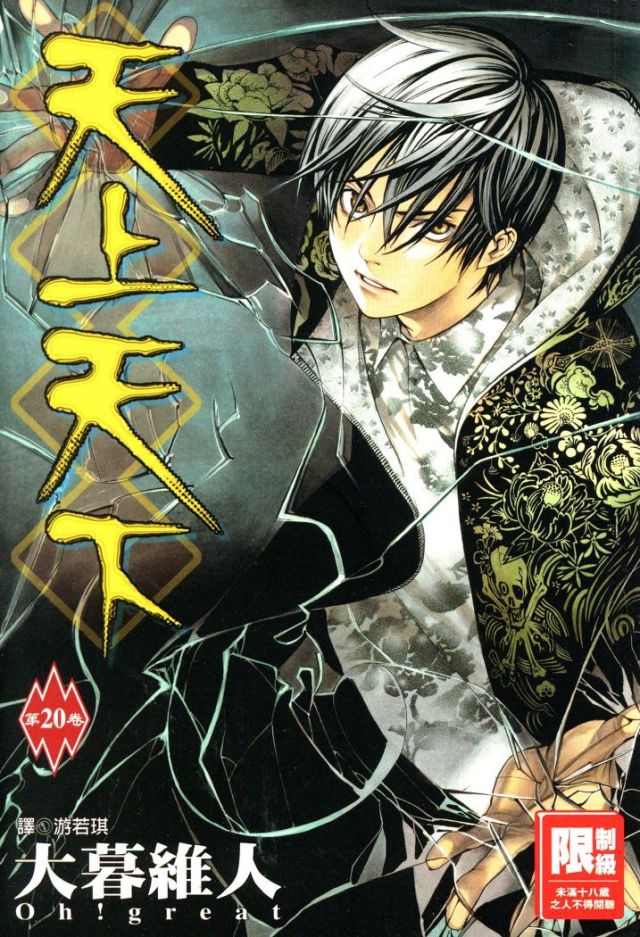
This phrase apparently sees less usage on its own than its partner 唯我独尊, or compounds with comparable meanings like 有象無象 or 森羅万象, but it sure did get made into a manga about… supernatural punching, I think? And swords and stuff.

TenJouTenGeManga

Note the lower right-hand corner: it’s an R-rated (NC-18, technically) fight manga.

Posted in Japanese, Yojijukugo | Tagged , , , , , , | 2 Comments

Birds of any feather care for kids together

Don’t be the kind of sordid villain that drives parents to this level of protective sacrifice. Don’t allow that kind of villain to hold any power over others. Think of the children.

焼け野の雉子夜の鶴
(Yakeno no kigisu yoru no tsuru;
The pheasant in a burning field, the crane at night”)

Definition:

This phrase is used to express the deep affection of parents for their children. The pheasant is said to protect and guide its children to safety instead of simply fleeing for its own life even if the field they nest in is on fire, while the crane is said to spread its wings to shelter and warm its young on cold nights instead of conserving its body heat.

Breakdown:

We begin with the noun 雉子 (kigisu), an archaic term for what is now more commonly known as the kiji – the Japanese pheasant. The associative particle の (no) connects it with the noun 野 (also no), “field,” which in turn is modified by the verb 焼く (yaku), “to burn,” in prenominal form. The next noun phrase in this simple pairing is 鶴 (tsuru), the Japanese crane, placed by another の in the 夜 (yoru), “night.”

Notes:

It’s also perfectly acceptable to write yakeno as simply 焼野, or kigisu as 雉, without any change in meaning or pronunciation. Some variants separate the two noun phrases with a comma.

Example sentence:

焼け野の雉子夜の鶴のような親が理想なのに、私は叱りすぎなんじゃないかと時々不安になるよね」

(Yakeno no kigisu yoru no tsuru no you na oya ga risou na no ni, watashi wa shikari sugi nan ja nai ka to tokidoki fuan ni naru yo ne.”)

[“The ideal is to be a loving and protective parent like the pheasants in the field or the crane at night, but sometimes I worry that I nag my kids too much.”]

Posted in Japanese, Kotowaza | Tagged , , , , , | Leave a comment

Written on the 4th of July

(I searched for phrases using 独 because of the 独立記念日.)

唯我独尊
yui.ga.doku.son

Literally: only – self – alone – precious

Alternately: Thinking that oneself is the best in the world. Being so self-assured that you don’t listen to anyone else. Conceit. Vainglory. Arrogance.

Notes: This compound may be paired with 天上天下 (which I thought I’d written a post on, but apparently not yet!), and apparently both come to us from the Dīrgha Āgama (長阿含経, Jou agonkyou in Japanese). It’s written that the Buddha (Shakyamuni) emerged suddenly from his mother’s side, took seven steps in each of the four cardinal directions, pointed to the earth and sky, and declared 天上天下唯我独尊. I suppose if you’re a newborn baby and yet already capable of walking and talking on your own, that level of self-importance may be a bit justified, but the rest of us should probably practice a bit of modesty. And despite this exalted origin, the phrase tends to be used to criticize someone’s unwarranted yet overweening pride.

YuiGaShaka

High or low, east or west, talking babies are the best!

[Image by ASUKAEN (Public domain), via Wikimedia Commons]

Posted in Japanese, Yojijukugo | Tagged , , , , , , | 1 Comment

Nor trying at plying

All the songless birds can fly, though

鳴かず飛ばず
(Nakazu tobazu; “Nor crying nor flying”)

Definition:

Quietly waiting one’s chance. Doing nothing for a long time, but with the specific intention of taking action as soon as the opportunity finally comes.

Breakdown:

This simple phrase comprises two verbs, in forms that look identical but are technically different grammatically. The first verb is 鳴く (naku), a catch-all verb for animals making noise and thus translatable as “chirp,” “call,” “cry,” “bark,” etc. It appears in imperfective form with negative suffix ず (zu) in conjunctive form. The next verb is 飛ぶ (tobu), “to fly,” also in imperfective form and followed by negative suffix ず… but in this case the zu can be seen as appearing in either conjunctive or sentence-final form.

Notes:

This saying comes to us from the 史記 (Shiki), the Records of the Grand Historian. Its original Japanese form apparently prefaced the verbs by specifying that the waiting took 三年 (sannen, “three years”), and some versions flip the order of the verbs.

The story goes that in the Warring States Period, king Zhuang of Chu paid no attention to affairs of state for a full three years after taking the throne, and in fact threatened to have anyone who tried to get him to change his ways killed. Wu Ju – who was acting as regent – came to him with a riddle, asking “What kind of bird is it that doesn’t call and doesn’t fly for three years?” The king got the point, dismissed the regent, and set about doing his job.

From this we get the meaning of “doing nothing,” while the part about biding one’s time seems to have been a later addition or extension.

Example sentence:

「エド君は大学卒業から三年飛ばず鳴かずけど、機会を待っているのか、引きこもり生活に陥っているのか分からなくて、ちょっと心配だ」

(“Edo-kun wa daigaku sotsugyou kara sannen tobazu nakazu kedo, kikai wo matteiru no ka, hikikomori seikatsu ni ochiitteiru no ka wakaranakute, chotto shinpai da.”)

[“Ed hasn’t really done anything for three years since graduating college. I can’t tell whether he’s waiting for his chance or just falling into a shut-in lifestyle, so I’m kind of worried.”]

Posted in Japanese, Kotowaza | Tagged , , , , , | Leave a comment

Reverse the order for Biblical time

Something birds, something stones?

一朝一夕
i-.cchou.i-.sseki

Literally: one – morning – one – evening

Alternately: A single day. By extension, a brief and fleeting span of time. Often used in a negative structure to express that something can’t be done in (such) a small amount of time.

Notes: This compound comes to us from the I Ching (易経, in Japanese Ekikyou).

In a variant, the character 朝 is replaced with 旦 (tan), “daybreak.” Meanwhile, while 夕 can often be read as yuu, doing so in either variant of this compound is considered an error.

ICchouDaietto

From this site, which tries to be cute by saying that the commonality between diets and asset management is that they both can’t be done in 一朝一夕.

Posted in Japanese, Yojijukugo | Tagged , , , , , , , | Leave a comment