Waft your way to a win?

身を捨ててこそ浮かぶ瀬もあれ
(Mi wo sutete koso ukabu se mo are;
“There are rivers that you cross by throwing away your body”)

Definition:

Sometimes facing danger head-on is the only way to escape it. There are times when you need to be willing to take a risk in order to deal with a situation. Similar to “nothing ventured, nothing gained,” but the goal is often survival or avoiding some bad result rather than pure profit. A drowning person’s struggles may only make their situation worse; the image is of floating to the surface and escaping by relaxing and entrusting one’s body to the water instead of by fighting it.

Breakdown:

We begin with the noun 身 (mi), “body,” marked as the object of a verb by the particle を (wo). The verb is 捨つ (sutsu), “to throw away,” in conjunctive form, with the perfective suffix つ (tsu), also in conjunctive form. This verb phrase is in turn followed by emphatic particle こそ (koso). The following clause begins with the verb 浮かぶ (ukabu), “to float,” in prenominal form, attached to and modifying the noun 瀬 (se), often used to refer to the “shallows” of a river (the part where you ford it), but in this case possibly referring to the “rapids.” In either case, se is marked by the particle も (mo), here serving to emphasis that “this kind of river-part does also exist.” And finally we get the verb あり (ari), “to be,” in perfective form.

Why is the final verb in perfective form instead of sentence-final form? Well, it turns out that in classical grammar, this was just kind of how you did it following koso, in effect using an unusual form at the end of the sentence to remind the reader/listener of the emphasis and focus from earlier.

Notes:

If you watch enough semi-realistic anime fights, you’ll probably notice this trope in action: rushing into the opponent’s space without hesitating is a dangerous move, but when used properly it can give an advantage or at least lessen the strength of the opponent’s attack where holding back (i.e. failing to “throw away the body”) would have resulted in being struck down.

There’s another saying that references fords, 立つ瀬がない (tatsu se ga nai), meaning that someone has lost face or is in a troublesome situation. Naturally, mixing these up and saying 身を捨ててこそ立つ瀬もあれ is an error.

This saying is descended from a 1632 kanazoushi called 尤双紙 (Mottomo no soushi).

Example sentence:

「空手は身を守るための運動だと言っても、打ち技を受ける心構えがなければ勉強にならん。つまり、身を捨ててこそ浮かぶ瀬もあれということだ」

(“Karate wa mi wo mamoru tame no undou da to itte mo, uchiwaza wo ukeru kokorogamae ga nakereba benkyou ni naran. Tsumari, mi wo sutete koso ukabu se mo are to iu koto da.”)

[“You can call karate a kind of exercise that protects your body, but if you’re not prepared to take a blow then you won’t be able to learn. In other words, it’s only by passing through danger that you reach safety.”]
Posted in Japanese, Kotowaza | Tagged , , , , , , , , | Leave a comment

Cosmic triage

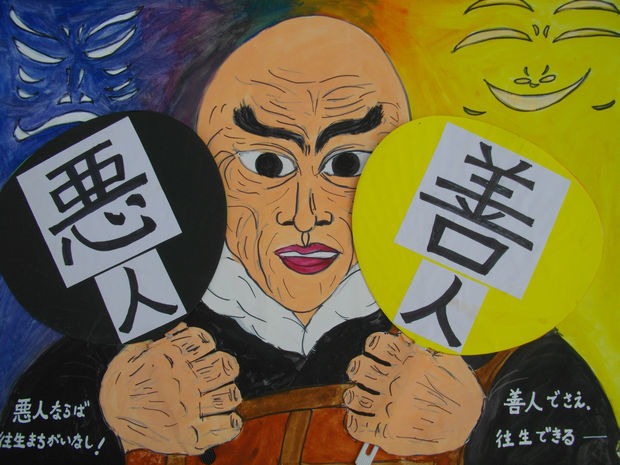
悪人正機
aku.nin.shou.ki

Literally: evil – person – correct – loom / machine

Alternately: No matter how evil a person is, the Buddha’s wish is for them to be saved. Or perhaps, the worse a person is, the more important it is for them to be saved. It is better to take evil and turn it toward good instead of simply fighting or condemning it. A Buddhist teaching that salvation is better than destruction. (Maybe Christians should consider adopting it.)

Notes: The term 正機 is a bit of Buddhist jargon that refers to the conditions and qualities necessary to achieve enlightenment, or at least to receive the Buddha’s aid and teachings and become a good person. According to the teachings of Pure Land Buddhism, the people with heavy loads of karmic sin are those for whom the Buddha’s teachings are most appropriate.

This compound comes to us from the third chapter of the Lamentations of Divergences, (歎異抄, Tannishou) a record of conversations between the Pure Land sect’s founder and one of his disciples, somewhat reminiscent of Socrates and Plato.

Reading 正 as sei or writing the ki as 気 are both considered errors.

AkuNinShouKiIrasuto

It’s interesting to think that this is a system where being reborn is the bad option.

Posted in Japanese, Yojijukugo | Tagged , , , , , , , | Leave a comment

Not just hermits

Buddhist tzaddikim?

仏千人神千人
(Hotoke sennin kami sennin; “A thousand Buddhas, a thousand gods”)

Definition:

The world may be full of bad people, but there are also many good people as well, including people good enough to be compared to bodhisattvas or benevolent deities.

Breakdown:

This simple noun phrases comprises a doubled use of the number-noun 千人 (sennin), “one thousand people.” The first use follows the noun 仏 (hotoke), “Buddha,” or a kind and enlightened person with the Buddha-spirit; the second follows 神 (kami), “god.”

Notes:

Compare and contrast with a similarly optimistic oni-focused saying from a while back.

My sources say that 千人 is used to suggest “a large number of people,” but it’s worth noting that there also seems to be a concept of 千仏 (senbutsu, “one thousand Buddhas,”) according to which there were / are / will be a thousand Buddhas over the course of the three past, present, and future kalpas of cosmic time. Let me stress that this isn’t a definite causal connection, but rather an interesting correspondence. Those interested in investigating further can check the source, a late 18th-century CE sharebon called the 太平楽巻物 (Taihei raku no makimono), by Morishima Churyo.

Some versions may include a comma between the two halves.

Example sentence:

「最近のニュースは鬼のような悪人たちの悪事ばっかりで、落ち込んじゃいそう。この世は仏千人神千人もいるのを忘れないように頑張らなくちゃ」

(“Saikin no nyuusu wa oni no you na akunin-tachi no akuji bakkari de, ochikonjaisou. Kono yo wa hotoke sennin kami sennin mo iru no wo wasurenai you ni ganbaranakucha.”)

[“The recent news has been a parade of evil deeds by demonically evil people, and I feel like I’m going to fall into a depression. I have to make sure to not forget that there are also plenty of saints.”]

Posted in Japanese, Kotowaza | Tagged , , , , , | Leave a comment

A day for lying in

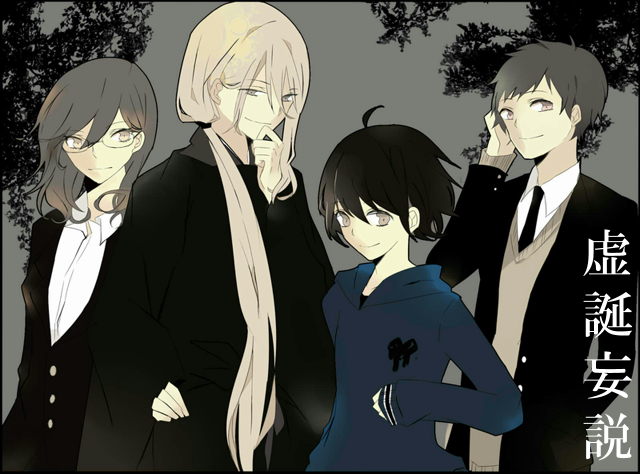
虚誕妄説
kyo.tan.mou.setsu

Literally: empty – birth / arbitrary – delusion – explanation

Alternately: Groundless remarks. False statements. Talking nonsense; making irresponsible comments; shooting off at the mouth.

Notes: This is another two-two-character-compound-compound: 虚誕 refers to not just falsehoods but exaggerated falsehoods, while 妄説 refers to unsupported assertions or false claims. The latter term can be pronounced bousetsu when used on its own, but not in this four-character compound.

This usage of 誕 is a bit of a revelation to me, actually – it’s almost only ever used in modern Japanese as part of the term 誕生 (tanjou), “birth.” Apparently the combination of 言, “word,” and 延, “extend” originally meant “words that extend beyond reality” – i.e. a falsehood. It can also mean “(speaking of) things as one wants them to be (rather than how they really are),” and at this point we have to be careful because the folk etymologies bridging the gap to “birth” practically jump at you… but assuming them to be true without in-depth research would just be another case of 虚誕妄説!

KyoTanGeeMu

Apparently also the name of a (fake) game whose (fake) development was announced on April Fool’s Day one year.

Posted in Japanese, Yojijukugo | Tagged , , , , , , | Leave a comment

Wer anderen eine Grube gräbt

fällt zusammen hinein?

人を呪わば穴二つ
(Hito wo norowaba ana futatsu; “If you place a curse, [dig] two holes”)

Definition:

If you try to harm others, harm will come (back) to you. More literally, if you curse someone to death, their dying grudge will afflict and kill you in turn, so that your initial malevolence results in two graves being needed. “Curses, like chickens, come home to roost.”

Breakdown:

We begin with the noun 人 (hito), “person,” marked as the object of a verb by the particle を (wo). What acts on the person is the only verb present: 呪う (norou), in imperfective form with the hypothetical particle ば (ba) attached. This is followed by a noun phrase comprising noun 穴 (ana), “hole,” and number 二つ (futatsu), “two.” We can imagine some elided final verb to make a complete sentence, but usage examples suggest that the whole saying is commonly used as a noun phrase.

Notes:

Making the “holes” (穴) explicitly graves (墓, haka) is considered an error. On the other hand, it’s okay to use the perfective form 呪え with the conditional ば instead of imperfective and hypothetical – in other words, it’s okay to say “when” rather than “if.”

This phrase comes to us from the Ise Monogatari, a Heian-era narrative poetic collection.

Example sentence:

「止めろ!たとえ敵を討っても、彼奴の味方が復讐をしにやってくるだけなんだ。人を呪わば穴二つだよ」

(“Yamero! Tatoe teki wo utte mo, aitsu no mikata ga fukushuu wo shi ni yatte kuru dake nanda. Hito wo norowaba ana futatsu da yo.”)

[“Stop! Even if you strike down your foe, his allies will only come for revenge. If you go to kill someone, dig your own grave too.”]

Posted in Japanese, Kotowaza | Tagged , , , , , , , , | Leave a comment

More likely when the person at the center is rotten

朝蠅暮蚊
chou.you.bo.bun

Literally: morning – fly (the insect, not the verb) – evening – mosquito

Alternately: A troublesome situation or gloomy atmosphere caused by an assemblage of narrow-minded, trivial people. Like being surrounded by clouds of flies in the morning and clouds of mosquitoes in the evening.

Notes: This delightfully insulting image comes to us from the collected poems of Han Yu (韓愈, in Japanese Kan Yu), whom we’ve seen before.

The “fly” character can be written as 蠅 (old form) or 蝿 (new) without any especial difference.

ChouYouKaRen

Found in the title of episode 34 of an obscure anime about… delinquent teenage girls with psychic powers?

Posted in Japanese, Yojijukugo | Tagged , , , , , , | Leave a comment

Has, shoots, and leaves

雨後の筍
(Ugo no takenoko; “Bamboo shoots after the rain”)

Definition:

The same thing, or similar things, popping up one after another. Repetition. Recurrence. Like a profusion of bamboo shoots sprouting after the rain. Like mushrooms after the rain, in Western parlance.

Breakdown:

This simple idiom is a noun phrase. It begins the adverbial noun 雨後 (ugo), “after the rain.” The associative particle の (no) marks it as connected to and modifying the noun 筍 (takenoko), “bamboo shoot.”

Notes:

Apparently some people interpret this phrase as referring to speedy growth, but this is considered an error.

Takenoko may also be written using better-known characters, as 竹の子.

Example sentence:

「最近、汚職スキャンダルが雨後の筍みたいに頻繁に顕れているような気がする」

(“Saikin, oshoku sukyandaru ga ugo no takenoko mitai ni hinpan ni arawareteiru you na ki ga suru.”)

[“I feel like recently, corruption scandals have been cropping up nonstop, like mushrooms after the rain.”]

Posted in Japanese, Kotowaza | Tagged , , , , | Leave a comment

A dangerous game when your name starts with “hundred”

I guess birds are illiterate?

百舌勘定
mo.zu.kan.jou

Literally: hundred – tongue – compare – determine

Alternately: Arranging things so that others end up paying your costs for you. Especially at a restaurant, manipulating the bill in a way that divides your own expenses among your partners so that you don’t have to pay anything yourself. Similar to acting presidential, but through one’s own cleverness rather than through borrowing the brains of an army of unethical accountants.

Notes: The 百舌 is actually the bull-headed shrike, supposedly so-named for its frequent calls. 勘定 is the act of settling a bill.

This compound is said to be based on a story in which the shrike, after buying food together with a sandpiper and a dove, talks them into paying the whole bill – essentially by playing on their names. They had a bill (pun intended) of 15 mon. In Japanese sandpiper is 鴫 (shigi), which starts with the same sound as 七 (shichi), “seven,” while dove is 鳩 (hato), which starts with the same sound as 八 (hachi), “eight.” The sandpiper paid seven, the dove paid eight, and the shrike walked away without paying a single coin.

Additional trivia: There’s an ancient tomb complex in Osaka prefecture named 百舌鳥古墳群 (Mozu Kofungun); note that here the name mozu includes the character 鳥, “bird,” without any change in pronunciation.

MoZuKanToku

I couldn’t find anything really illustrative of the compound itself, so here’s a photo of the male 百舌鳥; source in lower right.

Posted in Japanese, Yojijukugo | Tagged , , , , , , , | Leave a comment

Paul Ryan’s next plan for American health care

Nah, it would still cost rich people a bit of money.

二階から目薬
(Nikai kara megusuri; “Eye medicine from the second floor”)

Definition:

A frustrating situation where things don’t go as you want. Alternately, a roundabout way of doing things that doesn’t produce satisfactory results. Like trying to give somebody eye drops by dripping them from the second story of a building while they’re standing at street level.

Breakdown:

This noun phrase consists of the number-counter 二階 (nikai), the second floor of a building, marked by the particle から (kara), “from,” as being the origin of some motion or action, and compound noun 目薬 (megusuri), “eye medicine,” i.e. eye drops. One can imagine a verb, and or the phrase ように (you ni), “like,” but any such additions have been elided and are not used in modern Japanese.

Notes:

Apparently some people miss the point by assuming that the eye medicine manages to get into the eyes properly, and end up interpreting this phrase to mean “a lucky shot,” “a fluke success.” This is an error.

One variant phrase replaces the second story with 天井 (tenjou), “ceiling.” (I find myself imagining Spider-man.) A more obscure one replaces the eyedrops with 尻炙る (shiri aburu), “to warm one’s butt,” with the image of trying to warm oneself in the winter at a fire one floor below.

This is the に entry of the Kyoto iroha karuta set.

Example sentence:

「兄貴が姪っ子達を説得してみても、子供の心のわからない兄貴にはやっぱり二階から目薬だった。ちょっと失笑せざるを得なくて、兄貴を怒らせちゃった」

(“Aniki ga meikko-tachi wo settoku shite mite mo, kodomo no kokoro no wakaranai aniki ni wa yappari nikai kara megusuri datta. Chotto shisshou sezaru wo enakute, aniki wo okorasechatta.”)

[“My older brother tried to convince our nieces, but he doesn’t understand how kids think, so of course it didn’t go anything like how he expected. I couldn’t help laughing out loud, and kind of made him mad at me.”]

Posted in Japanese, Kotowaza | Tagged , , , , , | Leave a comment

Setting Idea: The Pious Barbarians

Fantasy literature and gaming are full to the brim with main characters living on the outside of some almost unbelievably advanced civilization that they only catch glimpses of through a handful of its members and artifacts. A few examples, just off the top of my head:

  1. Tolkien’s Middle Earth. The hobbits barely catch a glimpse of the mighty kingdoms of Lothlorien and Gondor, which are themselves pale reflections of the might and splendor of Valinor and Númenor.
  2. Steven Brust’s Dragaera series has Dragaerans – essentially Tolkienian elves – whose magic and culture are largely a mystery to the merely-human main character… but  also the Serioli, whose culture is multiple steps further advanced, in that they’re the ones who created the Dragaerans.
  3. The Dragonlance setting features the lost empire of Istar, with the original campaign setting taking place in a world still recovering from “the Cataclysm” in which Istar didn’t so much fall as get itself erased from the map
  4. Lovecraft’s fiction is full of alien races with technology so advanced that humans register it, not even as magic, but as pure madness.

But in this case, my inspiration isn’t an empire too long ago or far away for the players to access; it’s just up the river from the central setting. In this case, I’m thinking of Failbetter Games’ Fallen London world, in which London has, well, fallen… into a vast underground cavern only a short distance away from Hell. They’re close enough that devils come to the city to do business; close enough that London launched a (brief and ill-fated) invasion.

There’s a bit of a twist to the “devils” that I won’t reveal here – suffice to say that they’re based on more than just Dante – but what I want to focus on now is the fact that access to their resources is limited less by time and distance, or by the limits of human understanding as with Lovecraftian tech, than it is by human attitudes. So here’s a possible setting twist for your tabletop RPG:

The PCs are all “the barbarians.” There’s a neighboring civilization with overwhelmingly advanced technology and/or magic, but the players are only able to access a tiny sliver of this through adventuring or trade. A few conditions seem necessary to make this really work:

  • The neighboring civilization isn’t interested in conquest. Other than a little trade and meddling, mostly for their own amusement, they keep to themselves.
  • They don’t tolerate shenanigans, though. Any attempts at raiding, whether through violence or stealth, are met with efficiently and dispassionately ruthless countermeasures.
  • The PCs’ home culture(s) view this Empire as not just dangerous, but taboo. It’s not unheard-of for members of the two cultures to interact, but it is frowned on.
  • This taboo is enforced mechanically within the game system. Perhaps the Empire is something alien and getting too closely involved will actually cost Humanity, as in the “god-eaters” campaign concept. Perhaps it costs Sanity, if you use a Sanity mechanic.

One idea along these lines that particularly strikes my fancy is the idea of a Piety mechanic. Every character has a Piety score, perhaps with initial level depending on their class and/or background, and able to be boosted a bit (at least temporarily?) by performing whatever their religion deems to be acts of faith or good works. Meanwhile, interacting with members of the Empire, or using any of its artifacts, causes Piety to bleed away, or loads the scales against it with Impiety or Corruption points.

The main consequence of this would probably be reduced efficacy of (helpful) clerical powers. In a D&D-style system, either receiving helpful magic or healing requires a successful Piety check, or perhaps we flip things and have Impiety / Corruption levels be subtracted from the apparent caster level of the friendly cleric for purposes of beneficial spellcasting. In a devotions-and-boons type system, either a check as above, or specific devotions would be required to work off the Impiety.

If done right, this could add an interesting dimension of choices to the game. How much time do the characters want to devote to their Piety in order to maximize the gifts of their gods? How much corruption are they willing to take on in order to get their hands on a powerful artifact, if only for the duration of the current mission? What happens when an agent of the Empire contacts them directly to trade for something they have that it wants?

Even if there isn’t an especially deep impact on the play experience, this kind of setup can still add interesting flavor to the game world. It would fit well if you want a backdrop of near-godlike elves or Lovecraftian aliens, a monolithic Church, or even just another quirk to the traditional good-vs.-evil or law-vs.-chaos alignments. Finally, it would make for an interesting experience to later flip the campaign on its head to play as members of the Empire, loaded with high technology or magic and forced to deal with intrigue and delicate social interactions in a setting where the neighbors are hostile, but you’re not allowed to hurt or threaten them unless they attack first.

Posted in Miscellaneous, Rules, World-Building | Tagged , , , | Leave a comment