Scattered in the winds

I’m surprised it took me this long to get around to this one….

支離滅裂
shi.ri.metsu.retsu

Literally: branch – separate – destroy / perish – tear apart

Alternately: The things someone says, or writes, or says and does, make no sense. No logic, no order, no consistency, no coherence, no connections, no content. Scattershot; arbitrary; unreliable; self-contradictory. Things fall apart under even the slightest inspection.

Notes: This yojijukugo is formed by attaching two two-character compounds of related meaning in order to emphasize their content through repetition. Made all the more appropriate as commentary on the current administration because shiri (as the kanji 尻) means “butt.”

ShiRiGaoYaku

The falcon will not hear the falconer

Posted in Japanese, Yojijukugo | Tagged , , , , , | 3 Comments

Obamacare feedback PSA

So it turns out that the White House is soliciting negative “Obamacare stories,” perhaps in the belief that unverified rumors scavenged online count as some sort of meaningful data. You too can go here and tell them about your experience with Obamacare, or at least with the US health care system, which presumably they will pretend to take into consideration as they barrel recklessly forward with a universally-hated bill that would dramatically raise health-insurance prices for most Americans and according to the CBO, eject 24 million people out of insurance altogether… in order to help the super-rich become even more so.

Disclaimer: I strongly recommend that if you tell them a story that you use a throwaway email account, because obviously a subsidiary purpose of the site is to build a mailing list. Making a point to those in power shouldn’t necessarily have to mean you’re agreeing to be spammed by malicious idiots.

Anyway, here’s my Obamacare “horror story.” I hope I laid the sarcasm on thick enough that someone in there was clever enough to detect it.

My wife and I are graduate students, struggling to get by on a graduate student stipend while also raising a toddler. We managed to get him into a daycare, but of course he kept on bringing home diseases. Fortunately, thanks to Medicaid, we were able to get him covered for free instead of needing to break the bank or do without medical care.

But even as we lived this debauched lifestyle of regular checkups and our own pediatrician, I couldn’t help worry about how un-American it all was. It was practically European in feel, and I lived constantly in terror at the idea that one day I’d wake up and find that being so damn socialistic had turned all my clothing red.

One time a cut on my son’s toe got infected and I was able to take him in for prompt inspection and a cheap antibiotic instead of waiting until it was necrotic and then clogging up the ER with a stinking dead chunk of foot that needed to be amputated, which is the true American way for anybody making less than median wage. And ever since then my nights have been shattered by unstoppable dream-visions of how my selfish desire to be treated as a human being, with medical needs, deprived some poor insurance-company executive of his second yacht, or deprived some bigoted know-nothing proto-facist of his desire to be better than a black man who is his superior in literally every way.

Finally, we have people who are willing and able to replace that nightmare of preventative medicine, financial solvency and human dignity with a true-blue American dream of necrotic decay, inescapable debt, and irrational hatred.

Meanwhile, the Democrats apparently have a single-payer system proposed that would provide coverage for all Americans while costing $1.8 trillion less. The fact that something is on the table that would help the vast majority of Americans (and the ones it wouldn’t help, are rich enough to take the hit) should be food for thought for anyone trying to find an actually-better alternative to the ACA.

Posted in Nonfiction | Tagged , , | Leave a comment

The original campsite rule

立つ鳥跡を濁さず
(Tatsu tori ato wo nigosazu; “The bird taking flight doesn’t muddy its tracks”)

Definition:

When you leave a place, don’t leave it a mess – leave it at least as pristine as the condition you found it in. Clean up after yourself when you go home. Leave things better than how you found them.

Breakdown:

This saying is a full sentence. The subject (albeit unmarked by any particle) is (tori), “bird,” modified by the verb 立つ (tatsu) – often “to stand,” but in this case “to take flight,” in prenominal form. The sentence’s direct object – as marked by the particle (wo) – is , “trace,” “mark,” “footprint,” etc. And the verb that (isn’t) done to this object is 濁す (nigosu), “to roil,” “to muddy.” This verb appears in imperfective form with the negative suffix (zu) in sentence-final form.

Notes:

The specific image is of a wading waterfowl such as a crane, taking off to fly without kicking up mud from the bottom and dirtying the water in its wake.

Some versions replace 立つ with the more prosaic 飛ぶ (tobu), “to fly,” or 濁さず with 汚さず (yogosazu), “(don’t) make dirty.” One version specifies that the bird is a heron, (sagi).

This saying is also attributed to the Kefukigusa.

Example sentence:

立つ鳥跡を濁さずで、花見が終わったらちゃんとゴミを拾うの忘れないようにね」

(Tatsu tori ato wo nigosazu de, hanami ga owattara chanto gomi wo hirou no wasurenai you ni ne.”)

[“Like the bird that takes flight without muddying the water, let’s not forget to pick up the trash properly once the flower-viewing has ended.”]

Posted in Japanese, Kotowaza | Tagged , , , , , , , | 2 Comments

Not “an idle and most false imposition,” for once

一体何者なんだ!?

名実一体
mei.jitsu.it-.tai

Literally: name / reputation – reality – one – body

Alternately: A thing is as it is said to be. The truth of a matter matches its reputation. Title and substance are as one. For example, when a famous storyteller really can captivate an audience, or when a man said to be an incompetent pathological narcissist turns out to actually be an incompetent pathological narcissist even after being given lots of power and responsibility, instead of magically “pivoting” into the dignity of the office.

Notes: There are several non-yojijukugo variants of this phrase, such as 名実共に (meijitsu tomo ni), “reputation and substance together” and 名実相伴う (meijitsu aitomonau), “reputation and substance accompany each other.”

MeiJitsuKuruma

Whatever they said about this car, it sure looks like it’s true!

Posted in Japanese, Yojijukugo | Tagged , , , | 1 Comment

Fake it ’til you can make a break for it?

虎の威を借る狐
(Tora no i wo karu kitsune; “a fox borrowing a tiger’s menace”)

Definition:

A person without much personal authority, power, or menace, such as a child or servant, acting high and mighty due to their association with someone who has real power. Borrowing the influence of others.

Breakdown:

This noun phrase comprises two nouns – an object and a subject – and a verb. The primary noun is (kitsune), “fox.” It’s modified by the verb 借る (karu), “to borrow,” in prenominal form. The thing being borrowed is (i), “dignity” or “menace.” This noun is marked by the associative particle (no) as belonging to (tora), “tiger.”

Notes:

借る (often , kariru, in modern Japanese) may be written as 藉る – a rare character that in this usage yields identical pronunciation and meaning.

This saying comes from the Chu section of a historical text known as the Strategies of the Warring States, from (when else?) the Warring States period of Chinese history. The text contains a fable about a fox caught by a tiger who convinces the tiger to follow behind him and see how terrified the other animals are of the fox… the other animals flee from the tiger, who is nevertheless tricked into believing that the fox has divine backing and should not be eaten.

Example sentence:

柔道部のキャプテンの弟が低学年の子たちをいじめてるらしい。まったく、あの虎の威を借る狐!」

(“Juudoubu no kyaputen no otouto ga teigakunen no kotachi wo ijimeteru rashii. Mattaku, ano tora no i wo karu kitsune!”)

[“I hear that the judo club captain’s younger brother is bullying the underclassmen. Seriously, hiding behind his big brother like that!”]

Posted in Japanese, Kotowaza | Tagged , , , , , , | Leave a comment

A long dark teatime

of the soul?

暗雲低迷
an.un.tei.mei

Literally: dark – cloud – low – lost

Alternately: A bad or worrying situation, like clouds that look as if they could burst into rain at any moment. A negative situation, such as a recession, that continues with no end in sight. Primarily used to refer to economic or societal outlooks or situations.

Notes: This yojijukugo is another combination of two two-character compounds. “Dark clouds” is probably self-explanatory, but I was surprised to discover that 低迷 is actually a set phrase describing something hanging low and ominous, such as storm-threatening clouds or a prices, i.e. a sluggish economic outlook.

anunaho

Image from an article discussing the threat of economic harm caused by someone’s twits, before Nordstrom “broke the curse.”

Posted in Japanese, Yojijukugo | Tagged , , , , | Leave a comment

No lip-zipping for you

Until and unless you lead by example, perhaps

世間の口に戸は立てられない
(Seken no kuchi ni to wa taterarenai; “You can’t put a door on society’s mouth”)

Definition:

You can’t stop people from talking. You may not like it when people repeat or discuss rumors or criticism (about you), but there’s no way to force them to actually stop.

Breakdown:

We begin with the noun (kuchi), “mouth.” The question of what mouth is answered by joining it to the noun 世間 (seken), “the world” or more specifically “society,” with the associative particle (no). This noun phrase is then marked with the particle (ni) as the location of the following verb phrase.

The verb in question is 立てる (tateru), which can have a wide variety of meanings depending on the context, but which here means “to shut.” The verb appears in negative potential (“can’t”) form. What are we talking about that can’t be shut? A door (, to); specifically a traditional Japanese sliding door, marked by the topic particle (wa).

Notes:

There are many commonly-used variations for this saying. The negative ending may be changed from ない to (nu) or (zu), for example. 世間 may be replaced with (hito), “people,” or 世間のくち with 開いた口 (aita kuchi), “open mouth.” The particles may be changed from to には (ni wa) and from to (ga). And somewhat unusually, since in this context 立てる implies a door being closed, tateru may be written as 閉てる without any change in meaning or pronunciation.

Example sentence:

「あの腐敗政治家は毎日暴れ、記者たちに罵詈雑言を浴びせるが、その汚職が広く知られていく一方だ。世間の口に戸は立てられないことを早く理解すれば自分の尊厳の一かけらを保てるだろう」

(“Ano fuhai seijika wa mainichi abare, kisha-tachi ni barizougon wo abiseru ga, sono oshoku ga hiroku shirarete iku ippou da. Seken no kuchi ni to wa taterarenai koto wo hayaku rikai sureba jibun no songen no hitokakera wo tamoteru darou.”)

[“That corrupt politician rages and hurls abuse at reporters every day, yet knowledge about his corruption keeps on spreading. Perhaps if he realizes quickly that you can’t force people’s mouths shut, he might be able to preserve a shred of his dignity.”]

Posted in Japanese, Kotowaza | Tagged , , , , , , , | Leave a comment

An endless barrel of exposition

博学多才
haku.gaku.ta.sai

Literally: acclaimed – study – many – talent

Alternately: Possessing an extensive store of knowledge and a range of skills. Talented and educated. A “Renaissance man.”

Notes: This is another compound formed by simply joining two two-character words together. Common variants may use (shiki), “knowledge,” in place of either or .

hakugakuhanekawa

“It’s not that I know everything, it’s just that I know that.”

Posted in Japanese, Yojijukugo | Tagged , , , , | Leave a comment

You can try it if you’d like, but…

Before you entrust an important job to someone with zero experience, maybe make sure the stakes aren’t too high.

習わぬ経は読めぬ
(Narawanu kyou wa yomenu; “You can’t recite a Buddhist sutra you’ve never studied.”)

Definition:

Complicated tasks are impossible to perform correctly without study and practice. No matter how much people may say that you should try, don’t expect to succeed at something you’ve never learned about or experienced.

Breakdown:

We begin with the verb 習う (narau), “to learn,” or in this case “to memorize,” in imperfective form with negative suffix (zu) in prenominal form (nu). This allows it to attach to and describe the noun (kyou), “sutra,” and the noun phrase as a whole is marked by the topic particle (wa). (I’d say that here, the carries an implicit contrast with sutras that have been studied.) And the phrase ends with the verb 読む (yomu), “to read (out loud),” in negative potential form.

Notes:

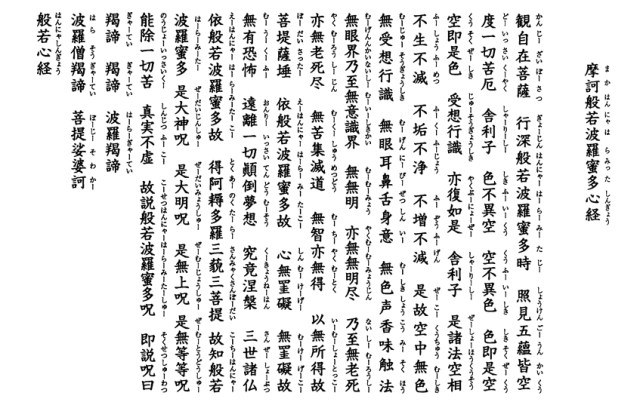
Keep in mind that Buddhist sutras in Japan are not prayers as most Westerners would envision them. Many are still in Sanskrit, for one thing. And the Sanskrit text is represented phonetically with Chinese characters. And even in texts translated into Chinese, the pronunciation is often different from the on-yomi used in most contemporary Japanese pronunciation. It’s as if an American Catholic were trying to pray in Hebrew, but the Hebrew text was presented phonetically, untranslated, in Cyrillic. If you’re lucky you get a Latinate gloss showing you the pronunciation of the Cyrillic text, but it would be ridiculous to expect a random person off the street to read it accurately.

sutra-example-shinkyou

For example, take a look at the Heart Sutra.

This saying is the entry of the Osaka iroha karuta set.

This saying is nominally antonymous with 門前の小僧習わぬ経を読む, “The child before the gate reads sutras they never learned.” I would say that they’re really complementary, though; the child’s case may seem paradoxical, but this seeming contradiction actually serves to highlight the importance of one’s environment – the child at the temple gate learns the sutras by rote without evening noticing simply by hearing them recited all day every day.

Example sentence:

後輩たちに出馬してみたら上手くいくと思いますよ!と促されても、中田さんは「私も習わぬ経は読めぬ」と言い続けて、遠慮した。

(Kouhai-tachi ni shutsuba shite mitara umaku iku to omoimasu yo! to unagasaretemo, Nakata-san wa “Watashi mo narawanu kyou wa yomenu” to iitsudzukete, enryo shita.)

[The underclassmen tried to encourage Nakata, saying they thought things would go well if she tried out for the position. But she declined, repeatedly saying “I can’t do I job I never learned.”]


Posted in Japanese, Kotowaza | Tagged , , , , , , | Leave a comment

The law of cause and fruit

Continuing the theme from Sunday’s kotowaza….

因果応報
in.ga.ou.hou

Literally: cause – fruit / reward – answer – news / reward

Alternately: The law of karma. What goes around comes around. What returns to you is good or ill depending on whether your actions are for good or for ill. Originally a Buddhist phrase that promised reward or retribution for one’s actions in both one’s immediate past and in one’s past lives. In modern usage, this compound most often refers to the consequences of evil or harmful actions.

Notes: A less common version reverses the second pair of characters and becomes 因果報応. Good-specific and evil-specific related compounds are, respectively, 善因善果 and 悪因悪果 (zen.in.zen.ka and aku.in.a-kka).

This compound apparently comes to us from a text called 大慈恩寺三蔵法師伝 (Daijionji sanzouhoushi den), a record of the life of the Chinese Buddhist monk Xuanzang, whose trip to India in the early to mid 7th Century CE provided the basis for the Journey to the West, one of the “four great novels” of classical Chinese literature. More recently, it comes to us via the late 8th or early 9th Century Japanese collection of Buddhist stories known as the Nihon Ryouiki.

ingaohno

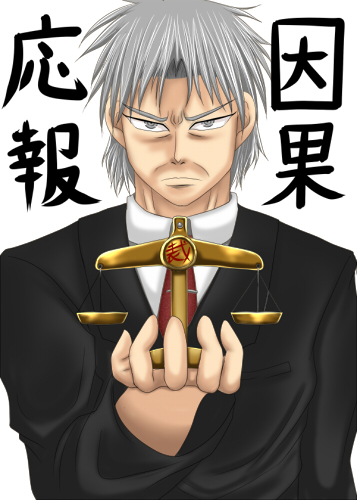
It’s a manga! About judgment! Apparently!

Posted in Japanese, Yojijukugo | Tagged , , , , , , , | 4 Comments