Magic Monday – For a world before refrigeration

Mark of Purity (Mark of the Renewer)

This spell requires a box or similar container. Food or drink is placed inside the container, which is sealed, and finally the Mark is placed or written on the outside in a ceremony dedicated to the Renewer. The container must remain until the Mark fades away, after which its contents will have been purified of all disease, harmful fungus, poison, and other contaminants. Note that this will not restore rotted food to its original condition; it will merely stop the deterioration and remove poison.

It is said that initiates into the deeper mysteries of the Renewer’s faith have access to variants of this ritual that can remove impurity from objects other than food or drink.

The base difficulty is d4. For each meal’s worth of food or drink to be purified, the ritual costs one point of fatigue or strain, and the container must be sealed for one hour – so purifying food plus drink for one meal for one person would take two hours and two points of fatigue or strain. Increasing the difficulty by one step can halve the time or the cost.

Posted in Rules, Setting | Tagged , , , , | Leave a comment

Be the change you want to see in the world, even if it’s only pocket change

Intro: I may have gone a little overboard with the explanation on this one. I hope somebody some time finds it useful, at least!

義を見てせざるは勇無きなり
(Gi wo mite sezaru wa yuu naki nari;
“To see what is right and not do it is to lack courage.”)

Definition:

This one is pretty self-explanatory. Knowing what you (as a human being) should do (as a matter of human morality) and yet not doing it means that you lack courage. In a more relativistic phrasing, believing that you’re supposed to do something, but failing to do it, means that you lack the courage of your convictions.

Breakdown:

(gi) is a complicated noun. It can refer to morality, justice, honor, Buddhist teachings, a word’s meaning (as in 同義語 – dougigo – “synonym”), or even an in-law relationship. It can also tie into duty, as in 義務 (gimu, “obligation, responsibility”) or 義理 (giri, “sense of duty, honor”). The object-marker (wo) marks it and connects it to the verb 見る (miru, “to see”), here in conjunctive form. This verb is paired with another one, する (suru, “to do”), in a formal or old-fashioned negative form.

Brief aside here: the verb we think of as する was originally merely (su); the ru comes from one of its conjugated endings. Attaching the negative auxiliary verb ざる (zaru) required that change to imperfective form, becoming (se). An alternate negative form using the same grammatical shift would be せず (sezu).

Anyway, the compound verb phrase above is marked as the topic of discussion by the particle (wa) – if it makes you happy, imagine an implied (no) or こと (koto) to nominalize it. Topic established, we comment on it. (yuu) is the noun “courage”; it is modified by the adjective 無し (nashi) in prenominal form. But the word that follows is simply the copula なり (nari), equivalent to modern である (de aru).

The whole thing, translated roughly and directly, thus becomes “As for seeing-and-not-doing morality, it is no courage.”

Notes:

This kotowaza descends from a saying by Confucius in the Analects. is one of the five Confucian virtues: in Japanese, 仁義礼智信 (Jin Gi Rei Chi Shin), “benevolence, justice, courtesy, wisdom, and sincerity.” This particular saying is attested at least as far back as the 14th Century.

Naturally, there’s no problem with writing 無き in hiragana only (なき). Some sources apparently read as isami.

Example sentence:

「おまえ、なんでそんな厄介な事件に関わったんだい?」 「義を見てせざるは...」 「勇気なんて言うな、このアホ!死にたいのかよ?」

(“Omae, nande sonna yakkai na jiken ni kakawattan dai?” “Gi wo mite sezaru wa…” “Yuuki nante iu na, kono aho! Shinitai no ka yo?”)

[“Why the hell did you get caught up in something like that?” “’To see and not do…‘” “Don’t talk to me about courage, idiot! Do you want to get yourself killed?”]


Posted in Japanese, Kotowaza | Tagged , , , , , , | 2 Comments

Can you see the road ahead?

前途有望
zen.to.yuu.bou

Literally: before / front – road – is / have – aspire / desire / expect

Alternately: Good prospects. A promising future. High chances of being successful. Said of a person’s overall prospective career rather than the success or failure of a more limited enterprise.

"excite ism"

Supposedly, Amazon (in Japan) has high hopes for this product: turn-signal gloves. Source: a blatant ad, in a page full of ads, that has taken the shape of a news article but should fool nobody. Also note how the light looks like an “L” and would probably take a while for drivers to parse if they saw it at night on the road.

Posted in Japanese, Yojijukugo | Tagged , , , , | 2 Comments

Magic Monday – The nuclear option

Bane-Spell (Secret Word of the Destroyer)

The Secret Word can only be taught to those who make a pledge to the Destroyer (a member of The Five). This may take the form of a taboo they must obey, a ritual they must regularly perform, a feat they must accomplish, or even an attribute point permanently sacrificed during the magus’ training. Those who enter this pact gain the knowledge of the Word and its terrifying destructive potential.

The base difficulty of using the word is d3. Saying the Word to one thing or person, and spending some amount of one’s personal energy in the form of strain, fatigue, or damage, will deal that many points of damage to the target. (The focus necessary for the caster to apportion points as desired between the three meters increases the difficulty by a step.) Alternately, the Word can be spoken “freely.” In this case the magic will automatically drain as much energy as is necessary to destroy the target. (If all three meters are filled, then the excess is distributed evenly.) In any case, the energy cost can be halved by increasing the difficulty by two steps.

Living beings destroyed by this spell may make Psychic saves, difficulty d12, to remain on as spirits.

Posted in Rules, Setting | Tagged , , , | Leave a comment

The blood doesn’t fall far from the tree?

This week is an echo of sorts, as I realized part-way through.

血は争えない
(Chi wa arasoenai; “You can’t fight your blood”)

Definition:

There’s no point trying to deny one’s heritage. “The apple doesn’t fall far from the tree,” as the Germans say. 蛙の子は蛙, perhaps. The wording might make this version sound darker, more fatalistic, more defiant to the Western ear, but apparently the phrase saw some use from servants and other low-status members of a household, to praise their young masters for mimicking the previous generation’s character, demeanor, or accomplishments.

Breakdown:

(chi) is “blood,” used here in the same metaphorical manner as in the West, to indicate heredity. It’s marked by the topic particle (wa), and followed by the verb 争う (arasou, with o and u standing as separate vowels rather than a single long o), “to contend,” in negative potential form – e.g. “cannot” form. The phrase, while brief, can function as a complete sentence. Stiffly translated, it would be rendered “As for blood, [you] can’t fight [against it].”

Notes:

This kotowaza seems less well-known than the frog version. While I was looking it up, I found a number of pages where one Japanese person asked what it meant, and others responded by using 蛙の子は蛙 as a point of comparison.

Example sentence:

「ハハハ、お前、気に入ったぜ。お前の親父も、お前も単刀直入だな。流石、血は争えない!」

(“Ha ha ha, omae, ki ni itta ze. Omae no oyaji mo, omae mo tantouchokunyuu da na. Sasuga, chi wa arasoenai!”)

[“Ha ha ha, I like you, kid. You get right to the point, you and your old man both. Like father, like son, for real!”]

Posted in Japanese, Kotowaza | Tagged , , , , , | 1 Comment

All the feels, all the grudges

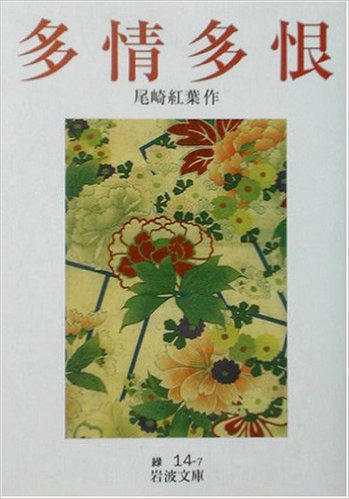
多情多恨
ta.jou.ta.kon

Literally: many – emotion – many – regret / resentment / hatred

Alternately: Easily swayed by one’s emotions, and therefore prone to resentment or sadness. Wearing one’s heart on one’s sleeve, and suffering as a result.

Amazon dot Jay pea!

Also the title of a story by Ozaki Kouyou, a Meiji-era writer and mentor of Izumi Kyouka, whom I’m actually researching right now.

Posted in Japanese, Yojijukugo | Tagged , , , , | Leave a comment

Magic Monday – An enchantment to evade entropy

Sign of the Maintainer

The Maintainer is one of a quintumvirate of deities worshiped in the Slakiv heartlands: the Shaper, the Destroyer, the Corrupter, the Renewer, and the Maintainer. The Five are believed to be personifications of the natural processes after which they are named, and while they receive little organized or abstract worship, they are routinely invoked for everyday activities.

This Sign is a charm common across Vestan, for it is thought to protect possessions from the ravages of time. In its simplest form, it may be scratched into the underside of a table or etched into a bronze statue. The Sign may be found drawn on the first page of a book and beautifully illuminated, or cut into the bottom of Folon’s famous glazed pottery. It may be found on mosaics and tapestries, silver and glass, tools and artwork, old things and new. In any case, the sign must be worked into the object it protects, and invested with some of the maker’s power. The duration of its effectiveness can range from a few months to decades, depending on medium, craftsmanship, environment, and other factors.

Working this Sign into an item is a ritual of base difficulty d4, but incorporating it increases the difficulty of the item’s crafting by a step as well. During its creation, the artisan takes some amount of both strain and fatigue, and thereafter the Sign increases the object’s hit points by an equal amount, and adds a single point each of absorption and deflection to its defenses and saves.

(Note: the mechanical aspect of this spell may be changed later as YAOSC is developed, if I replace or supplement “item hit points” with a “quality/condition” system, which is something I’ve considered.)

Posted in Rules, Setting | Tagged , , , , , | Leave a comment

Don’t bee sad!

泣き面に蜂
(Nakitsura ni hachi; “A wasp in a crying face”)

Definition:

It never rains but it pours. Bad things happen in groups, not in isolation. Misfortune compounded on top of further misfortune. A wasp flying into the face of someone who’s already been through enough that they’re crying. Some sources connect the puffiness of face that comes from crying hard to the swelling of a bee or wasp sting; others merely discuss the compounding of bad luck.

Breakdown:

We begin with the verb 泣く (naku), “to cry,” in prenominal form (連体形). Naturally, this is prefixed to the noun (tsura), “face.” This is marked by the directional/positional particle (ni), and finally the noun (hachi), “bee” or “wasp.” The final verb is elided or assumed, and thus the exact function of is not precisely pinned down; this doesn’t present any obstacle to understanding, though.

Notes:

Some versions add an emphatic sound shift, changing 泣き面 to 泣き(nakittsura).

This saying is the entry in the Edo Iroha karuta set.

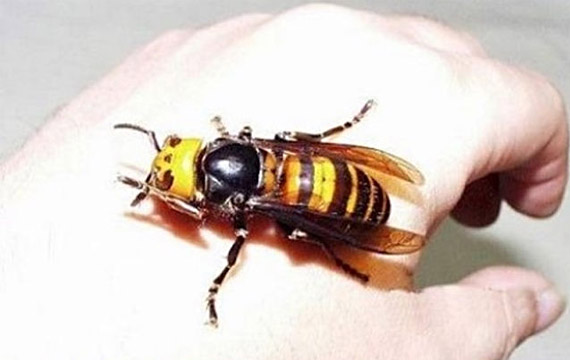
Japan is home to some truly terrifying wasps.

Example sentence:

そして落ちていた買物袋に足が引っかかって、転んで、肘まで打った」 「わああ、正に泣きっ面に蜂ですね!」

(“…Soshite ochiteita kaimonobukuro ni ashi ga hikkakatte, koronde, hiji made utta.” “Waaa, masa ni nakittsura ni hachi desu ne!”)

[“…And then my foot got caught on the shopping bag I had dropped, and I fell and hit my elbow too.” “Wow, that’s exactly what they mean by ‘It never rains but it pours‘!”]

Japanese Giant Hornet

That’s a hand, not a face… but you know what? Close enough! Far too close, in fact! [Source]

Posted in Japanese, Kotowaza | Tagged , , , , , | 2 Comments

Likeaflash

電光石火
den.kou.se-.kka

Literally: electricity – light – stone – fire

Alternately: A very short span of time. Alternately, incredible speed of motion. “Lightning-flash and sparks (struck from a stone),” as examples of things that happen quickly.

Notes: The parts can also be given in reverse order, 石火電光 (sekka-denkou). Apparently some people write sekka as 石下 (stone – down), but this loses the meaning of sparks and is an error.

O ki no mesu mama ni yakareta mono de gozaru

So all the top results of the image search were for this oddly hamburger-shaped okonomiyaki. I’m sure there’s a perfectly reasonable explanation somewhere.

Posted in Japanese, Yojijukugo | Tagged , , , , , , | 1 Comment

Magic Monday – A use for a pixie-crown

Happy-sky Charm

By weaving long grasses, red or yellow flowers picked in sunlight, blue flowers picked in moonlight, and white flowers picked in starlight into a closed loop, a charm is created that is said to improve the wearer’s luck. The charm must be worn continuously for a period to attune it with the wearer’s personal resonance, whether as a bracelet, crown, or other decoration. The acts of creating the charm, of putting it on to begin attunement, and calling upon its powers each require a ritual and invocation. Of course, there are many similar charms from a variety of cultures that will grant a similar luck, but only one will have an effect at a given time.

The base difficulty of creating the charm is d4, and during the attunement the wearer gains a point of strain that cannot be removed. One the charm has been activated, while it is worn it allows the bearer to re-roll one check each day. The benefits last one day for each hour spent attuning to the charm, up to a year and a day.

Man with flower beard

Whatever works for you, really. Source. Because of course.

Posted in Rules | Tagged , , , , | Leave a comment