The esoteric meaning of nice weather

We’re a bit late on this one, but it’s appropriate because recent weather has had me wishing it were still cool and spring-like.

暑さ寒さも彼岸まで
(Atsusa samusa mo higan made; “Heat and cold until the equinox”)

Definition:

Summer heat potentially lasts until the autumnal equinox, but not after. Winter cold potentially lasts until the vernal equinox, but not after. By the time of the equinox, a season’s extreme temperatures have calmed down to a happy medium.

Breakdown:

暑さ (atsusa) is the nominal (noun) form of the adjective 暑い (atsui), “hot.” Similarly, 寒さ (samusa) is the nominal form of 寒い (samui), “cold.” They are connected with the conjunctive particle (mo), “and” or “also.” Another after 暑さ would be acceptable and appropriate, but for compactness’ sake is not used here.

This noun phrase is followed by the noun 彼岸 (higan). While I translated this above as “equinox,” it seems that the term actually refers to an “equinoctial week,” i.e. a span of time surrounding the equinox rather than a single day. まで (made, pronounced like “ma day”) is a particle implying the end of a motion: “to” or “until.”

Notes:

Higan is a Buddhist term, translated from the Sanskrit “param.” The characters literally mean “that shore (of a river),” and contrast with 此岸 (shigan), “this shore.” Metaphorically “this shore” is this material world, while “that shore” is the world of enlightenment. It appears that the term came to be applied to the equinoxes because their weather is neither too hot nor too cold, and this was metaphorically likened to the balanced, pleasant state of existence one reaches in Nirvana.

Example sentence:

「三月上旬なのに、もう30度近く?暑さ寒さも彼岸までって言うじゃない!」 「ハハハ、地球温暖化かも」

(“Sangatsu joujun na no ni, mou sanjuudo chikaku? Atsusa samusa mo higan made tte iu na nai!” “Ha ha ha, chikyuuondanka kamo.”)

[“It’s only early March, and temperatures are already close to 30°?* Don’t they say heat and cold last until the equinox?!” “Ha ha ha, it’s probably global warming.”]

*(C, or 86°F)

Posted in Japanese, Kotowaza | Tagged , , , , , , , | Leave a comment

How an undamped system is like the dampest system

This one makes me especially happy, somehow, because it sounds like some kind of crazy banjo.

波瀾万丈
ha.ran.ban.jou

Literally: wave – large wave – 10,000 – measure

Alternately: (Life is full of) dramatic highs and lows. (Life is) like ocean waves, with wild swings between good and ill fortune.

Notes: This compound may also be written 波乱万丈. The pronunciation is the same, but the character (“disorder”) is more common and familiar than .

Posted in Japanese, Yojijukugo | Tagged , , , , , | 4 Comments

Magic Monday – Gravestone version for (American) Memorial Day

Litany on the Stone

There are certain ways of bringing the dead back to life or simply causing them to walk the world again, with or without a body. Most of these are disrespectful, disruptive of natural flows and cycles, even evil. There are also events or circumstances that will cause the dead to stay in this world of their own accord, and sometimes to cause trouble.

This ritual is an old and simple one, commonly known, that prevents the dead from rising or being raised. It is most often performed by a community. It requires its practitioners to stand and recite (in any language) in the presence of a stone, and as much of the body as they will dispose of, for the better part of an hour. The stone is then used in the body’s disposal. Different cultures will arrange the stone and corpse in different ways: some bury them together, others bury the body below the stone, placing a large stone or many above the grave; others inter the body in a tomb of which the stone is a part, or even place the stone within the body. After a particularly traumatic death, the spirit may already have departed the body. In this case the ritual merely prevents the reanimation of the body.

The ritual must be led by at least one person who knows it, making a base check with base difficulty of d3, increased by one step for each doubling in the number of participants. During the ritual each participant automatically takes one point of fatigue, although those familiar with the ritual can freely take any amount of fatigue or strain they wish. The stone will guard the body for one year for each point of fatigue or strain’s worth of energy it absorbed. Removing the stone will remove all remaining years of protection, although the body will still be immune to meddling until the next anniversary of its death.

Posted in Rules | Tagged , , , | Leave a comment

The warm and friendly heart of a fish

魚心あれば水心
(Uogokoro areba mizugokoro; “If fish-heart, then water-heart.”)

Definition:

If you show good will and courtesy, others will show the same to you. If the fish acts friendly to the water, the water will in turn befriend the fish.

Breakdown:

We begin with the noun , “fish,” often pronounced sakana but in this case uo. Next is , kokoro, “mind” or “heart” or “spirit.” The voicing to gokoro implies that 魚心 is a compound, but this seems to be a result of historical shift away from the original; see below. In any case a noun, whether the compound or just the , is given the copular verb (equivalent to “to be” in English) あり (ari) in subjunctive form, ending the clause. It is possible to translate the subjunctive marker as “when” (in the sense of “when in Rome”) rather than “if.”

The the second “clause” as it comes down to us is simply another pair of nouns: (mizu, “water”) and again. In the past the verb あり was also repeated, in sentence-final form, but this seems to have been lost. And there you have it!

Notes:

The version of this saying that has been transmitted to the present day is actually slightly incorrect in parsing. While the terms and general concept already existed, the origin of this specific phrasing seems to be in the 1767 Joururi play Sekitori senryou nobori, from a time before punctuation was imported from the West, and might be more clearly parsed as 魚、心あれば、水、心あり (uo, kokoro areba, mizu, kokoro ari; roughly “The fish, if it has a heart, the water, has a heart”). Over time the nouns seem to have been compounded and the final あり lost.

The term 魚心 can be used in a standalone way to refer to goodwill and friendliness.

A number of Japanese dictionaries give “You scratch my back and I’ll scratch yours” as an English equivalent, but I feel that this phrasing conveys more aloof calculation and profit motive than the Japanese conveys.

Example sentence:

魚心あれば水心あると言う通り、陽気な男の人があっと言う間に近所の人と仲良くなった」

(Uogokoro areba mizugokoro aru to iu toori, youki na otoko no hito ga a-tto iu ma ni kinjo no hito to nakayoku natta.”)

[“As it is said, if the fish has a heart, the water will also have a heart. Thus the cheerful man was on good terms with the neighbors in the blink of an eye.”]

Posted in Japanese, Kotowaza | Tagged , , , , , , | Leave a comment

Technically this post includes all the other posts I will ever have made….

森羅万象
shin.ra.ban.shou

Literally: forest – spread out / gauze – 10,000 – image / elephant

Alternately: All of nature. Everything in existence.

Keep in mind that the number , while literally meaning “ten thousand,” stands for any uncountably vast numbers or even infinity. So the latter two characters technically contain the whole meaning of the phrase. The first two characters evoke an image of a vast overgrown forest, provide a sort of concrete metaphor for the vastness, density, and interconnectedness of “everything.”

Notes: Apparently banzou or manzou, while very rare, may also be considered acceptable readings of the final two characters. However, manshou is incorrect.

This four-character compound is taken from the Dhammapada, a Buddhist scripture supposedly comprising various sayings of the Buddha.

This was designed to look weird, and it worked.

If you get this, give yourself 50 nerd points. If you look it up just so you get it, give yourself 100 nerd points. Source: Crunchyroll via Google Image Search.

Posted in Japanese, Yojijukugo | Tagged , , , , , | 1 Comment

Magic Monday – Thaumaturgic Tuesday? – They’re the faces of the stranger, but we love to try them on

Animal Mask

“Animal Mask” is a generic term used in Order record-books for innumerable spells in which the caster takes the form of… a wild animal. To prepare for this spell, the caster must first venture into the Dreamlands (in physical or dream form) and supplicate the lord of the type of animal in question. A Mask is usually granted in return for an oath to aid, and never harm, animals of that type. Supplicants who have had trouble with animals or honesty in the past may be tested, or rejected outright.

After the magician is given the Mask (carried by the caster’s dream and shadow selves, but seldom manifesting in the mortal world), they may freely cast the spell to transform into that type of animal. Breaking the oath earns the wrath of all animals of the betrayed type, both in the waking world and in Dream, and if an oath-breaker ever uses the mask again they are usually cursed, unable to resume their original form.

While under the influence of a Mask, the caster gains the physical form of its animal type while retaining his or her own mind. Spellcasting is difficult or impossible in animal form, naturally, but the caster may return to their original form at will. The spell ends of its own accord at some set time each day, such as sunrise or sunset – the exact time varies according to the animal. Many Masks allow a variety of shapes to be assumed; a Dog Mask would allow the caster to take the form of any breed of dog (or, in high-power campaigns, any species of canid).

It is possible to gain and use many Masks, although spiritual politics come into play: the bearer of a cat Mask will likely receive a chilly reception from the lord of mice, for example. On the other hand, magicians who have devoted themselves to one chosen sort of animal may wake (or return from Dream) to find that they have brought the Mask with them physically. In this case, the mask-wearer may remain in animal form indefinitely. These lucky few are expected not only to abide by their oaths, but to champion and protect the animals of their totem wherever they go. Such devotion usually precludes the ability to gain other Masks.

Casting the spell requires a brief invocation, base difficulty d6, and costs six strain (or d4 and two strain, with a physical Mask, but it must be put on as part of the casting). Shifting into an animal body more powerful than one’s own increases the difficulty by at least one step: using a Cat Mask to take the form of a puma instead of a housecat or lynx might be difficulty d8, a tiger might be d10, and so on. Increasing the difficulty by another step allows the caster to mimic the appearance of individual animals.

Posted in Rules, Setting | Tagged , , , , | 1 Comment

Just lettin’ things flow

I just now realized that today is Monday. Ironically, while I managed to maintain my posting schedule rigorously even during the end-of-semester crunch, as soon as summer vacation starts I find myself losing track of time. Please accept my apologies, and this belated kotowaza.

To avoid overlap, the scheduled Magic Monday post will accordingly be moved to tomorrow.

立て板に水
(tateita ni mizu; “water on a standing board”)

Definition:

Fluent, uninterrupted speaking. Being able to produce words, in a continuous stream, as smoothly as water runs down a plank that has been propped up into a standing position.

Breakdown:

We begin with the verb 立つ (tatsu), “to stand,” modifying the noun (ita), “board,” “plank.” This is connected to another noun, (mizu), “water,” with the directional particle (ni). And that’s all!

There’s actually a bit of a mystery here for me: what form is the verb taking? I mean, due to being attached to a noun like that I’d have to guess prenominal form (連体形). In classical grammar the verb 立つ behaves differently based on whether it’s being used transitively or intransitively, but in neither of these cases is 立て the prenominal form! Is this just a less archaic version of the grammar, or is something else going on that I hadn’t thought of?

Notes:

Writing the noun phrase as 立板 (still pronounced tateita) is acceptable, but using other kanji (縦板 or 建て板, both pronounced the same and with related meanings) is considered an error. A longer form, 立て板に水を流すように (tateita ni mizu wo nagasu you ni), “like pouring water on a standing board,” also exists.

The shorter form is included in the Kyoto iroha karuta set. Incidentally, while with this phrase we’re looking more at an “expression” than a “saying,” they both fall under the kotowaza rubric in Japanese.

Example sentence:

「通訳の訓練のお陰で、田中君が英語を立て板に水を流すようにぺらぺらと話せるようになったみたいだね」 「いいなあ」

(“Tsuuyaku no kunren no okage de, Tanaka-kun ga eigo wo tateita ni mizu wo nagasu you ni perapera to hanaseru you ni natta mitai da ne.” “Ii naa.”)

[“It looks like, thanks to all that interpreter training, Tanaka can just talk and talk and talk fluently in English.” “Aw, nice.”]

Posted in Japanese, Kotowaza, Meta | Tagged , , , , , , | 1 Comment

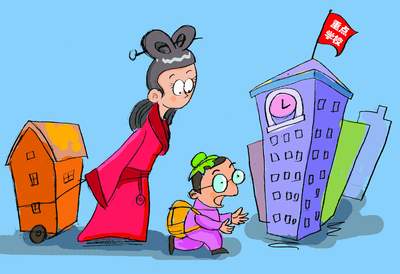
It helps that she didn’t need to deal with year-long leases.

One more thing for Mother’s Day.

孟母三遷
mou.bo.san.sen

Literally: [Mencius] – mother – three – change

Alternately: The importance of creating or finding an environment that aids a child’s education. Mencius’ mother, the story goes, changed between three different residences because she was unhappy with her son’s behavior when they lived near a cemetery and then a marketplace. Finally they ended up near a school, which influenced the boy to become a scholar, and his mother was satisfied.

Notes: As is probably obvious from the first character, this is another four-character compound handed down from Chinese Antiquity. It’s well-known enough in the modern day, too, to have its own wikipedia page.

The name “Mencius” is more properly written 孟子 (Moushi); the single-character form above is shorthand.

Mencius looks like a kappa somehow.

Not sure how they’re supposed to have fit in their house anyway. Source.

Posted in Japanese, Yojijukugo | Tagged , , , , , | 2 Comments

Magic Monday – Mother’s Day Version

Birthing Charm

A ritual beloved by midwives. When a woman is pregnant, the father creates a small stylized human figure and performs ritual actions over it for ten days. After it is complete, the man ceremonially presents it to the mother, who must keep it on her person or within arm’s reach at all times. If some misfortune strikes that would harm the child at any point up until the umbilical cord is severed, the Birthing Charm breaks and the child is left unscathed. A replacement Charm may be made, but it will only be effective if the couple honors the old one with appropriate funerary rites, showing their thanks and respect for the sacrifice it made. If a Birthing Charm survives the pregnancy, it becomes inactive at the baby’s birth and slowly wears away, although some cultures place it above the cradle (granting the baby a +1 bonus to any saves it needs to make in its first year).

During the creation of the charm the father spends about half an hour, and invests a small part of his life force (one hit point), each day of the ten-day span. (This harm can be healed naturally.) The base difficulty is d4, and often a midwife will be guiding the charm’s creation.

Posted in Rules | Tagged , , , , | Leave a comment

Once a sparrow, always a sparrow!

Here’s the experiential equivalent to last week’s 三つ子の魂百まで.

雀百まで踊り忘れず
(suzume hyaku made odori wasurezu;
“The sparrow, until 100, doesn’t forget [its] dance”)

Definition:

What you learn in your youth stays with you your whole life. Just as the sparrow maintains its leaping, playful-looking flight style from when it first learns to fly until its death, so do people never lose the customs of their youth, especially the pastimes they turn to for amusement.

Breakdown:

(suzume) is the common Eurasian tree sparrow. Like last week, (hyaku) is a hundred, specifically a hundred years of age, metaphorically one’s whole life; in modern writing one would probably expect a particle between it and the preceding noun phrase, but none is used. まで (made) is still “until.” However, in this case we get a complete sentence: the noun 踊り (odori), “dance,” based on the verb odoru (“to dance”), and the verb 忘る (wasuru), “to forget.”

Wait, “wasuru”? Yes. In classical Japanese grammar there was the verb wasuru. A grammatical distinction was made between “making an effort to forget; forgetting on purpose” – and “forgetting naturally when you weren’t thinking about something.” The former meaning conjugates as a 四段活用 (yodan katsuyou) verb. The latter conjugates as a 下二段活用 (shimo nidan katsuyou) verb. And since the point of the saying is that the swallow doesn’t forget its dance even over the course of a hundred years, we turn to the latter behavior.

The imperfective (未然形, mizenkei) form in this case is wasure, to which is affixed the auxiliary verb (zu) in sentence-final form.

Notes:

There seems to be some disagreement over whether this saying can be used for positive things. One source gives “My grandfather is still good at judo” as an example of mistaken usage; another gives “My grandmother is still good at handball” as an example of correct usage. Since the image invoked is so nice, for the time being I’m going to assume that it can be used to describe lasting positive habits as well as negative ones.

The word まで can be written with the kanji character . The verbal ending can be alternatively written as 忘れぬ (wasurenu) instead of wasurezu, which technically puts it in 連体 (rentai, attributive or prenominal) form. However, closer to the modern era, the nu ending is simply an alternate negative ending and can be found at the end of set phrases such as this one.

This saying is first attested in a poetry collection called 毛吹草 (Kefukigusa), printed in 1645; this instance uses the nu ending rather than the zu ending. The nu form is also found in the Kyoto iroha karuta set.

Example sentence:

雀百まで踊り忘れずというか、お祖父ちゃんは90歳になっても毎日七時に起きてラジオ体操してる」

(Suzume hyaku made odori wasurezu to iu ka, ojiichan wa kyuujuusai ni natte mo mainichi shichiji ni okite rajio taisou shiteru.”)

[“Like the sparrow doesn’t forget its dance even at a hundred, so to speak, grampa gets up every morning at seven to do radio calisthenics.”]

Posted in Japanese, Kotowaza | Tagged , , , , , , , | Leave a comment