Magic Monday: Introduction to YAOSC

+What is YAOSC?

YAOSC is Yet Another Old School Clone. The name is a joke; the important thing to know is that this is an adventure game of wilderness exploration, dungeon bashing, and perhaps a little social climbing in a late-antiquity fantasy milieu. One player, the Yet Another Master (YAM), generates a setting, stocks it with interesting things for the other players to discover and interact with, and adjudicates rules issues. Everybody else controls one or more characters each, through which they explore the setting, have adventures, and act out whatever dramas interests them. It’s a group activity, to be enjoyed with friends.

+What is “dungeon bashing”?

A dungeon is an enclosed space for adventuring in, as popularized by “Dungeons and Dragons.” Dungeons are often underground and filled with treasure – guarded by monsters, traps, and puzzles that must be avoided or overcome. While wealth may be found in the wilderness, dungeons represent an opportunity for high-risk, high-reward adventuring. This adventuring may be colloquially referred to as “bashing,” presumably to the usual focus on breaking down doors and fighting monsters.

+What is “late antiquity”?

A time before plate armor or gunpowder were in widespread use; a time when high-quality steel was a guarded secret and all science was, essentially, magic in the mind of the common man. Be aware, though, that this is a fantasy version; even if some of the assumptions or assertions of the setting you play with are different from real-world history, don’t let it bother you too much.

Fundamentals

+Rolling dice

The dice are the agents of fate in your game. When you need to depend on them to produce randomized results, you use one of three kinds of rolls:

A check is rolled when an action’s success depends mainly on the skill of the character, modified by impersonal environmental factors. Many skill rolls are checks; “saves” to escape dangerous situations are checks; a Strength-based roll to open a stuck door is a check, and so on.

  • On checks you do well by rolling at or below a target number. Bonuses raise the value of the target number, making the roll more likely to succeed, and penalties lower it.
  • The difficulty of a check is reflected by the number of faces on the die to be rolled. So a relatively easy check might be rolled on a d6 (a cubic die with six faces), while a more difficult one might use a d20 (an icosahedron). There are probably more kinds of dice available than you’d have thought.

In contrast, the roll is called a challenge when the action is directly opposed by another character. The most common challenge roll may be an attack against another character’s defense in combat. Note that some competitions between characters may call for checks when the opposition is indirect. For example, in competitions of strength, arm wrestling would be a challenge (one character must defeat the other in order to win, and each is working to push the other’s hand back), but a bench-press competition would be a comparison between checks (the contest for each participant is between themselves and the weights).

  • Challenges use 2d10; bonuses are added to the result of the die roll, and penalties are subtracted. High number wins.

Unlike checks, challenges have no additional measure of difficulty, and no target number. Instead, the higher of the two results wins.

There are actually a few other kinds of rolls that don’t fall into either of these categories: character creation starts with a series of 3d6 rolls, and sometimes you may roll on a table to determine a random result. But these are rare and specialized exceptions. The vast majority of rolls made during play will be checks or challenges.

Posted in Rules | Tagged , , , , , , | 1 Comment

For example, some day I might be good at this Japanese stuff

好きこそ物の上手なれ
(Suki koso mono no jouzu nare; “People are good at what they like.”)

Definition:

The things that you enjoy, you’re going to more cheerfully spend more time and effort on, so your skill in those areas will improve more quickly than it would if you were less invested. It’s easiest to become skillful when you’re enthusiastic. As a result, there’s going to be a decent amount of overlap between the things you like and the things you’re good at.

Breakdown:

More tricky old grammar at work here. We start with a noun phrase centered around (mono), “thing.” Beginning students of Japanese are sometimes taught to use this term for “things” that exist in a concrete, physical way, and to use (koto) for more abstract “things” like fact in “The fact that today is cold shouldn’t stop us from going outside.” But mono has historically been used very broadly to indicate concrete and conceptual things, people, places, even as a sort of euphemism for supernatural beings – the mono in mononoke, for example.

Anyway, that noun is modified by 好き (suki). In modern Japanese this is taught as a “na-adjective,” but language learners might be better served by thinking of it as a noun that can take on adjectival or adverbial functions with the right particles attached. Here they’re connected with こそ (koso), a linking particle (係助詞, kakarijoshi) with special properties and an emphatic function. If you see こそ, a decent English translation may use “especially” or the like to convey that emphasis.

The assembled noun phrase is topped off with (no), which can be confusing until you realize that in old Japanese this particle could also function like the modern subject marker (ga). The noun phrase is our subject, then, and we’re given a predicate as well: the old-fashioned copula なり (nari). But wait! こそ has special properties, and one of them is to throw connected words from sentence-final form into “realis” form (已然形, izenkei). And so nari becomes nare and the sentence ends, albeit in a nonstandard way.

A modern rendition might go 好きな事こそ上手である (suki na koto koso jouzu de aru).

Notes:

Modern speakers may misinterpret the final なれ as an imperative form of the verb なる (naru, “to become”) and accordingly add the particle (ni), making ~上手になれ; this is an error.

This saying may be contracted to 好きこそ物の上手 or even 好きこそ上手 without loss of meaning.

Example sentence:

「ジョン君、料理が上手ね」 「アハハ、食べるのが好きだから」 「あぁ、好きこそ物の上手なれというもんね」

(“Jon-kun, ryouri ga jouzu ne.” “Ahaha, taberu no ga suki dakara.” “Aa, suki koso mono no jouzu nare to iu mon ne.”)

[“John, you’re a really good cook!” “It’s because I like to eat, ha ha.” “Yeah, they do say ‘You get good at what you like.’”]

Posted in Japanese, Kotowaza | Tagged , , , , , , , | 1 Comment

Do what I don’t do, not what I do

反面教師
han.men.kyou.shi

Literally: opposition – face – teach – expert

Alternately: A negative example. Someone who sets a bad example and so teaches you what not to do.

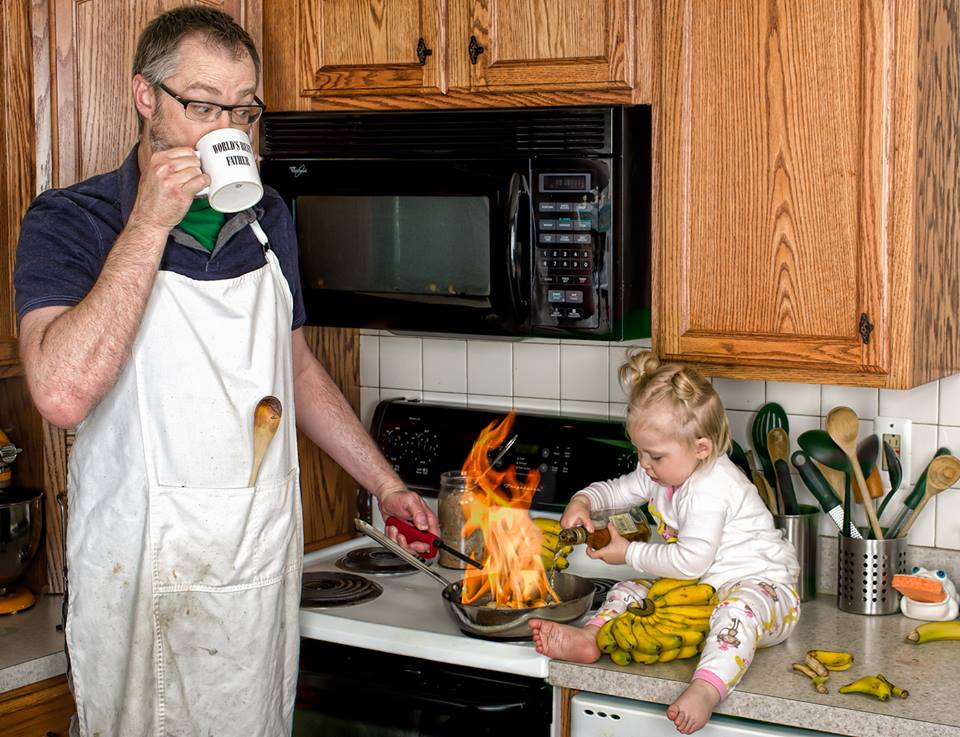
World's Best Father Pan Cooking

This guy! He makes some pretty cute pictures, actually.

Posted in Japanese, Yojijukugo | Tagged , , , , | 2 Comments

Magic Monday: Undoing, part 2ing

So last week we talked about counterspelling and dispelling rotes (normal “spells” in the D&D magic paradigm). This week we’re talking about the same for rituals and gnosis.

Rituals

This is magic-as-natural-philosophy. Like a chemical reaction or a Rube Goldberg device, if you set up the right conditions, the rest will take care of itself. Thus, there is no real “counterspell” necessary here. Anybody can do all sorts of things to disrupt a ritual in progress. In some cases – just as in chemistry – there will be terrifying unintended side-effects; in this case a successful Lore + Ritual skill check (Arcane Lore plus any points invested in that specific ritual) will allow you to know what parts to knock over, wipe away, or interrupt safely.

Dispelling a ritual after it’s been completed – or rather, undoing whatever long-duration magical traces it leaves – is probably much harder. (Undoing the effects of a ritual may be impossible, like unmaking an omelette.) I feel like it would work like dispelling a rote, but with the difficulty (die size) bumped up. Perhaps in both rotes and rituals, dispelling a standing magical effect can be made easier by spending extra time and effort on it. Either Lore or Concentration can be used (unweaving the effect through knowledge or through intuition), aided by the specific Ritual skill if applicable.

Gnosis

Gnosis is hard to use, because it’s mostly about focusing your will. There are no formulae, algorithms, or other crutches to lean on. Countering its use means reaching out with your own will and overcoming someone else’s. This means a simple Concentration challenge roll. As with rotes, each side is already paying a base energy cost to fuel their bending of the world’s magical currents, and similarly each side can spend extra energy to increase their chances of winning the contest.

Finally, how do you undo gnosis magic? Well, Arcane Lore or Concentration is probably a good start. Roll a check against a difficulty one step greater than the difficulty that would be assigned to create the effect through gnosis in the first place. As with countering rotes you may choose to roll two checks, succeeding if either of them passes but unleashing a blast of uncontrolled magic unless both of them pass. As with challenges you may spend extra energy to gain a bonus to the roll.

Today’s post ran much later than I thought it would due to baby-related matters. I’m sure it’s still Monday somewhere, though. In the meantime, it might be a good idea to step back and define some of the terms I’ve been using to this point, like “checks” and “challenges,” for those who haven’t read about them elsewhere.

Posted in Rules | Tagged , , , , , , | Leave a comment

Voiceless it cries, wingless flutters, toothless bites, mouthless mutters

Intro: A kotowaza from old Buddhist Japan, as relevant as ever in postmodern America.

地獄の沙汰も金次第
(Jigoku no sata mo kane shidai;
“Even your sentence in hell depends on money”)

Definition:

“Money is the best lawyer in hell.” “Money talks.” Everything in the (human) world responds to the power of money. Unless we guard carefully against corruption, money – like any other tool – is a dangerous thing. For example, it can be abused to pervert the justice system, or any other system that makes human society run. Whee.

Breakdown:

We begin with the noun 地獄 (jigoku, but see below in “Notes”), literally “earth prison,” usually translated as “hell.” (Again, see below for details.) The next noun is 沙汰 (sata), a very old term (in use by the 8th century CE) referring to a number of concepts – in this case, judgment, or distinction between good and evil. These two nouns are joined into a single phrase with the associative particle (no).

This noun phrase is followed by the particle (mo), an intensifier commonly translated as “and,” but here better rendered as “even.” Finally, we have a particle-free pile of even more nouns to close off this non-sentence: (kane), here in its more common meaning of “gold” or “money,” and 次第 (shidai), which expresses the idea of order, precedence, A depending on B. All together, “Even hell-judgment depends on gold.”

Notes:

This saying is the entry for (chi) in the Kyoto and Osaka Iroha karuta sets. While modern kana orthography has shifted to using (ji) to represent the voiced reading of the kanji , it used to be written in voiced form as (also ji). This somewhat unusual phenomenon can also be found in 鼻血 (はなぢ = hanaji, “nosebleed”).

Keep in mind that unlike in Christian or Islamic cosmology, where Hell is a single place or spiritual state that lasts forever and ever, in Buddhism there are multiple “hells” or lower worlds that are, in a way, the same as the paradises or middling worlds that make up the greater reality – the main difference between them being the degree of suffering each world contains. Since suffering teaches us lessons that help us to detach ourselves from earthly desires, and a soul in any of the worlds will eventually die and be reborn in a new position dependent on its karma, “purgatory” would probably be a closer equivalent for most Western audiences. It’s not a perfect fit either, but them’s the breaks in translation. An equivalent term to 地獄 is 奈落 (Naraku), descended from Sanskrit.

In some versions of this phrase, 次第 may be elided. In others, may be replaced with , apparently without change in meaning or pronunciation. (is usually pronounced zeni.)

Example sentence:

「一般人が石を投げて店の窓を割ったために逮捕されるのに、お金持ちが自分等の利益のために世界経済を崩させても何の罰も与えられないこの世の中は、正に地獄の沙汰も金次第というものではないか」

(“Ippanjin ga seki wo nagete mise no mado wo watta tame ni taiho sareru no ni, okanemochi ga jibunra no rieki no tame ni sekai keizai wo kuzusasetemo nan no batsu mo ataerarenai kono yo no naka wa, masa ni jigoku no sata mo kane shidai to iu mono de wa nai ka.”)

[“An ordinary person can throw a stone, break a shop window, and get arrested for it, but the rich can crash the world economy for the sake of their own profit without any punishment at all. This truly is a world where money talks.”]

Posted in Japanese, Kotowaza | Tagged , , , , , , , | Leave a comment

Make like a perfect square and SCRAM

Of course.

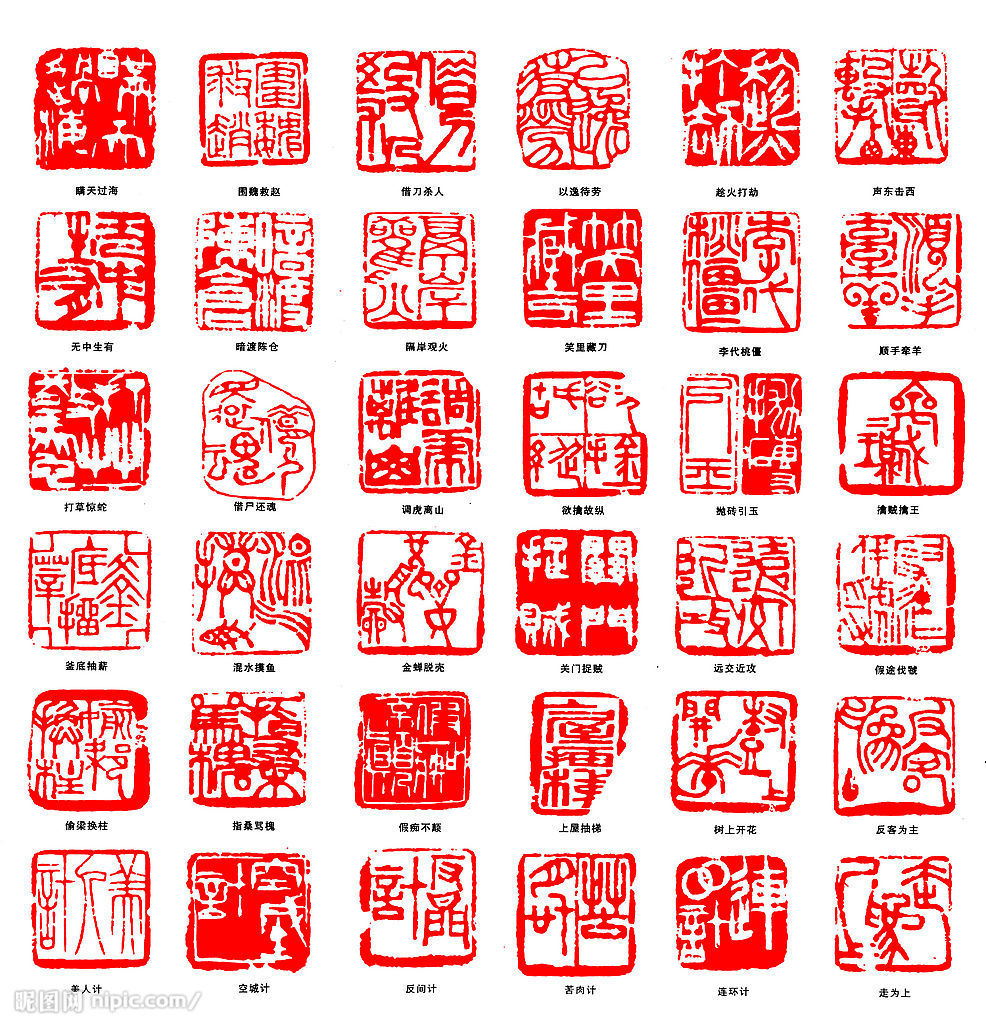
三十六計
san.juu.ro-.kkei

Literally: three – ten – six – plan

Alternately: Discretion is the better part of valor. Sometimes you just need to retreat, regroup, and try again another day. Run away.

Notes: Of the Thirty-Six Stratagems passed down from the Book of (Southern) Qi in Chinese antiquity, the thirty-sixth is flight, which (in contrast with surrender or compromise) is not considered a true loss and therefore, in a way, is the best of all of them.

A longer version of the phrase also exists: 三十六計逃げるに如かず (sanjuurokkei nigeru ni shikazu), “Of the Thirty-Six Stratagems, none compare with running away.”

Thirty-six strategy seals

There, that should answer all your questions quite nicely.

Posted in Japanese, Yojijukugo | Tagged , , , , , , , | 2 Comments

Magic Monday: Undoing

Unlike Necropraxis, I’m not building this system on a base of Vancian magic, in which (even without spell levels) each bit of magic is like a bullet that you load, fire, and are left without. So while the post linked above inspired me to think things over, I can’t use what he does as a basis. Instead, I have to think about how I want counterspelling (preventing a magical effect from being brought about) and dispelling (undoing one that’s already there) to work in YAOSC.

I like the idea of there being an art to undoing enchantments. Yes, if Bob is turned into a frog then you can quest to find the cure, hunting down princesses and all, but perhaps a skilled witch or wizard can be called on to un-frog him more directly. The literature is full of magical adepts stopping, redirecting, nullifying and unmaking magic, and I’d like that to be a common tool in the magician’s repertoire. I also like the idea of it taking time, research, and careful work in at least some cases.

I implied earlier that I don’t want either of those to be a “spell” in the sense that “rotes” are, but now I’m not so sure. On the one hand, they seem to call for their own special mechanics that operate differently from how most spells do. On the other hand, I’ve erased several of the things that make “spells” into their own special category in D&D. On the one hand, I feel like they should be just-about-universal tools in the magician’s toolbox. On the other, who says they have to be 100% universal? There’s a decent amount of storytelling to be found in a wizard who doesn’t know how to undo spells, in a world where most can to some degree or other, and of course there’s the matter of giving players more freedom of choice when it comes to customizing their characters.

Let’s consider the basic mechanics we have at our disposal. Neither counterspelling nor dispelling should be automatically successful, which means they have to be rolls. Do we make them into checks or challenges? Logically, counterspelling should be a challenge and dispelling can be either… but the spell being countered was already cast with a normal skill check, right? Do we double up on the rolls necessary for the first spellcaster? Do they just have to choose a roll type based on whether someone is working against them or not? Do we hack out a system for opposed checks to bridge the gap between checks and challenges?

To the hacking: no, definitely not. I just don’t like the repercussions for the system as a whole if we open that can of worms. In fact, now that I think about it, the first option of the three seems most logical. If you cast a spell there’s a possible point of failure there (from you screwing it up), and if someone tries to counter it, there’s a possible point of failure there as well (from them screwing it up for you). Two rolls it is: first one caster checks as usual to cast a spell. Then anyone trying to counter it rolls a challenge against them. If the first check fails, then anyone attempting a counter loses some time, but no other resources. If the check succeeds and the countering challenge fails, then the spell is cast as normal and counterer has wasted their time and energy.

The first caster uses the sum of their skill levels for the spell plus their choice of Arcane Lore (diverting the threat with their knowledge of the magical forces at work) or Concentration (pushing the magic in the right direction with sheer force of will). The countering caster can do the same, although if they don’t know the spell then they’re depending on the base skill alone. Either caster can spend energy (fill up their survival meters) to add to their result. I’m thinking there should be some base cost to a countering attempt as well. Should it be equal to the cost of the spell being countered? Less? I’ll need to think about much later, after getting a feel for the energy economy of spellcasting.

That gives a bit of an advantage to the first caster, which is fine. But here’s an optional twist that we can throw in. The countering caster can use their power to tear at the weaving of the spell, without caring about the results, instead of unraveling or blocking the magic more carefully. In this case, the countering caster makes two rolls for the challenge. If either beats the first caster’s roll, then the counter is successful. And if they both succeed, then nothing more dramatic comes of it than a fizzle and pop. But if one succeeds and the other fails, then the magic is redirected but not dissipated. It goes berserk, and you get to roll on a table for crazy results that probably give everyone a hard time.

Another option is adding in magnitudes of success. Maybe a counter attempt that overwhelms the first caster (beats them by ten points or more) allows the counterer to take control of the spell and change its parameters or re-target it. Maybe an overwhelming response to the attempt allows the first caster to take their opponent’s energy and add it to the spell, or put some kind of whammy on them with feedback.

Where does the time for a counterspell come from? From the same place it does when you want to counter a physical attack: I like the idea of a character’s “actions” being refilled at the end of their turn, and they have (a limited set of) options for spending these before their official turn comes around again. Part of the choices you make in combat will be trying to balance self-defense with the ability to respond when you get an opening. This means that, unlike 3.x D&D, you don’t need to hold back and wait in order to defend yourself. You can try to stop an incoming attack, magical or mundane, at any time; it just might leave you off-balance and unable to respond. This corresponds with real-world combat, where it can be easy to get put on the defensive.

That takes care of countering. How about dispelling? The problem with trying to use a challenge roll here is that someone may want to undo a bit of magic when you don’t know the skill levels of the original caster. In some cases it may not even be applicable. Couple that with no active force opposing the dispell attempt, and it makes sense for us to go back to a rolling a check. As with a counterspell, you can use either base skill, add the skill level of the specific spell (if you know it), pay a base price in energy, and pay extra energy to make your roll easier. Difficulty can be based on the check die for casting the spell in the first place. And again we can offer the option to roll twice and either fail, succeed perfectly, or succeed but with funky, unpredictable results.

The question I’m left with is whether I want to make “dispell” and-or “counterspell” into mini-skills (or one mini-skill for both), to reflect aptitude in unweaving patterns of magic. Probably yes: the application of skill points put into this are broadly useful across a lot of situations… but also focused, in the sense that they can only be brought to bear when enemy magic is targeting you. It gives characters something to specialize in if they want, but a minimum energy cost and consequences to failure keep it from being too powerful. If this still seems unbalanced, then we can take steps to bump up the difficulty or costs in some way, or at least allow optional situational modifiers. (For example, knowing a caster’s true name might give you a big bonus to counter or dispell their magic; working without certain specialized tools might give you a penalty.)

In brief:

  • To use a rote, make a check, adding your skill with the spell to a relevant base skill.
  • To counter a successful rote, roll a challenge. Each side uses the skills for casting the spell, spending a base energy cost plus extra as desired.
  • If the challenger succeeds, the spell is lost and the magic may run amok.
  • If the challenger fails, the spell is pushed through their defenses and manifests as normal.

We’ve spent all this time talking about rotes, and it’s already over 1400 words. Next time I think I’d like to take a look at rituals and gnosis… I’ll try to be less long-winded. As they say, I didn’t give myself enough time to make the post shorter.

Posted in Rules | Tagged , , , , , | 1 Comment

Tiger ventured, tiger gained?

虎穴に入らずんば虎子を得ず
(Koketsu ni irazumba koji wo ezu;
“If you don’t go into a tiger’s lair you won’t get a tiger cub.”)

Definition:

Nothing ventured, nothing gained. You won’t succeed at anything special if you’re not willing to stick your neck out and take some risks. Thinking defensively only prevents loss rather than bringing gains.

Breakdown:

There’s some complicated old Japanese here, so buckle your seatbelts, ’cause we’re in for a ride.

虎穴 (koketsu) starts us off gently with a noun, a compound of “tiger” and “hole” which means, logically enough, “tiger den.” The particle (ni) indicates directionality, … and here our troubles begin. Our fun troubles!

In modern Japanese, the common intransitive version of “enter,” 入る, is pronounced hai.ru, while 入れる (i.reru) is transitive. Here, though, we see the intransitive variant 入る, pronounced i.ru, which is no longer in common usage. The shift from to (.ra) denotes a shift into 未然形 (mizenkei, the “imperfective aspect”), and to this we affix the negative marker in 連用形 (renyoukei, “conjunctive mood”). For the rest of the ending, I was tempted at first to get out my chart and try and assemble a construct of contracted or pronunciation-shifted bound particles (like ). But my sources suggest that it’s actually just the unbound particle (wa). The structure ずは functions as negative supposition; “if you don’t ~,” and over time underwent a sound change from zu wa to zumba. Stranger things have happened!

A slightly alternate explanation suggests that instead of 連用形, the is actually also in 未然形, allowing it to take the hypothetical-marking bound particle (which may or may not be related to the use of cited above). From there the evolution is the same: the negative hypothetical is a little difficult to pronounce, so it shifts from zuba to zumba. And now you know!

What follows is simple in comparison. We have another noun, 虎子 (koji), a tiger cub, marked with the object marker (wo), and the verb (u), “get,” in negative sentence-final form. Note that because this is a 下二段 (shimo-nidan, literally “down second grade”) verb in the old grammar, the base u changes to e in the 未然形 for the negative ending (zu), which is why the modern version 得る can be read as either eru or uru, depending on the situation.

Notes:

The character can be replaced with without any change in pronunciation or meaning. Either compound (both 虎子 and 虎児) can also be read as koshi.

This phrase, too, traces its origins back to China, in the 5th century CE Book of the Later Han.

Example sentence:

虎穴に入らずんば虎子を得ずの気持ちで、株式市場に投機をすることにした」

(Koketsu ni irazumba koji wo ezu no kimochi de, kabushiki ichiba ni touki wo suru koto ni shita.”)

[“Thinking ‘nothing ventured, nothing gained,’ I decided to start speculating on the stock market.”]

Posted in Japanese, Kotowaza | Tagged , , , , , , , , | 3 Comments

How much tongue?

舌先三寸
shita.saki.san.zun

Literally: tongue – before/tip – three – sun (pronounced like “soon”; a unit of measurement approximately equal to 1.19 in. or 3.03 cm)

Alternately: Glib lies. Deceptive eloquence or flattery. The ability to control or influence people with words – false or hollow words, specifically, rather than genuinely persuasive argument.

Notes: Apparently many native speakers of Japanese replace with (kuchi), but this is still generally considered an error by scholars.

This four-character compound doesn’t mean what I thought it meant when I first encountered it. The problem for me was the English expression “on the tip of my tongue,” meaning a word or phrase that you know and want to use but can’t quite remember at the moment. Keep in mind, though, that three sun is about 9cm (three and a half inches), a significant percentage of the visible portion of the tongue.

There’s got to be an amazing story behind this one, but it seems to be relatively obscure and none of my sources treated its origins beyond mentioning the Shǐjì.

Media: presented without comment:

Posted in Japanese, Yojijukugo | Tagged , , , , , | Leave a comment

Magic Monday: governed by skills

One of the funkiest tasks in making a fantasy game has got to be the magic system. Rules for travel, combat, and any number of other mundane tasks can be modeled on real-world data, as in Justin Alexander’s famed breakdown of stats and skill use. But magic has no such analog.

…Actually, that’s not true, is it? The real world is full of “magical” practices. Some are just science obeying Clarke’s Third Law: botany, chemistry, and applied disciplines like metallurgy. Some are passive folk beliefs about properties of the natural world: the protective power of certain gems or the color blue, for example. And some are beliefs about supernatural powers that people can actively bring to bear, either through their own power (such as the Evil Eye) or through channeling, directing, or requesting the powers of spirits or gods.

Which explains why magic is so thoroughly all over the map when it comes to its manifestations as systems in games: it’s hard to unify something that’s based on such a widely disparate set of real-world phenomena and beliefs. That said, the various cultural influences on the form and feel of specific magical effects and practices in a game world are less important, in the game-design sphere, than the mechanics behind how magic works: while it’s possible to mechanically support a specific “flavor,” it’s also possible to design a mechanically generic system that can support a variety of flavors.

The fundamental question at the root of any magic system is, “How do you limit it?” Most activities are limited by simple reference to the real world: people often have a decent intuitive sense for things like swimming, running, even swinging a sword. But with magic, by definition real-world limits don’t apply. Anything that you can imagine, or even simply gesture toward with words, is possible. To prevent every game from becoming Calvinball, some limitations need to be imposed.

Which brings us to the question of how to limit magic in YAOSC. And the answer is, “There are a number of overlapping methods that I plan to use, to be honest.”

First, what we’re not going to do: “spell levels” per se. D&D has class levels and spell levels, and a character’s supply of the former limits their access to the latter. They’re not intrinsically bad; it’s just that after reading this post. I wanted to build YAOSC without them. The implied setting for the system is one where almost anyone can at least try to work almost any magic, if they have the know-how, and their skill in the art is what determines the result.

What does that mean specifically? Well, everything begins with the skill system. Most magic use is going to be a matter of making skill checks, or of having a high enough skill level that no check is necessary.

For a long time I was thinking that there would be three skills that governed magical power: “rote” (for something close to traditional “spellcasting,” requiring application of both special knowledge and the power of the user), “ritual” (for time-consuming algorithms or recipes that require no other knowledge and little or no personal energy), and “gnosis” (for intuitive manipulation of magic forces, depending entirely on the power, will, and intuition of the user). “Concentration” would also have been an important skill for magicians.

But in the meantime, I’ve thought a bunch about a “skill point economy,” and I like the idea of a system that allows and encourages skill points to be invested in the use of specific tools – including specific spells. And it doesn’t entirely make sense to me for “rituals” to be one unified skill either; by definition they’re going to be specific and finicky and situational.

So instead of that, we’re going to have just two skills: Concentration (the ability to focus on a task and cultivate a “flow” state) and Arcane Lore (possessing and comprehending a collection of metaphysical trivia useful in getting a feel for how magic works). There will still be rotes (standard “spells” that require power input), rituals (longer methods that use other in-game resources such as time, rare and costly props, etc.) and gnosis (working magic through sheer willpower), but every rote or ritual will be a mini-skill. Players who invest points in those skills can gain certain benefits (such as lower energy costs or greater effects). But also, if a check is required, the relevant skill levels are added together:

  • Rolling a check to perform a ritual adds your Arcane Lore skill to your skill level for that specific ritual.
  • Rolling a check to execute a rote adds your Arcane Lore OR Concentration skill (depending on the situation) to your skill level for that rote.
  • Casting by gnosis uses Concentration only. It’s harder to get good results when you’re not using a recipe.
  • The difficulty of a spell can be signaled by the default die size for a check to cast it. (This is as close as we’re getting to “spell levels.”) Magicians can work harder (roll a larger die) to get more power, range, duration, etc. out of their spells, or accept diminished effects for less difficulty (a smaller die).
  • Spells demand energy from the caster, reflected by filling one of the three resilience meters. Magic strains your mind and/or body. Difficulty can be increased to decrease the energy costs, or decreased by spending more energy. Energy costs should be calibrated so that anyone can afford to cast almost any spell at least once, but reliance on frequent magic use demands careful resource management.
  • Failure on a skill check to cast a spell should have consequences, ranging from wasting time and energy (on a close miss) to catastrophic magical weirdness (on a dramatic failure), to discourage players from simply rolling and re-rolling the dice until they succeed.

I anticipate several results of this setup:

  • Even at low character levels, simple spells can be cast automatically by dedicated students of magic, who have invested skill points in both the base skill and the spell itself and so their score is equal to or greater than the die they’d be using for a check – no result can be a failure.
  • Similarly, powerful magicians can reliably perform even difficult feats of magic, and have reasonably good chances to achieve effects that non-specialists wouldn’t dare attempt unless desperate.
  • It’s possible to fall anywhere on a spectrum of magical ability, from dilettantes who have only invested a handful of skill points into a single easy spell, to savants with a few points in Concentration and spells, to casual students with a few points in Arcane Lore and spells, to specialists with maximum points invested in both of the governing skills and in a wide variety of spells.
  • Novice magicians will tend to gravitate to simpler spells due to their ability to cast them reliably, but anyone can have any trick tucked up their sleeve. If you have access to a spell, the biggest limits on what you can cast are the risks you’re willing to take.
  • As YAOSC comes together as a whole, one thing to watch out for is cheap and easy ways to empty the resilience meters; those could be abused to provide magicians with unlimited magic use. In and of itself this isn’t necessarily bad, but it’s not what I want for this system.

All of the above is subject to change as I continue to work on things, of course, but it seems like a solid foundation to start building on for the time being. Join us next week when I come back to some of the Necropraxis-inspired thoughts that started off this whole thing in the first place: counterspelling and other sundry magical tasks that won’t be modeled as spells.

Posted in Rules | Tagged , , , , , , | Leave a comment