On upside-down trees

本末転倒
hon.matsu.ten.tou

Literally: root/origin – tip/end – revolve/turn – fall

Alternately: Putting the cart before the horse. Getting your priorities turned around, or otherwise being mistaken about the relative importance of things. Mixing up cause and effect.

Notes: and are root and branch of a tree; metaphorically this becomes the main and peripheral aspects of something. 転倒 is reversal, flipping, falling. I occasionally misremember this phrase in flipped form as “転倒本末,” which I suppose is appropriate.

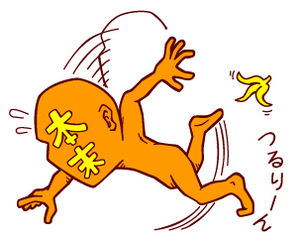
The banana is a metaphor your baser instincts, of course

A dramatization of what happens inside your head when you do this, I guess. Source.

Posted in Japanese, Yojijukugo | Tagged , , , | Leave a comment

Emeralds to a sea cucumber. Platinum to a moose.

猫に小判
(Neko ni koban; “Gold coins to a cat”)

Definition:

Casting pearls before swine. No matter how valuable or useful something is, if you give it to someone who doesn’t understand its worth or use, then it won’t do them any good.

Breakdown:

This brief phrase strongly implies a verb, and most likely is the condensed form of a longer phrase, even a complete sentence. But for now we’re left with two nouns and a particle.

The first noun is (neko), “cat.” The second, 小判 (koban), is an old form of currency: an ovoid coin (gold, in theory, but as with many examples of gold coinage the currency was increasingly debased over time) used during the Edo period. The particle between them is (ni), which has myriad uses, generally positional or directional in some way. You can see above that “to” is a good translation in this case, although “for” would work just as well.

Notes:

It turns out that there is a longer version: 猫の前に小判 (neko no mae ni koban), “gold coins in front of a cat.” Note that this changes our interpretation and translation of the particle from directional to positional, although the saying’s meaning is the same and we’re still lacking the verb that would make it into a proper sentence. An alternate version of the shorter phrase simply replaces with (inu, “dog”). In fact, it seems there’s a whole series of similar sayings revolving around the futility of giving something valuable – especially Buddhist signs or teachings – to any of a number of animal species.

This kotowaza is also from the Kyoto Iroha karuta set.

One of Japan’s more visible, if unremarked-on, cultural oddities is the 招き猫 (maneki-neko), a statue of a beckoning cat. The maneki-neko is said to bring good luck, or money, and can often be seen in Japanese businesses, on the counter or by the door. (In the US, the practice has spread for some reason to shops and restaurants in any East-Asia-related business.) In one of life’s little ironies, the maneki-neko is often portrayed as carrying a koban coin. Presumably this is not because the cat itself finds the coin useful, but because it is delivering the gold to its master.

Example sentence:

「絵の具を啓太にやったの?アイツは全然アートに興味がないから、猫に小判だよ!」

(“E no gu wo Keita ni yatta no? Aitsu wa zenzen aato ni kyoumi ga nai kara, neko ni koban da yo!”)

[“You gave the paints to Keita? That guy’s got zero interest in art; it’s completely wasted on him!”]

Posted in Japanese, Kotowaza | Tagged , , , , , , , , | 1 Comment

Other Heavens

Other Heavens

She shone for me like the sun,
Bringing certain truths to a stretched-tight sky,
Showing things according to her lights:
The fire-freckles on rivers’ skins,
The hues of crops arching high,
The living, raging joy of fusion!
She burned golden, and the world glowed with her.

I wanted to return her brightness
But paled by day, a ghost-self, hollow.
We live by light, but I want no deserts, no fury,
No harsh slow burn as the spheres turn.

I was and will be of the moon,
Telling my years by her soft glow,
At home adrift in muted colors, deeper waters,
Starlight and twilight gentler on the eyes,
Losing the rough edges of myself and others
In slow, cool, vast, thoughtful stillness.


I’d written love poems before and have written others since. My best poem for one girl was a farewell. Years later, we’re on good terms.

Posted in Poetry | Tagged , , , | Leave a comment

How to make of yourself an evening vessel

Today’s four-character compound stands in direct opposition to last time’s 栴檀は双葉より芳し.

大器晩成
tai.ki.ban.sei

Literally: big – container/tool – evening – become

Alternately: Great skill blooms late. Just as a large vessel such as a cauldron or temple bell isn’t cast and finished quickly or easily, so does enormous talent in a person require years, even a lifetime, of practice and polish before it comes to fruition.

Notes: This saying is attributed to Laozi (aka Lao-Tze aka Lao-Tzu), founder of Taoism.

Media:

So here’s a link to a video of some generic Japanese pubescent-girl group singing about how they want to seize their opportunities now instead of waiting for 大器晩成 to happen. This is important, though: while they have no idea what they’re talking about, they’re not actually wrong. If you want to get good at stuff, you don’t just sit on your butt until Ding! you magically become a genius at 60 or something. No, you go out there and you work and you practice and you build up the experience and lessons that will one day make you great.

So they’re right to say that relaxing and lying to yourself by saying “I’m just a late bloomer” is foolish. On the other hand, they’re missing the point that if they keep on doing what they do for decades, they’ll fulfill the 大器晩成 prophecy by, for example, eventually learning how to actually dance and/or sing instead of simply bouncing around being teenaged.

Posted in Japanese, Yojijukugo | Tagged , , , , , | Leave a comment

Precocity!

栴檀は双葉より芳し
(Sendan wa futaba yori kanbashi;
“The sandalwood tree is fragrant from when it’s a sprout”)

Definition:

Genius shows even in childhood. Just as the wood of the sandalwood tree smells nice even when it is just a sapling, so a human of exceptional talent shows their ability from an early age. If your kid were Mozart, they’d probably already be writing concertos.

Breakdown:

A full sentence in classical grammar presents itself. Fortunately, while the structure might surprise someone used only to the modern language, nothing here is terribly difficult. We begin with the noun 栴檀 (sendan), a tree known in English by multiple names including “Chinaberry” and “bead tree.” (However, see below for a note on the tree’s identity.) This noun is marked with(wa), which we can often read as simply the topic marker. In this case, though, I believe that the particle carries an implicit contrast: the sandalwood tree, as opposed to other, less fragrant trees, smells nice even as a tiny sprout.

Topic established, we move on to a verbless predicate. 双葉 (futaba), literally “pair of leaves,” means a bud or sprout – in this case, a sprouting sapling rather than a bud on the stem. The particle より (yori), often translatable as “rather than” (as in last week’s 花より団子), here takes the older sense of “from” or “since.” 芳し (kanbashi) is the adjective “sweet-scented,” “fragrant” in sentence-final form. (If a verbless sentence bothers you, then console yourself with the fact that a longer version of the phrase ends with a verb, in accordance with normal Japanese syntax.)

Notes:

双葉 can be replaced with 二葉 without any change in meaning or pronunciation. 芳し can be read koubashi. The entire phrase has a longer variant, 栴檀は双葉より薫じ梅花は蕾めるに香あり (sendan wa futaba yori kunji baika wa tsubomeru ni kou ari), meaning “Sandalwood is fragrant from when it is a sprout, and the plum-flower has a sweet smell while in the bud.” Interestingly, while , , and are all essentially synonyms, the longer phrase uses only the first two characters while the short version uses only the last one.

The saying uses 栴檀, but my sources tell me that the tree intended is actually 白檀 (byakudan), even though the latter name is never substituted into the phrase. It seems likely that the two trees were conflated, or one mistaken for the other, at some point – they are both mainland Asia plants, not native to Japan – and that the error has simply been preserved in this saying.

This kotowaza is included in the Kyoto Iroha karuta set, as one of two alternative entries.

Example sentence:

栴檀は双葉より芳しと言うのは本当で、今年ノーベル賞を取った方は中学生の時、既に積分学を理解していたらしい」

(Sendan wa futaba yori kanbashi to iu no wa hontou de, kotoshi Nooberu-shou wo totta kata wa chuugakusei no toki, sude ni sekibungaku wo rikai shiteita rashii.”)

[“Genius really does show from a young age; apparently, this year’s Nobel Prize winner could do integral calculus in junior high.”]

Posted in Japanese, Kotowaza | Tagged , , , , , , , | 1 Comment

A little high; a little low; any way the wind blows

一喜一憂
i-.kki.ichi.yuu

Literally: one – joy – one – sorrow/anxiety

Alternately: Alternating positve and negative feelings: joy and sorrow, hope and fear, cheerfulness and worry. Being unable to put one’s mind at ease. Mood swings. Extreme sensitivity to small changes in the situation.

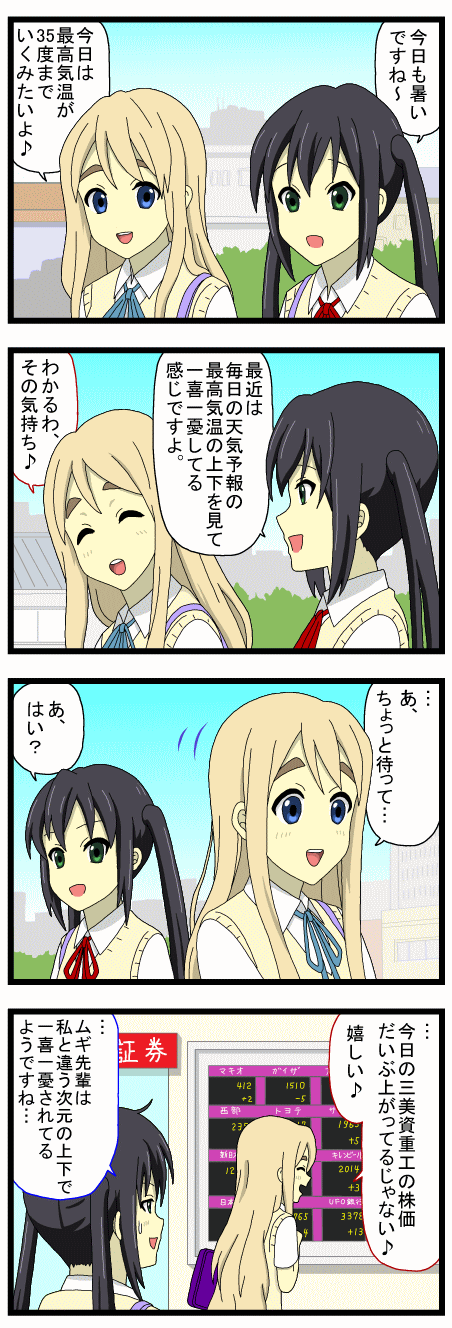
A fan-made comic? Not sure.

So, uh, one girl’s mood is influenced by the day’s high temperature; the other’s, by the stock market. Source.

Posted in Japanese, Yojijukugo | Tagged , , , , , | Leave a comment

Maslow would agree

Here’s another famous one:

花より団子
(Hana yori dango; “Dumplings before flowers”)

Definition:

People value things that address their concrete needs over more abstract, artistic considerations. It is better for something to be profitable or beneficial than merely pleasing. Substance is more important than surface. …Alternately, a negative reference to someone who focuses overly on practical considerations and is lacking in aesthetic sensibilities.

Breakdown:

Again we have a very simple phrase comprising two nouns and a connecting particle. (hana) is “flower,” 団子 (dango) is a round ball of cooked rice flour, grain flour, etc. While commonly translated as “dumpling,” 団子 are often sweets in Japan, eaten together with sweet-bean paste, sauce, kinako flour, and so on, rather than the savory soup elements that dumplings often are in the West. The particle より has a possibly surprising range of meanings, but the one we’re interested in here is comparison or replacement, as in “A over B” or “A rather than B.”

Notes:

The saying supposedly originates with people at 花見 (hanami, traditional spring sakura-flower-viewing picnic/parties) who preferred to focus on the refreshments rather than on the flowers that were ostensibly the focus of the occasion.

A popular girls’ manga from the 1990’s was titled with a pun on this saying, replacing 団子 with 男子, “boy(s).” Normally this word is pronounced danshi, but here the second character is read as ko, one of its other common pronunciations, which becomes voiced to become go, giving us 男子 = dango.

This kotowaza is the entry in the Edo Iroha karuta set.

Example sentence:

「我々の村を救って下さってありがとうございます。心からお礼を申し上げます。この感謝状を―」 「感謝などじゃない!金、お金をくれ。花より団子だぞ」

(“Wareware no mura wo sukutte kudasatte arigatou gozaimasu. Kokoro kara orei wo moushiagemasu. Kono kanshajou wo” “Kansha nado ja nai! Kane, okane wo kure. Hana yori dango da zo.”)

[“Thank you so much for saving our village, sir. Please allow me to express our heartfelt gratitude. This letter of thanks―” “Don’t just thank me! Money, give me money. I need substance, not show.”]

Posted in Japanese, Kotowaza | Tagged , , , , , | 1 Comment

A quick link about combat arrowing

Next time you encounter fictional archery, whether in a movie, book, or in a game (especially a fantasy-themed game that involves characters using magic or performing feats of legendary strength and skill), here’s something to keep in mind: 

Posted in Miscellaneous | Tagged , | Leave a comment

Who knows White River?

(Not me! I was asleep!)

白河夜船
shira.kawa.yo.bune

Literally: white – river – night – boat

Alternately: Being sound asleep. Being completely unaware of one’s surroundings. Alternately, affecting a know-it-all attitude despite a lack of actual expertise or experience.

Notes: (kawa) can also be written with the more common character . can also be written as , and pronounced either bune or fune (both are pronounced with two syllables, generally rhyming with “moon bay”).

Supposedly this phrase originates with someone who boasted (falsely) about having traveled to the capital in Kyoto, a journey that would have taken them through an area called 白河 (Shirakawa). When asked about Shirakawa, though, they thought it was the name of a river, and claimed to have traveled this river on a boat at night, and as a result they didn’t have much to report. The lie was discovered because of this mistake, and so we have the double meaning of today’s yojijukugo – both the deep sleep that the storyteller claimed, and the pretended knowledge.

(Google Maps locates the 白河 area here in present-day Kyoto.)

Posted in Japanese, Yojijukugo | Tagged , , , , | Leave a comment

For when you just have to say “At least it wasn’t….”

不幸中の幸い
(Fukouchuu no saiwai; “Happiness amidst misfortune.”)

Definition:

A cloud’s silver lining. A small consolation in hard times or sadness. A small mercy that things weren’t worse.

Breakdown:

This kotowaza is simply a noun phrase. 幸い (saiwai) is a noun indicating either good fortune or the happiness that arises from it. 不幸 (fukou) is another noun that attaches the negating (fu) to the kanji , changing its pronunciation and creating its literal antonym, “misfortune” or “unhappiness.” To the latter is attached the suffix ~(chuu), meaning “[in the] middle [of],” “during,” and so on. (no) is our associative particle. Literally, the phrase becomes “Luck associated with the middle of un-luck.”

Notes:

Supposedly, this saying can alternately refer to a blessing in disguise, although such usage seems to be rare.

Example sentence (source!):

「当たったのが生ものじゃなくて良かったって、そう考えれば不幸中の幸いって… …シャケだ~!」

(“Atatta no ga namamono ja nakute yokattatte, sou kangaereba fukouchuu no saiwaitte… …shake da~!”)

[“It’s good that what hit me wasn’t some raw food; if you think of it that way at least there’s a silver lining… …RAW SALMON!”]

Posted in Japanese, Kotowaza | Tagged , , , , | Leave a comment