The fruit of corruption

As opposed to 湯から出た錆?

身から出た錆
(Mi kara deta sabi; “Tarnished from within.”)

Definition:

Suffering due to one’s own misdeeds, especially the bad things one has done to others. Paying for one’s mistakes; getting one’s just deserts. The image here is of rust developing from the iron content of a sword blade – a 刀身 (toushin).

Breakdown:

This noun phrase is built on (sabi), “rust” or “tarnish.” The rust 出た (deta) “came out,” past tense of 出る (deru). It came out から (kara), “from,” the (mi), “body.”

Notes:

This appears in the Edo iroha karuta set, but is originally attributed to our old friend Kefukigusa (毛吹草).

Changing the verb to 出した (dashita), “put forth,” is less common but acceptable. Presumably it’s also possible to see alternate forms of , such as the one with the 円 element written as .

Unlike the contemporary GOP, Japanese culture is full of this sort of admonition that bad behavior leads to consequences that the responsible individual will face and suffer from – cf. 自業自得 and 自縄自縛.

Example sentence:

「まさ君にフラれたの?それは身から出た錆よ、小学校の時ずっと苛めてたし」

(“Masa-kun ni furareta no? Sore wa mi kara deta sabi yo, shougakkou no toki zuutto ijimeteta shi.”)

[“Masa rejected you? You reap what you sow, and you bullied him all the time in elementary school.”]

Posted in Japanese, Kotowaza | Tagged , , , , , , | 1 Comment

Little Bo Peep and the Paradox of Choice

多岐亡羊
ta.ki.bou.you

Literally: many – fork in the road – die – sheep

Alternately: Presented with an overabundance of options or possible paths, one ends up confused and lost. By extension, a field of study being so finely divided that it becomes difficult to discern underlying principles.

Notes: Despite the literal meaning of , the two-character compound 亡羊 actually refers to a sheep getting away from its shepherd and becoming lost. This compound supposedly comes from an allegory told by Warring States period philosopher Yang Zhu, as found in a classical Daoist text known as the Liezi.

takiloutherbourgyou

Well, this was one of the image search results, for what it’s worth.

Posted in Japanese, Yojijukugo | Tagged , , , , , , , , | 1 Comment

Forthright to an actual fault

身も蓋もない
(Mi mo futa mo nai; “No filter”)

Definition:

Too blunt; too open. Someone’s attitude or words being so blunt and tactless that they lack all nuance or subtlety; by extension, so blunt and tactless that further conversation becomes impossible. Literally “no body and no lid” – the “vessel” is entirely absent.

Breakdown:

We have two nouns: (mi), “body,” and (futa), “lid.” Each is marked by the particle (mo), “also” or “and.” They’re followed by ない (nai), the negative form of the “to be” verb, in sentence-final form.

Notes:

Note that (utsuwa), “vessel,” or “container,” can also metaphorically refer to someone’s level of ability, and that saying of someone that 器が小さい (utsuwa ga chiisai), “the vessel is small,” means they’re intolerant toward others’ foibles.

Mi can also be written as homophone without any change in meaning.

See also 単刀直入.

Example sentence:

「あの人は疲れた時、身も蓋もない話し方になるぞ。頼みたいことがあったら明日がいいかも」

(“Ano hito wa tsukareta toki, mi mo futa mo nai hanashikata ni naru zo. Tanomitai koto ga attara ashita ga ii kamo.”)

[“When they’re tired, they get really blunt. If you’re asking for something you should probably wait until tomorrow.”]

Posted in Japanese, Kotowaza | Tagged , , , , | Leave a comment

Parental Cognitive Development: Devolution to BUS

The kid continues to grow and learn. He’s picking up all sorts of phrases at daycare… and inventing some of his own? (For example, asking for “don don choo choo” videos. I have no idea what kind of train that might be.) He can count to five in both English and Japanese, and seems to understand that you use numbers to refer to a series of objects, although it’s also clear that he doesn’t understand the idea of “four apples” and “five apples” as such yet. He continues to pay attention to the behavior of trains (we live near train tracks and what seems to be a relatively busy switching station, so there are quite a few of them every day), and I’ve been using them to teach him a couple new verbs like “move” and “stop.” Oh, and he’s picked up colors (red, blue, white, black, green, and silver). And the adjective 速い (fast), which he gleefully shouts while running.

One unexpected and fascinating aspect of his development is that he repeats certain phrases a lot. For a while, hardly a day went by when he doesn’t see the rail lines and comment that チューチュー、線路走る (“choo choo runs on the railroad”). Now he comments on what is present or absent, and what’s moving or not.

All this communication is a two-way street, though. As I teach him nouns and verbs and adjectives, he forces me to develop search images that I hadn’t been using before.

I notice trains and other vehicles now. I notice whether a train is short or long, fast or slow, and what kinds of cars it’s composed of. I’ve become acutely aware of buses, which used to be just part of the scenery unless I was specifically interested in catching one at the time, but which now I notice from blocks away. And at times I’ve caught myself muttering, or at least thinking, “BUS!” The same with animals: “DOG!” “CAT!” “BIRD!” “SQUIRREL!”

updog

Turns out it’s just that he’d had puppies at some point previously and his neural circuitry was altered forever by the experience.

It affects my speech, too, at least at home. When I’m ready to turn in at night, I tell my wife that I’m going to 寝ね (ne-ne), i.e. “sleep-sleep”. When I need to go use the restroom, I might say I have to pee-pee. And of all things – a while back we borrowed the Captain America: Civil War movie from the library and watched it. And during the final dramatic fight, when one of the guys got absolutely clobbered in the face, I unthinkingly exclaimed 痛い痛いやろう (itai itai yarou) – roughly, “That must be a boo-boo!”

I’d read that becoming a parent does things to your brain as you bond with your squirmy little poop monkey. And I’m probably aware, on some subconscious level, of a bunch of quirks my parents had when I was a kid that will make perfect sense when I find them cropping up suddenly in my own behavior. But this was the first big one to really jump out and hit me. Kids, man.

Posted in Musing, Nonfiction | Tagged , , , , | Leave a comment

A humidifier in the rainy season

夏炉冬扇
ka.ro.tou.sen

Literally: summer – furnace – winter – fan

Alternately: Useless things. Things inappropriate to the situation, including skills, ideas, or opinions. Sources of warmth in the summer, sources of cooling in the winter, or perhaps pathological narcissists in a democratic government.

Notes: may be written as (an alternate form of the same character) without any change in meaning or pronunciation, although this version is rare. And while the character on its own means “hearth” or “furnace,” in this context it refers specifically to heating devices, such as braziers of hot coals, rather than to a fire being used for work.

This compound is attributed to the Lunheng, a collection of essays from the Eastern Han dynasty in the first century CE.

KONICA MINOLTA DIGITAL CAMERA

Updated for the modern age.

Posted in Japanese, Yojijukugo | Tagged , , , , , | 1 Comment

Magic Monday – YAOSC XP

At the end of each session, expedition or mission, everyone who participated gets experience points (XP). The recommended base value is three points, although this number may be changed according to the length of the session and the needs of the campaign. The XP award is adjusted based on how the party fared in that session, and given to each participating player (not divided up between them).

As a rule, there should be two “loss” conditions that can reduce the group XP award by one point each, and three “success” conditions that can increase the award by one point each. In addition, DMs may offer each individual player the opportunity to stake a single XP on a goal of their choosing. The conditions and available goals can and should vary according to the specifics of the campaign; below are YAOSC’s default “fantasy exploration”-oriented XP awards.

Losing materiel penalizes the award by one point. Small losses should be ignored, especially in the opening moves of an extended campaign, but in general a party that expends significant resources with no return probably hasn’t improved much.

Losing personnel penalizes the award by one point. NPCs who die in the line of duty do not have to be counted (although there should be social repercussions within the game world for parties who regularly sacrifice their followers), but if any PCs die, the party probably hasn’t improved much. Horror-themed campaigns may set the bar a little higher, only imposing a penalty if two or more PCs die in the same time period.

+ Victory gives a bonus point. If the party has completed a major mission, fully explored a moderate-sized area, recovered a significant treasure, defeated a recurring villain, or slain an especially fearsome beast, they have probably improved, and the DM may reward them with another XP. A victory bonus is based on major party achievements, not necessarily victory in battle or even the defeat of an opponent.

+ Being awesome in play gives a bonus point. Clever plans pulled off smoothly, skillful teamwork that snatch success from the jaws of failure, dramatic and cathartic role-playing, and other bits of play that impress and entertain the DM indicate that the party is improving. Note that lucky dice rolls, or long shots that count on them, do not earn a bonus point: getting lucky with the dice in a tense situation is reward enough. Awesome play on an individual rather than team level should be rewarded with an MVP point; see below.

+ An accomplishment gives a bonus point. If the party reaches some interesting milestone in their adventures, they are probably improving. Mapping a whole dungeon, finding all the special sites hidden in the forest, and other accomplishments that don’t readily fall under the “victory” or “awesome” headings may merit this bonus.

* * *

In addition, each player has the potential to adjust their individual reward: at the start of play, anyone who wishes may choose a goal under one of the rubrics of Acquisition, Challenge, Conquest, Discovery, or Exploration. The goal should be specific to the campaign rather than simply invoking the rubric – so simply choosing “Exploration” is not a valid goal, or even “exploring the jungle,” but “finding the watering-hole where the animals enforce the Law of the Jungle” is.

For good team cohesion, the players may want to discuss their options and choose character goals that don’t conflict with each other. (It’s fine to have everyone select the same goal: that just means everyone will be on the same wavelength for a while.) Achieving your specific goal through play gets your character another bonus XP when awards are made, but carries a risk.

If the character fails to get closer to their goal (or gets further from it!), their individual XP reward is penalized by one point. In effect, making an individual-reward goal is placing a bet of one XP that it can be accomplished. (Note that failure resulting from DM fiat rather than player choices should not be penalized; the player backs their stake with their character’s skill and their own engagement in the game-world and story.)

* Acquisition is getting something material or useful: a great treasure hoard, a legendary magic sword or ring, a castle or tract of land, a formula for a spell, the broomstick of the Witch of the West. If the character ends the session with it in their possession, they get a bonus XP. Remaining empty-handed – or worse, allowing the treasure to be stolen by someone else, or the castle burned and sacked – merits a penalty.

* A Challenge is performing some great feat. Crossing the Mountains of Madness, bringing the world-egg to its hatching-place, and the like. Some “challenges” (e.g. slaying the beast that haunts the moors) may be more accurately represented another way (e.g. as “conquest”), but it’s not a huge deal: “challenge” is intended as a catch-all category for goals that don’t fit neatly elsewhere, but the only reason I made categories at all was to get players thinking about different kinds of goals they could pursue. Failure implies that the character has not learned how to meet the challenge yet, and results in a penalty.

* Conquest is overcoming opponents. This may be through combat (slaying the dragon, taking the head of the bandit king, routing an opposing army) or other means (humiliating the vizier and seeing him driven from the court; convincing the princess to marry a suitor of your choosing instead of your rival’s son). Defeat or stalemate means the character cannot yet overcome their enemies, and results in a penalty.

* Discovery (in contrast to Exploration) is solving a mystery. Understanding a riddle, learning the identity of the Masked Man, finding the source of the corruption in the village, tracking the werewolf to its lair. Penalties are imposed if the players stymie themselves, muddy the waters, or do something so catastrophic that the puzzle is no longer solvable. (Probably no bonus should be given if they stumble into the answer through sheer dumb luck, either; keep in mind that these XP rewards are for good play and are given to show that the character has improved and therefore become better able to meet their goals.)

* Exploration is finding significant new things in the game world. In a megadungeon this might be a matter of getting to the lowest level, mapping most or all of one extensive level, or uncovering a hard-to-find or hard-to-reach location. A penalty may be applied if the character does nothing but retread old ground, or if they cause a pathway that they had planned to explore to become closed to them.

Finally, the group may choose to award one final bonus point to an MVP: if some character saves the party, advances their goals dramatically, or simply manages to entertain everyone with engaging play, the other players may reward them with an extra XP. This is a player-side version of the “awesome” bonus that the DM can award.

Posted in Rules | Tagged , , , | 2 Comments

On the red flags of self-hype

Real skill and competence are apparent without needing to declare themselves, so humility is the mark of a true master.

口自慢の仕事下手
(Kuchi jiman no shigoto beta; “Boastful mouth, bad at work”)

Definition:

If you’re always working your mouth, you’re never working your hands. Describes someone who can talk a good game, but who is completely useless when it comes to doing real work. Someone who can talk the talk but can’t walk the walk. Someone so focused on talking about something that they never get around to learning how to actually do it. For example, a shameless self-promoter who gets and stays rich thanks to inheritance, theft, fraud, and an army of unethical accountants, yet claims to somehow be good at business or negotiation despite not knowing the first thing about actual negotiation or having any actual sense for how the economy works.

Breakdown:

We begin with the noun (kuchi), “mouth,” coupled with 自慢 (jiman), “pride” or “boasting.” The latter half of the phrase comprises 仕事 (shigoto), “work,” and 下手 (heta, with the h voiced to make beta as often happens in compound nouns), “unskilled.” These two noun phrases are connected by the associative particle (no).

Notes:

This saying apparently comes from an early Edo-period kanazoushi book (an often-didactic genre) titled 為愚痴物語 (Iguchi monogatari).

A related saying is 口叩きの手足らず (kuchi tataki no te tarazu, roughly “Someone who flaps their mouth lacks in their hands.”

Example sentence:

「人類は口自慢の仕事下手というのが普遍的だし、己の業績を褒め称える政治屋には絶対投票しないことに決めた」

(“Jinrui wa kuchi jiman no shigoto beta to iu no ga fuhenteki da shi, onore no gyouseki wo hometataeru seijiya ni wa zettai touhyou shinai koto ni kimeta.”)

[“’More talk, less skill‘ is a universal human trait, so I’ve decided never to vote for a politician who goes around praising their own achievements.”]

Posted in Japanese, Kotowaza | Tagged , , , , , | 3 Comments

Yucky cause and yucky effect

畏怖嫌厭
i.fu.ken.en

Literally: apprehension – fear – hate – get tired of

Alternately: To fear and hate something. “Feelings of dread and aversion.” Afraid to a degree that makes you want to find a way to escape the situation.

Notes: This yojijukugo simply joins two two-character compound words together: 畏怖 is to recoil from something in fear; 嫌厭 is to dislike something enough that it shows in your attitude (a relatively high bar in polite Japanese society). Hundreds of millions of people around the world are feeling it right now because millions of people in rural USA felt it in response to a black man daring to be president.

ifubaby

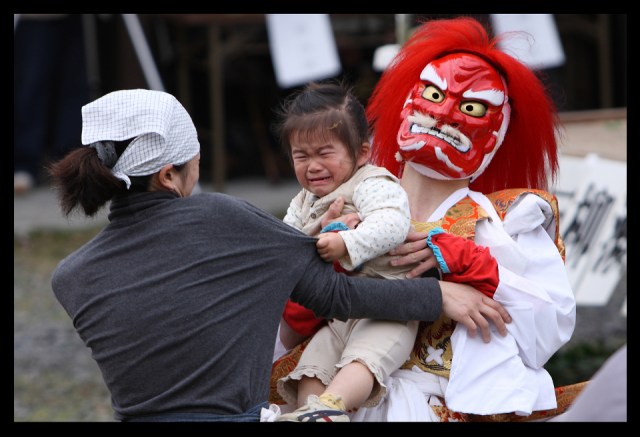
And now for a spot of humor! Little kids, amirite? (Source)

Posted in Japanese, Yojijukugo | Tagged , , , , , , | Leave a comment

What about when the roles are combined?

泣く子と地頭には勝てぬ
(Naku ko to jitou ni wa katenu;
“You can’t win against a crying child or the lord of a manor”)

Definition:

You can’t win (an argument) against someone who doesn’t listen to reason, such as a crying child or a feudal estate steward. There are some battles you can’t win, so it’s useless to try to take them head-on. Infants don’t have the capacity for rational thought, and the powerful ignore reason in favor of their own whims, which makes them similarly implacable opponents.

Breakdown:

We begin with the verb 泣く (naku), “to cry,” in prenominal form. This allows it to attach to and modify the noun (ko), “child.” This is followed by the particle (to), essentially “and,” connecting it to the noun 地頭 (jitou). This archaic term denotes a kind of government official placed in charge of managing an estate and collecting taxes – back in those barbaric, dark days when the super-rich idled around in sprawling private estates and shut-off enclaves and ignored the plight of the masses. (Specifically, we’re talking about the Heian and Kamakura eras.) The particles following these nouns are (ni), a directional particle probably best translated here as “against,” and (wa), which marks the entire preceding phrase (nouns and ) as the topic of discussion. Finally, as a comment on this topic, we have the verb 勝つ (katsu), “to win,” “to defeat,” in negative potential form (i.e. “can’t”).

Notes:

This saying’s ending may be found with modern grammar (勝てない, katenai, instead of 勝てぬ) or as 勝たれぬ (katarenu). But replacing 地頭 with 地蔵 (jizou), the name of a bodhisattva whose stone likeness is found all over Japan, is considered an error.

Example sentence:

泣く子と地頭には勝てぬというので、あの人とは論争をせずに、成功しそうな作戦を考え出すよう頑張りましょう」

(Naku ko to jitou ni wa katenu to iu no de ano hito to ronsou wo sezu ni, seikou shisou na sakusen wo kangaedasou to ganbarimashou.”)

[“They say that there’s no winning against crying children and strongmen, so instead of arguing with that guy, let’s work on coming up with a strategy that seems likely to succeed”]

Posted in Japanese, Kotowaza | Tagged , , , , , , , | Leave a comment

Nice while it lasted

品行方正
hin.kou.hou.sei

Literally: dignity – conduct – direction – correct

Alternately: Good morals, ethics, and deeds. Someone’s thoughts and actions both being beyond reproach.

Notes: 品行 on its own is “behavior,” 方正 on its own is “correct spirit and behavior,” or more literally, “proper direction.”

It was really, really pleasant having a leader who was not just ethical, but thoughtfully and carefully so, for nearly a decade. Already I miss the peace and stability of an administration full of good intent and free of greed and scandals. Thanks, Obama.

hinsenhoumen

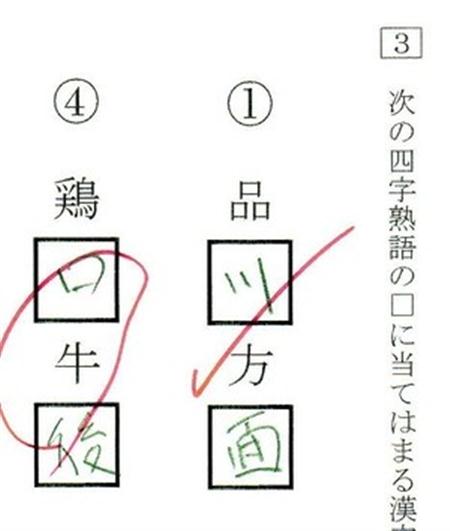
The joke is that some kid was supposed to fill in this compound on a test, but wrote 品川方面 (Shinagawa houmen, “Headed for Shinagawa”).

Posted in Japanese, Yojijukugo | Tagged , , , , , | Leave a comment