Just imagine what they’d do with the War of the Roses

The nuance of from last week’s 群雄割拠 is distinctly masculine; this week, let’s look at a more feminine compound in a similar theme.

百花繚乱
hya-.kka.ryou.ran

Literally: hundred – flower – twist around – disorder

Alternately: A profusion of blooming flowers. A gathering of many beautiful or talented people, especially women. Much talent and achievement in a field developing simultaneously.

Notes:  can also be written  (“disorder”) without any change in pronunciation or meaning of the four-character compound.

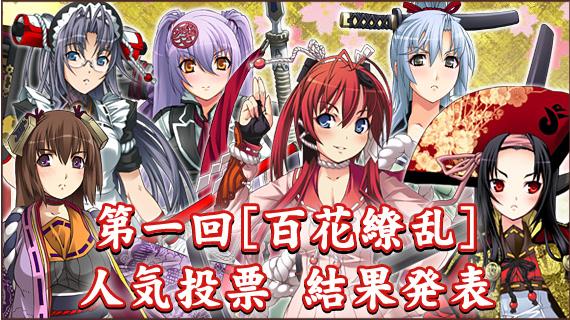
They vote on that kind of thing, doncha know

BECAUSE OF COURSE IT’S A FIGHTING GAME FEATURING LOTS OF ANIME GIRLS WEARING IMPROBABLE COSTUMES AND CARRYING WACKY WEAPONS. (These are the fan favorite characters.)

Posted in Japanese, Yojijukugo | Tagged , , , , | Leave a comment

Beasts at the gates!

前門の虎後門の狼
(Zenmon no tora koumon no ookami;
“A tiger at the front gate, a wolf at the rear”)

Definition:

“Out of the frying pan, into the fire.” While you were driving away a tiger at the front gate, a wolf came in the rear gate. No sooner do you escape one misfortune than you run into another. Compounded troubles. A pincer attack. A situation that even a hero could not hold up against.

Breakdown:

This kotowaza is simply a pair of noun phrases in the AB pattern; in this case is associative. (Which means that the English rendition “at” is not strictly a representative or equivalent to the Japanese grammar.) In each phrase (mon) is “gate,” as in the gate of a traditional estate or compound; 前門 (zenmon) is the front gate and 後門 (koumon) is the rear. The animal at the front gate is (tora), “tiger,” and the animal at the rear is (ookami), a wolf.

Notes:

In older script, the phrase would be written without a comma, which is after all a Western import. And this is a very old phrase; it seems to be derived from 「前門に虎を拒ぎ後門に狼を進む」, “Warding off a tiger at the front gate; advancing a wolf at the rear gate,” which itself descends from a work called (in Japanese) 評史 (hyoushi) by a Chinese writer called (again, in Japanese) 趙弼 (Chouhitsu).

Example sentence:

「学期の終わりが近寄ると、どんどん忙しくなって追い詰められました。論文もあるし、学生たちのエッセーの採点もあるし、前門の虎、後門の狼と言う状況です」

(“Gakki no owari ga chikayoru to, dondon isogashiku natte oitsumeraremashita. Ronbun mo aru shi, gakusei-tachi no essei no saiten mo aru shi, zenmon no tora, koumon no ookami to iu joukyou desu.”)

[“I’m increasingly pressed for time as the end of the semester approaches. I have my own thesis to work on, and I have to grade the students’ essays. It’s like I’m caught between a tiger and a wolf.”]

Posted in Japanese, Kotowaza | Tagged , , , , , , , | 1 Comment

A Tale from Clevaria

In the time of the god-king, lord of the sky, director of rain, clouds, and wind, whose name was secret, emissaries came from the plains to Clevaria. They worshipped strange gods of earth, and carried one with them in a box of silver and lapis. They brought this god to stand before the god-king, and they brought also gifts of silk and ceramic and oil, and they spoke of alliance between the plains and Clevaria: between the high and low places of Shoun.

The god-king, lord of the sky, was a wise and proud ruler who had led our people to the heights and protected us there with power, dwelling at the Tower-at-Llur for ten generations, giving us a good life in the high places. The god-king saw that the emissaries brought gifts not born of the plains; that they spoke of alliance but promised hegemony. They offered their god as a gift, but it was intended as a counter to the god-king’s power, so that one god might struggle against the other instead of protecting the high places, and Clevaria would be ruled by the low places. So plans were laid against their plans, and traps set against their traps.

The emissaries feasted there in the high places, near to the Tower-at-Llur, and all was good. Agreements of trade and peace were spoken and signed, sealed with the laws of gods, but never an alliance. And always the god from the plains dwelt in the Dome-at-Llur, at the center of the high places, where all forces but that of the god-king, lord of the sky, came to nothing.

Now the emissaries grew tired of feasting and talking in the high places; their thin plains blood longed for the food and words and heavy air of their home. So finally they came to the god-king and said, Lord of the Sky, we wish to speak of the alliance.

This was a time for spear-straight speaking, so the god-king asked the emissaries if they would leave their god in the high places after securing an alliance. They answered that they would, saying that if Clevaria had had gods other than the god-king, then one of these in turn would be invited to dwell in the plains. Then the god-king asked them where in Clevaria their god would dwell. At this the whole court watched and listened widely, because this was the question of proof. And the leader of the emissaries said, Our god will dwell in its shrine, on a little dais below the left hand of your throne.

Then the god-king, lord of the sky, stood, and the air darkened with his wrath, and the emissaries trembled at the terrible voice that came to them out of the darkness. It said, Had you invited my priests to erect a shrine on a hill in your land, I would have known your friendly intent and been satisfied. Had your words housed your god in the Dome-at-Llur, or in the valley we call Ammedar, I would have known your harmless intent and been satisfied to sign alliance. But to house your god in my room is worse aggression than if I, myself, god-king, were to stand with my feet on your very altars! Then the god-king, lord of the sky, broke the box of silver and lapis, and threw down and destroyed the god from the plains. The courtiers fell upon the emissaries and killed them with stones, and burned the bodies along with all their tainted gifts.

They praised the god-king then, exclaiming that no mere earthen god, who must be carried in a box, could possibly match the might of the lord of the sky, who was incarnate in human form immortal and could move or speak at will, instead of through agents or in dreams. But the god-king frowned in the midst of the triumph, knowing that there would now be war against the plains; that the plains were prepared for war in case their emissaries should fail. Preparations began for the defense of the high places even before the courtiers had enacted the rites of victory over the earthen god.

War did follow, for the plains could not ignore the affront to their power, even had they laid no shadow of their desire on the high places. After the harvest had passed, scouts and lookouts from the hills began to tell of the coming of an army, one hundred thousand men with spears and shields and the eight-foot willow bows of the plains. At this the god-king smiled, for against the armies of the director of winds arrows were worse than useless.

Battle was joined in the foothills, and continued with blade and spear and mace and stone, and the magics of the wise of each side, so that the terraced fields grew strong and wild for three generations after the watering of blood that came. The god-king reached forth in power from the Tower-at-Llur and ensured that for each warrior of the high places who fell, two soldiers of the plains fell too, and two more were injured, and two more fled. But the gods of the plains were almost silent, except that the earth would occasionally tremble as if in fear.

On the ninetieth day after the winter solstice, when planting would soon begin, as the armies rested around Borandai in the foothills and the god-king paced in the high streets of Llur, the earth awoke in violence. The mountain-top vanished in smoke, and burning stones fell from the smoke onto towns and roads and high pastures, even in places so far away that they could not see the lights of Llur except on the clearest of nights. The earth shook with the release, no longer in fear but in rage. Then the god-king’s immortal body was destroyed, and the god-king went to dwell in Dream as the other gods do. And then it was that Clevaria became nothing more than the high places of the Slakiv Empire, paying tribute of gold and strong mountain stone and labor to the plains for many generations.

Some are still alive who remember when the Slakiv Empire shook within itself even as the earth shakes, and the high places were walled against them, and emissaries sent to tell the court in Daphili that no more tribute would be paid. Ever since our emissaries returned unharmed, the sorcerer-kings have ruled the high places, and Clevaria has been free.

But when a sorcerer-king orders an execution, the condemned is taken to the Crater-at-Llur. There the Sign lies graven cold in the earth. Clear rains fall and gather in the cold lake, but no plant grows and no animal moves.

Posted in Setting, Short Fiction, World-Building | Tagged , , , , , , | Leave a comment

Ancient wisdom about market share?

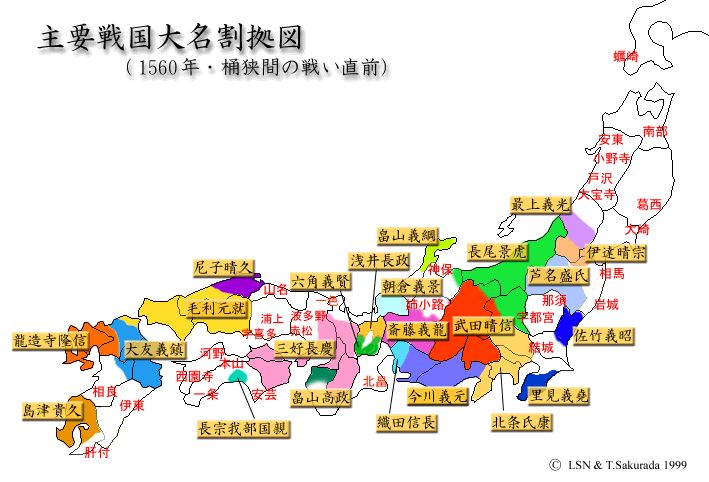
群雄割拠
gun.yuu.ka-.kkyo

Literally: group – masculine/hero/leader – divide – basis

Alternately: Many rival warlords, each controlling their own territory and vying for supremacy. A given field seeing multiple people of great ability, influence, or power – possibly competing for dominance. A time of heroes and leaders.

Because of course the Warring States period.

Warring States era Japan with important demesnes marked. Brought to you courtesy of this economic conspiracy-theory blog, of all things.

Posted in Japanese, Yojijukugo | Tagged , , , , | Leave a comment

Now!

善は急げ
(Zen wa isoge; “Hurry to do good”)

Definition:

“Strike while the iron is hot.” Specifically, if you think of something that would be good to do, something worth doing, something worthy – do it now. Don’t wait. Don’t procrastinate. If you have a good idea, a new year’s resolution, a plan – do it now! You can come back and finish reading this post later, I promise. (If your idea is “study more Japanese,” of course, please stay: that’s what you’re already doing.)

Breakdown:

(zen) is a noun meaning “virtue,” “good(ness).” It’s followed by the topic-marker or emphatic particle (wa), and the transitive verb 急ぐ (isogu), “to hurry (something)” in imperative form. An obsessively literal rendition might go “As for good(ness), do it quickly.”

Notes:

The phrase can be extended by adding its inverse, 悪は延べよ (aku wa nobe yo), “delay doing evil.” In this phrasing, the first should probably be interpreted as emphatic, and the second (the in 悪は) as contrastive. Finally note that, in Japanese if not in English translation, this saying is considered antonymous with 急がば回れ.

Example sentence:

「明日から、毎日ジョギングすることにした」 「あ、良いね。これからでも一緒にしない?善は急げだよ」

(“Ashita kara, mainichi joggingu suru koto ni shita.” “A, ii ne. Kore kara de mo issho ni shinai? Zen wa isoge da yo.”)

[“I’ve decided that I’ll go jogging every day, starting tomorrow.” “Oh, that’s a good idea! Why not do it now, together? ‘Strike while the iron is hot,’ you know.”]

Number One...

You’re not going to argue with the best captain, are you?

Posted in Japanese, Kotowaza | Tagged , , , , | 2 Comments

Tea, Rice, Tea, Rice

日常茶飯
nichi.jou.sa.han

Literally: day/sun – usual – tea – (cooked) rice

Alternately: An everyday occurrence. Just as boiled rice is a stereotypical part of almost every meal in Japan – breakfast, lunch, and dinner, every single day – and tea is a super common drink, so is the event described with this phrase utterly unremarkable in its universality. For a given cultural or personal context, at least.

Notes: Keep in mind that the “tea” here is pronounced sa rather than the more common cha. Also, despite this being a “four-character idiomatic compound,” feel free to add (ji) to the end to express… exactly the same concept. Isn’t Japanese fun?

NichiJouSameHand?!?!

In the right context, a robot with a shark hand is 100% completely normal.

Posted in Japanese, Yojijukugo | Tagged , , , , , | Leave a comment

When luck sticks

犬も歩けば棒に当たる
(Inu mo arukeba bou ni ataru; “Even a dog on a walk meets a stick.”)

Definition:

Originally this saying was a warning: a dog, even if it’s just innocently walking along, is likely to be driven off by someone with a stick. By extension, it meant that one is likely to run into unlooked-for trouble while engaged in normal activities. However, the verb 当たる is often used with positive connotations, contrasting with する (suru, written variously as 磨る, 摩る, or even 擂る, which can mean “to lose,” “to miss the mark”). So the modern meaning is completely reversed from the original. Nowadays, this kotowaza means that sooner or later, you’ll probably have a lucky break even if you weren’t especially looking for or expecting one.

Breakdown:

This one is a full sentence. We begin with (inu, “dog”) as our subject. The subject-marker particle in this case is replaced, or superseded, by the particle (mo), operating as an intensifier (“even”). Its verb is 歩く (aruku, “to walk”) in conditional form. The following clause contains the noun (bou), meaning “stick,” “pole,” “staff” etc.) and the verb 当たる (ataru), meaning “to be hit by,” “to contact,” – and many other things, including “to be correct,” “to win a game of chance.” The particle between them is (ni), indicating directionality or position. In this case it indicates the relationship between the dog and the stick – one meets the other.

Notes:

The final verb can be replaced with 会う (au, “to meet”) with little change in meaning.

This is the very first entry in the Edo Iroha karuta set.

Example sentence:

犬も歩けば棒に当たるというから、ちょっと今回の試合に賭けてみた」 「じゃぁ...当たった?」 「全然」

(Inu mo arukeba bou ni ataru to iu kara, chotto konkai no shiai ni kakete mita.” “Jaa… atatta?” “Zenzen.”)

[“Since they say that good luck comes out of the blue, I tried a little bet on the match.” “So… any luck?” “Not a bit.”]

Please sir, I want some more.

If you get 当たり, it means you get another popsicle. Hurray!

Posted in Japanese, Kotowaza | Tagged , , , , , | Leave a comment

A post a long time in the making

海千山千
umi.sen.yama.sen

Literally: ocean – thousand – mountain – thousand

Alternately: The pinnacle of cunning. A sly old fox. Someone who, though long experience, has developed an almost-unbeatable level of cleverness.

Notes: First, keep in mind that this is about general wits and worldly wisdom, not skill in a specific art or craft.

Remember the notes to 蛇の道は蛇? Well, here we are again. A snake that lives for a thousand years in the mountains and a thousand years in the sea will grow large, and learn many things, and become a dragon. A hebi that has reached ja status is so far above its former snake fellows that there isn’t even grounds for comparison.

Finally, note that some versions use (kawa, “river”) instead of , which makes sense if you keep in mind that dragons are associated with water and that rivers seen from a mountain-top might look like long snakes or dragons, slithering across the landscape below.

As above, so below

This amazing piece of 千と千尋の神隠し (Spirited Away) fanart by ensoulifly, who has graciously allowed me to use it here. Check out their other works!

Posted in Japanese, Yojijukugo | Tagged , , , , , , | Leave a comment

If you don’t study grammar, you won’t be able to confuse yourself with it

This one gets a bit technical, folks, so buckle up.

蒔かぬ種は生えぬ
(Makanu tane wa haenu; “Unsown seeds do not grow”)

Definition:

“Nothing comes of nothing.” Things don’t happen without causes. You can’t expect to profit without doing any work.

Breakdown:

蒔かぬ (makanu) is, in old grammar, a conjugated form of the verb 蒔く (maku), meaning to sow seeds, to plant, to sprinkle. It’s a verb of the 四段活用 (yodan katsuyou) type in imperfective form (changing maku to maka), and the nu is the negative zu suffix in attributive – in this case, prenominal – form. (“Prenominal” just means it comes right before a noun.) The noun it attaches to is (tane, “seed”).

The second verb is actually 生ゆ (hayu), a 下二段活用 (shimo nidan katsuyou) type verb. These days, the yu form is lost and the “dictionary” form of the verb is haeru, a remnant of the imperfective and conjunctive forms of of the verb. In the classical grammar that the first verb obeys, though, we see hayu becoming hae, followed as before by zu in its attributive form to make (nu).

Something’s odd here, though. Why is the negative suffix in the attributive form? There are a few possible culprits. One is that the saying simply used to be longer, and used to contain a noun that has since been elided even while the prenominal verb form was preserved. Another is that the particle (wa), or a structure that it was once a part of, changed the phrase’s ending from sentence-final to attributive form. Certain particles and situations would in fact cause this to happen, for some reason, although wa is not generally one of them. (Incidentally, wa here is probably acting in its emphatic or topic-marking role.)

Notes:

Source is the Kyoto Iroha Karuta set. There are a number of related kotowaza, some synonymous (such as 打たぬ鐘は鳴らぬ, utanu kane wa naranu, “An unstruck bell doesn’t ring”) and some antonymous (such as 開いた口へ牡丹餅, hiraita kuchi e botamochi, “Adzuki-bean rice cake falling into an open mouth”). What I can’t find, however, is a longer form of the same kotowaza.

Example sentence:

「作家になりたかったら、原稿を作って出版社に連絡しなければなりませんよ。『蒔かぬ種は生えぬ』ですよ」

(“Sakka ni naritakattara, genkou wo tsukutte shuppansha ni renraku shinakereba narimasen yo. ‘Makanu tane wa haenu‘ desu yo.”)

[“If you want to become an author, you need to put together a manuscript and get in touch with a publisher. ‘Unsown seeds don’t grow,’ you know.”]

Posted in Japanese, Kotowaza | Tagged , , , , | 1 Comment

Why not 千歳? I’m not sure, actually

千載一遇
sen.zai.ichi.guu

Literally: thousand – ride/publish/get on – one – encounter/receive (guests)

Alternately: A once-in-a-lifetime opportunity. The kind of chance that only comes along once in a thousand years.

Notes: 千載 refers to a thousand years; 一遇 is a single 遭遇, “encounter.” This saying doesn’t refer to rare occurrences or coincidentally meeting someone; it refers to an unexpected opportunity to gain some profit or benefit.

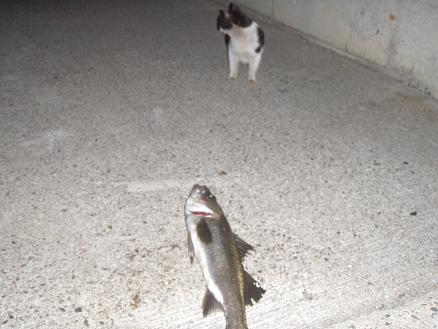
I guess cats don't often get a shot a fish this big

For some reason, this was one of the top results when I did an image search. From this random blog post about fishing.

Posted in Japanese, Yojijukugo | Tagged , , , , , | 1 Comment