Even Perlman?

論より証拠
(Ron yori shouko;
“Proof over theory”)

Definition:

The proof of the pudding is in the eating. Things tend to be clarified more by evidence than by arguing or philosophizing about them. Concrete examples are the first step and foundation when trying to prove a point, or to get someone’s agreement or understanding on a topic. The saying can also imply that one thinks abstract discussion in general is a pain.

Breakdown:

This simple assertion begin with the noun 論 (ron), “debate,” “theory,” “doctrine,” followed shortly by the noun 証拠 (shouko), “evidence,” “proof.” The particle より (yori) marks the latter as being in some way “more than” or “preferable to” the former.

Notes:

There are a number of phrases considered synonymous with this one, including 証拠が先 (shouko ga saki, “evidence comes first”), sometimes preceded by 論は後 (ron wa ato, “theory comes after”).

This phrase is attributed to the Edo-era joururi play titled 『神霊矢口渡』 (Shinrei yaguchi no watashi). It is the ro entry in the Edo iroha karuta set.

Example sentence:

「今朝天気予報で読んだことはどうでもいいさ。外に行ったら、雨が降っていたんだ。降るはずがないなんて言っても、論より証拠だ」

(“Kesa tenki yohou de yonda koto wa dou de mo ii sa. Soto ni ittara, ame ga futteita nda. Furu hazu ga nai nante ittemo, ron yori shouko da.”)

[“It doesn’t matter what you read in the weather report this morning! It was raining when I went outside. You can say that it’s completely unexpected, but proof beats theory.”]

Posted in Japanese, Kotowaza | Tagged , , , , , , | 1 Comment

The great insulator

Second only to sudden bereavement – Joan Aiken

一攫千金
i-.kkaku.sen.kin

Literally: one – take – thousand – gold

Alternately: Making a large profit at one stroke without much effort. Note that the instantaneous and easy nature of the wealth in question means that this phrase can’t be applied to even a great fortune if it was earned through steady effort.

Notes: This is a compound of compounds; 一攫 refers to “a single handful,” while 千金 indicates “a large amount of money.”

Replacing 攫 with homophone 穫 (“harvest”) is considered an error, but homophone 獲 (“to get,” “to earn”) is acceptable. Another variant replaces 千 with 万 (ban), “ten thousand.”

This phrase is attributed to our friend the Records of the Grand Historian (Japanese 『史記』 = Shiki).

 
If it doesn't have elaborate mind games, is it even really a manga?

Found in the title of a live-action adaptation of the gambling-centered manga 『賭博覇王伝 零』 = Tobaku haouden Zero, a.k.a. Gambling Emperor Legend Zero

Posted in Japanese, Yojijukugo | Tagged , , , , , , , , , | Leave a comment

Skating on thin wood

板子一枚下は地獄
(Itago ichimai shita wa jigoku;
“One plank below is perdition”)

Definition:

This sailors’ saying expresses the fact that sailing is a dangerous profession, and warns them to be careful while out on the water. Only a thin bit of wood separates you from what is likely to be your death if that protection ever fails. By extension, it can metaphorically describe a situation where a single error can result in disaster.

Breakdown:

We begin with the compound noun 板子 (itago), a plank that is specifically part of the flooring of a wooden boat. This is followed and modified by number-counter 一枚 (ichimai), “one flat thing,” and then associated (despite the lack of particles) with the noun 下 (shita), “down,” “below.” All this is marked as the topic of discussion by the particle は (wa), and the comment on this topic is the pithy compound noun 地獄 (jigoku), “hell.”

Notes:

In contrast to the unitary, eternal hell of Christian theology, Buddhism conceives of multiple hells, each with its own degree and style of awfulness, which pay off bad karma before the soul moves on to a different plane of existence. My sources don’t explain why the sailor is necessarily bound for a bad plane in the next life; perhaps it’s simply because a saying about how a finger’s breadth of wood is all that separates one from a pleasant afterlife wouldn’t make a very good warning.

One thing to be careful of is that an 板子 does not seem to be part of a ship’s hull; as near as I can make out, it’s either the part you walk on, and/or a trap-door in that floor that can be opened to provide access to the bilge compartment, at least on larger ships. Thus, the “plank” in question is not necessarily the part of a boat that keeps the water away, but rather the part that supports the sailor directly.

Another thing to be careful of is that read as Itako, 板子 appears to be a family name, although hardly a common one.

Variant phrases tend to specify that what separates the sailor from “hell” is a thickness of just 三寸 (sanzun), about 9 cm or 3.6 inches – or just 一寸 (issun), which is obviously one-third of that. Not all versions mention the physical board itself, and some merely call it by the generic term 板 (ita).

Example sentence:

「ね、一緒にあれ見ない?『ベーリング海の一攫千金』っていうアメリカの番組」 「嫌だヤダ!私、かなりの海洋恐怖症だよ。板子一枚下は地獄って考えるだけでお腹が痛くてしょうがない。絶対見たくない!」

(“Ne, issho ni are minai? ‘Beeringu-kai no ikkaku sen kin’ tte iu Amerika no bangumi.” “Iya da yada! Watashi, kanari no kaiyou kyoufu shou da yo. Itago ichimai shita wa jigoku tte kangaeru dake de onaka ga itakute shou ga nai. Zettai mitakunai!”)

[“Hey, you want to watch that show together? The American one, Deadliest Catch.” “No way, no! I’ve got a really bad phobia about the sea. It makes my stomach hurt so bad I can’t stand it, just thinking about how there’s just a plank between you and a watery grave. I definitely don’t want to watch it!”]

Posted in Japanese, Kotowaza | Tagged , , , , , , , , , , , , | Leave a comment

A shot, but not in the dark

Completely ignoring the phantom dog

(Today I got my second covid vaccine! “Injection” in Japanese is 注射, chuusha, so please enjoy this four-character compound containing 射.)

射石飲羽
sha.seki.in.u

Literally: shoot – stone – drink – feather

Alternately: If you throw yourself into something as hard as you can, with intense concentration, then there is no worry or difficulty you cannot overcome; nothing you cannot achieve.

Notes: This comes from a possibly-familiar story from our friend the Han shi waizhuan (Japanese 『韓詩外伝』 = Kanshi gaiden) in which Xiong Qu of Chu (熊渠, Japanese Yuu Kyo, of 楚, Japanese So) thought he had spotted a tiger crouching in the darkness. He loosed an arrow at it and struck home, only to find after approaching that he had shot a stone hard enough for the arrow to sink in all the way up to its fletching.

This is a compound of compounds; 射石 means “shooting [an arrow] into a stone,” while 飲羽 refers to “being taken in up to the feathers.”

 
They got the spike proteins wrong, though

Artist’s rendition: antibodies surrounding a virus

Posted in Japanese, Yojijukugo | Tagged , , , , , , , , , , , , | Leave a comment

If at first you don’t succeed…

…that’s perfectly normal, so wait.

(My records show that this is the 365th kotowaza post in the series! In celebration, I decided to use a saying that includes the character 年, “year.”)

商い三年
(Akinai sannen;
“Business dealings, three years”)

Definition:

A business takes three years to become profitable. More broadly, you shouldn’t expect instant success in a given endeavor; it takes time to settle in and learn the ropes, so have patience and hang in there even if things are tough at first.

Breakdown:

This simple phrase begins with the verb 商う (akinau), “to trade [in goods],” appearing in prenominal form and acting as a noun, compounded with number-noun 三年 (sannen), “three years.”

Notes:

Compare phrases such as 石の上にも三年 and 桃栗三年柿八年; apparently Japan has traditionally considered three years a good benchmark for patience and perseverance. Contrast the mere three days in 三日坊主.

Example sentence:

「ピアノを毎日頑張って練習してるのに、ちっとも上手くなってる気がしない」「まだ早いよ!商い三年って言うし、ピアノが嫌いじゃないなら少なくとも一年は続けてみないとわかんないよ」

(“Piano wo mainichi ganbatteru no ni, chitto mo umaku natteru ki ga shinai.” “Mada hayai yo! Akinai sannen tte iu shi, piano ga kirai ja nai nara sukunakutomo ichinenn wa tsudzukete minai to wakannai yo.”)

[“I’m practicing the piano every day, but it doesn’t feel like I’m getting any better at all.” “It’s still early! They say a business takes three years, so unless you really hate the piano, you won’t know unless you keep at it for at least a year.”]

Posted in Japanese, Kotowaza | Tagged , , , , , , , | 1 Comment

Seven is just the beginning!

子子孫孫
shi.shi.son.son

Literally: child – child – grandchild – grandchild

Alternately: One’s children and grandchildren; one’s descendants; posterity; until the end of history.

Notes: Each repeated character may be written with the repetition mark 々; the second 孫 (in either form) may be voiced as zon.

This phrase is an emphatic doubling of 子孫 (shison), “descendant.” It comes to us from the Book of Documents (Shujing), a truly ancient collection of rhetoric that we’ve met before.

 
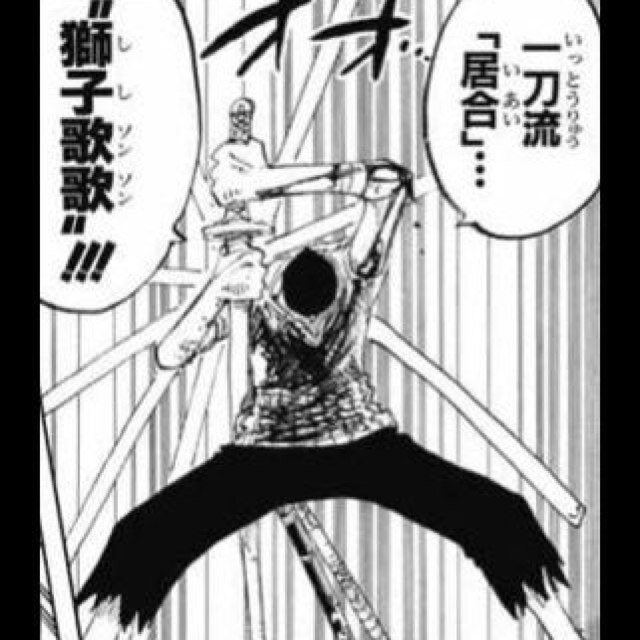
Shi shi shi, nan no oto?

I guess Zoro’s a bit of a punster

Posted in Japanese, Yojijukugo | Tagged , , , , , , , , , , , | Leave a comment

A cup of water onto the sand.

In the Dry Land.

爪で拾って箕で零す
(Tsume de hirotte mi de kobosu;
“Scraped up with the fingernails; spilled with a basket”)

Definition:

Some resource that was gathered slowly and with great effort over an extended period of time is used up in an instant. Often this suggests a sense of disappointment, or that the resource has been squandered. By extension, this phrase may describe a situation of meager income and huge expenses. The image is of grain painstakingly picked up by hand but then accidentally spilled again.

Breakdown:

We begin with the noun 爪 (tsume), “fingernail,” marked by the particle で (de) as the means by which the verb 拾う (hirou), “to gather,” “to pick up,” is performed. This verb appears in conjunctive form, and points us to a following, parallel verb phrase. This begins with the noun 箕 (mi), “winnowing basket” – that is, a shallow woven tray for shaking grain to separate it from chaff. This is also marked as the means of an action by the particle で (de), and the action in this case is 零す (kobosu), “to spill,” which appears in conclusive form.

Notes:

While some versions of this phrase write kobosu in kana as こぼす, every kanji version that I’ve found uses the character 零, despite this being a nonstandard reading for a character which is often read as rei and used to mean “zero.” The final verb may also be replaced with あける (akeru), “to empty [something].” Beyond this, there’s practically a genre of such sayings with work done by a small tool such as a needle or an ear-pick, and then undone by a much larger tool, such as a hoe or rake.

Example sentence:

「生き残ったことは勿論嬉しいけど、長い歳月を費やして蓄えて、全身全霊を注いで魔女用の帽子に編み込んだ魔力が火竜の襲撃であっと言う間に灰にされてしまって、爪で拾って箕で零したような鬱陶しい気持ちはずっと消えない」

(“Ikinokotta koto wa mochiron ureshii kedo, nagai saigetsu wo tsuiyashite takuwaete, zenshinzenrei wo sosoide majoyou no boushi ni amikonda maryoku ga hiryuu no shuugeki de a tto iu ma ni hai ni sarete shimatte, tsume de hirotte mi de koboshita you na uttoushii kimochi wa zutto kienai.”)

[“Of course I’m glad that I survived! But the magic power that I had spent long years building up, and that I poured body and soul into the work of weaving into a witch’s hat, was reduced to ash in the blink of an eye during the dragon’s attack. It’s like everything I’d scraped together by hand was dashed to the floor, and this heavy feeling won’t go away.”]

Posted in Japanese, Kotowaza | Tagged , , , , , , , , , | Leave a comment

I can see clearly now; I’m way up high

I can see all obstacles in my way

一望千里
ichi.bou.sen.ri

Literally: one – see / desire – thousand – ri

Alternately: A broad, expansive vista. Being able to see out to a great distance with a single glance; having a bird’s-eye view of things. By extension, a broad expanse of space.

Notes: This phrase has a number of synonyms, including 一望千 (ichi bou sen kei), where 頃 is a unit of land area, and 一望無限 (ichi bou mu gen), where 無限 is “limitless.”

 
IchiBouSenRiClouds

A common phenomenon in such a mountainous country. Source.

Posted in Japanese, Yojijukugo | Tagged , , , , , , , , | Leave a comment

Square Eggs that Look Round

“‘My dear old fish,’ said Mr Wonka, ‘go and boil your head!’” – he probably didn’t know about this saying.

丸い卵も切りようで四角
(Marui tamago mo kiriyou de shikaku;
“Even a round egg can be square, depending on how you cut it.”)

Definition:

A given thing will go smoothly – or not – depending on your choice of words and methods. Be careful, because the same essential content can create different impressions, or even cause offense, depending on the presentation. The devil’s in the details. Despite the image being the presentation of a cooked egg – in a way that gives it “horns,” despite the inoffensive roundness of its original shape – this saying mostly seems to refer to watching one’s tone while speaking.

Breakdown:

We begin with the adjective 丸い (marui), “round,” preceding and modifying the noun 卵 (tamago), “egg.” This is marked by the emphatic particle も (mo) as an extreme example of a given rule; “even.” The rule begins with the verb 切る (kiru), “to cut,” in prenominal form and acting as a noun; it is compounded with the noun よう (you, pronounced as a long “yo”), “form,” “style.” The compound is marked by the particle で (de) as the means by which something happens, but this is simply followed by the noun 四角 (shikaku), literally number-noun “four corners,” i.e. a rectangle or square. Any other structures or verbs are elided.

Notes:

This phrase is considered synonymous with, and sometimes followed by, the phrase 物も言いようで角が立つ (mono mo iiyou de kado ga tatsu), “a thing can cause offense depending on how it is said.”

Example sentence:

「学校の教師もそうかも知れないけど、チューターは特に、丸い卵も切りようで四角で、クライアントの間違いを直すときは、関係を損ねないように言葉遣いに気を付けないといけません」

(“Gakkou no kyoushi mo sou kamoshirenai kedo, chuutaa wa toku ni, marui tamago mo kiriyou de shikaku de, kuraianto no machigai wo naosu toki wa, kankei wo sokonenai you ni kotobadzukai ni ki wo tsukenai to ikemasen.”)

[“It’s probably the same for school teachers but especially for tutors, because presentation matters as much as content, when correcting a client’s mistakes, you need to pay careful attention to how you phrase things so as not to damage your relationship with them.”]

Posted in Japanese, Kotowaza | Tagged , , , , , , , , , , , | Leave a comment

We all agree with that man, Joe

And his Bizarre Adventures

満場一致
man.jou.i-.cchi

Literally: full – place – one – do

Alternately: Universal accordance. Unanimity. There is not a single dissenting voice in the entire place / group / assembly.

Notes: This is a relatively simple compound of compounds. 満場 is “everyone in the place”; 一致 is “of the same opinion.” (See also 言行一致 and 一致団結.)

 
HANAEMI

“And thus, we all agreed on shadow butterflies.”

Posted in Japanese, Yojijukugo | Tagged , , , , , | Leave a comment