Hearing is dreaming, seeing is believing?

Speech is silver, experience is lead

聞いて極楽見て地獄
(Kiite gokuraku mite jigoku; “Hearing is heaven, seeing is hell”)

Definition:

When you only hear about something second-hand it may sound amazing, but experiencing it personally is another matter. Use this saying in cases where “other matter” means “much worse.” Hearsay and experience tell different tales. Expectations don’t always match reality. Don’t trust nostalgia, or the impressions you get about people’s lives from social media, ha ha ha.

Breakdown:

We begin with the verb 聞く (kiku), “to hear” or “to listen,” in conjunctive form, followed by the noun 極楽 (gokuraku). Above I translated this word as “heaven,” but more specifically it refers to the Buddhist “Western Paradise,” or Sukhavati, a “celestial abode” inhabited by the Amida buddha.

Next we have the verb 見る (miru), “to see” or “to look,” again in conjunctive form. This is followed by the noun 地獄 (jigoku). Again, for the sake of pith I went with “hell” above, but more specifically the term refers to Naraka (Naraku in Japanese), a realm of suffering that souls with bad karma may be born into.

Notes:

Careful observers will note that everything but a pair of verbs and a pair of nouns is absent, so the precise grammar at work is somewhat open to interpretation. Rather than being a contracted form of something longer or a translation from Chinese, the phrase seems to have sprung into existence in its current form in the 18th century CE, first attested in 1797 in an Edo-era dictionary named 諺苑 (Gen’en), literally “garden of kotowaza.”

Let me just reiterate that while “heaven” and “hell” are convenient Western analogues for the general concepts indicated by 極楽 and 地獄, it would be a mistake to think that these terms represent anything like Christian thought. Remember especially that the Buddhist 地獄 is probably closer in concept to purgatory than to hell, as a temporary residence resulting from the weight of karma.

This is the ki entry of the Edo iroha karuta set.

Example sentence:

「大統領というのは凄まじい権力を揮えて、人生が楽になると思えてしまうが、実はそのようなことはない。仕事が多く、辛く、苦しく、寂しくて、しかも常に公衆の注目や批判を浴びされるので、結局のところ聞いて極楽見て地獄の重たい責任に過ぎないのだとすぐ悟ってしまったのである」

(“Daitouryou to iu no wa susamajii kenryoku wo furuete, jinsei ga raku ni naru to omoete shimau ga, jitsu wa sono you na koto wa nai. Shigoto ga ooku, tsuraku, kurushiku, sabishikute, shikamo tsune ni koushuu no chuumoku ya hihan wo abisareru no de, kekkyoku no tokoro kiite gokuraku mite jigoku no omotai sekinin ni suginai no da to sugu satotte shimatta no de aru.”)

[“A president wields terrifying power, so you’d think that life would be easy, but it tuns out that that’s not the case. There’s a lot of work; it’s tough and trying and lonely; and what’s more you’re always in the glare of public attention and criticism, so in the end he realized that the reality doesn’t match the expectation – it’s nothing more than a heavy responsibility.”]
Posted in Japanese, Kotowaza | Tagged , , , , , , | Leave a comment

What we need now is a more dangerous boat…?

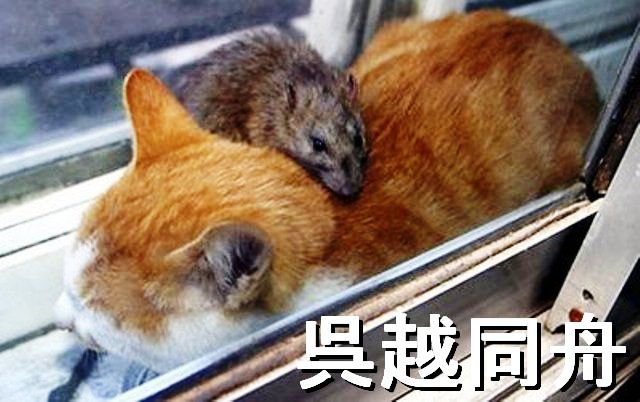
呉越同舟
go.etsu.dou.shuu

Literally: WuYue – same – boat

Alternately: Enemies in the same place at the same time, especially facing a common danger, challenge, or foe. People who would normally fight, forced by circumstances to work together. Being in the same boat.

Notes: This is a famous compound dating from the Spring and Autumn Period of Chinese history. If people from rival states Wu and Yue found themselves riding on the same boat, it goes, they would be constrained from fighting for fear of harming those around them, or damaging or capsizing the vessel itself. In fact, if a storm were to arise, they’d be forced to work together in order to survive. Similarly, if rivals within a foundering company or politicians from opposing factions within an endangered nation set aside their differences to work together, they’d be in a state of 呉越同舟. Wouldn’t that be nice?

GoEtsuByouSo

Only by working together can we accumulate enough naps!

Posted in Japanese, Yojijukugo | Tagged , , , , , , | Leave a comment

Why say good-bye

Hello, hello?

ああ言えばこう言う
(Aa ieba kou iu; “If (I) say this, (you) say that.”)

Definition:

Quibbling and back-talk. Arguing for the sake of arguing. No matter what advice or instruction one person gives, the other objects to as much of it as they can, often through insincere and annoying rhetorical strategies such as hair-splitting or ignoring the main point in favor of trivialities.

Breakdown:

This idiom has only one verb (used twice) and two adverbs, although their grammatical status is a little obscured by being quoted speech. We begin with ああ (aa), “in that way.” This is followed by 言う (iu), “to say,” in hypothetical form. Next comes こう (kou), “in this way,” and then again 言う in a form that could be sentence-final or prenominal.

Notes:

People unfamiliar with Japanese should note that there’s a pattern – the ko-so-a-do set – that informs a number of groups of words. The ko element is roughly equivalent to “this” in English, for something relatively close or related to the speaker. So and a are different flavors of “that”: the first is relatively close to the listener, while the latter is relatively detached from both speaker and listener. And do is the interrogative form. So for example, koko is “here,” soko is “over there (by you),” asoko is “over yonder,” and doko is “where?” (Yes, there are nuances and weird fringe cases, but that’s the gist.) The kou and aa of this phrase, along with sou and dou, are another such set, although aa is not in especially common usage in modern Japanese.

A number of variations on the theme of this idiom use other oppositional pairs such as east and west, left and right, or even mountain and river! Some versions may add the speech-marker particle と (to) or elide the second verb entirely.

Example sentence:

「結局、サークルは接し難くてああ言えばこう言う連中に乗っ取られちゃったから辞めるしかないと思った」

(“Kekkyoku, saakuru wa sesshi gatakute, aa ieba kou iu renchuu ni nottorarechatta kara, yameru shika nai to omotta.”)

[“In the end the club was overrun by a bunch of bothersome types who always had to contradict everything you say, so I thought I had no choice but to quit.”]

Posted in Japanese, Kotowaza | Tagged , , , , | Leave a comment

Now flying at the speed of internet

流言蜚語
ryuu.gen.hi.go

Literally: flow – word – cockroach – speech

Alternately: Baseless rumors. Canards.

Notes: The rare character 蜚 may be replaced with homophone 飛 (“fly”), but why would you want to do that?

RyuuGenKoDomo

She did what to who for how many coconuts?!?

Posted in Japanese, Yojijukugo | Tagged , , , | Leave a comment

Pay it forward…

…until it comes back?

情けは人の為ならず
(Nasake wa hito no tame narazu; “Compassion isn’t just for the sake of others”)

Definition:

Showing pity, mercy, or compassion for others isn’t just a favor you do to them; it’s for your own sake as well, because eventually what goes around comes around. Those who treat others with kindness benefit themselves as well. Be good to people, yo.

Breakdown:

We begin with the noun 情け (nasake), with meanings ranging from “affection” to “sympathy” to “mercy.” The particle は (wa) marks it as the topic of discussion, so what follows is a comment on such goodwill. Next we find 人 (hito), literally “person” but in this case indicating “other people.” The associative particle の (no) links 人 with 為 (tame), “benefit,” “purpose,” or “result.” Finally we close with the verb なる (naru), “to become,” which in older Japanese was often used as a copula. Here it appears in imperfective form with the negative suffix ず (zu) in sentence-final form.

Notes:

The meaning of this saying seems to be shifting a bit, losing the idea that kindness benefits everyone rather than just the person showing it, and moving toward kindness being “not for the sake of others” – i.e. it’s simply for your own sake that you should practice compassion and allow yourself to feel affection. A fine distinction, perhaps, but it’s worth keeping in mind that usage and nuance have shifted over time.

Example sentence:

「山田くんが明日の試験がヤバいから今日のバイトを休みたいって言ってたから代わってあげようと思ってるんだー。情けは人の為ならず、って言うし、いつか私も困った時には誰かに助けてもらうことあるだろうしさ。」

(“Yamada-kun ga ashita no shiken ga yabai kara kyou no baito wo yasumitai tte itteta kara kawatte ageyou to omoun da. Nasake wa hito no tame narazu, tte iu shi, itsuka watashi mo komatta toki ni wa dare ka ni tasukete morau koto aru darou shi sa.”)

[“Yamada-kun’s in real trouble over the test tomorrow, so he was saying he wanted to take the day off work today. So I’m thinking of taking over his shift. They say that what goes around comes around, so maybe some time when I’m in trouble somebody will help me, see.”]

Posted in Japanese, Kotowaza | Tagged , , , , | Leave a comment

Hagoromo

Or, you know.

天衣無縫
ten.i.mu.hou

Literally: heaven – clothing – no – stitch

Alternately: Naturally flawless and beautiful. Amazingly well-made, without any sign of artifice. Usually refers to poetry, or to a person’s unaffected innocence of character.

Notes: A number of East Asian folktales include Tennin or Tennyo (天人, 天女), “heavenly people,” whose beautiful clothing has no visible stitching.

Apparently this yojijukugo goes back to the Song Dynasty in China, from a collection of stories known as the Taiping Guangji (太平広記), Taihei kouki in Japanese.

TenITaoru

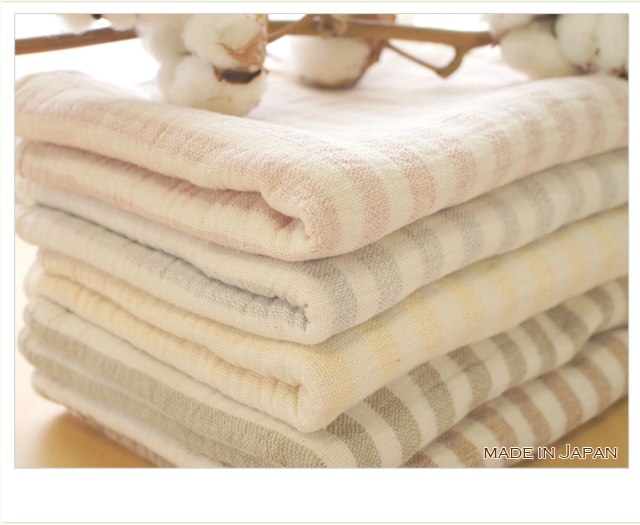
But of course an image search produces mostly hits for textiles.

Posted in Japanese, Yojijukugo | Tagged , , , , , | 1 Comment

Out of mouth, out of mind

喉元過ぎれば熱さを忘れる
(Nodomoto sugireba atsusa wo wasureru; “To forget the heat after swallowing”)

Definition:

No matter how painful a situation was, the pain – or alternately, the debts owed to people who helped out when times were bad – are quickly and easily forgotten once the situation is over. The image is of a hot drink (or food) that burns your mouth, but no longer bothers you once it’s been swallowed.

Breakdown:

We begin with the noun 喉元 (nodomoto), “the base of the throat,” and then the verb 過ぎる (sugiru), “to go past,” in conditional form. (This may feel odd grammatically because the thing performing the verb is presumably the hot drink, which doesn’t explicitly appear in the sentence.) After this we come to the main clause. The particle を (wo) marks the noun 熱さ (atsusa), “heat,” as the object of a verb, and the verb itself is 忘れる (wasureru), “to forget,” in sentence-final form.

Notes:

Replacing 熱 with homophone and near-synonym 暑 is an error: the former refers to the heat held within a physical object, while the latter is ambient heat in the air.

This is the の entry of the Edo iroha karuta set.

Example sentence:

「勇介くんは何人にフラれてもすぐ別の女の子に惚れて告白しちゃうね」 「うん、喉元過ぎれば熱さを忘れる人ね」 「そうかな。ただの信頼のできないバカなプレイボーイじゃない?」

(“Yuusuke-kun wa nannin ni furarete mo sugu betsu no onna no ko ni horete kokuhaku shichau ne.” “Un, nodomoto sugireba atsusa wo wasureru hito ne.” “Sou ka na. Tada no shinrai no dekinai baka na pureibooi ja nai?”)

[“No matter how many people have turned him down, Yuusuke turns around and falls for another girl.” “Yeah, he’s one of those people who forget their pain as soon as it’s passed.” “Maybe. Or is he just an unreliable idiot playboy?”]

Posted in Japanese, Kotowaza | Tagged , , , , , | 2 Comments

The widening gyre

But the centre yet holds?

物情騒然
butsu.jou.sou.zen

Literally: thing – emotion – noisy – “in that way”

Alternately: Widespread unrest and turmoil. Something, especially society at large, in a state of upheaval, disturbance, convulsion, and kerfuffle. Even if you’re reform-minded, not the best way to live.

Notes: This is another combination of two two-character compounds. 物情 is popular sentiment. 騒然 is a state of disruption and instability.

ButsuJouKakuMei

Open carry of swords leads directly to revolution, I guess.

Posted in Japanese, Yojijukugo | Tagged , , , , | Leave a comment

A sinister retirement package

If you’re a lefty, do you substitute in 右?

左団扇で暮らす
(Hidari uchiwa de kurasu; “Living with a fan in your left hand”)

Definition:

Living a life of ease and relaxation. A lifestyle without stress or worry. The image invoked is of an aristocrat lounging around, no work to do beyond idly fanning themselves with a fan in the off-hand. For some reason, the fan being in the left hand for idle fanning seems to be an important element. (Perhaps if you want to seriously cool off, you use the dominant hand?)

Breakdown:

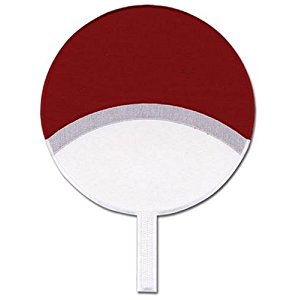
This brief idiom is nonetheless a complete sentence. Our noun is 団扇 (uchiwa) – a round, stiff fan of a design that any Naruto fan (ha ha) should find instantly familiar. This is modified by 左 (hidari), a noun meaning “left,” shorthand for “held in the left hand.” The particle で (de) indicates that the noun is the means by which the verb is performed, and the verb is 暮らす (kurasu), “to live,” “to spend time,” in sentence-final form.

Uchiha

Yup, the うちは (Uchiha) clan is literally the “fan clan.”

Notes:

In addition to invoking the image of idle aristocrats, this phrase carries connotations of a style of retirement, of taking things easy after (presumably) a life of satisfying accomplishments.

This phrase may be condensed down to the noun phrase 左団扇 to signify “ease and comfort.” The predicate may also be replaced with を使う (wo tsukau), “to use,” or 団扇 may be replaced with 扇 (ougi), a folding fan.

Example sentence:

「幼いとき、左団扇で暮らしたかったけど、年を取ると次第に晴耕雨読の生活に憧れてきた。可笑しいでしょう」

(“Osanai toki, hidari uchiwa de kurashitakatta kedo, toshi wo toru to shidai ni seikouudoku no seikatsu ni akogarete kita. Okashii deshou.”)

[“When I was a little kid I wanted to live a life of ease, but as I got older I started longing for a life of both outdoor work and study. Funny, right?”]

Posted in Japanese, Kotowaza | Tagged , , , , , , , | Leave a comment

🎶So🎶

Later someone invented a system of eight directions.

四面楚歌
shi.men.so.ka

Literally: four – face – Chu – song

Alternately: Completely alone and cut off, surrounded by enemies. Having foes in all (four cardinal) directions. Feeling forsaken and betrayed.

Notes: This thoroughly historical compound comes to use from the Records of the Grand Historian, in the chapter on Xiang Yu, a warlord who was eventually defeated by the first emperor of the Han dynasty. The story goes that the Han forces constantly harassed and ambushed the Chu, and at night attacked them psychologically by forcing captured Chu soldiers to sing the songs of their homeland. Thinking that their own country had been overrun while they were campaigning in enemy territory, many of Xiang Yu’s army deserted. In the end he and his dwindling force were hunted down and defeated. Xiang Yu himself is said to have committed suicide.

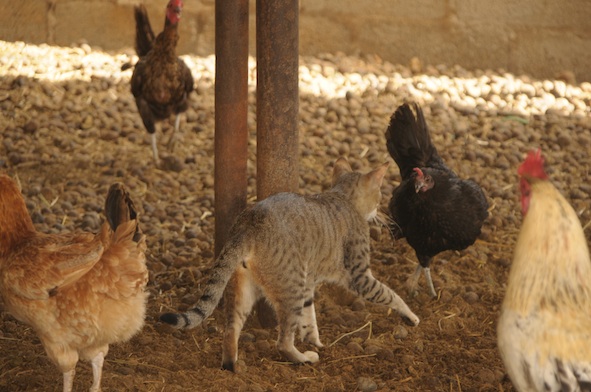
ShiMenChiKens

With the twist that the cat suspects that a couple of the chickens used to be cats but changed sides… because they’re meowing.

Posted in Japanese, Yojijukugo | Tagged , , , , , , , , , | 1 Comment