Never bring a gun to a stats fight

Seriously; that’d be a crime.

下手な鉄砲も数撃てば当たる
(Heta na teppou mo kazu uteba ataru;
“Even an inept gun, fired a number of times, will hit.”)

Definition:

Even if someone is very bad at something, with enough tries they’ll produce strong results or success every now and then out of pure chance. Take enough shots, and one of them is bound to get lucky. Bear in mind that this is about statistics, where good results are produced by random chance from a high volume of attempts, rather than the change-averse trait of “even a stopped clock is right twice a day,” in which (for me, at least), someone holds to one belief or strategy that is usually wrong, and benefits when the situation matches it.

Breakdown:

We begin with noun 下手 (heta), “unskilled,” with particle な (na) allowing it to act as an adverb and modify the noun 鉄砲 (teppou), “gun.” This is marked by emphatic particle も (mo), here acting like the English adverb “even.” It also subsumes an implied topic-marker は (wa), and the remainder of the phrase is the comment on this topic.

The comment begins with what looks like the noun 数 (kazu), “number,” but is actually acting as an adverb: “frequently,” “repeatedly.” This modifies the verb 撃つ (utsu), “to hit,” “to attack,” “to shoot (at),” which appears in perfective form with conditional suffix ば (ba), “when.” And the following conditional clause consists of the verb 当たる (ataru), “to hit,” “to be accurate,” “to go well,” etc. (among myriad other possible translations) in conclusive form.

Notes:

撃てば may be contracted to 撃ちゃ (ucha), and/or the kanji 撃 may be replaced with homophone 打, without any change in meaning.

A variant saying asserts that 下手な鍛冶屋も一度は名剣 (heta na kajiya mo ichido wa meiken), “Even an unskilled smith will produce one high-quality sword.”

This phrase can be insulting (as you’d expect, given the use of 下手), so use with caution in conversation or public discourse.

A couple of my sources claim that this comes from an English saying, “He that shoots oft at last shall hit the mark.” To be honest, I’ve never heard this before and most search results seem to be for Japanese pages making the same assertion, so take this with a grain of salt.

Example sentence:

下手な鉄砲も数撃てば当たるだろうと思って、拙著を数十社の出版会社に送ってみました」

(Heta na teppou mo kazu uteba ataru darou to omotte, seccho wo suujuusha no shuppan gaisha ni okuttte mimashita.”)

[“Believing that even a terrible marksman will hit the target with enough shots, I tried sending that little thing I wrote to several dozen publishing companies.”]

Posted in Japanese, Kotowaza | Tagged , , , , , , , , | 1 Comment

Kaitenzushi

I certainly prefer it to the pork

行雲流水
kou.un.ryuu.sui

Literally: go – cloud – flow – water

Alternately: Going where the wind and tides carry you, instead of sticking with one thing or staying in one place. Constantly changing rather than keeping a single shape. By extension, this phrase may also describe a Zen priest on a pilgrimage.

Notes: This phrase is attributed to the writings of Song-era Chinese poet and government official Su Shi (蘇軾, Japanese So Shoku), perhaps via the epic history text, the History of Song (Japanese 『宋史』 = Sou shi).

The order of the parts may be switched to 流水行雲 without any change in meaning, although this version seems to be relatively rare.

A little worried about that red spot

The name of an actually completely stationary restaurant in Nagano (site). Appropriately enough, 蘇軾’s “art name” Dongpo (東坡, Japanese Ton Po) was also given to a roast pork dish that he is credited with inventing.

Posted in Japanese, Yojijukugo | Tagged , , , , , , , , , , , | Leave a comment

Hefty fluff

重箱の隅を突く
(Juubako no sumi wo tsutsuku;
To poke at the corners of a juubako”)

Definition:

To fuss over trivial details; to nitpick; to carp endlessly about fine points that don’t actually make a difference. The image is of someone who has essentially finished their meal, but uses a toothpick to pick tiny bits of food out of the corners of the tray. The phrase has a negative nuance and is commonly invoked to criticize someone’s behavior or attitude.

Breakdown:

We begin at the end with the verb 突く (tsutsuku), “to poke,” in conclusive form. The particle を (wo) marks the noun 隅 (sumi), “corner,” “recess,” as the object of the verb. Meanwhile, the associative particle の (no) associates 隅 with, and allows it to be modified by, the noun 重箱 (juubako), a “multi-tiered food box.”

Notes:

Bear in mind that while the English “corner” can refer to a convex or a concave angle, 隅 is only concave; it refers to the “inside” part of a corner. The “outside” (convex) part is a 角 (kado), as seen in terms like 三角 (sankaku), “triangle.” Naturally, replacing 隅 with 角 is an error.

That said, this saying does allow for quite a few variations. Tsutsuku may be written in kana as つつく. It may be replaced by ほじくる (hojikuru), “to dig out,” “to pick [one’s nose, teeth, etc.].” The specificity of の隅 may be elided, or specificity may be added by saying that the picking is done 楊枝で (youji de), “with a toothpick”; this may be added at the beginning of the sentence, or just before the verb.

重箱 is a fascinating word. It’s a rare example of a compound in which one character uses the Chinese-origin on reading while the other uses the Japanese-origin kun reading (in this case, respectively juu for 重 and hako for 箱). In fact, juubako is the ur-example of an on/kun combination, while the kun/on equivalent is 湯桶 (yutou), a “container for hot liquids” that might be used to serve drinks, or for washing in a traditional bath or onsen. Beyond this, while 重 is commonly translated as “heavy,” here we see it refer to something that is “piled up” or “layered”; cf. 二重 (futae), “twofold.”

Taro!

A decorated juubako, from Wikimedia Commons

Example sentence:

「お兄ちゃんが塾に通い始めてから、何でもかんでも重箱の隅を突くような言い方をするようになった。なんでだろう、ちょっと嫌な気分」

(“Oniichan ga juku ni kayoi hajimete kara, nandemo kandemo juubaku no sumi wo tsutsuku you na iikata wo suru you ni natta. Nande darou, chotto iya na kibun.”)

[“Ever since my big brother started going to cram school, he’s been nitpicking every little thing, no matter what we’re talking about. I wonder why; it’s kind of gross.”]

Posted in Japanese, Kotowaza | Tagged , , , , , , , , | Leave a comment

A life spent just hanging around?

一生懸命
i-.sshou.ken.mei

Literally: one – life – hang / depend – life / destiny / decree

Alternately: Putting maximum effort into something. Striving as hard as you can; putting your very life on the line.

Notes: The original form of this phrase used 所 (sho – note the short vowel), “place,” rather than 生. This form has almost identical pronunciation and meaning, although the 一所 carries connotations of someone (such as a samurai) staking their life on the maintenance and defense of the domain they had been placed in by their lord; that territory might be called 一所懸命の土地 (isshoukenmei no tochi), where tochi is “land,” or “place.”

The version that uses 生 spread and eventually became more common in the modern era after the feudal system was abolished, travel became free and widespread, internal warfare died out, and 一所 was rendered largely irrelevant to the Japanese lifestyle. One may still find the 一所 version here and there; the main issue is to pronounce each version with the correct vowel length.

This is such a common phrase that I was shocked to discover that I don’t seem to have done a post on it yet! Well, better late than never.

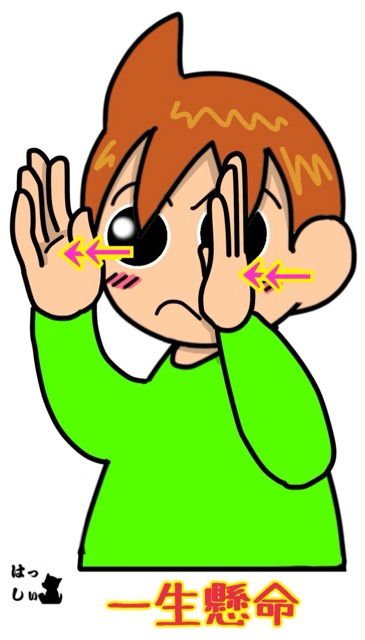
Experts disagree on whether the hair spike is necessary for proper 手話.

The Japanese sign language sign for 一生懸命, from this site. My daughter saw this image and declared that it was a picture of her, so I am required to use it in this post.

Posted in Japanese, Yojijukugo | Tagged , , , , , , | Leave a comment

Next verse, same as the first

二の舞を演じる
(Ni no mai wo enjiru; “to dance the second dance”)

Definition:

Committing someone else’s previous errors, even with the awareness of what has happened. Seeing someone fail, and then making the same mistakes.

Breakdown:

This simple phrase begins three characters in with the noun 舞 (mai), “dance.” The associative particle の (no) connects it to, and modifies it with, the number 二 (ni), “two.” The resulting noun phrase is marked as the object of a verb by the particle を (wo), and the verb in question is 演じる (enjiru), “to perform,” in conclusive form.

Notes:

This saying is based on a gagaku (classical court music) performance in which a dance called the Ama (安摩) was followed by a second dance (the 二の舞) that followed the form of the first but with comedically exaggerated errors. (The curious can watch a nearly 30-minute performance here; it’s probably very different from what you expected!) The saying used to simply refer to a “repeat performance,” but over time greater emphasis has been placed on the making of mistakes.

Original* verb form 演る (enzuru) is also perfectly acceptable, although apparently less common (*In the sense that the ~じる structure is derived from the ~ずる structure as a way to turn nouns into verbs.)

Another expression that may appear almost identical at first glance is 二の足を踏む (ni no ashi wo fumu), literally “to take a second step,” but in use meaning “hesitation.” Mixing the two up and writing this “dance” saying as 二の舞を踏む (ni no mai wo fumu, where 踏む is “to (take a) step,”) is technically an error, but has been a common enough occurrence that it may pass unremarked-on. However, replacing 演じる with 繰り返す (kurikaesu), “repeat,” is considered an error.

Example sentence:

「準決勝で砂田に先手を打たれてすぐに負けてしまった先輩の二の舞を演じたくないから、明日の試合に備えてアイツの技をしっかり見学して把握しておこうと思う」

(“Junkesshou de Sunada ni sente wo utarete sugu ni makete shimatta senpai no ni no mai wo enjitakunai kara, ashita no shiai ni sonaete aitsu no waza wo shikkari kengaku shite haaku shite okou to omou.”)

[“I don’t want to just repeat the way sempai immediately lost the initiative, and the match, to Sunada, so I’d like to prepare for tomorrow’s match by watching his technique until I really get how it works.”]

Posted in Japanese, Kotowaza | Tagged , , , , , , | Leave a comment

Child Development: Words with character(s)

The Tomato Princess has been expanding her vocabulary day by day, and it’s interesting watching the way she’s trying out the use of various words.

When her older brother was the same age, we actually used quite a lot of English at home; so much so that sometimes it catches me off-guard when we watch videos from those times. But when he started going to daycare (where they spoke mostly English and a little bit of Spanish), we got worried that he would end up like so many American-raised children whose parents speak a second language. I’ve met quite a few people who are able to understand the non-English language; they can speak and read it to some degree, but they’re hesitant about speaking or writing and tend to default to English, even to the point of carrying on bilingual conversations where they reply in English while their parents speak to them in their ostensible mother tongue. If possible, we’d like our kids to be fully bilingual, so when the Kid was in daycare we switched to (almost-)all Japanese at home, and that’s been working out pretty well for us so far.

So, the Tomato Princess has picked up “Oh no!” somewhere, and will pull it out for the cutest exclamations at odd moments throughout the day, but other than that her vocabulary is largely in Japanese.

The word for “ear” is mimi (耳), which she’s been able to say for a while now. But she also uses a lone mi to say both “eye” (目 = me, pronounced like “meh”), and “glasses” (眼鏡 = megane).

She’s picked up her brother’s love of drawing, and will ask for a pencil with empichi (鉛筆 = enpitsu) before drawing dozens of little blobs, solemnly declaring each one a bee (蜂 = hachi, which she pronounces correctly).

She can say both “poop” (うんち = unchi) and “pee” (expressed onomatopoetically in a book on potty training as しいしい = shiishii), but tends to use unchi to announce every diaper event. This is still a little worrisome, because we need to check every time, but before we got used to it, this habit caused a few high-alert situations.

Finally (for now), she’s somehow managed to combine “raisin” (レーズン = reezun) and “water” (水 = mizu) into miizun, and uses the same phrase to ask for both, so it takes a little context-assessing or back-and-forth to discover whether she’s asking for a drink or a snack.

She’s also learned a number of other words and phrases, of course! She’s even started combining them into multiple-word sentences of a sort. But the above are what stand out in my memory right now as particularly interesting or cute.

Lest the Kid be forgotten, he’s progressing in his studies as well! We’ve started a practice of daily sentence-writing (he invents one on whatever topic he wants, while one of his parents dictates another). While one hopes this refines his skills in grammar, word choice, and creativity, the two primary goals are good handwriting and kanji mastery.

And… it’s working! While he grumbles and complains about being sent back to erase and rewrite, his characters are more legible than the handwriting of many university-age students of Japanese – even ones with comparable amounts of practice in reading and writing, and presumably superior study skills – and he’s closing in on being able to write 200 kanji characters at will.

Compared to the Japanese school system, this puts him more or less on track. While the standard curriculum only demands that students master 80 kanji by the end of first grade, most children know rather more than that by the virtue of simple daily exposure. And I don’t doubt that our home-teaching is lacking in several areas compared to the comprehensive Japanese-language education gained simply by going to a Japanese school and speaking the language with a variety of people all day every day, I feel relatively confident that we’re hitting the mark as far as our goal of bilingualism is concerned, kaynahara.

Now all we need to do is keep it up, every day, for another dozen years (for the Kid) and 17 years or so (for the Tomato Princess), and after that it’s up to them! Easy peasy, lemon squeezy! (Well, no; but at least it’s relatively fun.)

Posted in Musing, Nonfiction | Tagged , , , , , , | Leave a comment

If you meet the Buddha on the road, eff him

Is the word “ineffable” a paradox?

不立文字
fu.ryuu.mon.ji

Literally: non – stand – sentence – letter

Alternately: The Buddhist observation that satori (“understanding,” specifically insight into the true nature of reality) is not something that can be written down or put into words. By extension, anything difficult or impossible to express. Ineffability; indescribability.

Notes: This phrase seems to be particularly associated with Zen Buddhism, and is attributed to a 13th-century CE koan collection, The Gateless Barrier (Japanese 『無門関』 = Mumonkan)

Reading 不立 as furitsu or 文字 as moji is considered an error.

There are a number of synonyms and related terms, including 以心伝心 and 拈華微笑.

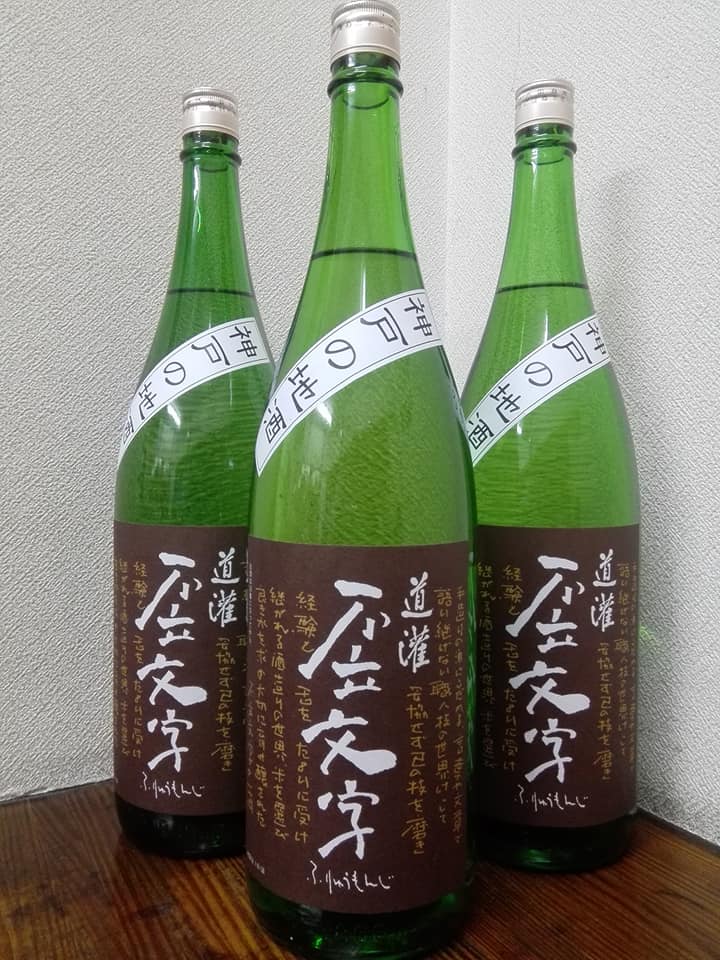
From Kobe! That's an interesting town; well worth a visit.

An apparently-indescribable rice wine

Posted in Japanese, Yojijukugo | Tagged , , , , , , , | Leave a comment

As you sow, so shall you reap… the opposite!

楽は苦の種苦は楽の種
(Raku wa ku no tane ku wa raku no tane;
“Ease is the seed of hardship; hardship is the seed of ease”)

Definition:

If you spend all your time taking things easy, you’ll fall on hard times later on as a result; if you push yourself through problems or challenges now, things will be more stable later on and you can take it a little easier. Ease and effort are two sides of one system, and each feeds into the other. Get your work done early lest you regret it later.

Breakdown:

We begin with the noun 楽 (raku), “ease,” “comfort,” marked as the topic of discussion by the particle は (wa). The comment on this topic centers on the noun 種 (tane), “seed,” modified via the associative particle の (no) by the noun 苦 (ku), “suffering,” “hardship.” We may imagine an elided copula here; what follows is a parallel phrase that is almost identical, except that switches 苦 into the topic position, while 楽 becomes its seed.

Notes:

The two phrases may be separated by a comma. More distant, but synonymous, phrases include 楽あれば苦あり (raku areba ku ari), “if there is ease, there is also suffering” – the ら entry of the Edo iroha karuta set – and 苦する良かろう楽する悪かろう (ku suru yokarou raku suru warukarou), “suffering, likely good; ease, likely bad.”

For me, this saying raises all sorts of complicated topics. It’s perfectly possible to have a life of ridiculous ease paid entirely for by the labor of others, for example, if you were born into wealth, and it’s all too common to have a life of hard work with little reward for many who weren’t. And the structure itself may call to mind the idea (which I find to be convincingly discredited here!) that “hard times create strong men. Strong men create good times. Good times create weak men. And weak men create hard times.” It’s likely best to think of this saying as simply an admonition to get your work done sooner, so that you may enjoy its fruits in comfort later.

Example sentence:

「最近、災難続きでしんどいけど、楽は苦の種苦は楽の種って思えばまだ頑張れそうだよ」

(“Saikin, sainan tsudzuki de shindoi kedo, raku wa ku no tane ku wa raku no tane tte omoeba mada ganbaresou da yo.”)

[“Lately it’s just been one disaster after another and I’m wiped out. But as long as I keep in mind that ease fosters hardship while hardships foster ease, I can keep going.”]

Posted in Japanese, Kotowaza | Tagged , , , , , , , , , | 1 Comment

Just lions having fun!

And… gin?

獅子奮迅
shi.shi.fun.jin

Literally: lion – child – vigorous – quick

Alternately: Highly-energetic, even violent activity. Doing things in a furious, intense, or overwhelming way. Ferocious, or at least energetic, like a lion.

Notes: This phrase apparently comes to us from the Mahaprajnaparamita Sutra (Japanese 『大般若波羅蜜多経』 = Daihannyaharamitta kyou, often shortened to 『大般若経』 = Daihannya kyou), and started its life in Japan as a Buddhist term, although it has since passed into broader lay usage.

While 奮進 (funshin) is a near-homonym and even a synonym to 奮迅 (they both refer to dashing forward energetically), replacing 迅 with 進 in this compound is an error.

獅子 is one of those words that almost demands you look up its etymology: why is there a “child” in lion? It turns out that the reason is simple phonetics: the Chinese adapted the Sankrit word for lions, simha (cf. the singa in Singapore) using 師 (shi) and 子 (zi), and then added the “beast radical” 犭 to produce 獅子. It helps that in Japanese, shishi can refer to “wild animals” in a generic sense, being both one of the readings of 鹿, “deer,” (cf. 鹿威し, shishi odoshi) and a component of 猪, inoshishi, “wild boar.”

But is it fiercer than a CRAB BATTLE!!?!?!?!?

Lions may be big cats that spend most of their time sleeping, but you’d forget that too if you saw this up close and personal.

Posted in Japanese, Yojijukugo | Tagged , , , , , , , , , , , | Leave a comment

If you want good fruit, sleep on it

果報は寝て待て
(Kahou wa nete mate; “For good fortune, sleep, wait.”)

Definition:

Good fortune will come of its own accord, in its own time, so it’s best to prepare and patiently wait for it rather than fretting or trying to force things. There are limits to what any of us can do with our own power, so it’s best to do what you can and then let things run their course. Good things come to those who wait.

Breakdown:

We begin with the noun 果報 (kahou), which translatable as “good fortune” or “happiness,” but in a more literal reading (“fruit reward” or “fruit news”) we see its Buddhist meaning of Vipāka, that is, karmic payoff. (Cf. 因果応報.) This load term is marked as the topic of discussion by the particle は (wa), and the comment on this topic is an admonition: the verb 寝る (neru), “to sleep,” in conjunctive form (as simply 寝, ne), taking the suffix つ (tsu), itself in conjunctive form as て (te); this structure as a whole is being used to mark a connected series of verbs. This “series” is rounded out by 待つ (matsu), “to wait,” in imperative form.

Notes:

Replacing 果報 with homophone 家宝 (“heirloom,” literally “family treasure”) is an error. Variant phrases may replace it with 運 (un, “luck”) or 福 (fuku, “good fortune”), however. Compare and contrast 待てば海路の日和あり and 蒔かぬ種は生えぬ (alternately, this….)

Keep in mind that just waiting is not recommended; this proverb simply reminds us that you don’t always see the fruit of your labor or deeds right away. One should do all necessary (or possible) work, but then calmly wait for the payoff instead of wasting energy by stressing over it.

This saying is attributed to our friend, the poetic collection 『毛吹草』 (Kefukigusa). Perhaps surprisingly, it is the く (ku) entry of the Osaka iroha karuta set, because 果 used to be pronounced kwa (rendered as くゎ in modern orthography) – cf. terms like 怪談 as kwaidan.

Example sentence:

「うん?冷静じゃないか、入学試験の結果の報告を待ってる割に。緊張しないのか?」「緊張しても結果は変わらないじゃないか。一生懸命勉強して試験でやりきったと思うから、後は果報は寝て待つだけさ」

(“Un? Reisei ja nai ka, nyuugaku shiken no kekka no houkoku wo matteru wari ni. Kinchou shinai no ka?” “Kinchou shite mo kekka wa kawaranai ja nai ka. Isshoukenmei benkyou shite shiken de yarikitta to omou kara, ato wa kahou wa nete mate dake sa.”)

[“Hm? You’re awfully chill, for someone waiting on the results of their entrance exams. Aren’t you nervous?” “How would being nervous help? I believe that I studied as hard as I could, and followed through on the test itself, so after that it’s just a matter of waiting for my work to bear fruit.”]

Posted in Japanese, Kotowaza | Tagged , , , , , , , , , | 1 Comment