Inception, but with normal gravity

自己暗示
ji.ko.an.ji

Literally: self – self – dark – show

Alternately: Self-suggestion. Working to convince yourself that something is true, or implant an idea, perception, or similar mental construct in one’s own head. This can range from self-hypnosis, to daily affirmations, to someone with crippling delusions trying to scream reality into the shape he wants. (The latter is not recommended.)

Notes: This is another compound of compounds; 自己 is “oneself,” while 暗示 is “to show or convey something indirectly,” “to hint.”

As always, replacing 己 with similar-looking characters such as 巳 (mi, the Chinese-zodiac sign for “snake”) or 已 (i, “stop,” “already”) is an error.

For the more positive kind, check out this relentlessly dorky video:

Posted in Japanese, Yojijukugo | Tagged , , , , , | Leave a comment

At the foot of a difficult wave

難波の葦は伊勢の浜荻
(Naniwa no ashi wa Ise no hamaogi;
“What they call ashi in Naniwa is hamaogi in Ise”)

Definition:

Different places are different – they have different manners, different customs, and even different words for the same things, so be aware. Don’t expect everything to be the same everywhere.

Breakdown:

We begin with place name 難波 (Naniwa), an area in Osaka whose name is now read as Nanba, followed by the noun 葦 (ashi), a kind of reed. The associative particle の (no) shows that the ashi “belongs to” Naniwa.

Similarly, the following phrase begins with place name 伊勢 (Ise), a place in Mie prefecture known for the Ise Jingu shrine; the particle の again associates with this place the noun 浜荻 (hamaogi)… which can mean multiple things, including a form of seaside grass, but which in this case refers to the exact same plant as 葦.

These two noun phrases are joined by the particle は (wa), in this case acting as a topic marker and implying that one half of the phrase matches the other.

Notes:

It’s only natural that this kind of saying would have a number of variations! These range from the very general 所変われば品変わる (tokoro kawareba shina kawaru), “when the place changes, the [physical] things also change,” to the very specific 品川海苔は伊豆の磯餅 (Shinagawa nori wa Izu no isomochi), which seems to be comparing regional specialty foods – in this case, sheets of dried seaweed versus a style of pounded-rice cake.

Example sentence:

「ニューヨーク市に引っ越して、ヒーローってメシを食べてみようと思って行ってみたら、ただのサブマリン・サンドイッチだったんだ。アメリカも難波の葦は伊勢の浜荻で食べ物の名前に地方差があるみたい」

(“Nyuuyooku-shi ni hikkoshite, hiiroo tte meshi wo tabete miyou to omotte itte mitara, tada no sabumarin sandoicchi datta nda. Amerika mo Naniwa no ashi wa Ise no hamaogi de tabemono no namae ni chihousa ga aru mitai.”)

[“After moving to New York I thought I’d go try this food called a “hero,” but it was just a sub sandwich! It looks like American food has its own regional naming variations, just like Naniwa’s ashi and Ise’s hamaogi.”]

Posted in Japanese, Kotowaza | Tagged , , , , , , , , , | 1 Comment

Crane your neck to look at the clouds

閑雲野鶴
kan.un.ya.kaku

Literally: leisure – cloud – field – crane (bird)

Alternately: A relaxed, hermit-like lifestyle in a natural setting, far from worldly cares and social intrigues. The pleasant side of isolation.

Notes: This is another compound of compounds. 閑雲 is exactly what it sounds like: a carefree cloud floating in the sky. And 野鶴 is a crane playing in a field.

This comes to us from the early 18th century CE Chinese poetry anthology Quan Tangshi (Japanese 『全唐詩』 = Zen Toushi) – or from a collection of stories or essays based on the poems? – apparently discussing the lifestyle of someone who has retired from public life to take Buddhist vows.

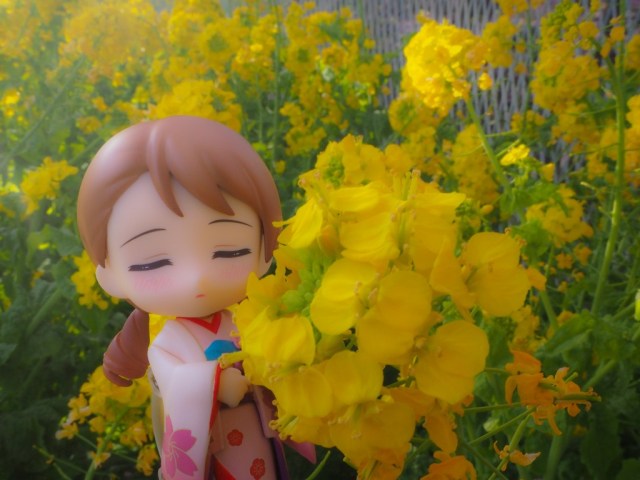
kanunyakaku 560 days

From the website of a project of the same name to… photograph Nendoroid dolls enjoying nature?

Posted in Japanese, Yojijukugo | Tagged , , , , , , , , , | Leave a comment

Arts and crafts for quarantine

門前雀羅を張る
(Monzen jakura wo haru; “To spread a sparrow-net at the gate”)

Definition:

For a place, especially a home, to feel desolate and deserted due to lack of visitors. When the entrance to your estate (because you are an aristocrat with a whole estate to manage, right?) sees so little traffic that you might as well use it to set up a net to catch sparrows in.

Breakdown:

This simple phrase ends, and is made into a sentence, with the verb 張る (haru), “to stick [something to something],” “to spread [something out],” etc., in conclusive form. The particle を (wo) tells us that the verb takes a direct object, which is the noun 雀羅 (jakura), “sparrow net.” This may be compounded with and modified by, or simply located in space by, the noun 門前 (monzen), “in front of the gate.”

Notes:

This comes to us from a story in our friend, the Records of the Grand Historian (Japanese 『史記』 = Shiki), in a comment about a court official whose supply of visitors and friends dried up after he was dismissed from his position. The specific choice of sparrows seems to be simply because they are often seen flocking and playing in an empty street.

It should come as no surprise that this saying can be expressed with the four-character compound 門前雀羅 (monzen jakura) on its own.

Example sentence:

ビデオチャットで友達や親戚に連絡が可能でも、子供がずっと一緒でも、やっぱり時々門前雀羅を張ったような事実の認識がジンと刺してくる。

(“Bideochatto de tomodachi ya shinseki ni renraku ga kanou de mo, kodomo ga zutto issho de mo, yappari tokidoki monzen jakura wo hatta you na jijitsu ga jin to sashite kuru.”)

[“Even being able to video-chat with friends and family, and despite being together with the kids all the time, it’s only natural that every now and then you’d be pierced through by an awareness of the reality that the gate stands empty, as it were.”]

Posted in Japanese, Kotowaza | Tagged , , , , , , , , , | 1 Comment

Row, row, row your bye

Gently down the WOLF CRYPTIDS?!?!

周章狼狽
shuu.shou.rou.bai

Literally: circumference – badge/writing – wolf – wolf

Alternately: Confusion and commotion; getting freaked out and not knowing what to do.

Notes: This is another compound of compounds; both 周章 and 狼狽 on their own mean “panic,” “consternation.” The latter two in particular are interesting; they form an uncommon but acceptable kanji rendition of the verb urotaeru (狼狽える), “to be flustered,” “to lose one’s presence of mind.”

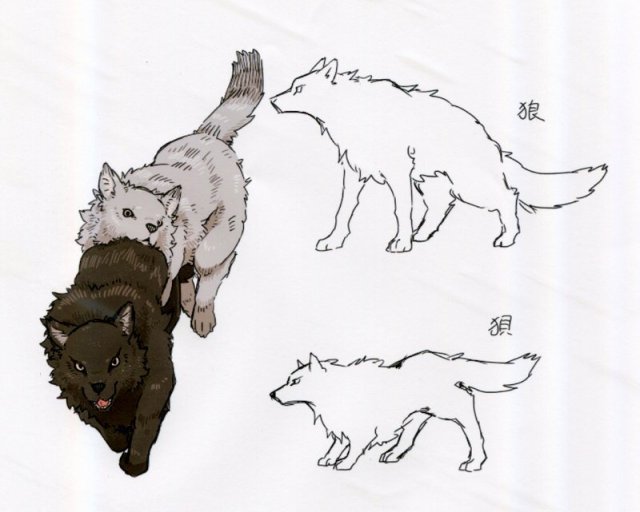
But beyond that, they supposedly represent a pair of cryptids: the 狼 has very short hind legs, and the 狽 has very short front legs. When together they can support each other, but when separated each can barely walk on its own. Nevertheless, in contemporary Japanese, 狼 is almost always used to refer to a regular real-world wolf, while 狽 has fallen out of usage entirely.

Replacing 狽 with 敗 (hai, which in compounds can be voiced as bai), “failure,” is considered an error.

Previous entry 右往左往 is considered a synonym.

ShuuShouRouBaiPair

Source: “ochi clinic

Posted in Japanese, Yojijukugo | Tagged , , , , , , , | Leave a comment

But supposing you brought the light inside

Just shine full-strength sunlight into every single cell of your body and you’ll never need to worry about viruses again.

馬鹿と暗闇おっかない
(Baka to kurayami okkanai; “Both idiots and darkness are scary”)

Definition:

The darkness is frightening because you don’t know who or what may be there or what may happen; you can’t see the dangers and therefore need to be especially on guard.

With an idiot, even if you have a good idea of their general modus operandi, motivations, and so on, there’s always a chance that they’ll latch on to some completely senseless idea without warning and cause unnecessary trouble. You can never quite know what they’ll do or say or what harm they may cause, and therefore need to be especially on guard. In other words, idiots are just as frightening as the darkness itself, and for similar reasons.

Breakdown:

We begin with noun 馬鹿 (baka), “fool,” “idiot,” and the noun 暗闇 (kurayami), “darkness,” joined by the particle と (to, like “toe”), here acting as “and.” Any further particles are elided, but we may assume that this noun phrase is a topic, and that the comment on this topic is おっかない (okkanai), a Tokyo-dialect colloquialism for “scary.”

Notes:

A related phrase replaces darkness with a bee/wasp nest (蜂の巣 = hachi no su, where hachi is a classification that combines both wasps and bees) and warns you not to touch it (手を出すな = te wo dasu na).

おっかない is an interesting term. Its etymology is not entirely clear, but it seems to have spread through eastern and northern Japan from the “Shitamachi” part of Edo (= Tokyo), and the leading theory is that it’s a slurred derivative of classical adjective おほけなし, “beyond one’s means,” “discourteous,” or even “awe-inspiring.” These days it seems not to be in common usage and has taken on a childish tone, perhaps by association with other verbal distortions found in Japanese baby talk.

Example sentence:

「まったく、げん君ってばさっきアルミホイルで包んだじゃが芋をチンするところだった、馬鹿と暗闇おっかないな」

(“Mattaku, Gen-kun tteba sakki arumihoiru de tsutsunda jagaimo wo chin suru tokoro datta, baka to kurayami okkanai na.”)

[“Sheesh, just now Gen was about to nuke a potato wrapped in aluminum foil. Idiots and darkness are full of dangerous unknowns.”]

Posted in Uncategorized | Tagged , , , , , , , | Leave a comment

Ace of crowns: Challah!

The onset of coronavirus brought a rush of baking to the country, and our household was no exception. I tried baking challah for the first time I can remember, certainly the first time on my own, in the first week of April.

Conditions were less than ideal. We didn’t have enough flour, and the stores nearby had all run out, so I was forced to reduce the recipe and to use some ground flaxseed meal that we had lying around for some reason instead. Our honey had crystallized, so I substituted brown sugar. Also, my complete inexperience meant I was unprepared for some of the challenges. During the kneading process, for example, the dough started out incredibly sticky and ended up surprisingly stiff and resistant, which gave my hands quite a workout. I also failed to secure the ends after braiding the dough, so they came apart a bit in the oven.

All told, though, the experiment was a success. I painted the surface with melted butter instead of egg, and we ended up with a smallish and dissociated, but still fragrant and tasty, loaf of challah for Shabbat. A friend had warned me during the process (by text) that the flax meal might make the bread gritty, but it was fine. At most, we had something the texture of whole wheat bread instead of smooth white bread.

Passover began the following Wednesday, though, so we had to rush to finish it alongside with the rest of our tidying-up of the house’s leavening.

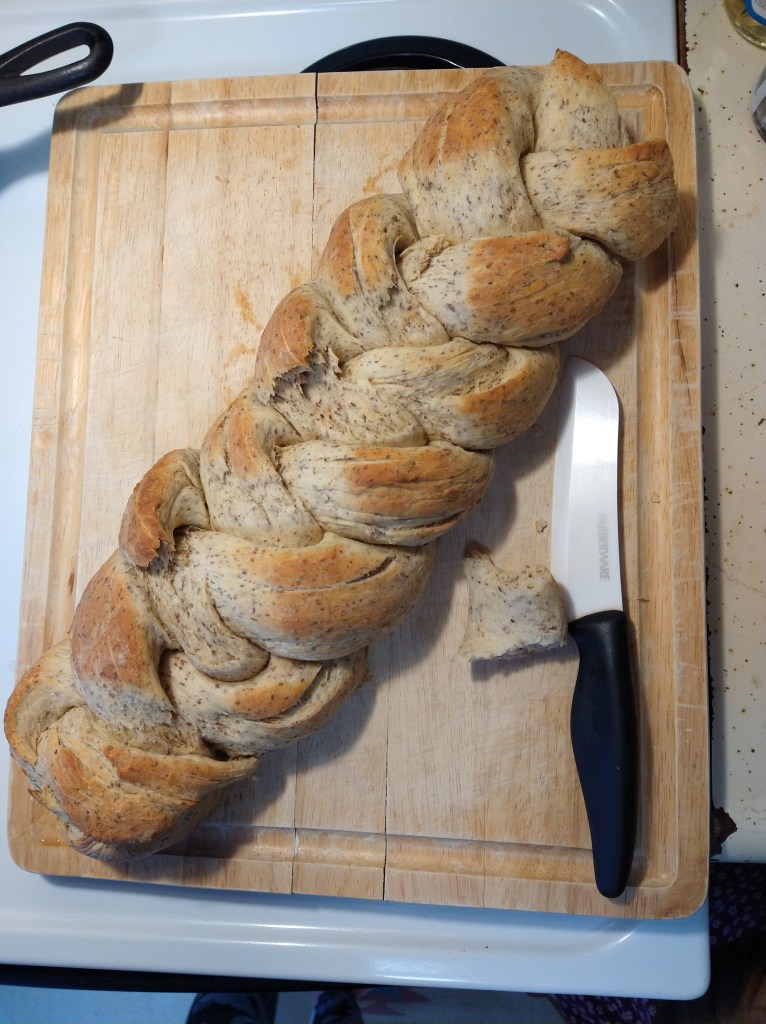
This week, I tried a second time. This time we had enough flour, and while I added a little more flax meal, I was able to follow a recipe normally (this recipe, for the record). The Kid helped me roll the dough into ropes for braiding, and again I painted the surface with melted butter.

The result was an unqualified success! We ended up with a surprisingly large loaf of soft challah, and the salt in the butter I’d painted it with gave it a just a bit of an extra oomph. We’re no longer in a rush to consume or dispose of our leavening, but I suspect that this one won’t last very long either.

Tradition!
Posted in Nonfiction | Tagged , , , , , | Leave a comment

Not “as mysterious as the dark side of the moon”

(The closest to that seems to be 難知如陰, “as hard to know as a shadow.”)

風林火山
fuu.rin.ka.zan

Literally: wind – woods – fire – mountain

Alternately: The principle of dealing with things according to what’s most appropriate to the situation at hand.

Notes: This phrase is derived from Sun Tzu’s The Art of War (in Japanese, it seems that both the author and the text are simply called 『孫子』 = Son shi), and the four components stand as metaphors for qualities an army should have:

  • moving quickly like the wind,
  • waiting quietly like the woods,
  • attacking fiercely like a fire, and
  • holding firm like a mountain.

It is also said that the Sengoku-era warlord Takeda Shingen (whom you may remember as the beneficiary of a kotowaza) took the phrase as his battle standard.

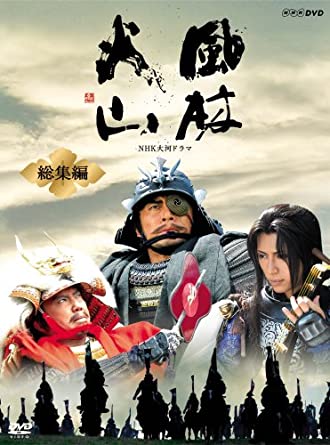
FuuRinKaZanDrama

They even used it to name this period drama

Posted in Japanese, Yojijukugo | Tagged , , , , , , , , | Leave a comment

You can lead a horse to sutras

縁なき衆生は度し難し
(En naki shujou wa do shigatashi;
“It’s hard for the Buddha to save those who do not know the Buddha”)

Definition:

People who don’t heed advice or warnings are very hard to help. Salvation is difficult for those who refuse to take into account the informed opinions of experts on a given subject. For example, if you’re a Buddhist dealing with Samsara, you should listen to the Buddha’s teachings. And if you’re a human dealing with an epidemic, you should listen to the data-backed thoughts of epidemiologists.

Breakdown:

We begin with the noun 縁 (en), often “connection” or “relationship,” in this case used as a Buddhist term to refer to connection with the benevolence of the Buddha himself. Following this we have the adjective なし (nashi), “not,” in prenominal form. This allows it to attach to noun 衆生 (shujou), a Buddhist term for all people, or even all living things collectively; “the whole world.” Following this we find the particle は (wa), which marks the entire preceding noun phrase as the topic of discussion.

The comment on this discussion begins with the verb 度する (do suru), yet another Buddhist term that might be translated as “to save (someone from sin),” but more directly refers to “the Buddha leading someone to a state of enlightenment.” This verb appears in conjunctive form and connects to the adjective 難し (gatashi), “difficult,” in conclusive form.

Notes:

It should be no surprise that this saying is based on the Lotus Sutra (Japanese 『法華経』= Hokekyou). Specifically, it was inspired by the second chapter, on “Ways and Means” (方便品, Houben hon or Houbenpon), and scholars believe it first appeared in Japanese literature through an Edo period ukiyo-zoushi work titled 『諸芸袖日記』 (Shogei sode nikki), literally something along the lines of “daily marginalia about artistic accomplishments.” Note that in contrast to some of the sayings we’ve seen, this seems to have been an inspiration rather than the direct translation of a line from the scripture.

Example sentence:

「かっちゃん、お酒飲んだのに車を運転して帰るって聞かないんだけど。もう仕方ないよね、縁なき衆生は度し難しだもんね」「いやいやいや、そこは絶対止めないと。もしものことがあったら、やれやれまいったで終わるわけないでしょ!」

(“Kacchan, osake nonda no ni kuruma wo unten shite kaeru tte kikanai nda kedo. Mou shikata nai you ne, en naki shujou wa do shigatashi da mon ne.” “Iya iya iya, soko wa zettai tomenai to. Moshimo no koto ga attara, yareyare maitta de owaru wake nai desho!”)

[“Kacchan is insisting on driving home even after drinking. We can’t really do anything about it, I guess; ‘you can’t help those who won’t listen,’ right?” “No, no, no, we need to stop him! If something happens, it won’t just be some ‘Oh gee that guy’ situation!”]

Posted in Japanese, Kotowaza | Tagged , , , , , , , , | 1 Comment

A spectral interlocutor

音信不通
on.shin.fu.tsuu

Literally: sound – trust – non – pass through

Alternately: Communications getting cut off. While any break in expected communications can qualify, it seems to be commonly used to refer to “ghosting” – when one person simply stops responding without explanation or warning in text-based communications.

Notes: This practical yojijukugo comprises two compound words: 音信 is “correspondence” or “news”; 不通 is, as its component characters imply, a stoppage; a “not-pass-through” situation.

It is acceptable to read 音 as in for purposes of this compound.

OnShinFuTsuuKu

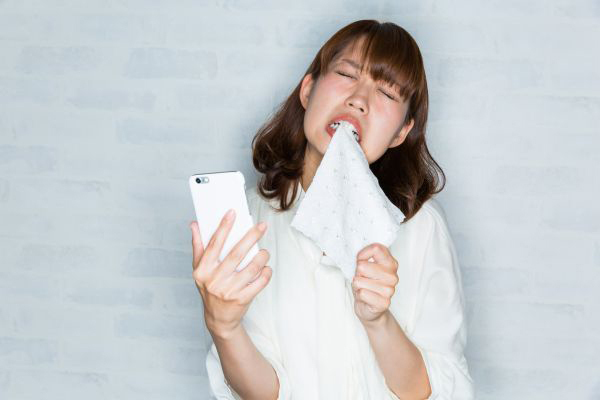
Why the traditional image of a Japanese woman in distress has her biting cloth is a bit of a mystery. I’d love to hear from anybody who knows the trope’s origins!

Posted in Japanese, Yojijukugo | Tagged , , , , , , | Leave a comment