The evillest nom

飼い犬に手を噛まれる
(Kaiinu ni te wo kamareru;
“Bitten on the hand by your pet dog”)

Definition:

To be betrayed or harmed in some way by someone you had deeply cared for, or taken care of on a regular basis. (In other words, it doesn’t apply to a stranger whom you once did a favor for, etc.)

Breakdown:

We begin with the verb 飼う (kau), “to keep / raise / feed (an animal),” in conjunctive form, which allows it to function as a noun. This noun compounds with, and modifies, the noun 犬 (inu), “dog.” Direction particle に (ni), “from,” marks the dog-one-raised as the source of the verb 噛む (kamu), “to bite.” This verb appears in imperfective form and takes the passive formation れる (reru). The direct object of the “being bitten” is marked by particle を (wo); this object is the noun 手 (te), “hand.”

Notes:

This is interesting, because in English we have a parallel saying, “to bite the hand that feeds you.” The content is almost exactly the same (although the English lacks the canine specificity and could apply to a one-off favor being repaid with harm), but from the opposite point of view.

Example sentence:

「例の上院議員は誰よりも先にあの革命的な政治家を支援した一方で、誰よりも罵詈雑言を浴びされて、誰よりも先に棄てられた。一言も口は利かないが、脳裏で飼い犬に手を噛まれたと考えているんじゃないかな」

(“Rei no jouin giin wa dare yori mo saki ni ano kakumeiteki na seijika wo shien shita ippou de, dare yori mo bari zougon wo abisarete, dare yori mo saki ni suterareta. Hitokoto mo kuchi wa kikanai ga, nouri de kaiinu ni te wo kamareta to kangaeteiru n ja nai ka na.”)

[“Although this senator gave his support to that revolutionary politician before anyone else, he was also showered with abuse more than any other, and thrown away before any other. He doesn’t say anything about it, but in the back of his mind he must feel like he was bitten by the dog he’d raised.”]

Posted in Japanese, Kotowaza | Tagged , , , , , , | Leave a comment

See also: obstruction of justice

証拠隠滅
shou.ko.in.metsu

Literally: proof – foothold / based on – conceal – destroy

Alternately: Destruction, suppression, or concealment of evidence. This phrase may be used metaphorically, but is most commonly encountered as actual criminal-justice jargon.

Notes: Some legal contexts may replace 拠 with 憑 (rare character hyou, similarly “depend on,” “evidence” as well as, less relevantly here, “haunt” or “possess”) or add 罪 (tsumi), “crime” or “sin.” Note that in Japanese law, 証拠隠滅 falls under the broader crime of 犯人蔵匿及び証拠隠滅の罪 (hannin zoutoku oyobi shouko inmetsu no tsumi), literally “the crime of harboring a criminal and destroying evidence,” AKA “spoliation of evidence.”

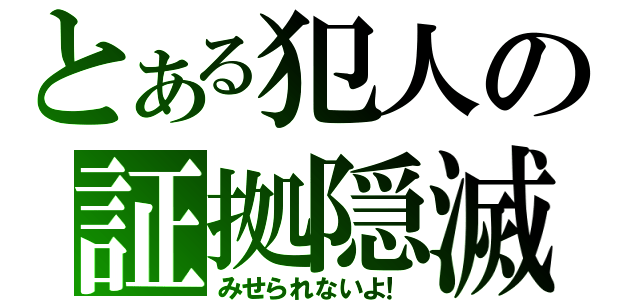
「とある犯人の証拠隠滅」(みせられないよ!)

An amusing presentation that alludes to a certain Sci-Fi anime, from this random blog.

Posted in Japanese, Yojijukugo | Tagged , , , , , , , | Leave a comment

Not even jackalopes, please

怪力乱神を語らず
(Kairyoku ranshin wo katarazu; “Speaking not of spirits and demons”)

Definition:

A wise person does not indulge in talking about irrational or unreasonable things; a great person does not dabble in conspiracy or superstition. When you make an assertion, you need to make it based on facts and evidence rather than vague supposition or unconfirmed impressions – especially if you’re in a position where your words have power.

Breakdown:

This simple phrase is completed by the verb 語る (kataru), “to talk about,” “to tell (a story),” in imperfective form and with negative suffix ず (zu) in conclusive form. The particle を (wo) tells us the object of this verb; in this case, compound noun (and yojijukugo) 怪力乱神 (kai ryoku ran shin), literally “mysterious power disordered god(s),” but taken together, referring more generally to mysterious or supernatural phenomena.

Notes:

This admonition comes to us from the Analects of Confucious (論語, Japanese Rongo).

There are contexts in which 怪力 may be pronounced kairiki. This saying is not one of them.

Example sentence:

「カナダの存在はただの都市伝説だなんていう陰謀説は遊びにしたら面白いかもしれないけど、さすがに常識に逆らってるから、友達の間でしか話さない方がいい。怪力乱神を語らずって言うんだ」

(“Canada no sonzai wa tada no toshi densetsu da nante iu inbousetsu wa asobi ni shitara omoshiroi kamoshirenai kedo, sasuga ni joushiki ni sakaratteru kara, tomodachi no aida de shika hanasanai hou ga ii. Kairyoku ranshin wo katarazu tte iu nda.”)

[“It might be entertaining to play around with conspiracy theories, like saying that Canada is just an urban legend. But it does go against common sense, and it’s something best saved for when you’re with friends. In other situations there’s no call for Bigfoot stories.”]

Posted in Japanese, Kotowaza, Yojijukugo | Tagged , , , , , , , , , | Leave a comment

What you don’t know CAN kill you

夏虫疑氷
ka.chuu.gi.hyou

Literally: summer – insect – doubt – ice

Alternately: A person of extremely limited experience, knowledge, and discernment. Someone ignorant, doubtful, or distrustful of everything that falls outside of their own (meager) personal experience. Like an insect that is born and dies all within the span of a single summer, which does not believe that winter ice even exists.

Notes: For historical reasons, this may also be read as 夏虫氷を疑う (natsu mushi koori wo utagau); “ice” may also be rendered with the rare/archaic character 冰 without any change in meaning or pronunciation.

This reportedly comes to us from foundational Taoist philosopher Zhuang Zhou (荘子, Japanese Sou Shi), aka Zhuangzi, found in the “Autumn Floods” (秋水, Shuusui) section of the eponymous Zhuangzi text.

There are also longer kotowaza variations on this theme, including the cute image of 夏の虫冰を笑う (natsu no mushi koori wo warau), “the summer insect laughs at (the idea of) ice.”

A section of a principal’s address to an elementary school, although he inverts the saying by suggesting that the listeners don’t even know “true heat.”
Posted in Japanese, Yojijukugo | Tagged , , , , , , , , | Leave a comment

Everyone knows they prefer accordions

牛に対して琴を弾ず
(Ushi ni tai shite koto wo danzu; “Playing a koto for a cow”)

Definition:

No matter what you say to a fool, your words are wasted. Even the most moving stories or the most edifying sermon, or the most beautiful music, will fail to move the heart of a cow.

Breakdown:

We begin at the end, with verb 弾ず (danzu), “to play a stringed instrument,” in conclusive form. This is an interesting usage because the character 弾 indicates a sort of elastic snap, and can refer all sorts of related concepts from beads to bullets, stimulation to momentum, popping to repulsion. In this case it refers to the twang of a plucked string, but even for that single meaning, 弾く (hajiku), 弾じる (danjiru), or 弾ずる (danzuru) would all be more common renditions than the aggressive pithiness of danzu. (Note that of the three alternatives, the latter two are common ways of making a single kanji character – grammatically a noun – into a verb, and function identically to simply adding する (suru).)

Anyway, particle を (wo) marks noun 琴 (koto), “koto,” a zither-like stringed instrument, as the direct object of the playing. Skipping back to the beginning, we find the noun 牛 (ushi), “cow.” And the relationship between the cow and the koto being played is described by directional particle に (ni), noun 対 (tai), “with regard to,” and verb する (suru), which turns the preceding noun into a verb, and appears in conjunctive form in order to attach this clause to the koto’s clause.

Notes:

Note that the koto is Japan’s national instrument; also that, with 13-string and 17-string variants, it seems to have been chosen as an example of the pinnacle of musical mastery.

Apparently, this saying comes to us from the Zuting shiyuan (祖庭事苑, Japanese Sotei jien), a Chinese Song-era annotated dictionary of Zen-related terminology from around 1100 CE. The story goes that in the state of Lu, a famed musician encountered a cow while out walking. Inspired by the pastoral scene, he began playing with his utmost skill, but the cow remained completely unresponsive. When he tried a more common tune, though, the high notes seemed to remind the cow of the sound of biting flies, so it perked up and became attentive. The great scholar concluded, quite rationally, that cows simply have no taste when it comes to music.

That said, it’s quite easy to find videos online nowadays of cows strolling over to watch curiously as humans play music at them, so maybe he just didn’t know his audience.

Example sentence:

「自分の言っていることはどんなに合理的だと思っても、インターネットで討論するのは所詮、牛に対して琴を弾ずように時間の無駄遣いにすぎないのだと思えてきた」

(“Jibun no itteiru koto wa donna ni gouriteki da to omotte mo, intaanetto de touron suru no wa shosen, ushi ni tai shite koto wo danzu you ni jikan no mudadzukai ni suginai no da to omoete kita.”)

[“I came to believe that no matter how rational your words, a debate on the internet was ultimately nothing more than a waste of time, whistling into the void.”]

Posted in Japanese, Kotowaza | Tagged , , , , , | 1 Comment

Power is small things in large numbers

一粒万倍
ichi.ryuu.man.bai

Literally: one – particle – ten thousand – times (as in multiplication)

Alternately: From something tiny, a huge profit. By extension, an admonition not to look down on small or simple things, because even the most humble appearance can hide vast potential. Also, it seems, a metaphorical appellation for the rice plant, which grows from one grain and produces countless more. And finally, this phrase is a Buddhist teaching that one good deed, no matter how small, can produce myriad good results in the world.

Notes: This saying apparently comes to us from a Buddhist sutra known in Japanese as the 『報恩経』(Houon-kyou), short for 『大方便仏報恩経』 (Daihou benbutsu houon-kyou), literally “Great teaching Buddha gratitude sutra” – if it has a more poetic or standard English name, I haven’t found it yet.

IchiRyuuManBaiShin

Now imagine that this is full of rice.

Posted in Japanese, Yojijukugo | Tagged , , , , , , , , , | Leave a comment

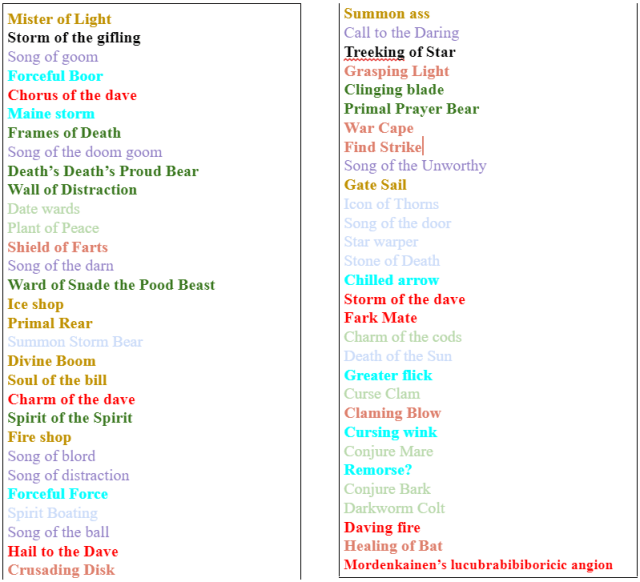
Magic Monday: AI Magic 8

Week 8: Mrs. McCave’s Spellbook

Looking over the list of spell names we’re working from, we see that the only ones remaining are a little difficult to parse at first. Sometimes life gives you nonsense, and you’ve just got to make the best nonsenseade you can. Keep in mind that “David” means something akin to “beloved.”

Fark Mate

After a long and involved ritual, you separate any one thing from another that it had been paired with, although especially strong bonds will resist the spell, and it must be performed again on any bond that has been renewed. By adjusting the ritual’s parameters you might be able to shatter royal alliances, trigger a fission reaction, or open a particularly stuck jar. This spell can not arbitrarily divide a unified whole, though, such as a person’s body parts or an acorn shell.

Charm of the Dave

Craft this charm for someone you love so much it’s hard to put into words; whenever they face injury, disease, or other harm, you may choose to either take the harm upon yourself in their place, or allow the charm to absorb it. In the latter case you both remain unscathed, but their protection is gone until and unless you are able to craft a new one.

Chorus of the Dave

Gather a group of people who care deeply for each other and sing this ritual song together, adjusting the lyrics as appropriate: together you will sing something into existence, whether from materials that have already been gathered or out of thin air. The song must continue for a set number of heartbeats from the assembled group; this number required increases exponentially depending on the complexity and impossibility of the creation.

Hail to the Dave

Chant this spell in the presence of someone whose accomplishments you are able to praise without even a twinge of envy. They become stronger, healthier, more beautiful, more alert and thoughtful, and in general reach a peak of their abilities as your admiration and love boost their body’s capacity to heal itself of wounds, disease, fatigue, and other afflictions great and small. This boost fades slowly over the next day, after which weariness, sickness, and harm may begin to accrue again, but for as long as the magic lingers, a warm and calming glow appears whenever you are together in the same space.

Storm of the Dave

When someone who would die for you is in mortal danger, speak these seven words of power. An overpowering tempest of iridescent light and indescribable almost-musical sound will blow through the area, neutralizing or carrying away whatever is responsible for the threat. Summoning the Storm leaves you exhausted to the point of immobility, but several popular legends tell of lovers who were able to do so twice in a row, in times of dire need.

Daving Fire

Use this dramatic ritual only after the death of someone who would remain in your thoughts every day, no matter what time and distance intervened and no matter what distractions surrounded you; it will only work once in your lifetime, but if the emotion woven into it is pure, a phoenix will arrive before the next sundown and spend the night building its pyre over your beloved. At dawn it will immolate their body along with itself. When the inferno has died down and the ashes have cleared, both will be whole and hale, and back among the living.

Mordenkainen’s Lucubrabibiboricic Angion

DO NOT CAST THIS SPELL.


AI Spells Used

Color-coded by week. What a trip it’s been!

Posted in World-Building | Tagged , , , , , , , | Leave a comment

From a land before credit?

(Actually, tools allowing you to use money that you don’t actually possess have existed in Japan for centuries. A quick search turned up one source* saying that multiple such systems have existed since at least the Muromachi period. And now I’m interested in reading up on when and how the idea of credit first came to Japan, but… that’s beyond the scope of a kotowaza post, so we’ll leave it there for now.)

ない袖は振れない
(Nai sode wa furenai; “A nonexistent sleeve doesn’t wave”)

Definition:

You can’t use something that doesn’t actually exist or that isn’t available to hand. In particular, you can’t spend or give money that you don’t have. “Nothing comes from nothing.” “You can’t squeeze blood from a turnip.”

Breakdown:

We begin three characters in, with the noun 袖 (sode), “sleeve.” This is preceded and modified by adjective ない (nai), “not,”and followed by the particle は (wa). The particle can be read both in its contrastive function (i.e. “as compared to sleeves that do exist”), and as a topic marker (“this is what I have to say about sleeves that don’t exist”). The comment on these sleeves comprises the intransitive verb 振れる (fureru), “to swing,” with negative suffix in conclusive form.

Notes:

There are a number of tweaks that can be made to this one: the starting nai may be rendered with kanji as 無い; the final nai may be replaced by old-fashioned negative ぬ. The contrastive function of the は may even be made explicit by preceding this phrase with 有る袖は振れど (aru sode wa furedo, “Even though sleeves that do exist do wave, …”).

Keep in mind that this saying primarily refers to lack of money, or occasionally to a physical object that is used up, out of stock, or otherwise absent. (Before modern pockets, money was sometimes carried in a pouch secreted inside one’s sleeve.) Using it to describe a lack of something abstract, such as ideas or opinions, is generally considered an error.

*Dekle, Robert and Koichi Hamada, “On the Development of Rotating Credit Associations in Japan,” Economic Development and Cultural Change, vol. 49, no. 1, 2000, pp. 77–90. JSTOR, http://www.jstor.org/stable/10.1086/452491.

Example sentence:

「ごめん、ごめん!借りたお金を返したいけど、ない袖は振れないんだ。金曜日に給料が入るはずだから、週末になったら返せるはず」

(“Gomen, Gomen! Karita okane wo kaeshitai kedo, nai sode wa furenai nda. Kinyoubi ni kyuuryou ga hairu hazu dakara, shuumatsu ni nattara kaeseru hazu.”)

[“Sorry, sorry! I want to return the money I borrowed, but you can’t pay what you don’t have. I should be getting my paycheck on Friday, so I should be able to pay you back on the weekend.”]

Posted in Japanese, Kotowaza | Tagged , , , , , , | Leave a comment

An open heart in your pocket

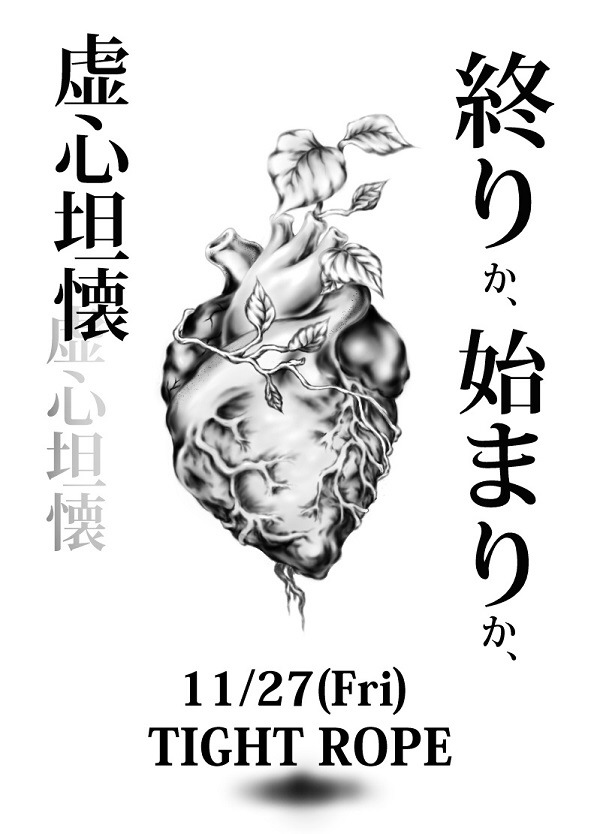
虚心坦懐
kyo.shin.tan.kai

Literally: empty – heart/mind – wide/level – pocket/heart

Alternately: Open-minded and open-hearted. Without any bias, hangups, or pent-up bad feelings.

Notes: In this compound of compounds, 虚心 refers to a lack of prejudice or preconception, while 坦懐 is inner peace.

Replacing 坦 with homophone 担 (“carry on the shoulder”) is of course an error.

KyoShinTanKai no Kokoro

The name of a band that, it seems, performed at a Nagoya bar called Tight Rope on the date noted, in the fall of 2015.

Posted in Japanese, Yojijukugo | Tagged , , , , , | Leave a comment

Magic Monday: AI Magic 7

Week 7: The Weird Stuff

We’re getting deeper into the weeds, now.

Clinging Blade

You enchant a flat metal object – such as a sword – so that it adheres to whatever you touch it to, or releases again, at a command. The spell’s name suggests that was intended to make it easier to carry knives and other bladed objects, but a good supply of spare metal parts could potentially allow for myriad creative uses – albeit ones vulnerable to disassembly by anyone else who knows the spell or the command word.

Frames of Death

For those burdened with the gift/curse/weapon of the Evil Eye, this enchantment is a potent magnifier. You erect one or more gates or doorframes, often of hewn stone, and attune them to your power in a series of ceremonies. Thereafter, if you meet someone’s eyes through the space of these frames, each gate doubles your Eye’s power. When combined with a modified version of the Gate Sail that allows two-way vision, this can become a potent long-range weapon.

Ward of Snade the Pood Beast

Snade is a wandering godling of chimerical form. You can call upon its power to attract one sort of “beast” and repel another (of roughly equal mass) in equal numbers – for example, keeping one tiger at bay for each panda that answers the call. Some scholars theorize that this invocation is one of the oldest spells known to humanity, and is responsible for driving the domestication of various animals, from cats to elephants.

Wall of Distraction

This favorite of illusionists allows you to use your craft explicitly for entertainment: you place an image on a wall as if painting a fresco. Experienced illusionists can extend the apparent depth of the wall to produce three-dimensional images, cause their images to move, and even produce sounds and smells to accompany the image. An optional ritual can render the illusion permanent.

Primal Prayer Bear

You summon a living embodiment of human faith: a Primal Prayer Bear. The Bear can speak and understand all known languages and has an awe-inspiring voice whether it speaks in a whisper or a shout. It appears for the duration of one religious ceremony, from a five-minute koan discussion to a full day of fasting and chanting, and during that time it both participates in whatever role its summoner assigns, and guards the ceremony from outside disruption. Those who try to enter the area it protects with ill intent find themselves confronted with wrathful, snarling ursine visages and then lacerated and bludgeoned by overwhelmingly powerful claws.

Death’s Death’s Proud Bear

This supernatural ursine summon is a closely-guarded secret because the bear it summons is literally capable of slaying a death. If called just as someone or something is drawing their final breath, the Bear appears, snatches the death that just arrived for that person, and carries it away to places unknown and better unasked-about. Even better, although the person so protected is still wracked and ravaged by whatever poison, wound, or disease was about to do them in, they are functionally immortal until the next dusk, dawn, high noon, or midnight. At that point, some sort of cosmic something is reset and a new death will be assigned to their case as appropriate.

Spirit of the Spirit

After trapping a ghost in a magic circle, you use this complicated weaving to draw out and distill its fundamental essence: the ghost’s ghost, as it were, after the original ghost has been slain. In astral terms this manifests as a rippling sphere, shining with the pure pseudo-color of one particular emotion. This does not move, communicate, or take any sort of action, and only mildly impacts the mood of living mortals in the area. Spirits nearby are affected dramatically, though, and divination or sensory magic in the area tends to be skewed beyond all usability.

Posted in World-Building | Tagged , , , , , , , , | Leave a comment