The sunny ant of the high seas

待てば海路の日和あり
(Mateba kairo no hiyori ari;
“If you wait, there will be ideal weather on the sea-routes”)

Definition:

Good things come to those who wait. Do your best to endure when things are bad, because they will get better. Even if current stormy weather prevents you from setting sail, the simple passage of time will be enough to bring good weather suitable for sailing.

Students of history or followers of current events may take exception to the optimistic fatalism of the phrase, arguing that it takes decisive action to bring about “good weather,” while inaction only invites malice to cause ever-worse storms. That said, Japanese hardly lacks for sayings expressing the importance of decisive action. There also exist places and times, in cases that truly are beyond one’s control or influence, for the patience counseled here.

Breakdown:

We begin with the verb 待つ (matsu), “to wait,” in conditional form. The following clause begins with the noun 海路 (kairo), “sea route,” connected by the associative particle の (no) to the noun 日和 (hiyori), the state of which is described by the verb あり (ari), “to be,” in sentence-final form.

Notes:

This is the ま entry of the Osaka Iroha karuta set.

The saying may be contracted to just 待てば海路. Apparently the original phrasing used 甘露 (kanro), “nectar,” instead of 海路, but usage has shifted over time so that the latter is more common.

Example sentence:

「家の坊やがさ、雨が降ってるのにどうしても公園に行きたくて、ずっと駄々を捏ねてて。私が待てば海路の日和ありと撫でようとしても、全然聞いてくれないの。もう十分だわ!」 「まあまあ、駄々っ子も待てば海路だよね」

(“Uchi no bouya ga sa, ame ga futteru no ni dou shite mo kouen ni ikitakute, zutto dada wo konetete. Watashi ga mateba kairo no hiyori ari to nadeyou to shite mo, zenzen kiite kurenai no. Mou juubun da wa!” “Maa maa, dadakko mo mateba kairo da yo ne.”)

[“My boy really wants to go to the park even though it’s raining, so he’s been whining the whole time. I tried to calm him down by pointing out that good things come to those who wait, but he won’t listen! I’ve had enough!” “It’s alright, a child’s whining is also something that will pass with time.”]

Posted in Japanese, Kotowaza | Tagged , , , | 2 Comments

Every stick and blade

一木一草
ichi.boku.i-.ssou

Literally: one – tree – one – grass

Alternately: Everything in the area; every last tree and blade of grass.

In contrast, this phrase can also mean something of which there’s only a very small amount – a mere single tree or single blade of grass instead of a whole forest or prairie.

Notes: The order of the elements may be reversed, although 一草一木 seems to be the less common usage. However, reading 一木 as ichimoku or ikki is an error.

IchiBokuZeroSou

Also the name of a restaurant serving zero trees and zero grasses.

Posted in Japanese, Yojijukugo | Tagged , , , | Leave a comment

Much less dramatic than “Takekurabe”

(Higuchi Ichiyou)

団栗の背比べ
(Donguri no seikurabe; “A height-measuring contest between acorns”)

Definition:

A group where none of the members particularly stand out from the rest. A collection of average types. Alternately, a pointless competition between people of no special ability; a pissing contest. Like comparing acorns, which are all about equally small.

Breakdown:

This noun phrase begins with the noun 団栗 (donguri), “acorn.” This is followed by 背 (various pronunciations; here sei), “back,” which joins together with 比ぶ (kurabu), “to compare,” acting as a noun in conjunctive form. The associative particle の (no) links the two halves of the whole.

Notes:

Kurabe can be written 競べ without any change in meaning or pronunciation.

This phrase apparently comes to us from Kaozheng scholar Qian Daxin (銭大昕), in a work called 恒言録 (Héng yán lù, Japanese pronunciation unclear but probably Kougenroku)

Example sentence:

「今年の予備選挙の候補者達は団栗の背比べで、ちょっと意気消沈してしまった」

(“Kotoshi no yobisenkyo no kouhosha-tachi wa donguri no seikurabe de, chotto ikishouchin shite shimatta.”)

[“The candidates in this year’s primary race are all just average; it’s kind of a let-down.”]

Posted in Japanese, Kotowaza | Tagged , , , , | Leave a comment

I see your Aeschylan harpies

And raise you LOVELY OPERA HARPIES

迦陵頻伽
ka.ryou.bin.ga

Literally: “ka” (this character is only used phonetically) – imperial tomb – repeatedly – attend

Alternately: A beautiful voice, or a person (especially a woman) who possesses one. This phrase refers to the kalavinka, a bird (with the upper body of a woman) said to dwell in the “pure land” plane of existence, where it sings and preaches Buddhist teachings with an incredibly beautiful voice.

Notes: Don’t pay any attention to the literal meaning of the characters; as the note on the first character suggests, this phrase is an entirely phonetic rendition, based on Sanskrit. As such, a number of replacements are possible, including switching the 迦 and the 伽, or replacing 頻 with 嚬 or 毘.

The term comes to us from a philosophical commentary on the Mahayana sutra, known as the Mahayana-sutra-alamkara (in Japanese 大乗荘厳経論, Daijoushougonkyouron).

KaRyouBinGa

This is apparently a t-shirt design.

Posted in Japanese, Yojijukugo | Tagged , , , , | Leave a comment

Even the roosters missed the dawn?

Depends on the frogs

春眠暁を覚えず
(Shunmin akatsuki wo oboezu; “Spring sleep knows no dawn”)

Definition:

The air of a night in spring feels good, and the nights themselves are getting shorter, so one ends up sleeping in instead of waking with the dawn as usual. Sleeping past the normal time to get up in the spring.

Breakdown:

We begin with the compound noun – not one in common usage – 春眠 (shunmin), “spring sleep.” This is followed by, but separate from, the noun 暁 (akatsuki), “dawn,” marked by the particle を (wo) as the object of the verb 覚ゆ (oboyu), “to remember,” “to feel,” in imperfective form, with negative suffix ず (zu) in sentence-final form.

Notes:

This phrase comes to us from a poem by Tang dynasty poet Meng Haoran (孟浩然, in Japanese Mou Kounen or Kouzen).

As you might expect, this phrase is only used in reference to the actual spring: it’s generally not going to be alluded to for regular sleeping-in at other times of year.

Example sentence:

春眠暁を覚えずで、何度起こしても妻が起きない」

(Shunmin akatsuki wo oboezu de, nando okoshite mo tsuma ga okinai.”)

[“Sleep in the springtime knows no dawn… so no matter how many times I try to wake my wife, she doesn’t actually wake up.”]

Posted in Japanese, Kotowaza | Tagged , , , , , | Leave a comment

Not the good kind

自暴自棄
ji.bou.ji.ki

Literally: self – violence – self – abandon

Alternately: Coming unmoored and lashing out, to the point of actually harming one’s own self or interests, in a surfeit of disillusionment or desperation. Impulsive and self-destructive flailing without regard for the consequences. Self-harm born of despair.

Notes: Some people apparently read 暴 as baku; although an acceptable reading for the character in some contexts, here it’s considered an error.

This saying comes to us from the writings of prominent Confucian scholar Mencius.

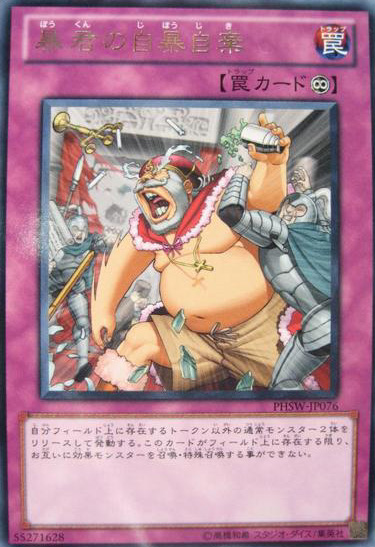
JiBouBouKun

The English name of this (Yu-Gi-Oh) card is “Tyrant’s Throes”

Posted in Japanese, Yojijukugo | Tagged , , , , , , | 3 Comments

AND I WOULD WALK TWO HUNDRED NINETEEN POINT SIX MILES

AND I WOULD WALK TWENTY FOUR POINT FOUR MORE, JUST TO BE THE MAN WHO WALKED A HUNDRED RI TO FALL DOWN AT YOUR DOOOOOOOOOR

百里を行く者は九十里を半ばとす
(Hyakuri wo iku mono wa kujuuri wo nakaba to su;
“To one traveling a hundred ri, ninety is half the distance.”)

Definition:

An admonition: Finishing things well is hard. The end of a task is often the most difficult and error-prone part, so those close to the end should be extra careful and work extra hard instead of just trying to coast through. Consider ninety-percent completion as if it were only halfway, and keep on plugging.

Breakdown:

We begin with number-noun compound 百里 (hyakuri), “hundred ri,” with a ri being a unit of distance just shy of 4km (a little less than 2.5 miles). The particle を (wo) marks this distance as the object of the verb 行く (iku), “to go,” and the verb appears in prenominal form, allowing it to attach to and modify the noun 者 (mono), “person,” which in turn is marked as the topic of discussion by the particle は (wa).

The comment on this topic begins with number-noun compound 九十里 (kujuuri), “ninety ri,” which is again marked with as a direct object by を (wo). This time, however, the verb is す (su), “to do,” which modern usage knows better as する (suru); the verb caps off the sentence with its sentence-final form. However, the verb is preceded by the noun 半ば (nakaba), “half,” to which is affixed the particle と (to, sounds like “toe”), in its function of attributing words, thoughts, or feelings to someone.

The set phrase とす(る) has a number of possible renditions, but in this case is probably something close to “to think of ~ as ~.”

Notes:

As with many such cases, the distance 百里 should be taken as “a long way” or “a large project,” rather than a literal and exact measurement of distance.

This saying comes to us from Qin (秦) section of the the Strategies of the Warring States (戦国策, in Japanese Sengokusaku), a historical text discussing – of course – the Warring States period of Chinese history.

Example sentence:

「あとちょっとだけだからと思って休んだウサギは亀に負けたでしょう?「百里を行く者は九十里を半ばとす」よ!」

(“Ato chotto dake dakara to omotte yasunda usagi wa kame ni maketa deshou? ‘Hyakuri wo iku mono wa kujuuri wo nakaba to su’ yo!”)

[“The rabbit lost to the turtle because it thought it could rest because there was only a little way to go, right? You should treat ‘almost finished’ like ‘halfway there’!”]

Posted in Japanese, Kotowaza | Tagged , , , , , , , , | Leave a comment

You want me to shave *what*?

Ohhh, it’s a metaphor.

(My deepest apologies to my readers! On Sunday, in place of the regularly-scheduled kotowaza, I instead posted a song as a joke. At the time I promised that the real thing – which had already been almost entirely written up – was coming the next day, but then I got caught up in other things and forgot to make it actually happen. Here, then, is your belated Japanese saying for the week of April 1st, 2018.)

頭剃るより心を剃れ
(Atama soru yori kokoro wo sore;
“Rather than shaving your head, shave your heart”)

Definition:

Outward appearance isn’t important compared to what’s on the inside. Worry about content, not just presentation. Those who want to be good (Buddhist) monks should focus less on shaving their heads to look the part, and more on purifying their hearts.

Breakdown:

We begin with the noun 頭 (atama), “head,” connected without any particles to the verb 剃る (soru), “to shave,” in prenominal form and acting as a noun itself, in the sense of “the act of shaving.” The particle より (yori) suggests that “rather than” the above noun phrase, something else (is preferable), and the latter takes the form of a command: the noun 心 (kokoro), “heart,” “mind,” or “spirit,” marked by the particle を (wo) as the direct object of the verb 剃る, here in imperative form.

Notes:

This somewhat obscure saying is derived from a poem by Kamo no Choumei, literary hermit and author of the Hōjōki, an autobiographical classic of Japanese literature meditating on the transient nature of things in the material world.

Example sentence:

「どんなに立派な袈裟を着ても、あの人は意地が悪くて汚いことばかりする。頭剃るより心を剃れ、って言いたくなるよ」

(“Donna ni rippa na kesa wo kite mo, ano hito wa iji ga warukute kitanai koto bakari suru. Atama soru yori kokoro wo sore, tte iitaku naru yo.”)

[“No matter how splendid the monk’s robe he wears may be, he’s a nasty person and he’s always doing underhanded things. It makes you want to tell him to quit shaving his head and instead shave his soul.”]

Posted in Japanese, Kotowaza | Tagged , , , , , | Leave a comment

It’s mondo useless!

Apparently the latter word is supposed to be “pseudo-Italian.” Eh.

問答無用
mon.dou.mu.you

Literally: question – answer – nothing – use

Alternately: “Further discussion is pointless.” “I’m not going to argue any more.”

Notes: 問答 is a discussion; in this case, and in contrast to last week, 無用 is “useless” or “not needed,” more directly discernable from the meaning of the individual characters. This phrase may be used to call a discussion to a close.

MonDouYuuTou

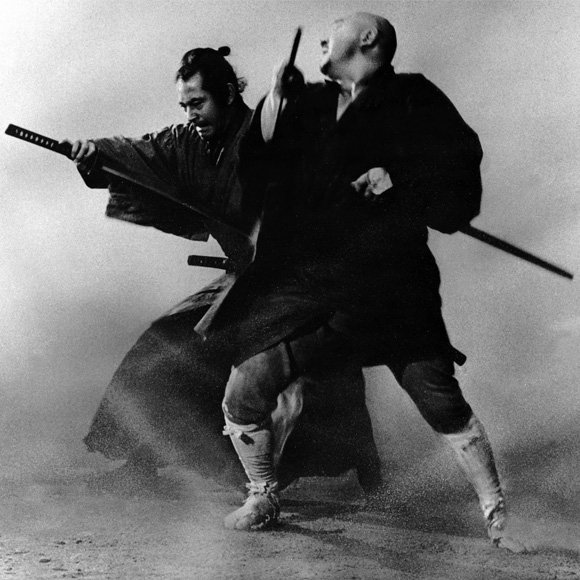
Talk doesn’t burn nearly as many calories as a good stabbin’ anyway.

Posted in Japanese, Yojijukugo | Tagged , , , , | 1 Comment

We have to try!

Puffer-fish lined up

(Boy, if you got that one, massive points. You win.)

(出ん出らりゅうば出て来るばってん
出ん出られんけん出て来んけん
来ん来られんけん来られられんけん
来ん来ん;

“If it’s the case that if it tries to come out then it will be able to come, then it will come out, but it can’t come out, so it won’t come out. Even if it tries to go it can’t go, so it can’t go, so it won’t.”)

Definition:

It ain’t comin’ out.

Breakdown:

We begin with the verb 出る (deru), “to come out,” in volitional form, then again, in hypothetical potential form, then again in conjunctive form attached to the verb 来る (kuru) in sentence-final form, marking the end of the clause. This is followed by ばってん (batten), “but.”

Next comes 出る again, in volitional form followed by negative potential form, with けん (ken), “therefore,” separating it from the same verb for a sixth time, appearing for the second time in conjunctive form which again connects it to 来る, which appears here in negative form, followed by a second けん.

This is followed by the verb 来る in volitional form, negative potential form, then after another けん another, different, negative potential form, and then after another けん, again twice more, for emphasis presumably, in negative sentence-final form.

Notes:

In some cases, the ば of the initial hypothetical formation is replaced by が (ga), apparently without any change in meaning, for no apparent reason.

This whole thing is in deep, thick, gooey, rich Nagasaki dialect, in which – among other things – 来る can also be used to mean its exact opposite 行く (iku), “to go.” Good luck telling apart your comings and your goings!

Today’s offering is probably inextricably linked to Nagasaki’s famous dragon dances, famously performed during the Kunchi festival, in which at least a dozen people team up to play a dragon chasing after its egg. The dragon, unfortunately, is famously sulky and will repeatedly give up the chase and curl into a ball, so that the audience is repeatedly called upon to yell at it until it acquiesces and resumes the chase/dance. Animal-rights organizations have thus far had no more luck in ending this subtropical equivalent to bear-baiting than they’ve had in ending the more infamous practice of whale-hunting. At any rate, sometimes the dragon just doesn’t want to come out, you know?

Happy April first, by the way. Look for an update tomorrow!

Example sentence:

Posted in Japanese, Kotowaza, Meta | Tagged , , , , , , | 1 Comment