I wouldn’t wish it on a dog

夫婦喧嘩は犬も食わぬ
(Fuufu genka wa inu mo kuwanu;
“Even a dog doesn’t eat a husband-wife fight”)

Definition:

Fights between marital partners are based on small issues that seem ridiculous to outsiders but can become emotionally charged. Then they quickly blow over and the couple returns to its prior equilibrium. It’s best not to get involved. The image of a dog illustrates the not-getting-involved portion: dogs will eat just about anything, but won’t even be interested in this.

Breakdown:

The first four characters form a single compound noun. (here, fuu) is “husband” or “man” while (fu) is “bride” or “woman,” and logically enough, 夫婦 means a husband-and-wife pair. Both and mean “noisy” on their own, but together as kenka they mean an argument or fight.

So all together, they make “husband-wife fight.” This noun is marked with (wa) as the topic of the sentence, and then we get a little subject-verb pair that elaborates on the topic. The subject is (inu), “dog,” and the verb is 食う (kuu), “to eat,” in imperfective form so that it can take on a negative suffix. Interestingly, the suffix itself is in prenominal form, implying that either the phrase is meant to be attached to something else rather than used in isolation, or some odd grammatical quirk is forcing the shift. (It happens sometimes….) Or it’s a quirk on the part of the speaker? (See below.) Anyway, inu is modified by the particle (mo), an intensifier meaning “also,” or in this case “even.”

Notes:

The archaic and possibly odd grammar at the end may be replaced with the modern negative form, 食わない (kuwanai) without significant change in meaning.

A longer version of the saying adds と夏の餅 (to natsu no mochi), “and summer rice cake,” after 夫婦喧嘩, as a concrete example of something else dogs don’t eat.

This phrase comes from the famous playwright Chikamatsu Monzaemon, who used it in a joururi piece titled 淀鯉出世瀧徳 (Yodoigoi shusse no takinobori).

Example sentence:

夫婦喧嘩は犬も食わねど親喧嘩程恐ろしき物在らじかな」

(Fuufu genka wa inu mo kuwanedo oya genka hodo osoroshiki mono araji ka na.”)

[“Even a dog won’t pay attention to a couple fighting… but man, there’s nothing as frightening as your parents fighting.”]

(I took the liberty of trying my hand at classical grammar here, but didn’t bother trying to reflect that in the translation!)

Posted in Japanese, Kotowaza | Tagged , , , , , | Leave a comment

Like those dreams where you’re running

不即不離
fu.soku.fu.ri

Literally: non – instant/agree/conform – non – separate

Alternately: At just the right distance, often mentally rather than physically. Neither approaching nor getting further away. Not loving nor hating; neutral; noncommittal; ambivalent.

Notes: This four-character compound can be read in a more “Japanese” way, by the rules traditionally used to decode Chinese-style writing, as 即かず離れず (tsukazu hanarezu), without significant change in meaning.

This yojijukugo is supposedly derived from the Buddhist Sutra of Perfect Enlightenment, and quoted in Natsume Sōseki’s famous satirical novel I am a Cat.

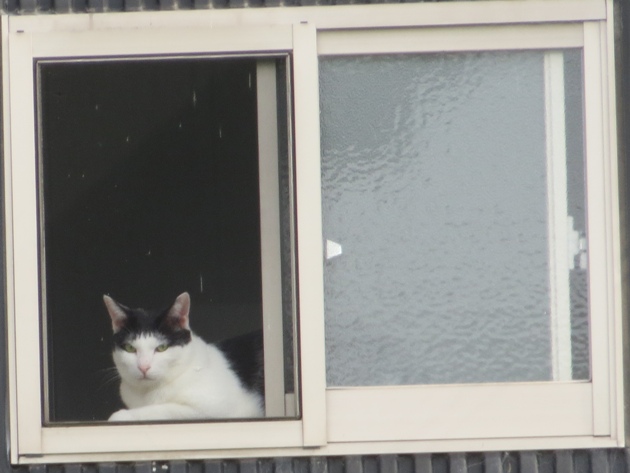
FuSokuNeko

Yeah, that’s a good distance. Stay there.

Posted in Japanese, Yojijukugo | Tagged , , , , , , | Leave a comment

Magic Monday – Literally above the law

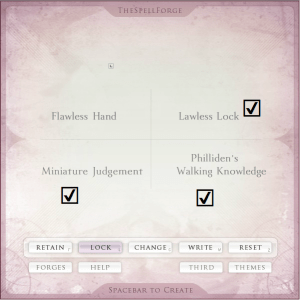
Miniature Judgment

A Miniature Judgment is a set of figurines dressed as clan elders from a long-passed age, carved of dark, highly-polished wood. If arranged on an appropriate dais, altar, or other foundation, they have the ability to impose a society’s laws and customs upon all present. For this to work, the foundation upon which they stand must contain those laws in some way – often through placing scrolls, books, or tablets in a hollow space; less commonly by simply writing on the surface. The effects they can impose depend in part on how many members of the Judgment are present. Note that a Judgment is an objective but morally and ethically neutral arbiter of whatever text it is given to enforce.

There are many sets of Miniature Judgment figures, of varying make and number. They are based on The Judgment, a circle of larger-than-life marble figures on a tel in Hollin. Originally there were twenty figures in the Judgment, although two have been destroyed over the years. A heavily-armed priesthood occupies the underground complex dug into the tel and presumably guards a copy of Hollin’s laws therein.

  • 1: Nobody present may misstate the contents of the laws present in the foundation.
  • 3: All Knowledge checks pertinent to solving the case at hand gain a +1 bonus per figure present.
  • 5: Nobody present may lie.
  • 6: To the extent that the law may be carried out through physical punishment, upon a guilty verdict the Judgment immediately inflicts pain or damage on the accused accordingly.
  • 7: Nobody present may quibble, prevaricate, or otherwise knowingly misrepresent the truth while avoiding lies; nobody present may ask misleading questions.
  • 9: Nobody may fail to answer a question when they have some knowledge about the answer.
  • 11: Each person present and involved in the trial may ask one question of the Judgment, and the figures will answer it to the best of their ability – they are not omniscient, but do have perfect memory of all law codes they have ever been linked to, and all evidence that has ever been presented before them.
  • 12: Upon a guilty verdict, the accused is transported into an isolated bubble in Dream, where they suffer the crimes that they committed until they repent and swear to make recompense in a manner acceptable to the law. Failure to obey the terms of this oath result in death. Changing the composition of the laws while the punishment is underway may affect its course in unexpected ways.
  • 13+: Any attempt to unlawfully tamper with the text of the laws results in instant death.

Forge Items 7-25-2016

Posted in Rules, Setting, World-Building | Tagged , , , , | Leave a comment

Lend an eave, cause to grieve

庇を貸して母屋を取られる
(Hisashi wo kashite omoya wo torareru;
“Lending the eaves, having the main room taken”)

Definition:

Giving someone an inch, only for them to take a mile. Lending or giving someone part of something, especially when that person is in need of help, only to have them take the whole thing. Literally, lending someone (the use of) the eaves of a traditional Japanese estate – or rather, the narrow raised walkway that runs around the outside of the house and is protected from the elements somewhat by its eaves – only to have them take advantage and occupy the main room of the central building. Somewhat less-used secondary meanings are to be harmed in some way by a guest, or to have one’s kindness met with enmity.

Breakdown:

This saying comprises a pair of verb phrases. The first verb is 貸す (kasu), “to lend” or “to rent out,” in conjunctive form, with the particle (wo) marking as its direct object the noun (hisashi), the eaves and/or raised walkway that run around the outside of a traditional Japanese estate-home. The second verb is 取る (toru), “to take,” in passive sentence-final form, again with the particle showing that it acts on the noun 母屋 (omoya), literally “mother roof” but in this case signifying the central space of the estate.

Notes:

can also be written , and 母屋 can also be written 母家, without any change in meaning or pronunciation. may also be replaced with synonym (noki), although the latter is more commonly used to refer to the eaves of a modern, Western-style house.

Example sentence:

「百円貸してって頼まれていいよと答えたけど、知らないうちに財布を引っ掻き回されたよ。庇を貸して母屋を取られると思わなかったわ」

(“Hyakuen kashite tte tanomarete ii yo to kotaeta kedo, shiranai uchi ni saifu wo hikkaki mawasareta yo. Hisashi wo kashite omoya wo torareru to omowanakatta.”)

[“She said ‘Loan me a hundred yen,’ and I said ‘Okay,’ and next thing I knew she’d rifled through my whole wallet! I never thought I’d give her an inch and she’d take a mile.”]

Posted in Japanese, Kotowaza | Tagged , , , , | Leave a comment

Ninety-nine problems and also another problem

When I first encountered this compound, I pictured it as a quaint conga line of traditional Japanese bakemono. Now all I can see is [redacted topical political comment].

百鬼夜行
hya-.kki.ya.kou OR gyou

Literally: hundred – oni (often translated “demon” or “ogre”) – night – go

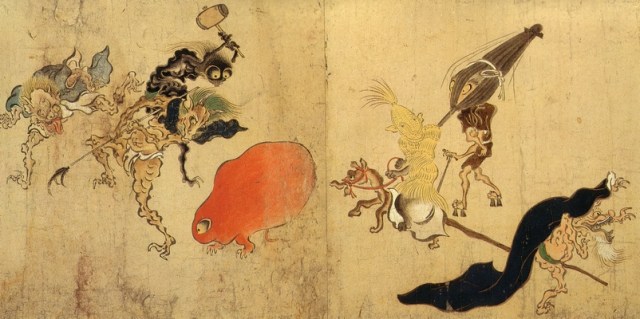
Alternately: A procession of monsters in the night; the night swarming with monsters going about their business as if they owned the place. Supposedly, the origins are in stories of a literal parade of beasts carried out on certain summer nights, against which only onmyou (yin-yang) magic could protect a traveler with the bad luck to meet them. Metaphorically, lots of bad people doing lots of bad things without worrying about the consequences.

Notes: This yojijukugo is essentially synonymous with 魑魅魍魎, but trades the explicit spirit names for a more vivid picture of their behavior. And unlike the origin of 魑魅魍魎 in Chinese antiquity, 百鬼夜行 seems to spring from Japanese folklore. It dates back at least to the medieval times, and has been a popular theme in folklore and art.

Both readings of the final character seem relatively common. I like the phonetic qualities of gyou better, but that might be due to having a non-native phonetic intuition.

Hyakki-Yagyo-Emaki_Tsukumogami_1

Image from Wikipedia, but I heartily encourage readers to do their own search – there’s a huge variety from over the centuries.

Posted in Japanese, Yojijukugo | Tagged , , , , , | 1 Comment

Magic Monday – A common alternative to “smoke bomb!”

Raise Cloud

The magician causes a bank of mist or fog to accumulate in an area. Similar to the Breath of Av-Beleren, this spell has a very simple fundamental form that can be used in training, but clever and skilled magicians can dramatically expand the utility of their mists. A cloud so raised generally lingers until it is cleared away by normal action of the air.


The base cost is a single point of strain, and the base difficulty a mere d4, for a light mist that fills a room-sized area with haze. Increasing the area by a step increases the difficulty by a step and doubles the cost in strain. In addition, the quality of the mist can be modified in a number of ways. All cost increases are factored in before the doubling for increased area is applied. For all versions of this spell, restricting its effect to a Wizard-Warded area attuned to the caster decreases both difficulty and cost by one. Otherwise, the cloud may be set on its creation either to remain in place, or to move with its creator at a slow walking pace.

Thick mist: limits visibility to about arm’s length. Difficulty increases by one step, and cost by one strain.

Burning or freezing mist: to make the cloud painfully warm or cold, increase the difficulty by a step and the cost by two. Or, to make it damaging (one harm per round), increase the difficulty by two steps and the cost by five strain instead.

Psychic mist: the cloud afflicts those within it with an emotion, akin to the effects of the Fear-Spell, but not limited to fear. Difficulty increases by three steps, and cost by three strain.

Permanent mist: an extended ritual allows the caster to permanently sacrifice an attribute point in order to create a mist (of any kind) that, even if dispersed by normal conditions such as wind, will automatically re-form as soon as conditions permit.

Vision mist: an Illusion spell may be cast into a thick mist and affects anyone who enters it. This lowers the difficulty of the Illusion by a step, but doubles its cost in strain.

Other effects are certainly possible! As with the vision mist, it may be possible to create a cloud that “holds” spells, alchemies, and so on, and inflicts them on all who enter. The primary drawback to this sort of versatility is that there is no inherent aspect of the Raise Cloud that can be manipulated to render the caster immune. More than one clever-feeling magician has been slain by their own poison cloud.

Posted in Rules, World-Building | Tagged , , , | Leave a comment

Or eggshells. Frozen eggshells?

薄氷を履むが如し
(Hakuhyou wo fumu ga gotoshi; “Like treading on thin ice”)

Definition:

Being in an intensely dangerous situation. When a thick layer of ice covers a body of water, it can safely support people walking on it or even heavy loads of freight on a sledge. If the ice is thin, then it can break without warning and drop you into near-freezing water, which can easily be fatal. This saying compares a situation to that danger. Note, though, that this kotowaza does not refer to a dangerous venture undertaken knowingly; that usage is considered an error.

Breakdown:

薄氷 (hakuhyou) is literally “thin ice.” This noun is marked by the direct-object particle (wo) as being acted on by the verb 履む (fumu), which can take on a number of different meanings but here becomes “to step on.” Together these elements are technically a verb phrase, but in this case they act as a noun which is connected by the archaic associative particle (ga) – filling the same role as modern (no) – to the adjective 如し (gotoshi), “like,” “as,” in sentence-final form. Keep in mind that although the final element is in sentence-final form, this kotowaza doesn’t really function on its own; it needs context, and will generally be part of a longer sentence.

Notes:

This phrase is remarkably similar to an English idiom, “[skating] on thin ice.” In fact, my policy of avoiding back-translations of phrases borrowed from English in the first place nearly led to hakuhyou wo fumu getting skipped… but it’s not from English at all! The origin of this one seems to be in the 2600-year-old Chinese Classic of Poetry (詩経), specifically the 74 “Lesser Court Hymns” section (小雅), written in the 9th to 8th centuries BCE. There, the phrase is coupled with another example of danger – the intense fear of gazing into a deep abyss.

This kotowaza can be shortened to 薄氷を履む.

Example sentence:

不意に大型トラックに囲まれて、スミスさんが薄氷を踏むが如く恐怖を覚えて動けなくなってしまいました。

(“Fui ni oogata torakku ni kakomarete, Sumisu san ga hakuhyou wo fumu ga gotoku kyoufu wo oboete ugokenaku natte shimaimashita.”)

[“Suddenly surrounded by large trucks, Smith was filled with fear akin to walking on thin ice, and became paralyzed.”]

Posted in Japanese, Kotowaza | Tagged , , , , , , | 2 Comments

Questions about high school, dux and redux

Here’s a list of questions about one’s high school days that I saw on Facebook recently. For the sake of being completionist, I’ve answered them, but the real meat of my response is below.

1. Did you know your spouse?
Nope.

2. Did you car pool to school?
I rode my bicycle or, rarely, the bus.

3. What kind of car did you drive?
My bicycle was a Mongoose Crossway 450.

4. What kind of car do you have now?
My current bicycle is a Mongoose Crossway 450. Yes, I’ve been using the same bike for almost 20 years.

5. Where would you have been on a Tuesday afternoon?
After school in the fall I had cross country; in the spring I had track.

6. What kind of job did you have then?
Delivered newspapers in the morning.

7. What kind of job do you have now?
Still in school somehow, although I did take a break for seven years to teach English in Japan.

8. Were you a party animal?
For certain nonstandard definitions of “party,” perhaps. (No.)

9. Who was in your crew?
Nerds! Also… jocks? I was both in math club and a runner, and now that I think about it there was surprisingly little overlap between those groups.

10. Were you considered a jock?
Only insofar as a scrawny awkward long-distance runner can be one. (No.)

11. Were you in band, orchestra, or choir?
I still can’t even read music. And I’m tone deaf.

12. Were you a nerd?
You get one guess, and if the answer isn’t “yes,” you lose.

13. Did you get suspended or expelled?
Not that I recall. Once in junior high I got detention for reading a book in class. I spent detention reading a book too.

14. Can you sing the fight song?
Nope. I can sing the first verse of the school song of the place I taught at in Japan, though! “Ashita wa hikaru…”

15. Who was/were your favorite high school teachers?
Two particular math teachers who taught most of my math. I liked and/or respected most of my teachers.

16. Where did you sit at lunch?
Wherever I could read a book on my own in peace.

17. What was your school’s full name?
West.

18. What was your school mascot?
The Trojans. Nobody ever told any jokes about that. Maybe.

19. If you could go back and do it again, would you?
It depends. If I could go back and re-live most of my life with the knowledge, wisdom and experience I have now, I’d have the ability to achieve insane things. Simply repeating the experience verbatim doesn’t seem worthwhile, though.

20. Did you have fun at Prom?
It was so-so. The main event that sticks in my memory was my girlfriend’s friend being terribly sad that the guy who hadn’t wanted to go to prom with her, still didn’t want to dance with her now that they were both (separately) at prom.

21. Do you still talk to the person you went to Prom with?
Nope. I’m not even sure she’s on Facebook.

22. Are you planning on going to your next reunion?
Not planning to, but I might go if it happens at a time that’s convenient.

23. Are you still in contact with people from school?
Technically, a few of them, through Facebook. Not really, though.

24. What are/were your school’s colors?
Lots of red brick, if I recall. How is this an even remotely appropriate question to cap off this kind of list?


Overall, I’m disappointed in these questions. There was potential in the idea to make people really examine their lives – or society – and consider how things change with the march of time, experience, and age. Some of the questions point in the right direction: what is your relationship to the people and experiences you had in high school? How have you changed in the intervening time? But then it squanders this promise by asking about trivia, as if the trivia had equal weight.

Who cares what my high school mascot was? Who cares whether I remember what it was? Why is Tuesday specifically singled out – why not simply have one question for weekdays and another for weekends? Why do questions 8-12 essentially all ask the same thing? Why does #2 ask about carpooling specifically, instead of simply asking how people got to school?

In that spirit, here’s a list of questions that I think would produce more interesting results.

  • 1A. How many details about your school’s rituals and pageantry can you recall? Go on, dredge up that trivia and spend a little while enjoying it and using it as a springboard to your memories.
    • 1B. How do you feel about the amount and tone of the trivia that you remember?
  • 2A. What was your social group like, and why were you part of that particular group?
    • 2B. Are you part of a similar group now? What parts of your social identity have changed, and what parts remain constant?
    • 2C. How many of the people you knew in high school are you still in contact with? (Include teachers.) What percentage of your current social circle do they make up? How has the role they play changed? How has your relationship with them changed?
  • 3A. What classes from high school have had the most impact on the course of your life?
    • 3B. What teachers (or coaches, or other school-affiliated mentor figures) have had the most impact on the course of your life, independent of what they taught?
    • 3C. What extracurricular activities from high school have had the most impact on the course of your life?
    • 3D. What other events from those years have had the most impact on the course of your life?
  • 4A. How much of your current lifestyle is something you might have planned/predicted when you were in high school?
    • 4B. Of the unexpected elements, how many would school-age you have thought were great, and how many would you have thought were bad? How many seem good or bad to you now?
  • 5A. If you could re-live your high school experience with your current knowledge, would you want to… and what would you change?
    • 5B. If you could re-live your high school experience exactly the way you lived through it the first time, would you want to? What parts would you most look forward to or dread?
    • 5C. What do you think your answers to the above questions say about your current situation?
  • 6. What aspects of your own experience would you definitely like to see reproduced, or avoided, in the experience of your children (hypothetical or real) when they go to high school in turn?
  • 7. What were the color of your teacher’s best friend’s cat’s eyes?
Posted in Musing, Nonfiction | Tagged , , | Leave a comment

A learning mechanic for YAOSC

Some readers may remember that I’ve got my own “fantasy heartbreaker” tabletop RPG system perpetually on the back burner, whimsically titled YAOSC (Yet Another Old-School Clone). The basic design elements for most action resolution are:

  • Roll equal to or under your score to succeed. So if you have a score of 4 in a skill and roll a d6, then 1-4 are successes, while a 5 or 6 is a failure.
  • Sliding dice scales. This means that a moderate task may ask you to roll a d6, while a simple task calls for a mere d4, but a steep challenge asks you to roll a d20. The same score of 4 can mean anything from guaranteed success to slim odds.

Yesterday I was thinking about what happens when a character picks up an informational book, such as Philliden’s Walking Knowledge, in mechanical terms. There’s a chance that they can learn something, of course. But how do you determine how easy it is to learn, and how do you decide how much knowledge can be extracted from a text (or similar source)?

My first thought was to automatically grant skill points in return for time invested. So, say you have a textbook and you spend a month reading through it, a little each day. Maybe you gain a skill point in its subject matter. Maybe a slim monograph or the Walking Knowledge can only ever give you one point in a subject, while a hefty tome or series can grant up to three +1 skill boosts.

The immediate problem with this one is the book-keeping. If a group gets their hands on an informational text, suddenly you have to keep track of how many skill points each character has gotten from it. It also doesn’t make sense for a low-level book to be able to increase the skills of an expert. Sure, even a master of the field might be able to glean new insights from an introductory text, or be reminded of tips that they’d forgotten, but would it be enough to justify the master getting the same +3 benefit from a book as a neophyte? I think not. There are a number of possible kludges that address this particular issue, but they all only make the book-keeping problem worse.


The solution I came up with is intuitive and pleasingly simple. Forget about each bit of instructional material (I’m mainly thinking of books, but it doesn’t have to be!) having a set bonus that gets doled out in increments over time. Instead, it has a die rating. A beginner text might have a rating of d4, while an advanced one might have a rating of d12. Every increment of study (a month of daily reading and practice, or whatever it ends up being) allows the player to roll the book’s rating die and check the results against their skill level.

Success on this role leads to the character’s skill being increased by one, up to a maximum of the die size. So a d4 book can increase your skill level to 4 and no further; a d12 book can increase your skill level to 12. But the more advanced texts are also more difficult to grapple with: a super-sophisticated treatise with a d20 rating may have the capacity to bring a reader up to expert level, but a greenhorn with a score of 1 only has a 5% chance per time increment to learn enough from the text to advance at all. Your book-keeping for a given text is limited to its difficulty rating, which through a single roll determines both how easy it is to gain information from, and how far it can take you.

I am aware that this is an oversimplification. It’s easy to imagine a poorly-written beginners’ survey text that requires a lot of work for little reward, or a beautifully written masterpiece that smoothly guides the reader from basic principles through to the most complex concepts. As a general shorthand, though, a single rating feels like it gives us a nice balance between simulation and streamlined gameplay.

The downside of this system is that it means, counterintuitively, that if you know nothing about a field (score of zero in a skill), then no amount of book-reading can ever teach you anything. Since this runs counter to reality as we know it, it might be worth ruling that relatively simple texts (anything with a d4 rating or below, perhaps?) is easy enough that a roll of 1 counts as success even if the character’s skill is zero.

The system could even be expanded to work with in-person teaching. The instructor could choose a die size (i.e. choose the difficulty and pacing of their lessons), and then both teacher and student roll using that die. Two successes means that the lesson is learned and the student gains a skill point. Two failures means that the teacher was lost in their own little world while the student flailed and learned nothing. One success and one failure should not grant any skill points, but might represent progress that makes later rolls slightly easier in some way.

Posted in Musing, Rules | Tagged , , , | Leave a comment

A two-dimensional definition of beauty

In 3D it’d be 26方美人?

八方美人
ha-.ppou.bi.jin

Literally: eight – direction – beauty – person

Alternately: Trying to be all things to all people. Originally this compound was read literally as a beautiful person who was without flaw no matter what angle or perspective you viewed them from. Over time, though, it took on a negative meaning. In contemporary Japanese, a happoubijin is someone duplicitous (octoplicitous?), who in their desperation to be universally loved, take pains to seem agreeable to everyone they meet. Apparently this derive comes from the Meiji era, when it was used to describe politicians who refused to allow their actual beliefs to be pinned down and identified.

Notes: The idea of “eight directions” crops up repeatedly in Chinese and Japanese, these days often in a martial-arts context. The four cardinal directions around a person (north, east, west, south), plus the four directions that fall halfway between those, are thought to sufficiently describe a full circle. This motif can be found everywhere from the Bagua octagon to contemporary karate’s tendency to move, turn, or point in multiples of 45 degrees.

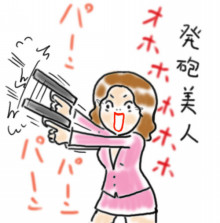
HaPpouBiPun

発砲 (happou) is “to fire a gun,” of course. From this blog, which muses about 美人-related topics.

Posted in Japanese, Yojijukugo | Tagged , , , , , | 1 Comment