A Forging of Beasts

Heylo! I’m so pleased with the results of the last look at the Forge that I thought I’d have another go at it, this time in one of the specific fields (BeastForge). Skip down below if you just can’t wait. 8^P

Before getting down to business, though, I’d like to talk a little more about what a great tool it really is. Sturgeon’s Law holds, in that many of the word combinations won’t feel especially usable or evocative, or just won’t fit the feel of what you’re looking for. And that’s fine. Anything at all that grabs your attention can be locked in; anything that doesn’t move you can be changed or rewritten.

I’ve been using it for a while, too. Way back when I needed to make a new adventure-area map in a relatively sort time-frame, I whipped up Sella Island in part thanks to this tool: specifically, I believe that the Forge is what gave us the Dull Valley, the Upper Kin and Grey Pages, the Gate of Dusk and the Moon-Stair.

And now, for your viewing pleasure, I give you:

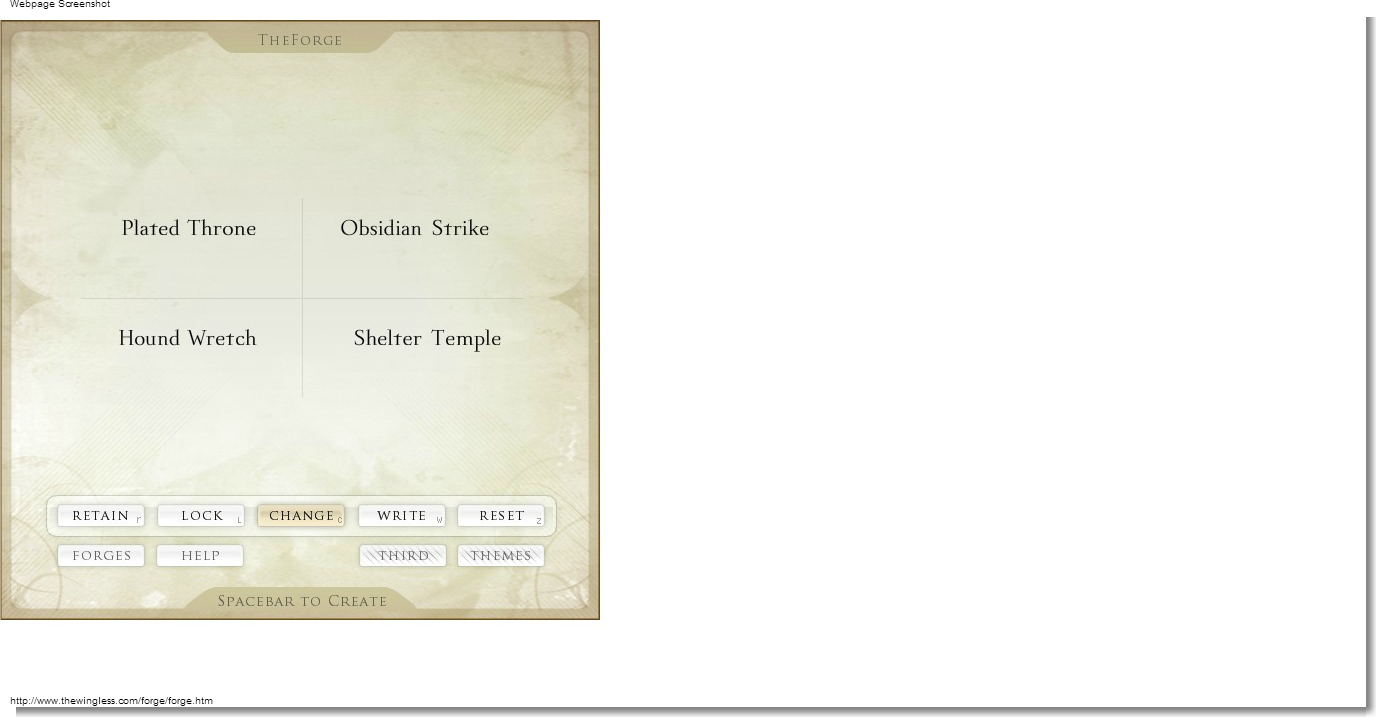
Four Beasts

One of these things is not like the others… and took significantly more time and revisions to reach the current state.

A Shard Rat appears, at first, to be nothing more than an ordinary Rodent of Unusual Size. Alas for the poor soul who fails to realize that that this creature’s power, when threatened or angered –and their tempers are so very short – is to explode itself, even in mid-leap, into a flailing hairy cloud of jagged-toothed normal rats. Dozens of them. The process by which this swarm re-forms into one large Shard Rat is hardly for the faint of heart either, to be honest. 

Wash Ants are so called because of their tendency to catch living prey and “wash” it in a nearby pool of water, even carefully engineering their burrows to include washing-holes near both the entrance and the food-storage chambers. It has been theorized that the purpose of this behavior is to drown the victim, or to knock away as much surface debris as possible. It may be worth mentioning that these ants are as large as horses and perfectly willing to prey on people.

The insidious Blood Runner Fly, on the other hand, is not a natural animal at all, but rather an alien being summoned by the shamans of certain gods. The flies are typically used as spies, for they can understand any language, but can be enticed by shallow pools of blood, which they are drawn to and seem to enjoy frolicking around in. Aside from this habit, the best way to distinguish them from normal insects is to ask them odd questions about emotion and philosophy; this invariably drives the Blood Runner Fly into a rage and betrays its identity.

Finally, the fabled Strong Elk is a powerful beast, headstrong, seldom tamed and never domesticated, expensive and dangerous to keep in captivity – yet it is more desired as a pet by warlords and princes than any other animal of its size. You see, as a cousin of the Goofy Elk, this creature actually fills those it gazes upon with great strength. This boon fades over the next day or so – often leaving the affected with strain and fatigue to deal with from their exertions while under the influence – but a few royal princes have been raised and trained with regular Strong Elk exposure, leaving them both unexpectedly strong in their own right… and addicted.

…And thus ends my second excursion into public Forging. I rather enjoyed some of the results I got while fiddling around, too; don’t be surprised if there’s some more of this later on.

Posted in Uncategorized | Tagged , , , | Leave a comment

Forging Ahead

If you’re looking for random fantasy terms, whatever your purpose, there’s worse you could do than “The Forge.”

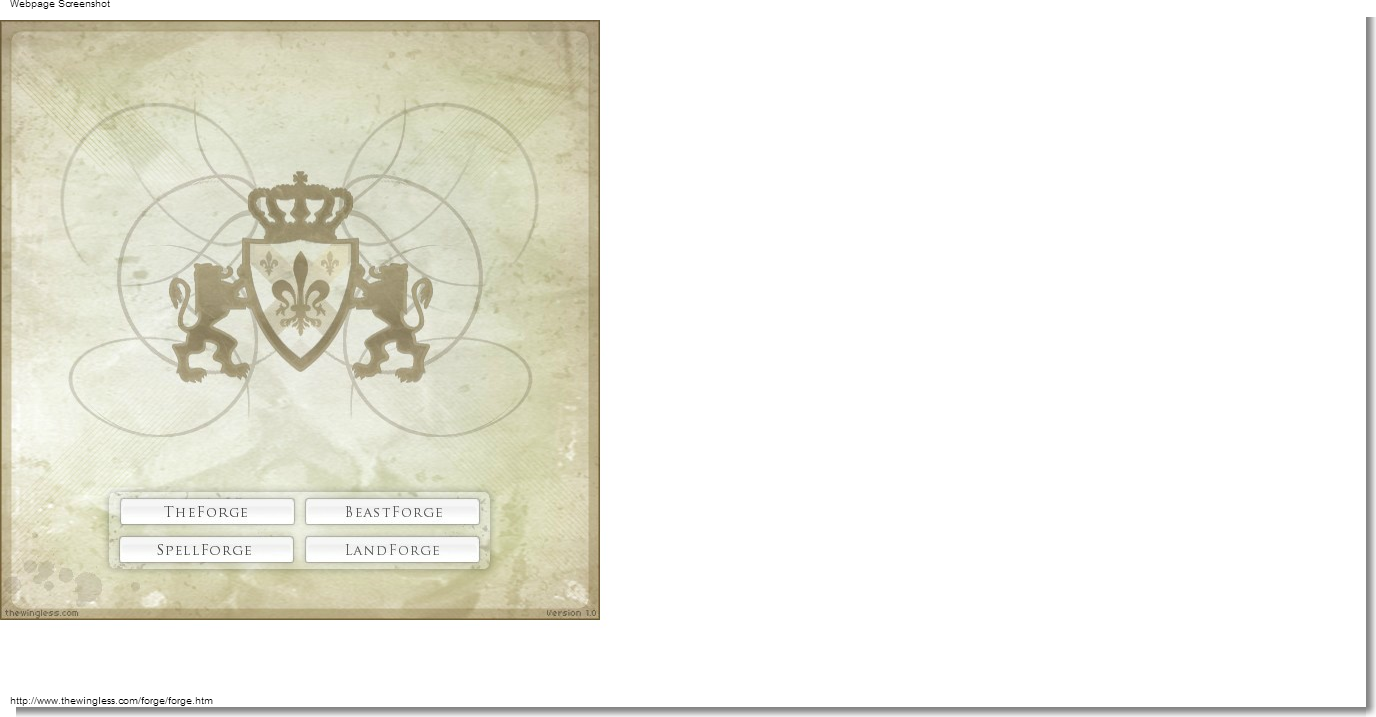
Pictured here. So fancy!

As you can see, some random phrases pop up at the very start.

There are four “generators”: one for creatures, one for locations, one for magical-sounding stuff, and one that’s sort of all-purpose. Choose one, and it’ll take you to this kind of window.

At this point instead of painstakingly explaining the whole tool, I’ll just point out that there’s a Help button; clicking it gives you explanatory text when you hover over anything in the box. Choosing any of the Forges will automatically generate four names, as you can see, so after this it’s just a matter of fiddling around or refreshing until something comes up that inspires you.

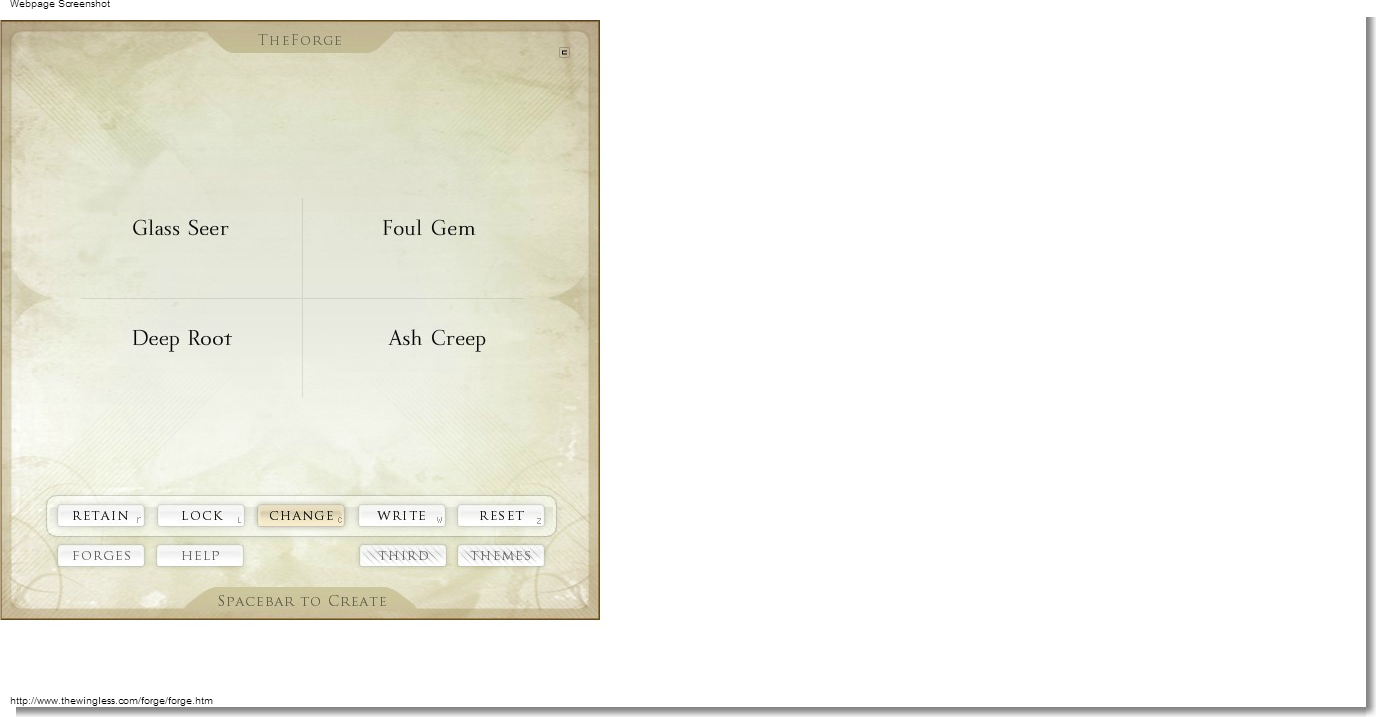
While I was going over the site for screenshots, this set came up without any tweaking.

The raw material of creative juice farming! Mixed metaphor!

It caught my fancy, so here’s my interpretation, just as an example for how this works, clockwise from the top right.

A Foul Gem is a dwarf’s assassination tool. It’s widely known that certain kinds of stones have magical properties that affect the body, and can be used in various ways – worn against the skin, inserted into the skin, fashioned into a dish or utensil so that it touches what you eat or drink, or even swallowed – to protect against poison, disease, and other ills. A Foul Gem is a crystal hand-grown and -crafted to mimic, as closely as possible, a beneficial stone, but with more sinister effect. Exceptionally well-made ones will even incorporate some minor protection or benefit in order to conceal their main effect, which is to poison the user’s body or mind and eventually destroy them.

Ash Creep is a wizard’s death-curse. It starts slowly, with fires around the afflicted giving off slightly more smoke and ash than normal. Soon dust and soot begin accumulating around them even without open fire – first in unused spaces, then on any open surface, and soon everywhere, with horrifying speed. In later stages, the afflicted may go to sleep in a sterile, hermetically-sealed box and still wake up in a pile of ash. Unless the curse can be lifted in time, Ash Creep is messily fatal.

Deep Root is a legendary tuber, found only deep underground in volcanic caverns, apparently living off of geothermal energy in place of sunlight. Although not especially tasty or nutritious, they are highly sought after due to being rare, impossible to cultivate, and completely unaffected by heat, which makes them useful in a variety of magical concoctions. Salamanders and other beings affiliated with fire also seek Deep Root, which to them is a powerful hallucinogen, a sacred plant that grows in sacred sites.

The Glass Seer is a hollow crystalline bust of an androgynous, possibly inhuman figure, found at the mouth of the oracular cave at the top of Mount Fevetch. Anyone who sits inside of the bust and gazes at the stars as they turn above from dusk to dawn may truthfully, if cryptically, answer one question put to them. Each successive meditation within the Seer yields deeper insights – and escalating danger of madness as cosmic truths threaten to overwhelm the user’s mortal mind.

I hope these are interesting, or that you can find something to your own tastes in The Forge!

Posted in Miscellaneous, Nonfiction, World-Building | Leave a comment

Setting Idea – Animism / Spontaneous Generation

There was a time when human knowledge of biology was underpinned (and dragged down) by the theory of “Spontaneous Generation” – the idea that living organisms need not necessarily be born, but may spring wholly formed from some appropriate substrate, such as maggots from rotting meat or tapeworms from intestines. The idea has been replaced with our more complex modern understanding, and is for the most part a mere interesting historical footnote (which, incidentally, gives me hope when considering the bizarre persistence of “creationism” in the face of overwhelming scientific evidence for evolution. This too shall pass.).

But like many other Greek theories about the world, SG seems to have a lot of potential for fantasy world-building (cf. “the four/five elements”). While I’m not currently looking to flesh this out fully, it could certainly throw an interesting twist into a novel’s foundation-work or an RPG setting: a world where pretty much any form of life spontaneously generates (for purposes of brevity, referred to hereafter simply as “generation” or “spawning”) if an appropriate environment is created and left undisturbed for a while.

Let’s start with the basics: we presuppose a normal earth-like world, made of rocks and metals and sand, with water and an atmosphere around the outside. It receives sunlight, is heated from within by nuclear decay and compression, and is shaped and reshaped by geological forces and erosion. Maybe there are satellites such as a moon. The main thing, though, is that the whole space is also inhabited by myriad spirits, which left to their own devices will manifest as life-as-we-know-it.

Stone will spawn lichens and mosses; soil will spawn plants and small arthropods (e.g. insects and other tiny creepy-crawlies); sea-floor ooze will spawn seaweed and… sea-arthropods. Anything dead spawns bacteria (and other microscopic life not already generated by air, water, or soil) and fungi. Geothermal vents spawn soft, slimy things like salamanders or sea cucumbers. And many forms of life don’t just “die of natural means” — they’ll continue to grow and develop until something kills them. So tiny critters will eventually become massive scorpions, behemoth lobsters, giant squid, whales, and other real-world or mythical beasts.

Shallow, sunlit waters generate corals. Coral reefs and seaweed forests generate fish, especially colorful ones. The open sea near coasts generates dolphins, orcas, and other cetaceans. Littoral zones spawn sea mammals such as otters and seals. Icy or salty or wet rocks spawn auks, penguins, pelicans, and other sea birds. Marshlands spawn wading birds, among the reeds. Woods, grasslands, and jungles spawn other birds and beasts… we could go on in great detail, but that’s not the truly interesting part, nor the fantasy tie-in.

How about sentient life? Humans, say, are spawned by hilly scrubland, near water. (I believe this accords with our understanding of humanity’s origins in pre-Saharan north Africa.) Humans can still reproduce and spread to other biomes, but an unattended scrubland will eventually produce wandering tribes of H. sapiens.

Elves spawn in deep forests, perhaps as tiny sprites or pixies, eventually wandering out and encountering humanity as willowy, slightly-scatterbrained faerie creatures. Although the different sizes and flavors (um… phenotypes?) go by many different names, “elves” are specifically the human-sized ones. Go look at some Charles Vess artwork to see what I’m thinking of. As they age they grow ever taller and more slender until, effectively, they fade away… perhaps instinct pulls them back to the forest where they can die, if not in peace, then at least in nature.

Dwarves spawn in crystal formations — often underground, naturally. This leads to the instinctive love for gems that keeps them mining out their halls under the earth; where elves are wistful and whimsical, dwarves are industrious and mathematical. Perhaps as they age they harden and stiffen, until the wrong stimulus pushes them past some tipping point and they just turn back into stone. Perhaps “trolls” are dwarves of great age, grown to monstrous size and strength, but senile beyond all hope and in danger of flash-petrification on exposure to sunlight.

Goblins, on the other hand, are second-tier sentients: they spawn in ruins, as a sort of warped echo of the people that once lived there. (My main inspiration, naturally, is Brian Froud.) An abandoned house that’s making strange lights or noises at night is as likely to be goblin-infested as it is to be haunted. Riffing obliquely off of Tolkien, let’s say that after consuming sufficient food, goblins enter a chrysalis phase and emerge as the larger, less madcap, more violent orcs. While goblins’ main method is mere madness, orcs are driven by an instinctive need to create more ruins to spawn in, leading to constant strife between them and other sentient species.

Orcs that live long enough continue to grow (perhaps they go through another chrysalis?), eventually becoming ogres, then giants, and finally growing too ponderous to move or support their own mass and effectively starving themselves to death. The only ones to escape this cycle are orc shamans whose mastery of magic allows them to halt their own growth, eventually becoming fearsome witches like the Baba Yaga.

Finally, let’s say that any sufficiently large and pure mass of a chemical element is what spawns dragons. Smaug-like dragons don’t hoard treasure — they are generated by treasure, and the smart ones collect more because they can feel the gold adding to their strength. That throws a nice little monkey wrench into any human attempts at chemistry, too, if any purified element produces dragons, and helps justify a fantasy world that doesn’t move on into an industrial age. And the equivalent of an atom bomb is simply a collection small lumps of pure metal that can be smuggled into a target area, piled together, and allowed to generate a dragon.

There’s a lot more you could do with this, but that’s the basics for now. I hope it’s an interesting, or even an inspiring, idea!  8^)

Posted in Miscellaneous, Setting, World-Building | Tagged , , , , , , , , , | 3 Comments

Megadungeon Idea: Vertical Highway/Abyss

Preamble

A common setting for D&D adventures is the dungeon: an enclosed, usually underground space, divided into rooms and hallways and so on, filled with monsters (some sentient and some not; not all of them necessarily hostile), traps, and treasure, providing a certain amount of constraint and direction for the group’s exploration.

A megadungeon is a dungeon of considerable size, such that it can take many sessions (or even an entire campaign) to explore. Megadungeons (or at least the good ones?) tend to be characterized by multiple sections or layers, complex (nonlinear) connections between those sections, multiple factions of sentient residents that hold each other in check, and secrets that can be discovered through clever or lucky play.

Anyway, here’s a smattering of ideas that grew in my head and could be assembled into what I hope is a novel megadungeon. I don’t have the time to devote to it right now (there are other projects I’m spending my free time on), but I did want to post it here – first, to prevent it from fading away on the back burner, and second, to present it in case anyone is inspired to develop it further (if so, let me know! I’ll be interested in seeing what you came up with).

Concept

The core conceit is a megadungeon in which every level (perhaps not every sublevel, but at any rate a clear majority of the areas) are all connected by one large open space. Easy to find, easy to access; of obvious utility.

There are plenty of forms this could take, including an expanded version of the Circle of Doom, but the one that appeals to me is an extinct volcanic cone. Okay, there’s some sort of structure – a school, a fort, a monastery, or the like – built on top of an extinct volcano, one with a (perhaps unnaturally) large open tube. The structure has basement complexes that open out into the tube (not always on purpose?), perhaps including some – smoky forges, etc. – that specifically take advantage of the space.

The problem with this design is twofold. First, one of the tropes of dungeon design is increasing danger with increasing depth, and players will lose some of this implicit metric that they would otherwise factor into their plans. And second, the volcanic shaft threatens to become a cheap shortcut. There’s not much point in building a dungeon that is mega if you give the players a free pass to bypass as much of it as they want, any time they want.

My solution is to make the central artery difficult to use. It’s not just a clean tube of basalt or obsidian; no, it’s a stinking, shrieking abyss. It’s vast, echoing, dark, with a hot wind blowing up from below. The walls are sharp and crumbling in some places, encrusted with crystal or slick with condensation and slime in others. It’s infested with an entire ecosystem of critters and monsters, from weird subterranean flora and the swarms of insects that live in and off of it, to the flocks of bats that eat them, to the increasingly large and dire beasts that eat them (and wouldn’t mind spicing up their diets by adding human explorers).

Because we’re responsible DMs, we throw in some warnings. The structure on top is specifically built in such a way as to plug the hole – it’s actually a fortress designed to defend the surface world against the horrors of the depths. It’s in ruins now (what isn’t, these days?) but writings can be found referring to how deadly “the abyss” is, or graffiti might provide a limited but ominous bestiary. The upshot is that successfully navigating the central artery is one of the more dangerous challenges the site has to offer, and that the players can realize this quickly and plan accordingly.

That’s all you need for a solid adventure site, but let’s spice it up a little! Any selection of these could make for an even more memorable play experience:

  • Floating structures: “islands” suspended in the air by magic or fantastic architecture. In a huge dark space, these would essentially be secrets, with hints about their existence and location scattered around in the rest of the dungeon. They might be prisons still containing dangerous creatures, high-security treasure vaults, labs separated from the rest of the complex for safety reasons, or the private fortified residences of powerful loners.
  • A magma lake at the bottom: it is, after all, a volcano. Maybe the party has a limited time (measured in weeks, sure, but limited) to get into the complex, find a target MacGuffin or secret, and get back out. Or maybe it’s just that the lower you go, the hotter and more poisonous the air is.
  • A sea of bones: volcano or not, it’s long dead. Also long-dead are the millions of ancient bones that can be found in a grotesque and painful mound at the bottom of the shaft, ranging in size from tiny bat and rat bones to mammoth skeletons that could be built into human-scale structures. Also possibly not dead: the horrible things that live in the sea of bones. How did all this stuff get down here anyway?
  • Failed experiments: the monastic order that once guarded the volcano’s mouth was fanatically devoted to self-improvement. Unfortunately, some of their experiments in body- or mind-warping magic went hideously wrong, eventually leading to the collapse of the order and the abandonment of the site. Both the results, or their descendants, and the secrets that spawned them remain in the complex’ depths.
Posted in Miscellaneous, Setting | Tagged , , , | 3 Comments

Meters, Made

This is another post on what seems to be turning into a series of re-imaginings of D&D-style RPG play. In fact, I’ve gone to Obsidian Portal and started creating a wiki in order to keep everything organized; for the curious, it can be found here.

The most recent target of my de- and re-construction is “hit points.” Briefly, hit points (HP) are a nebulous and problematic concept — for a far more thorough discussion of the weirdness that is “hit points” by a far more knowledgeable guy, try here. Generally your character will have a supply of HP with a preordained maximum. Taking damage from enemy attacks, falling, kitchen accidents, etc. subtracts HP from the supply; losing them all means the character dies, or at least is hovering on death’s door. Magical healing and medical care can bring the supply back up, but no higher than the maximum.

I kind of want to combine hit points with stamina and Call-of-Cthulhu-style Sanity stat (“mental hit points,” if you will). Then I flip the polarity: no more subtraction, and no more counter-intuitive situations with “negative hit points.”

Survival Meters and Depletion Meters

My proposal is for three separate “meters” representing the character’s ability to withstand physical and mental wear and tear. The first will be good old hit points; the second, endurance (points?); and the third, stability.

  • Hit points, in this conception, are not so much the measure of one’s ability to stay alive despite harm, as they are the measure of one’s ability to keep standing and doing stuff instead of collapsing in agony. This neatly resolves one of the problems with D&D-style HP; namely, how hard it can be to believe that a character has no “hurting and hampered” state between “fine” and “dead.”
  • Endurance is the ability to carry on despite physical exertion, sleep deprivation, lack of food, and other things that cause lethargy in the body. Sprinters and marathoners may both be powerful runners, but the latter have greater endurance. My hope is that an endurance mechanic can act as a foundation for other useful systems, and perhaps provide a limiter encouraging combat to be short and decisive.
  • Stability is the mind’s resilience in the face of stress and shock. I have a deep fondness for sanity mechanics, but not so much for fire-and-forget Vancian magic. I see one of the main uses of Stability in being a limiter on magic use, but that’s hardly the only thing that can be done with it.

Each of these meters is then paired with a “depletion meter” — a measure of the bad stuff that the character has to deal with. Respectively, these are damage, fatigue, and strain.

  • Damage is anything that harms the physical body on the macro level: burns, gashes, punctures, crushing. I’m thinking there’s “major” and “minor” damage, where the former represents potentially life-threatening types of injury, while the latter is potentially painful or incapacitating (bashed nerves, cuts and scrapes, etc.) but not lethal.
  • Fatigue is a combination of tiredness from sustained activity, soreness or stiffness arising after intense activity, tiring environmental factors, and so on.
  • Strain is anything that disrupts the normal function of the psyche. This can be anything from the horrors of lethal combat, to beholding Great Old Ones, to bending your mind into the illogical patterns of magic. Perhaps, as with damage, this should be divided into two kinds representing long-term issues versus temporary stresses and shocks.

If the level of a depletion meter is ever greater than the level of the corresponding survival meter, the result is a “drop roll,” something along the lines of this “injury table,” except a separate one for each pair of meters. Keep in mind that damage exceeding hit points is not death; it simply means that the character is overcome by their wounds and cannot carry on. Depending on the results of the drop roll, this could range from instant messy death to “it’s merely a flesh wound!”-style results that are quickly recovered from. I’m considering a relatively wide spread of possible results (1-20 instead of 1-12, for example), perhaps with excesses from the depletion meter (9 damage versus 6 HP would be an excess of 3) turning into penalties on the roll.

I think there’s a lot of potential here. Yes, there’s extra bookkeeping compared to simply tracking current and maximum HP. On the other hand, it feels like a more intuitive and self-consistent system, and the number of other tasks that could be plugged in (fear effects manifesting as temporary strain? Mind-domination effects as temporary strain?) seems promising. I’m going to keep working on this, and see how it develops.

(One final note: I’m not entirely satisfied with all the names for stuff. If anybody has any suggestions for alternate terminology, please feel free to let me know in a comment!)

Posted in Nonfiction, Rules, Uncategorized | Tagged , , , , | 3 Comments

The Head that Wears the Crown

In D&D and related games, there’s a somewhat unusual problem that pops up every now and then:

  1. Adventurers most commonly gain strength by going out into the wilderness and defeating monsters. The standard pattern is “kill things; take their stuff.”
  2. Members of the nobility spend most of their time at home, ruling, and never seem to go on adventures or defeat monsters; it stands to reason that they are not personally very powerful.
  3. So… what is there to prevent a party of adventurers from killing kings and taking their stuff?

There are a number of possible answers, from the blunt (kings are powerful and hard to defeat because I said so) to the boring (the best way to become stronger is actually through controlled training with a master-of-arms, not mucking about in dungeons on the hunt for orcs or dragons to slay, so kings tend to be powerful warriors) to the delicate (kings know they could be murdered at any time, and tend to surround themselves with bodyguards, rituals, and other security) to the Machiavellian-but-unrealistic (all the fragile kings have already been overthrown, meaning all living rulers are actually powerful former adventurers) to the historical (usurpers tend to find themselves unpopular, and on the wrong side of armed rebellions).

What I want to suggest today — the idea that got me out of bed in the middle of the night to write — is another solution that taps more directly into fantasy-gaming conventions.

My inspiration was HBO’s Game of Thrones series (disclaimer: I haven’t read the books, and may well have misinterpreted Martin’s world-building. C’est la vie.) I was struck by the Starks, Targaryens, and Greyjoy families in particular, and by other aspects of the world as it is shown and told to us:

  • The Starks keep wolves as pets, and after his injury Bran dreams of wearing a wolf’s body. Robb Stark is called “the young wolf.” They worship “the old gods,” although the exact implications of this aren’t clear.
  • The Targaryens are said to have historically commanded dragons. Viserys Targaryen refers to himself as “THE DRAGON!!1!”, while his sister Daenerys is genuinely immune to fire and forms a bond with dragon hatchlings.
  • I think I read somewhere online that the Greyjoys also worship one of the “old gods,” a dead god of the sea (not Cthulhu, alas), and ritually “baptize” themselves through drowning and resuscitation.
  • Magic is portrayed as returning to the world after a long absence. What (if anything) this has to do with the looming capital-W Winter, with the birth of new dragons into the world, etc. I’m not sure, but what is certain is that magic once existed in the world, has in some part been lost, and is resurgent during the story; I imagine a storyline in which the noble houses, during their struggle for dominance, find and are forced to use their supernatural abilities. It would be interesting, if that’s the actual arc of things, to see whether the Lannisters have any actual power aside from “filthy rich.”

The idea that sprang up in my mind very early on was that each of the noble families is “in charge” specifically because they have some special power. The Starks, to me, are obviously werewolves. And probably not “cursed to change during the full moon,” either: the kind that can change when they want into especially large and intelligent wolves, communicate with and command normal wolves, and perhaps enjoy some sort of immunity to weapons not made of silver or the like. The Targaryens have dragon essence in them, giving them similar communion with dragons and various other gifts as well. The drowned-and-reborn islanders are perhaps living zombies, unable to be slain unless some magical condition is met (say, forcing them to drink salt water, which is after all what killed them the first time around).

A nice nod in all this to real-world royal politics lies in the “old gods” — what if the royal houses of Game of Thrones got their powers from the gods themselves? Perhaps each family has its own patron deity, and their powers reflect the god’s associations: a wolf-god gives wolf-gifts, a sea-god gives sea-gifts, etc. A much more concrete display of divine favor than the real-world “divine right” or “celestial mandate,” and perhaps requiring a special ritual, like a Bar Mitzvah or Confirmation but even less pleasant, to become effective.

The application to your friendly neighborhood D&D campaign is simple. Noble X holds the title not just because of wealth, or connections, or even a relatively familiar trope such as magical powers (your good old witch-king or mageocracy, although they tend to rule exotic foreign realms in a lot of campaign settings). No, this guy has a hard-core fantasy superpower, which at its tamest means being able to command monsters. They’re still killable, of course; everything in D&D is killable if you’re powerful enough and lay your plans well enough. But most adventuring parties will at least be given pause in their murder spree if they know that almost all nobles, and especially royalty, are liable to have a nasty ace or two up their sleeves.

 My use of the term “superpower” above wasn’t casual, either; you can mine comic-book superheroes for ideas for the secret powers that keep royal bloodlines royal.

  • Lots of money plus super ninja training (Batman)
  • Invulnerable to harm except in the presence of a special material or token (Superman)
  • Echolocation plus also I guess super ninja training (Daredevil)
  • Super-speed (The Flash)
  • Can shape-change into something smashy and hard to hurt (The Hulk)
  • Able to be on fire at will and obviously immune to fire (The Human Torch)
  • Can shoot friggin’ laser beams out of his eyes (Cyclops)
  • …etc, There are probably thousands. Have fun!
Posted in Uncategorized | Leave a comment

Tweaking magic

Last time was a grab-bag of ideas, but the main one that drove me to post was the idea of Devotions. I like the idea of (myths and game settings that feature) human-like gods, with moods and whimsy, and the idea that human cultic practices arose from a need to keep the local divinities properly coddled and appeased.

This post is a complement to that. I’ve been thinking about ways to spice up traditional non-divine magic use. What I came up with isn’t an entire alternate system as such, more a modification or house rule or alternate perspective that can be layered on top of Vancian, point-based, and probably other systems without any serious conflicts. In my mind, this gives the sort of variety that the designers of D&D 3.x / Pathfinder were aiming for with their profusion of spellcasting classes. It overlaps to a degree with the Use Magic Device skill as well.

The idea is that while the underlying magical effects remain largely the same, the methods used to generate each one defend on the tools and methodology, or more abstractly the medium. Here’s a list of examples along with some thoughts about how they would balance against each other in play.

1. Casting by rote. This is the system’s default style. It’s moderately quick, requires a moderate expenditure of energy (whether in the form of a spell slot, mana points, fatigue taken on, etc.), and offers a high level of control over the results with just a baseline requirement for preparation and resource investment. Rote casting can only be used by people with relatively extensive training in order to control all the little variables; anybody without the necessary level of expertise must find an aid of some sort (as detailed below).

2. Casting by ritual. This is the poor man’s version of rote, requiring a relatively complicated or time- or resource-consuming setup. Rituals might demand multiple people acting on concert to meet all the requirements, or have strange and specific elements — can only be performed in the dark of the moon when the pole star is clearly visible in the night sky; can only be performed on a mountain peak within an hour of a lightning strike; the final step can only be completed by a one-armed man who has never shed a tear. Ritual probably takes less training than rote to pull off, if only because it tends to move at a more sedate pace and the practitioners can consult instructions during the process.

3. Casting by reading. Ritual for dummies, or perhaps just a natural consequence of a world where words inherently hold magical power. Someone needs to write down the magic words in a scroll or book, on a clay tablet, etc., and anybody who can read the script used can simply read the spell aloud for the magic to take effect. The reader will probably need no particular magical talent or training, and depending on how benign the spell is may not need to invest any energy or other resources of their own. I see this method as being somewhat faster and less-involved than ritual, once the text is in hand, but the reader probably has very little control over the results — the majority of the costs, and the majority of the control, go to the text’s creator. Texts like this are often used up when used.

4. Casting by device. This is the category for your magic wands, mirrors, seven-league boots, and other magical tools. Like texts, devices will have a limited set of uses, and parameters that are set during creation rather than controlled by the user. The trade-off is that they are even simpler to use than texts (while some secret, like a command word or similar trick may be necessary, they don’t require literacy) and, again, probably need no energy or resource investment after creation.

5. Casting by familiar. This is Prospero and Ariel, or Faust and his demons. The supposed magic-user is not using the magic personally as much as they are asking some magic being to help them out. The relationship between magician and familiar may be one-way or two-; harmful, benign or mutually beneficial; it may be based on friendship, slavery, continual minor transactions, some past debt that needs to be repaid, or a future price to be extracted when the time is right. Each individual act of magic costs little or nothing to the user… but how much time it takes, how much say they have in the details, and how much they will have paid by the end will vary depending on their relationship with the being. There may be a formal pact involved, and the familiar will almost always have limits on what deeds it can or is willing to perform.

6. Casting by gnosis. Or casting by sheer force of will, if you will. The caster relies on nothing but a passionate outburst of their innate energies, or an intuitive understanding of how the forces of the cosmos align, to perform magic. This will probably be the most draining method, because it uses no props or crutches to make the job easier. It will also be one of the most demanding — that kind of passion can only come at moments of extreme emotion; that level of intuition can only come after long years of study and experience, or at least once-in-a-generation levels of talent. There may be terrible costs involved, usually from the strain, but the amount of power and often of precise control over that power are greater than for any other method.

For example, say you want to get some pants. You might just cast Summon Pants by the normal method. You might call your friends and dance around a pile of lint for the Trouser Ritual. You might read the Pants Calling Song from a book, or just strike Der Hosengong until pants come out. You might ask the black cat that lives with you to bring you some pants, and wake the next morning to find them by your front door (shredded and with bits of dead animal inside, of course). Or perhaps you blaze with an eldritch light and, when everyone can see again, you are clad in proper britches. (Amazingly enough, spellcheck refuses to acknowledge “eldritch” and suggested “britches” as a replacement.) After that, the details will depend on the system, the genre, the needs of the moment.

That’s all for now, but there’s more cooking somewhere back in there. I know I left the “Four Realms” system somewhat in the lurch lo these many moons ago, but recent reading has rather inspired me to dream up what I can only call a “wildly mutated original D&D clone.” Emphasis on “mutated.”

Posted in Nonfiction, Rules | Tagged , , , , , , , , , , | Leave a comment

Brainstorm of the day — Random RPG Mechanics

The other evening I was shooting the breeze with a friend, talking about various mechanics that could be used in constructing a traditional-style tabletop role-playing game. Here are some of the brainchildren of that conversation, in no particular order:

Stat balance: Min-maxing, in which a character’s statistics are manipulated in a way that renders the character overpowered in a chosen sphere at the cost of most or all others, is a perennial problem in this sort of game. One possible counter-measure would be what I call “stat balance.”

To wit: complementary stats are paired together and assigned a mutual maximum so that the more one is raised, the more the other decreases. In D&D, for example, you could say Strength + Dexterity must be less than or equal to 24, rendering it impossible to create a strong-and-agile combat machine at the expense of social and mental acuity. If desired, in-game training or the like could be used to raise the cap for more experienced characters. This would allow them to transcend their starting limits while still curtailing min-maxing at the beginning.

Tech Tree skills: A skill system often involves raising the score of a single metric: adding bonuses to a single die roll, or adding extra dice to a “pool.” How about a “tech-tree“-style progression? Each gain in experience allows new skills to be purchased, which in turn become prerequisites for various in-game actions and/or more advanced skills. For example, “Literacy” would allow the character to read and write and act as a prerequisite for “Calligraphy,” while in turn relying on “Language.”

This runs some risk of devolving into a replacement “adding bonuses” system: if Swim 1 leads to Swim 2 and then Swim 3, then there’s not much point. But a system with streamlined skill mechanics (a simple pass/fail or on/off system; rolls based on stats rather than skill values; etc.) could benefit from this kind of structure.

End-of-turn Action Points: Some systems use an allowance of “action points” to determine what a character can do in a single “turn.” These seem to be universally renewed at the start of the character’s turn, leading to the question of whether the characters can act in response to other events “off-turn.” Special reaction actions and borrowing against the next turn’s action points are both solutions I’ve seen to the problem.

But why not just have a character’s actions refill at the end of their turn? If pressed by dire circumstances, they can spend these freely to react and defend themselves from accident or attack, and then on their turns use any that remain to pursue their own agenda. It makes organic sense, too, that if the character is sorely put-upon then they don’t have time to do anything but react; a system like this would model the benefits of taking the initiative.

Renamed Stats: Okay, I’m being more than a little tongue-in-cheek here. But what if the traditional D&D stats (Strength, Dexterity, Constitution, Intelligence, Wisdom, Charisma) were renamed (Example: Brawn, Agility, Toughness, Cleverness, Sensitivity, Presence)? Would this have a meaningful impact on the players’ perceptions of the system or the nature of the characters they play?

Devotions: Last but not least; rather, this is my centerpiece and the one idea that I really want to use. In D&D and related fantasy games, it’s relatively common to have “clerics” capable of channeling the power of the gods to aid their companions… but almost unheard-of for the gods to have any say in how that power is used. Another complaint common to recent editions is that clerical magic is essentially identical to wizardly magic, but with a slightly different focus (more healing and disease-curing) and based on different stats.

No more! How about priests be required to perform specific acts of devotion to their gods in order to be granted miracles? How about those who would receive divine blessings also be required to show their devotion, or at least make a meaningful gesture? A community might be required to perform a harvest festival and sacrifice the first fruits before their priest could bless the fields for next year’s crop. Donations to a shrine might be required in return for healing or curse-removal because the coin pays for incense and candles that please the resident god.

“Good” gods would be pleased by benign or benevolent acts. “Evil” or wrathful gods would enjoy human sacrifice and ritual torture. A system of Devotions like this can easily be used to support the tropes and tone of your genre of choice.

It could also present players with interesting moral choices: if they’re in a town full of dark cults but need divine magic, what devotions are they willing to perform to get what they want? Can they convince the cultists to take simple monetary donations? Would even a cash donation, ostensibly for church-building upkeep or fragrant spices, be acceptable? How about priests of god A, who grants one kind of miracle, but need the kind granted by god B? What compromises are they willing to make; how far can they go before A becomes jealous? Would pantheons under this system simply be alliances of deities willing to trade favors and devotions from a body of mutual worshipers? I definitely want to expand this idea further.  8^)

Posted in Nonfiction, Rules | Tagged , , , , , , , | 4 Comments

Location: Sella Island

Geography

Located about sixty miles southwest of Kyper, the nearest major island is Sella. The island is roughly saddle-shaped, with a mass of high cliffs dominating its northern third and another, slightly lower mass of hills to the southwest. The eastern part of the island is rugged but low country, while the comparatively smooth west is dominated by a savannah, with salt flats along the coast. The island has only one river of significant size, the Dekaniki, which flows down out of the mountains in the eastern half of the island before abruptly turning east and heading to the sea, passing through a series of limestone caverns en route. There is some evidence that the entire island is the remains of a large volcanic caldera, but the limit of geothermal activity within living or oral memory is nothing more threatening than a handful of natural hot springs.

A map of the island Sella, as sketched by a sailor in Okero Port

Population

Most human habitation of the island is limited to scattered strongholds and camps. The largest town on Sella is Okero, nestled in a valley around the Dekaniki just north the point where it meets a tributary stream, the Para, coming from the south and turns toward the sea. A couple hours’ walk over the hills to the east, there is a small but well-protected natural harbor with an equally small, but energetic, port. About four hours’ walk southwest of Okero is Para Potam, less a town than an unusually dense region of farming villages and hamlets. It is here that most of the island’s agriculture takes place.

In contrast, the western half of the island is more sparsely populated. The two major centers of human habitation there are Skygate, a small community in the southwestern highlands, and on the edge of the salt flats stands Castron Cremo, the name of both a still-functioning pirate stronghold and the community under its protection.

Except for isolated druid and hermit camps, the mountainous northern third of the island is almost entirely bare of human habitation. The slopes and valleys there have a dark reputation as the home of monsters and madmen.

Okero is home to about six thousand people and includes the island’s seat of government, with a Levy-Master and a druidic hierarchy. Administration of the island is nominally in the hands of a Navarch, although this ruler is clearly little more than a renamed pirate king whose authority only extends as far as his soldiers – it just so happens that he pays lip service and some taxes to the Archipelago’s central government, and his soldiers control or influence most of the land east of Castron Cremo. The rest of the island together holds about ten thousand, with no more than a few hundred in any given community.

The bulk of the island’s populace is Archipelago people of melting-pot ancestry, although there is a noticeable minority of Rune Sailors living in coastal communities in the east and south, and some of the islanders have some degree of Uluogu or “Bronze” heritage. Languages spoken on the island include Pata Ila, Vandik, and two local pirate-jargon version of Gyamt, known colloquially as Okero Cant and Cremo Cant.

Culture

Compared with the tangled and unruly – but ultimately law-abiding – enclaves of Kyper, Sella is more chaotic and more uniform. The Archipelago’s piratical history is closer to the surface here, and where law rules, it’s at the point of a spear. The character of Sella is feudal where Kyper is mercantile; mysterious where Kyper is complex.

There is no thriving guild presence here; each community produces what resources it can and sells off the rest. There is no authoritative Order of Magi presence here; there is one low-key master with two apprentices in Okero, and all the rest of the island’s practitioners are from unregulated traditions. Family gods are common, and the Interpreters of Dream are the most common breed of priest to be found, with one or two in nearly every community. Mercenaries are not uknown on Sella, but the masters of neither Okero nor Cremo smile on freelancers; a sell-sword is just too unreliable for the comfort of the powers that be.

Points of Interest

The Axis – A baobab tree of immense size, said to grow in the exact center of the island and root it into its position in the sea, without which it would drift into far more dangerous waters. The only monkey on the entire island lives in this tree; those who catch a nut it has thrown are said to be blessed.

The Citadel – In the middle of a small but dense patch of jungle in the southeastern corner of the island stands an ancient tower of simple sun-baked bricks. Despite its apparently crude construction, the Citadel never seems to age, and its origins are lost to antiquity. Now home to the island’s resident archmage, a paranoid type who refused to reveal his name or face, but nonetheless supported a thriving community of craftsmen in a walled and gated village around the base of the tower and could be counted on for aid in dire times. He single-handedly enforced a de facto truce between the Navarch and Castron Cremo. The Citadel has gone silent recently, to the concern of many.

The Dull Valley – A great, shallow depression in the western savannah. Said to be the site of a long-forgotten supernatural battle. Shunned.

The Gate of Dusk – At the southernmost extremity of the northern mountains, an ancient but broad and well-kept road leads to what must be a pass into some hidden valley. But the road is blocked by a wall and gate formed from a single, unbroken piece of obsidian. Each month on the dark of the moon, mute acolytes emerge and trade curiosities and charms with the locals. The gates are said to open during eclipses as well, but none have ever ventured beyond them and returned to tell the tale.

The Limestone Caverns – The cave complex that the Dekaniki passes through on its final push to the sea is roomy and labyrinthine. Fish caught in the still pools of its depths are renowned as the most excellent catch in all the waters on or around the island. Fishermen seem to be considered a delicacy by something that lives in the darkness, too. Recently rumored to be safe for fishing as long as one appeases the water-spirit who lives there.

The Moon-Stair – The road that passes through the Gate of Dusk continues straight south, across the grasslands and hills, out to the very end of a thin spit of land, where a gray-white pillar stands planted in the rock. The pillar seems to be made of a piece of whale-ivory, but is easily as high as five men are tall. Tiny hieroglyphs in some arcane language cover its surface. An minor site of reverence for the Rune Sailors.

The Stonefall – The Dekaniki comes down from the mountains above Okero in a massive waterfall, the mists of which mark the town’s northernmost marches. It is said that anyone who meditates under its waters for a full day and night will gain great strength, endurance, and wisdom. Many have died in the attempt.

The Upper Kin – The grasslands around Skygate are dotted here and there with basalt pillars, atop which live hermits who are said to possess madness and insight in equal measure. They are served by the Grey Pages, men and women at the end of hope who take vows of chastity, wear unisex garments, and perform menial labor in return for double meals.

Posted in Setting, World-Building | Tagged , , , , , | 1 Comment

Creation Legend (Retold from the Amsa of Ya-Khem family)

Long before the world was divided into Halls, all things were mixed and uniform. This was called the living world. It went on for such a long time that each element slowly changed into each of the others and then finally back to itself; an eon of eons. But when the elements returned to what they had once been, the shock of recognition went through them, and shook the living world with a ripple. Where the ripple went, the world was no longer uniform, and clumps began to appear within it.

The first clump to appear was a bubble of air. A wind began to blow within the air, brushing the water away from the stone. Inside the air a pebble and a droplet formed. On the surface of the pebble, heat separated from cold, and in the depths of the droplet, light separated from darkness. The light and heat created more wind, and as the wind blew, it separated the elements all around the edges of the bubble.

The last element to separate was that of living-things. At first, all the life had been spread out through the world, so that the world itself was all alive. But now little pebbles of life formed at the edges of the bubble. They walked on the pebble of stone and drank the water. As more pebbles of stone formed, the living things took them and made a larger place to walk on. As more droplets of water formed, the living things took them and stored them in cracks in the stone. Some living things ate the light, and became plants. Others ate the heat, and became animals.

Another eon passed like this, and within the living world, a new world was formed. It was made of pebbles and water, with wind blowing around it and living things on it, eating the heat and light that were separated out by the stone and water. But the living world felt the bubble eroding it from inside, and decided to kill the new world. So the living world compressed itself, trying to crush and mix all things inside it again.

When the living things saw the world crushing in all around them, they did not wish to die, and wove barriers to stop it. They made a barrier of light-and-dark, and placed this as far away from their world as they could. Then they made a barrier of heat-and-cold, and placed this inside the first. These barriers are called “Sky.” The wind blowing around the world began to push on Sky, making it spin also.

The living world tried to crush Sky, but found that it could not, for a round shape is the strongest and the living world itself had no shape at all. But the currents within the living world, which it made by compressing itself, brushed against Sky and were separated by its motion. Because of this, more pebbles and droplets and heat and light came into the new world through Sky. The new world was growing, and became divided into different Halls, with different amounts of each element.

Many eons after the Sky was made, the world became big enough for people to live on. As the world grew, the living things grew as well, and finally, they were too large to eat only heat and light. The plants still eat light, but also they eat stone. The animals still eat heat, but also they eat plants. When the time came to build people, all the living things wanted to have the honor of building people, and they fought to gain that honor. Because of the war, plants and animals changed into many different kinds. Some did not want to fight, so they hid in the waters or under the stones or even in the air. But because the animals could eat the plants, they won the war. This is why people are like animals. The plants were jealous of people, and made trees. But the animals had already given the people-minds to the people, and so there were no minds left for the trees. This is why trees have always been the servants of people.

One day, the living world will be all gone. Then there will be no new light and heat coming into this new world through the nodes, and there will be no new stone and water to make the core of the world out of, and there will be no more increase of living things. This is why it is important to learn how to use only as much of each thing as you need: because while right now there is always more, it will not always be so.

Woman picking fruit

Art by Ryan Armand (kiwisbybeat.com)

Posted in Setting, Short Fiction, World-Building | Tagged , , , , , , | Leave a comment