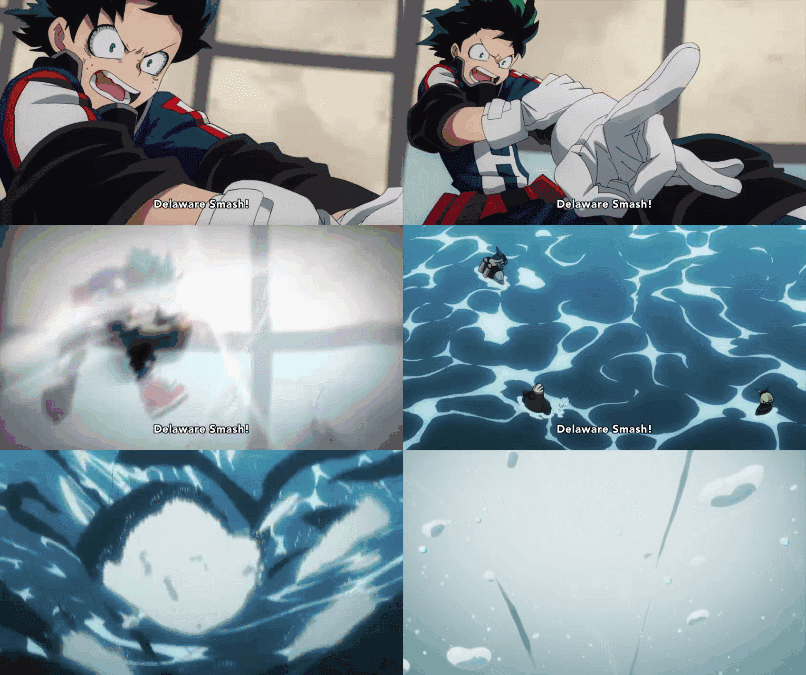
Hot air, cold air

物言えば唇寒し秋の風
(Mono ieba kuchibiru samushi aki no kaze;
“When you say something, then your lips will feel the chill of an autumn wind”)

Definition:

Being nasty will only make you feel bad later; shooting off your mouth invites disaster. Needlessly talking about other people’s (perceived) shortcomings and boasting about your own (perceived) virtues only invites ill-will and misfortune, so it’s better to be circumspect. “Silence is golden.” From the image of opening your mouth (for malicious gossip, etc.) and feeling an unpleasant chill as the autumn breeze brushes your lips.

Breakdown:

We begin with noun 物 (mono), “thing,” compounded with verb 言う (iu), “to say.” The latter is in perfective form, with conditional suffix ば (ba), “when(ever).” This dependent clause is followed by noun 唇 (kuchibiru), “lip(s),” with adjective 寒し (samushi), “cold,” in conclusive form. This is followed by what I parse as a separate comment: a noun phrase comprising 秋 (aki), “autumn,” and 風 (kaze), “wind,” joined by associative particle の (no). One might imagine particles (such as an を between 物 and 言えば) or other additions, but these are elided.

Notes:

Careful readers will already know why the grammatical structure is a bit unusual for a kotowaza: it’s because this is also poetry. This “saying” is a 5-7-5-syllable hokku from the poetic collection『芭蕉庵小文庫』 (Basho-an kobunko) by, well, famed poet Matsuo Bashō.

That said, it’s acceptable to shorten the saying to a pithier form such as 物言えば唇寒し.

The wisdom of keeping one’s mouth shut is not a new topic.

Example sentence:

「ママ、ママ、テストで百点満点取った!」「良くできたわね!嬉しいね」「でも、はるちゃんは」「そんなの言わなくていいわよ、物言えば唇寒し」「え?普通にあったかいけど」

(“Mama, mama, tesuto de hyakuten manten totta!” “Yoku dekita wa ne! Ureshii ne.” “Demo, Haru-chan wa” “Sonna no iwanakute ii wa yo, mono ieba kuchibiru samushi.” “E? Futsuu ni attakai kedo.”)

[“Mama, mama, I got a perfect hundred on the test!”
“Well done! I’m so happy!”
“But Haru got a—”
“No need for that. Say too much and it chills the mouth.”
“Uh? But I’m as warm as usual.”]

Posted in Japanese, Kotowaza | Tagged , , , , , , , , , | 2 Comments

Sorry about all the words

暴言多罪
bou.gen.ta.zai

Literally: violence – word – many – guilt/sin/crime

Alternately: This is a polite, formulaic phrase to use at the close of a letter, apologizing to the recipient for being overlong, going too far with its content, or anything else that might have inadvertently given offense.

Notes: Commentary on this compound suggests a special ire for people who actually put harsh or offensive language in a message and then slap this phrase on the end like a useless band-aid… but I’m sure we can all think of that one guy who would happily fill a letter with insults without any appearance of awareness that he had done anything wrong. That’s the sort of jerk who makes you long for people who know and care enough to at least pretend not to be trying to be nasty.

BouGenTaZaiPeko

Posted in Japanese, Yojijukugo | Tagged , , , , , , | Leave a comment

Magic Monday: AI Magic 6

Week 6: Offensive Magic

What do angry witches and wizards do? Curse people! This week we’re looking at a series of spells that are likely to give somebody a really bad day.

Cursing Wink

You inflict an obsession on your victim by meeting their eyes, after the proper arcane preparations, with a well-timed wink. The object of the obsession can be almost anything you choose, but it must be within the victim’s field of vision even as they look at your winking eye, so the spell is commonly associated with young and foolish magicians using it on the object of their own affections as a sort of love-spell. Despite its relative ease of use, this curse is rare, because the caster must also take on a tic or obsession of their own for as long as it is in effect.

Chilled Arrow

You thrust your hand into a nearby piece of ice and pull out an arrow, dart, javelin, or similar missile. Whatever this ice-bolt next touches will be struck by a wash of rising cold that condenses moisture out of the air, then freezes it solid, effectively bonding the two together. Legend claims that this spell was originally devised as a means of marking pathways, in some cold country, but now any such benign use has been subverted by the human lust for violence.

Maine Storm

Through a grueling ritual you call all of the wind and potential precipitation from as far as the eye can see – from horizon to horizon – and direct it to focus on a single area. That locale suffers from a fierce blizzard, but everything else in sight enjoys a pleasant calm. This spell is one of the reasons why weather-wizards are so keen about living on mountaintops, but rumor claims that a true master can use it to sail at unbelievable speeds by carefully pacing the blizzard at just the right distance behind their ship.

Forceful Boor

This social curse dulls its victim’s ability to feel empathy for, or even pay attention to, others, while magnifying the seeming importance of small details about the victim’s own life and thoughts, resulting in a conversational partner who becomes increasingly aggressive and tasteless over time. Perhaps the most dangerous aspect of this spell is that its victim quickly loses the capacity to notice their affliction, instead becoming paranoid and petulant as they shed acquaintances, alienate friends, and drive away family.

Forceful Force

This double-faceted curse may be mistaken at first for a boon. On the one hand, it multiplies the power of its victim’s every motion in a manner similar to Greater Flick (below), effectively granting them superhuman strength. But at the same time, it removes their ability to sense or regulate the force with which they move. Everything the victim picks up risks being crushed or torn; every footfall is a floor-shaking stomp; objects casually tossed become deadly missiles; anything like a hug is right out. On the plus side, involuntary reactions such as hiccups or sneezes tend to be hilarious for onlookers at a safe distance.

Remorse?

This cruel but subtle curse does nothing more than plant a tiny seed of doubt in the victim’s mind. Every night, the primary focus of the victim’s dreams is infected, and the victim’s attitude on that topic becomes just a bit more pessimistic. If the curse is left unbroken for too long, the victim may come to see themselves as incapable of doing any good, paralyzed with regret over the past and fear of the future.

Greater Flick

You create a tensed loop with part of your body – such as by bracing one finger against another in order to flick it – and magnify the potential energy the loop contains into a shattering concussive blast. This can place great strain on the body, and inexperienced users would be wise to only invest a little energy before using it to flick a projectile – such as shooting a marble at high speeds – but hardened physical-magic adepts have been known to release gale-force winds with a mere snap of the fingers.

Deku Greater Flick
(Side effects may include: sore muscles, bleeding, shattered bones, supervillain attention, tear-jets, and bitter rivalries with childhood friends.)
Posted in World-Building | Tagged , , , , , , , | Leave a comment

The softest immolation

鳴かぬ蛍が身を焦がす
(Nakanu hotaru ga mi wo kogasu; “The silent firefly burns itself”)

Definition:

Those who feel the most deeply are silent, while those who talk the most are often shallow in their thoughts and feelings. “Light cares speak, great ones are dumb.” “Still waters run deep.” In the insect world, some (especially cicadas; see below) are impressively loud… but the voiceless firefly glows as if it were burning up inside.

The saying may be used for thoughts and feelings in general, but is most often applied to love or romantic attraction. Keep in mind the traditional idealized image of the stoic samurai man, and the 大和撫子 (Yamato Nadeshiko) woman who is so silent and retiring as to be nearly nonexistent. I’m reminded of the famous assertion (apocryphally attributed to Soseki) that the best Japanese translation for “I love you” would be 月がきれいですね (tsuki ga kirei desu ne), “The moon is beautiful, isn’t it.”

Breakdown:

We begin* with the noun 鳴く (naku), “to make an animal sound,” in imperfective form. It then takes the negative suffix ず (zu), in prenominal form as ぬ (nu), which allows it to connect to and modify the noun 蛍 (hotaru), “firefly.” Particle が (ga) marks the silent firefly as the subject of a verb; particle を (wo) marks the noun 身 (mi), “body,” “one’s self,” as its direct object. The verb in question is 焦がす (kogasu), “to burn (something).”

Notes:

*A longer version of the saying begins with 鳴く蝉よりも (naku semi yori mo), “much more than the cicada, who does call.”

I have mixed feelings about this saying. On the one hand, it certainly is true that people with absolutely nothing in their hearts will overcompensate with bombastic and excessive talk about the feelings they think they’re supposed to have. (Cf. 45.) And at the same time, the more deeply-held a feeling is, the harder it can be to put into words. On the other hand, humans are social animals and communication is of vital importance to our inner and outer lives. If you take this saying as mere description, it’s fine, but anyone who takes it as prescriptive, or romanticizes silence, and avoids the work of proper expression is only hurting themselves.

Example sentence:

鳴かぬ蛍が身を焦がすように、家の娘が別のクラスの男の子に片思いをしていて、毎日サッカーで目立つように奮励努力してるらしい」

(Nakanu hotaru ga mi wo kogasu you ni, uchi no musume ga betsu no kurasu no otoko no ko ni kataomoi wo shiteite, mainichi sakkaa de medatsu you ni funrei doryoku shiteru rashii.”)

[“Apparently our daughter, like the fabled firefly who burns bright but doesn’t call out, has developed a one-sided crush on a boy in a different class, and has been working as hard as he can every day to stand out in soccer.”]

Posted in Japanese, Kotowaza | Tagged , , , , , , , , | Leave a comment

A garde for vants

斬新奇抜
zan.shin.ki.batsu

Literally: behead – new – strange – extract

Alternately: Completely new. Unprecedented. Often used to describe a novel idea or unconventional way of thinking.

Notes: Compare and contrast this compound with prior entry 奇想天外.

It is an error to replace 斬 with its cousin 漸 (zen) “gradual,” or 奇 with homophone 寄, “bring near.”

ZanShinHonDana

“Hey, what if we made… a bookshelf that wasn’t very good at holding books!” “How novel!”

Posted in Japanese, Yojijukugo | Tagged , , , | Leave a comment

Magic Monday: AI Magic 5

Week 5: Power Play

Magic is a tool, and people tend to find ways to use tools for amusements or relatively trivial tasks; it’s not all killing curses and raising new islands out of the depths of the sea. This week’s selection is spells more or less suitable for children – with perhaps some potential for more serious effects, if conditions are right.

Divine Boom

By casting a handful of colored pebbles on the ground and examining the results, you learn where loud noises are going to occur. Generally, louder noises can be foreseen further in advance, up to about a week’s time. This hedge-magic divination is most often used to discover where lightning is going to strike as a storm approaches, but other sources of noise, such as avalanches and volcanic eruptions, may also be detected. Note that this divination only tells you when, where, and how loud a sound will occur, not what will cause it.

Soul of the Bill

By scratching an appropriate representation in the middle of a magical bigram, you imbue a tool with the essence of a bird’s beak. A hawk’s hook, a pelican’s pouch, a heron’s spear, a woodpecker’s hammer, or a duck’s… anyway, any kind of bird bill that you can imagine can lend its vital aspect to a tool as simple as a random twig, or as complex as part of an intricate clockwork. The only real limit is the limit of your ornithological knowledge.

Gate Sail

By shutting your eyes, walking toward a doorway of some kind in a specific arcane pattern of steps, and then opening your eyes just as your hands touch the frame, you send your point of view rushing forward as if propelled by a gale-force breeze. With a word, you can stop its motion, and with another word, you can bring your vision back to your actual body, but other than that the potential distance you can see is limitless. The line of sight cannot be stopped by physical obstacles such as mountains, but it can only travel in a straight line (actually a great circle around the circumference of the world), and certain magical forces could theoretically bend or capture it to their own ends. The fabled Tower of Eyes is said to have been designed around maximizing the utility of this spell.

Summon Ass

By yelling out the right combination of syllables, you call a donkey to perform basic tasks, about as well as any other donkey, until the next sunrise or sunset. It can be ridden, or given things to carry, but remember to treat it well, lest your next summoning begin with a vengeful kick.

Primal Rear

By ingesting the right infusion of herbs and inhaling the scent of the right minerals, you supercharge your flatulence for a period of about half a day, starting about half a day after the ritual. Skilled practitioners can modulate the force, the volume of sound, and other features as well. Woe betide the magician whose teenaged apprentices get their hands on this one.

Mister of Light

By weaving your hands in an intricate cat’s-cradle gesture, you transform radiance into a spray of fine water droplets. The resulting moisture and moment of shade are a perfect bit of relief on a bright summer day. Note that a light mist of liquid water is what you get from normal incoherent light spanning the entire visible spectrum: narrower bands of wavelengths (i.e. colored light) or light that has been manipulated in some way may yield unexpected results.

Fire Shop / Ice Shop

By spending a season (summer or winter, as appropriate) crafting and enchanting a little home or shrine for elemental spirits, you create a site where offerings can be made in return for flashes of elemental heat or cold, often used for household tasks such as sparking fires or freezing a bit of water to help preserve food in hot, humid weather.

Posted in World-Building | Tagged , , , , , , , | 1 Comment

When nothing sticks

箸にも棒にも掛からない
(Hashi ni mo bou ni mo kakaranai;
“Can’t be caught on a chopstick or a pole”)

Definition:

A work that’s just really badly made, or a person who is completely out of control. By extension, something or somebody about which, or about whom, there’s nothing that you can do. An unsalvageable situation. The image is of trying to snag something out of arm’s reach when neither a thin but short tool like a chopstick, nor a long but thick tool like a pole, is able to catch the thing and bring it to you.

Breakdown:

We begin with noun 箸 (hashi), “chopstick(s).” This is marked as the indirect object of a coming verb by the particle に (ni). Jumping forward just a bit, we find the noun 棒 (bou), “pole,” “staff,” marked by the same ni. Each of these noun-particle combinations is followed by particle も (mo), which may be used alone or in this doubled form to mean “also,” “and.” And at the end, direct object elided, we find the verb 掛かる (kakaru), “to hang” (as well as “to depend on,” and a startling variety of other renditions depending on context). This verb takes the imperfective form, with negative suffix ない (nai) in conclusive form.

Notes:

The final negative ending may take the older form ぬ (nu) without any change in meaning, although ない seems to be significantly more common.

Apparently some people are tempted to use this saying to describe a situation where one is at loose ends, without any indication of where to go or what to do next, but this is considered an error. 箸にも棒にも掛からない is for when you technically know what needs to be done, but the doing itself just isn’t practicable.

Example sentence:

「居眠りしちゃって、スープすら焦がしちゃって、晩ご飯はもう棒にも特に箸にも掛からない状態だから、ちょっと贅沢に外食しよっか」

(“Inemuri shichatte, suupu sura kogashichatte, bangohan wa mou bou ni mo toku ni hashi ni mo kakaranai joutai dakara, chotto zeitaku ni gaishoku shiyokka.”)

[“I fell asleep and even the soup got burned; dinner is beyond the reach of any staff or especially any chopstick, so let’s splurge a little and go out to eat.”]

Posted in Japanese, Kotowaza | Tagged , , , , , | Leave a comment

The actual cruelest month

…would be September, then, I guess.

秋霜烈日
shuu.sou.retsu.jitsu

Literally: autumn – frost – intense – sun

Alternately: Stringent severity – of intent, or of some expression of authority such as discipline, punishment, etc. Strictness as harsh as a lethal late-fall frost or the burning summer sun.

Notes: Naturally, replacing 烈 with homophone 列, “line up,” is an error.

ShouSouRetsuJitsuKiShou

Apparently also the common name of this badge design for public prosecutors. Make of that what you will.

Posted in Japanese, Yojijukugo | Tagged , , , , , , , | Leave a comment

Magic Monday: AI Magic 4

Week 4: Tools of War

Many say that the best magicians are those with a wide repertoire of spells that allow them to control a situation without any need for violence. But many also say that the longest-lived magicians are those with a few combat spells up their sleeves, just in case of emergency. Don’t dash into battle – but if you must, knowing one or more of these tricks is likely to help you stagger back out again.

War Cape

You clothe yourself in your culture’s tokens of martial excellence, and for a time, this spell gives you a shimmering aura and grants you might and skill appropriate to the costume. For as long as you concentrate the War Cape adds acuity to your senses, strength and precision to your muscles, and endurance to your lungs, as if all your magical training had instead gone into the warrior arts. An advanced version of the spell will even stave off pain and fatigue – for as long as you maintain the magic.

Find Strike

You send a weapon flying to attack a foe on your behalf. This requires some token that binds the magic to the proper target – a personal possession, a true name, a lock of hair or other body part – but the weapon will pursue its victim at a swift running pace for as long as they are alive and it has the capacity. Beware, though: a weapon that you have enchanted is bound to your magic, and another magician can use it as if it were your possession, to find and strike back at you.

Claming Blow

You strike someone with a blunt object and render them mute. The blow does not need to cause any harm, but it does need to connect hard enough for the target to feel it. The final word of the spell, which you speak while striking, determines the length the enforced silence lasts – for a few moments, for a day, for a year, or until the next time they are struck by this spell.

Grasping Light

For this spell you build a small flame and feed it special minerals until it glows a spectral shade of blue. You then pick it up in your hands (the flame is cold to the touch) and blow it into an area – where instead of burning, it will be attracted to the souls of things, limning almost everything in light with color and brightness matching the strength and type of soul present. This reveals people, of course, and differentiates them from unthinking animals, plants, the natural spirits of soil, stone, and water, and other entities. Soulless undead will show up as voids of pure darkness, in an area of effect where even seemingly-bare stone takes on a faint iridescent sheen.

Healing of Bat

You catch a live bat, enchant it in a surprisingly humane ritual – and then release it to carry on with its life as usual. However, when possible, the bat will eat a little more than usual, and save up the excess in the form of magical energy. When the time comes, you may call the bat back to you and use it in an even more surprisingly humane ritual to call forth healing vibrations that will knit closed even the most horrific wounds within minutes. (Note that this cannot save anyone who is dead before the ritual is completed.) Rumor whispers that a large enough flock of bats may be used to gain true immortality, but there are no records of any sorcerers who remained sane long enough to enchant the requisite number.

Crusading Disk

You summon a spinning, screaming disk of force and fling it in a direction that you strongly dislike. After its release, the disk is entirely out of your control – it will tear and crush and ruin friend, foe, or innocent alike, fanatically ricocheting around with inconsistent speed and counterintuitive changes in direction until its energy is spent.

Shield of Farts

You weave certain airborne essences into a tangible barrier that resists motion with a strength proportional to the velocity. Any attacks directed against the one you choose to protect will respond as if being pushed through rubber, or layer after layer of woollen batting. For whatever reason, though, only warm and aromatic essences may be used, so a wise magician who plans to use this spell will carefully regulate what, and when, they eat – or perhaps just carry a handy bundle of incense.
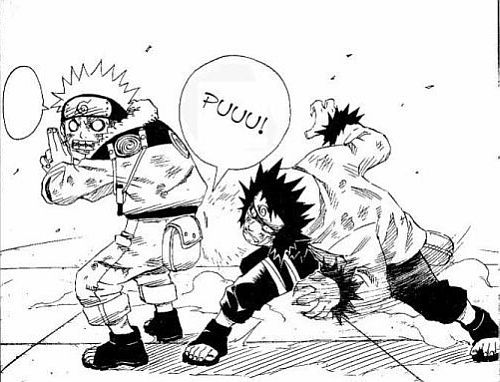
Naruto Shield of Farts

Magic!

Posted in World-Building | Tagged , , , , , , , | Leave a comment

Blue sea, Red Cliffs, pale blue dot

滄海の一粟
(Soukai no ichizoku; “A single grain of millet in the deep blue sea”)

Definition:

Something incredibly small in the middle of something something incredibly big. A needle in a haycontinent. Metaphorically, the trifling, ephemeral existence of humans within the universe.

Breakdown:

This week we have another two-part noun phrase. The associative particle の (no) connects number-noun 一粟 (ichizoku), “one (grain of) millet,” to 滄海 (soukai), “blue sea.” And that’s all you need!

Notes:

This comes from Song Dynasty superstar Su Shi (蘇軾, Japanese So Shoku)’s rhymed prose piece “Former Ode on the Red Cliffs” (前赤壁賦, Japanese Zen sekiheki no fu).

In some versions, 滄 may be replaced by homophone 蒼 without any change in meaning. In others, 滄海 may become the more prosaic 大海 (taikai), “big ocean.” A slightly further variation takes this to 大海の一滴 (taikai no itteki), “a drop in the (big) ocean.”

Example sentence:

「宇宙の写真を見ると、綺麗だけど、人類はただの滄海の一粟なんだと思えてたまらなく鬱陶しくなる」

(“Uchuu no shashin wo miru to, kirei da kedo, jinrui wa tada no soukai no ichizoku nanda to omoete tamaranaku uttoushiku naru.”)

[“When I see pictures of space, they’re beautiful, but it reminds me of how humanity is just a tiny speck in a vast sea, which is unbearably depressing.”]

Posted in Japanese, Kotowaza | Tagged , , , , , , , , , , | Leave a comment