Now with more star power

As in literally not just the north star, but six other stars

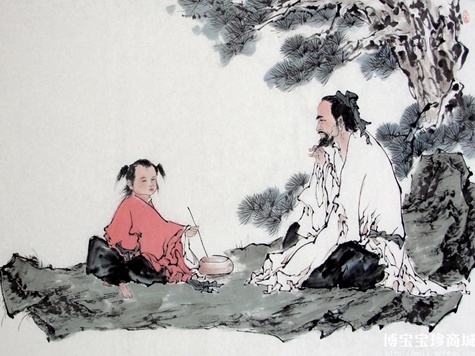
泰山北斗
tai.zan.hoku.to

Literally: Tai – mountain – north – dipper

Alternately: A leading and respected figure in a given field; someone of immense personal authority by whose standard others chart their courses and measure their progress. The human equivalent of a famous mountain or constellation.

Notes: Cartographical in feel, this is a compound of proper nouns: 泰山 is simply the name of a famous mountain, Mount Tai (a.k.a. Tai Shan), while 北斗 is the Big Dipper constellation.

This phrase comes to us from the New Book of Tang, or Xīn Tángshū, (Japanese 『新唐書』 = Shintoujo), essentially a heavily-revised replacement for the history text that we retrospectively call the Old Book of Tang, which we’ve met before. It seems to be describing Han Yu (韓愈, Japanese Kan Yu), whom we have definitely met before.

 
One of the grandmasters of modern fiction, and by all accounts a decent guy

One of the earliest and greatest luminaries in my personal constellation of heroes

Posted in Japanese, Yojijukugo | Tagged , , , , , , , , , , , , | Leave a comment

Too hot for a cold reading

“Philosophers / must ultimately find / their true perfection // in knowing all / the follies of mankind / -by introspection.” – Piet Hein, Grooks, “The Ultimate Wisdom.”

陰陽師身の上知らず
(On’youji mi no ue shirazu;
“The diviner knows not their own fate”)

Definition:

Everybody is their own worst blind spot: it’s easy to notice quirks and tendencies in the people around you while remaining ignorant of your own. Fortune-tellers can’t tell their own fortunes.

Breakdown:

This time we’re going to start close to the end with the noun 身 (mi) and the noun 上 (ue), joined by the associative particle の (no). While in literal terms 身 is “body” and 上 is “above,” the phrase 身の上 in this case refers to someone’s fate. This core noun phrase is preceded, without particles, by the noun 陰陽師 (here on’youji, but see below), a diviner/magician/exorcist (etc.) in the 陰陽五行説. And it is followed, also without particles (but we may imagine an object-marker), by the verb 知る (shiru) “to (come to) know [something],” in imperfective form and taking the negative suffix ず (zu) in conclusive form.

Notes:

This is the お (o) entry of the Osaka iroha karuta set. However, most of my sources replace the yin-yang practitioner 陰陽師 with the more generic 易者 (ekisha), “fortune-teller.”

The word 陰陽師 is probably most commonly pronounced onmyouji, but it can also be read as in’youshi, omyouji, on’nyoushi, or on’youji. The final one is considered correct for this saying.

Example sentence:

陰陽師身の上知らずというように、いつもあの人の忠言には救われているんだけど、本人も自分の言ったことを実践すべきだと思っちゃう時もあるんだよね」

(On’youji mi no ue shirazu to iu you ni, itsumo ano hito no chuugen ni wa sukuwareteiru nda kedo, honnin mo jibun no itta koto wo jissen subeki da to omocchau toki mo aru nda yo ne.”)

[“Just as the diviner can’t see their own destiny, their advice always helps me out, but there are times when I can’t help but think that they need to be putting their own words into actual practice.”]

Posted in Japanese, Kotowaza | Tagged , , , , , , , , , | Leave a comment

You and I, wacky together

Armpit noises???

用和為貴
you.wa.i.ki

Literally: (to) use – harmony – do – valued

Alternately: A statement that the most important thing is good relations between people. One should cherish positive interpersonal relations in all of society.

Notes: This one is in the “Seventeen-Article Constitution” (Japanese 十七条憲法, Juushichijou kenpou), a 1400-year-old treatise on good governance based on Buddhist and Confucian thinking. Some of my sources suggest that it was borrowed from the foundational Confucian text, the Book of Rites (Japanese 『礼記』 = Raiki).

This phrase can also be rendered in native-Japanese style as 和を用って貴しと為す (wa wo motte toutoshi to nasu).

 
Interesting choices in the color palette

The guy who wrote the one thing, Prince Shotoku (聖徳太子 Shoutoku taishi)

Posted in Japanese, Yojijukugo | Tagged , , , , , , , , , , , , , | Leave a comment

The hammer of kindness

鑿と言えば槌
(Nomi to ieba tsuchi;
“When [asked for] a chisel, [one also brings a] mallet”)

Definition:

To be intelligent and thoughtful in all things – as a description, or as an imperative. If someone asks you to bring them a chisel, having enough consideration and foresight to also bring a mallet, since they’re used together.

Breakdown:

We begin with the noun 鑿 (nomi), “chisel,” marked with the particle と (to). The particle here acts as speech marker, as demonstrated by the following verb 言う (iu), “to say,” here in perfective form and taking the conditional suffix ば (ba), “when.” Without further particles or verbs, the result of the condition is reduced to simply the noun 槌 (tsuchi), “mallet.”

Notes:

This is the の (no) entry of the Kyoto iroha karuta set.

There are several variants on the phrase, including one that specifies a 才槌 (saidzuchi), a small mallet. Compare and contrast 一を聞いて十を知る, which includes the same powers of insight but leaves out the implications of consideration for others.

Example sentence:

「現代社会ではほとんどの雇用主が鑿と言えば槌という気遣いができる働き手を探しているが、その働きぶりに相応しい給料を払っているかは別の話だ」

(“Gendai shakai de wa hotondo no koyoushu ga nomi to ieba tsuchi to iu kidzukai ga dekiru hatarakite wo sagashiteiru ga, sono hatarakiburi ni fusawashii kyuuryou wo haratteiru ka wa betsu no hanashi da.”)

[“Most employers in our contemporary society are looking for workers who take that extra step. Whether they’re offering wages commensurate with that level of diligence is another story.”]

Posted in Japanese, Kotowaza | Tagged , , , , , , , | Leave a comment

From sea to shining sea to another sea to yet another sea

Earning an A+, though, not a C

海内無双
kai.dai.mu.sou

Literally: ocean – inside – not – pair

Alternately: Top-ranked in the nation, or in the world. Without peer.

Notes: This compound comes from our friend, the ancient poetic anthology Wen Xuan (Japanese 『文選』, Monzen). And it’s important to keep in mind that 内 here is not given its more-common reading of nai here; only the Tang-style reading dai is correct. (Cf. 境内 keidai). Compare and contrast the temporal, rather than spatial, span of 古今無双.

This is a compound of compounds. 海内 refers to “within the four seas,” e.g. throughout the entire land, or by extension, in the whole world. 無双 refers to something that is “without compare.”

 
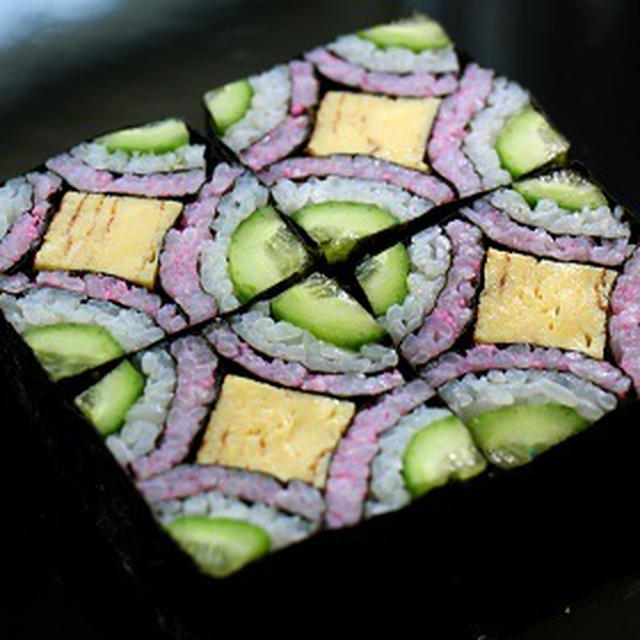
Sushi mandala

Apparently this arrangement is a 四海巻き, a “four seas roll.”

Posted in Japanese, Yojijukugo | Tagged , , , , , , , , , , , , | Leave a comment

“Faith is believing in something when common sense tells you not to.”

For better or for worse… or for just vaguely smelly

鰯の頭も信心から
(Iwashi no atama mo shinjin kara;
“Even a sardine’s head, from faith”)

Definition:

Faith works in mysterious ways; faith is kind of weird if you stop to think about it. Even a simple, unexceptional thing like a sardine head on a stick can become important or celebrated through (religious) belief. The objects of faith hold very different significance for a believer and for an outside observer. This phrase may be used as a neutral observation, to warn people about the dangers of irrational beliefs, or to make fun of someone whose stubborn (blind) faith in something seems to have carried them away from common sense.

Breakdown:

We begin at the end with the particle から (kara), “from.” It marks the noun 信心 (shinjin), “belief,” especially referring to religious faith in the Buddhist teachings. Jumping back to the start of the phrase we find the noun 鰯 (iwashi), the sardine or “pilchard.” The associative particle の (no), in its possessive function, gives the fish its 頭 (atama), “head,” and the resulting noun phrase is marked with the emphatic particle も (mo), “even.”

Notes:

The Japanese 節分 (Setsubun) holiday is most well-known for a little household ritual in which children symbolically drive out evil spirits by throwing beans, but apparently there’s also a (less common) custom in which sardine heads are stuck on twigs of 柊 (hiiragi), “false holly,” and used to decorate the household’s gate so that their smell can keep the evil spirits out.

This phrase has several close variants. The sardine heads may be replaced with 白紙 (hakushi), “white paper,” presumably in reference to 紙垂 (shide; rhymes with “bidet”), the white folded-paper decorations often found at Shinto shrines. 信心 may be replaced with 信仰 (shinkou), which refers to (faith in) a religious creed. から may be replaced with 次第 (shidai), a suffix indicating that one thing depends on, or follows from, another. 頭 may also be read as kashira without any change in meaning.

This is the ゐ ([w]i) entry in the Kyoto iroha karuta set, and is attested in our friend, the poetry treatise 『毛吹草』 (Kefukigusa).

Fish heads, fish heads, juicy juicy fish heads

By Tonusamuel, courtesy of Wikimedia

Example sentence:

「高校の時の同級生は鰯の頭も信心からでテスト前日の夜に、電卓やら辞書やら勉強道具を枕の下に入れて寝れば、次の日のテストは必ずうまくいくと信じていたらしい。変なヤツって思っていたけど、まあ、もともと真面目だったおかげか、いつも9割以上取ってたんだ」

(“Koukou no toki no doukyuusei wa iwashi no atama mo shinjin kara de tesuto zenjitsu no yoru ni, dentaku yara jisho yara benkyoudougu wo makura no shita ni irete nereba, tsugi no hi no tesuto wa kanarazu umaku iku to shinjiteita rashii. Hen na yatsu tte omotteita kedo, maa, motomoto majime datta okage ka, itsumo kyuuwari ijou totteta nda.”)

[“There was a kid in the same grade as me who supposedly believed – really believed, this didn’t seem weird to them – that if they slept with a calculator or a dictionary or some kind of study aid under their pillow on the night before a test, that the test would go well for them. I thought they were kind of a weirdo, but well, maybe it’s just because they were serious about their grades, but they did always get over 90%.”]

Posted in Japanese, Kotowaza | Tagged , , , , , , , , , , | Leave a comment

Under the bushel you go, light!

Reading doujinshi for the Buddha’s sake.

和光同塵
wa.kou.dou.jin

Literally: harmony – light – same – dust

Alternately: An especially wise or talented person hiding their abilities (often through self-effacement) and living a common life among the common people. In a Buddhist context, the phrase describes how Buddhas and Bodhisattvas may hide their true nature and live among us in order to bring enlightenment to the masses.

Notes: Perhaps ironically given the Buddhist usage, this phrase comes to us from a foundational Taoist text: the 『老子』 (Japanese Roushi), i.e. the eponymous Laozi, a.k.a. the Tao Te Ching.

This is another compound of compounds: 和光 refers to the “softening” of light; 同塵 refers to something being matched to ordinary life, or to secular society.

 
But which is the secret Buddha, and which is being led toward enlightenment

A couple of completely ordinary schmucks, just hangin’ out

Posted in Japanese, Yojijukugo | Tagged , , , , , , , , , | Leave a comment

Out of the wrong, something sweet

嘘から出た実
(Uso kara deta makoto;
“Truth that came from a lie”)

Definition:

Something that was said as a lie or joke turns out to be true after all. Note that this applies to coincidences and accidental truths, not “fake it ‘til you make it” type situations where the truth is produced from the lie per se. A familiar example might be the boy who cried wolf: the wolf eventually arriving is an ironic turn, not a natural consequence of the boy lying.

Breakdown:

This noun phrase centers on the noun 実 (makoto), “truth,” modified by the verb 出る (deru), “to go out,” in past prenominal from. The particle から (kara), “from” marks the starting point of this verb of motion; in this case the noun 嘘 (uso), “untruth.”

Notes:

This is the う (u) entry of the Edo iroha karuta set.

One variant uses the more archaic particle より (yori) in place of から. It is also possible to replace the character 実 (which can also mean “fruit”) with other characters that can also mean “truth,” 真 or 誠, without changing the phrase’s meaning or pronunciation.

Compare and contrast 瓢箪から駒が出る.

Example sentence:

「子供の時の喧嘩で、将来、世界的に有名な科学者になってみせる!とか言ったことがあったけど、今日、この賞を本当に受けるなんて、嘘から出た実で未だに半信半疑だ」

(“Kodomo no toki no kenka de, shourai, sekaiteki ni yuumei na kagakusha ni natte miseru! to ka itta koto ga atta kedo, kyou, kono shou wo hontou ni ukeru nante, uso kara deta makoto de imadani hanshin hangi da.”)

[“When I was a kid, sometimes during a fight I’d say stuff like I’ll show you by becoming a world-famous scientist some day!, and stuff like that. But today, actually receiving this award, I can only half believe that that lie actually came true.”]

Posted in Japanese, Kotowaza | Tagged , , , , , , , , | Leave a comment

Thoughtful social distancing

遠慮会釈
en.ryo.e.shaku

Literally: far – thought – meet – explain

Alternately: Holding back and thinking of others; reserve and consideration.

Notes: This is a compound of compounds; 遠慮 is “discretion,” “restraint,” and 会釈 is “thoughtfulness (for the sake of others.” These parts may also be switched to give 会釈遠慮 (eshaku enryo). The phrase may be negated to give the critical phrase 遠慮会釈も無い (enryo eshaku mo nai), “arrogant,” “inconsiderate,” or even “ruthless.” Finally, 傍若無人 is considered an antonym.

I’m actually cheating a bit here. Strictly following the iroha ordering means that this week’s compound should start with を (wo). But while the iroha karuta sets themselves tell us that words like 鬼 used to be をに, I’ve found it a lot harder to find four-character compounds that use a reading that begins with を (cf. phrases like 夜行 (hyakki yagyou); almost all yojijukugo use the Chinese-style reading in this fashion).

The approach I’m taking is based on kana derivations: we know that every kana sign is the simplified form of a kanji, so the mere existence of kana for wo means there must be kanji that can be read as wo per se. In this case, the katakana “wo” (ヲ) is derived from 乎, and the hiragana を is derived from 遠. That said, it seems pretty clear to me that this を is the analog of the modern Japanese-style reading o rather than anything that actually appears in a yojijukugo. Ultimately I feel like this is an え entry acting as a placeholder because for purposes of our series, no true を entry seems to exist, but it’s the best I could muster with limited time and resources.

 
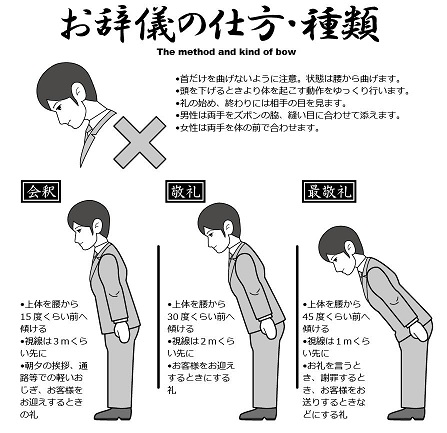
Bow with your waist, not with your knees (or neck)

By extension, an 会釈 is also a very precisely defined style of bow

Posted in Japanese, Yojijukugo | Tagged , , , , , , , , , | Leave a comment

Not a typo.

NOT a typo.

馬の耳に風
(Muma no mimi ni kaze;
“Wind in a horse’s ear”)

Definition:

Ignoring something somebody has said, especially people’s opinions or criticism that you don’t want to bother with. “In one ear and out the other.”

Breakdown:

We begin this noun phrase with the noun 馬, “horse,” which you’d expect to be pronounced uma but here is pronounced muma for some reason. This associative particle の (no) marks it as the possessor of the noun 耳 (mimi), “ear.” This in turn is marked by the directional particle に (ni) as the target to which is applied the noun 風 (kaze), “wind.”

Notes:

This is the む (mu) entry in the Kyoto iroha karuta set. No, none of my normal sources explain why they went with mu for this one. Is it dialectical? Court lady word-play? (That’s a real part of some etymologies!) There’s a claim that this brief saying is derived from the four-character compound 馬耳東風, but while Japanese does have some m/b overlap, the ba reading there doesn’t really seem like a great fit for muma.

Compare and contrast this phrase with both the above yojijukugo and with close synonym 馬の耳に念仏 (uma no mimi ni nenbutsu), “a Buddhist prayer in a horse’s ear.” Beyond this there’s apparently an entire picture-book’s worth of similar sayings… including, but not limited to:

  • Dogs and the Analects of Confucius
  • Cats and Buddhist sutras
  • Pigs and Buddhist prayers
  • Rabbits and a style of Shinto prayer called 祭文 (saimon)
  • Cattle and koto music

Example sentence:

「もう、あいつ、馬の耳に風だから何言っても無駄だった」 「ムマの耳?」 「ウマの耳と同じ意味だよ」 「ムマの耳はウマの耳に似ている?」 「あんたもわざわざウマの耳にならない方が良いんだよ」

(“Mou, aitsu, muma no mimi ni kaze dakara nani itte mo muda datta.” “Muma no mimi?” “Uma no mimi to onaji imi da yo.” “Muma no mimi wa uma no mimi ni niteiru?” “Anta mo wazawaza uma no mimi ni naranai hou ga ii nda yo.”)

[“Ugh, it’s like talking to a brick wall; there’s no point talking to them no matter what I say.” “You talked to a wall?” “No, it means that that jerk didn’t listen to me.” “A wall of jerky?” “You don’t need to turn into a wall either.”]

Posted in Japanese, Kotowaza | Tagged , , , , , , , , , | Leave a comment